

Feeling Behind in GCSE Drama? How to Catch Up
Feeling behind GCSE Drama is common. Learn how to identify the real gap, catch up calmly and protect your GCSE maths revision with a practical plan.
There is a particular kind of worry that appears in a GCSE Drama lesson. Someone remembers every line. Another student seems effortlessly confident in rehearsal. Your folder is unfinished, your performance choices feel uncertain, and the written exam is getting closer.
If you are feeling behind GCSE Drama, the short answer is yes: it is understandable, and it is usually more manageable than it feels. Drama contains several different forms of assessment, so students rarely progress evenly across all of them. You might be secure in performance but behind on your portfolio, or confident with the set text but unsure how to evaluate live theatre.
The solution is not to catch up with everyone at once. It is to identify your next assessable gap, complete one concrete task and repeat that process without allowing Drama panic to consume the revision time needed for maths and your other GCSEs.
Your quick catch-up checklist
Before making a complicated timetable, establish five things:
- Confirm your exam board and the Drama components you complete.
- Ask your teacher which unfinished task matters most.
- Separate missing work from work that merely feels imperfect.
- Choose one small action for your next Drama session.
- Protect regular time for GCSE maths and your other subjects.
That distinction between missing and imperfect matters. A missing portfolio section requires action. A rehearsal that did not feel brilliant may simply be part of the normal process of developing a performance.
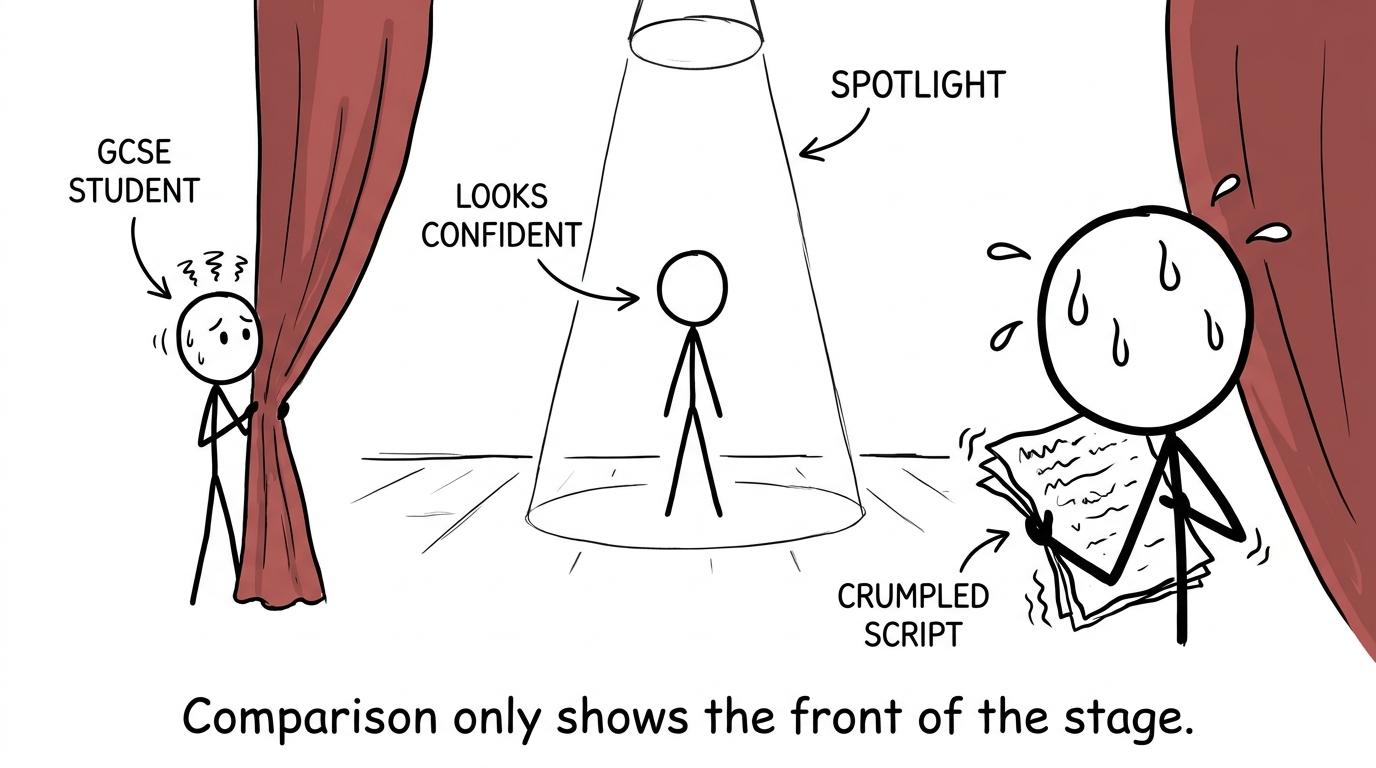 A confident-looking performer is secretly nervous behind the curtain
Why feeling behind in GCSE Drama is so common
GCSE Drama does not move in a neat, visible line. In maths, a completed set of algebra questions provides reasonably clear evidence of what you can do. Drama progress can be harder to see. A rehearsal may look unproductive while a group is testing ideas, rejecting weak choices and discovering what the scene needs.
Comparison makes this uncertainty louder. You see another student's finished performance, but not the private line-learning, abandoned interpretations or teacher feedback behind it. Confidence is also highly visible in Drama, although confidence and assessment readiness are not the same thing.
There is another reason the course can feel fragmented: it combines practical and written demands. Current specifications from AQA, Edexcel, OCR and Eduqas all include devised work, performance or design work based on a text, and written assessment involving theatrical understanding. The precise weightings and requirements vary by board.
For example, AQA and Edexcel currently divide the qualification into components weighted at 40%40\%40%, 20%20\%20% and 40%40\%40%. OCR uses weightings of 30%30\%30%, 30%30\%30% and 40%40\%40%. Eduqas uses 40%40\%40%, 20%20\%20% and 40%40\%40%. These figures do not tell you what your personal priority should be, however. Your teacher can tell you which component, deadline and evidence format apply to your class.
That mixture explains why two students can both be doing well while looking completely different. One may have stronger acting skills; another may produce more precise analysis. The useful question is not, “Am I as good as them?” It is, “What evidence do I need to improve next?”
Find out whether you are actually behind
Anxiety often treats every unfinished thought as an emergency. Evidence is calmer.
Create a simple status check using your specification, teacher instructions and current folder. Sort your work into three groups:
- Complete: submitted or ready for checking.
- In progress: started, with a clear next action.
- Not started or unclear: missing, misunderstood or awaiting guidance.
Then ask your teacher a specific question. “Am I behind?” is difficult to answer precisely. “Which task should I complete first, and what would acceptable evidence look like?” is much more useful.
You should also distinguish between course requirements and optional improvements. Learning missing lines, completing required portfolio evidence or preparing a compulsory written response may be urgent. Rewriting an adequate page simply because someone else's looks more polished may not be.
The same evidence-first principle works in maths. MathsGenie's guide to finding your weakest GCSE topics explains how to diagnose gaps rather than revising whatever happens to feel frightening. Across both subjects, the pattern is similar: identify the gap, practise the relevant skill, check the result and return to it later.
Build a calm GCSE Drama catch-up plan
Choose the smallest useful task
“Catch up on Drama” is too vague to begin. Replace it with a task that produces visible evidence, such as:
- learn one short section of dialogue;
- annotate one moment from the set text;
- organise existing devising notes;
- write one paragraph evaluating a theatrical choice;
- rehearse one transition with your group;
- ask your teacher to clarify one portfolio requirement.
The task should be small enough to start today. Small does not mean unimportant. A performance is built from cues, decisions and repeated rehearsals; revision works in much the same way.
Prioritise by consequence
Deal first with work that has a fixed deadline, affects a group or is required for assessment. Group rehearsals deserve particular care because your absence or lack of preparation can affect other people. Communicate early if illness, absence or another genuine difficulty has interrupted your work.
After urgent requirements, focus on the weakness most likely to improve with deliberate practice. Do not automatically spend all your time polishing the part you already enjoy.
Use short, repeatable sessions
A huge rescue session can feel productive while leaving you exhausted and reluctant to return. Short sessions are easier to repeat. Decide in advance what “finished” means for each one.
For instance, your goal might be to annotate a particular extract, test your recall of a scene or turn rough rehearsal observations into organised notes. Stop when the defined task is complete, record the next action and return at the planned time.
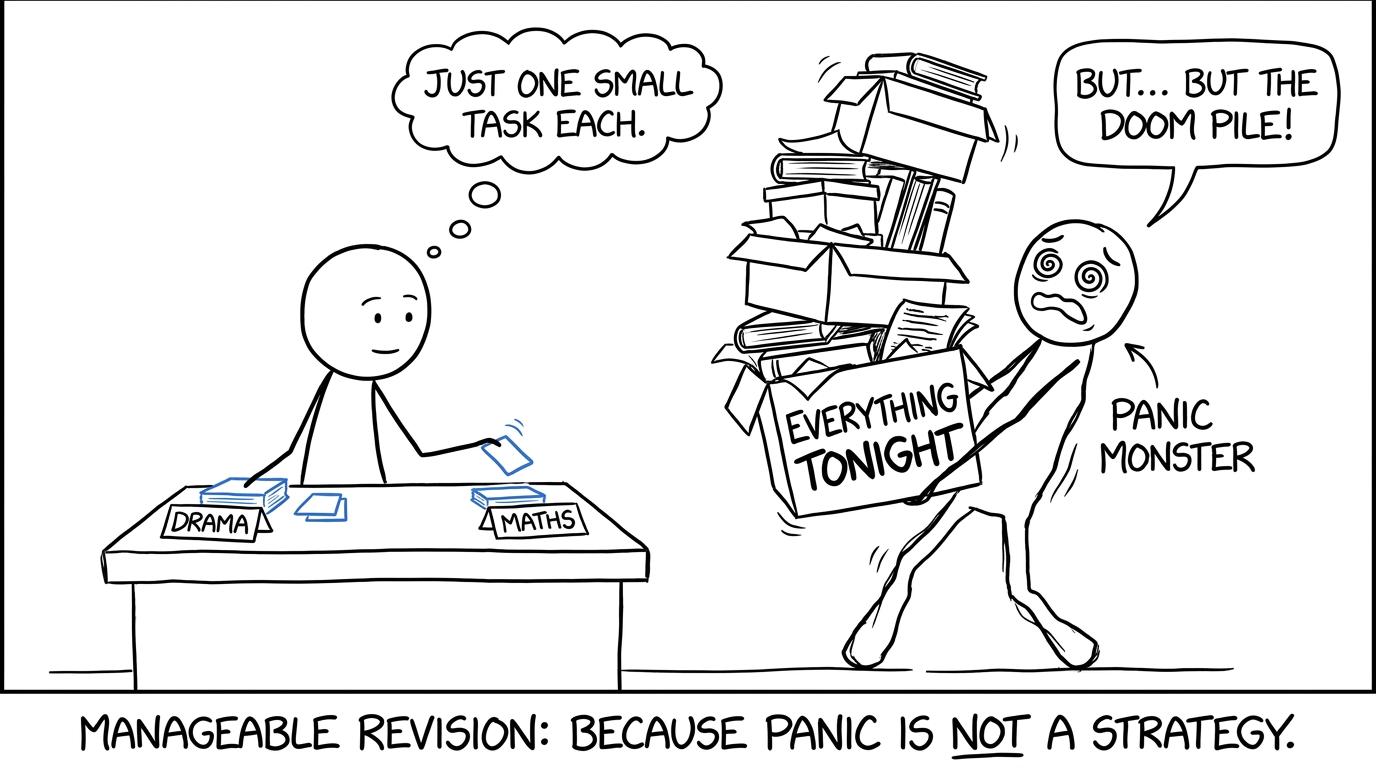 A calm student balances Drama and maths while the Panic Monster carries everything
Protect your GCSE maths revision while catching up
Drama may be the source of today's anxiety, but allowing it to take over every evening can create a second problem. Maths improves through regular contact with methods and questions. Long gaps make previously familiar skills harder to retrieve.
Keep a small maths minimum during your Drama catch-up period. This might be one revision lesson followed by a short set of questions, or a mini test that reveals what needs attention next. The GCSE maths revision hub brings together free topic lessons, practice questions, papers and board-specific resources.
A balanced weekly rhythm could include:
- short Drama sessions tied to specific evidence;
- regular maths topic practice;
- one review of mistakes from each subject;
- protected rest rather than late-night panic.
If the exams are approaching, the GCSE one-month maths revision plan can help you organise lessons, mini tests and paper practice. If you are unsure what your maths board or tier requires, use the GCSE maths topics by exam board and tier guide.
The aim is not to divide every evening perfectly. It is to prevent one anxious subject from erasing steady progress elsewhere.
Make feedback practical rather than personal
Drama feedback can feel personal because your voice, movement and ideas are visible. Try translating every comment into an observable action.
“Needs more energy” is difficult to practise until it becomes something specific: increase vocal projection, sharpen the pace of a particular exchange or make a clearer physical choice at a named moment. “Add detail” in written work might mean using precise theatrical terminology, referring to a specific moment and explaining its intended effect on the audience.
Ask for clarification when feedback is broad. Then record the action, rehearse or revise it, and seek another check. Feedback becomes less threatening when it functions as an instruction rather than a verdict.
Use the same method when marking maths. Complete a paper, use the mark scheme and convert each lost mark into a topic or technique to repair. MathsGenie's guide to using Edexcel GCSE maths past papers properly demonstrates this process, while the Edexcel GCSE maths past papers collection provides papers and mark schemes for timed practice.
What to do if the gap is genuinely large
Sometimes the concern is accurate. You may have missed lessons, misunderstood a component or fallen significantly behind because of illness or difficult circumstances. Calm action still matters, but you should not attempt to solve everything alone.
Speak to your Drama teacher as soon as possible. Bring a list of what you have, what appears to be missing and any deadlines you know about. Ask for priorities rather than a general instruction to “catch up”. Your teacher understands the specification, your centre's chosen texts and the evidence already completed in class.
If stress is affecting sleep, attendance, concentration or your ability to begin ordinary tasks, tell a trusted adult at school or at home. Seeking support is not avoiding responsibility. It is how you make the work manageable again.
Avoid trying to repair a major gap the night before a deadline. MathsGenie's GCSE maths night-before plan is written for maths, but its central lesson travels well: choose a few high-value actions, use the correct resources and stop at a sensible time.
Common mistakes when trying to catch up
Comparing confidence instead of evidence
A confident rehearsal does not reveal the quality of someone's written work, preparation or eventual marks. Compare your current evidence with the assessment requirements and your teacher's feedback.
Trying to perfect everything
Perfection can become a sophisticated form of delay. Complete required work to an appropriate standard before repeatedly polishing one section.
Ignoring your group
If your performance depends on other students, agree rehearsal expectations and communicate problems early. Solo catch-up cannot replace collaborative rehearsal.
Revising passively
Reading a script or set-text notes can feel reassuring, but assessment requires retrieval and application. Test lines without looking, explain a staging choice aloud or plan a response from memory before checking your notes.
Maths follows the same rule. Watching a solution is useful only when followed by independent practice. MathsGenie's advice on stopping forgotten GCSE maths content shows how retrieval, spacing and re-testing turn recognition into usable knowledge.
Sacrificing every other subject
A temporary priority is sensible; abandoning maths for weeks is not. Maintain a modest baseline, then increase paper practice as your timetable allows. Guidance on when to start GCSE past papers can help you choose an appropriate stage rather than rushing into full papers too soon.
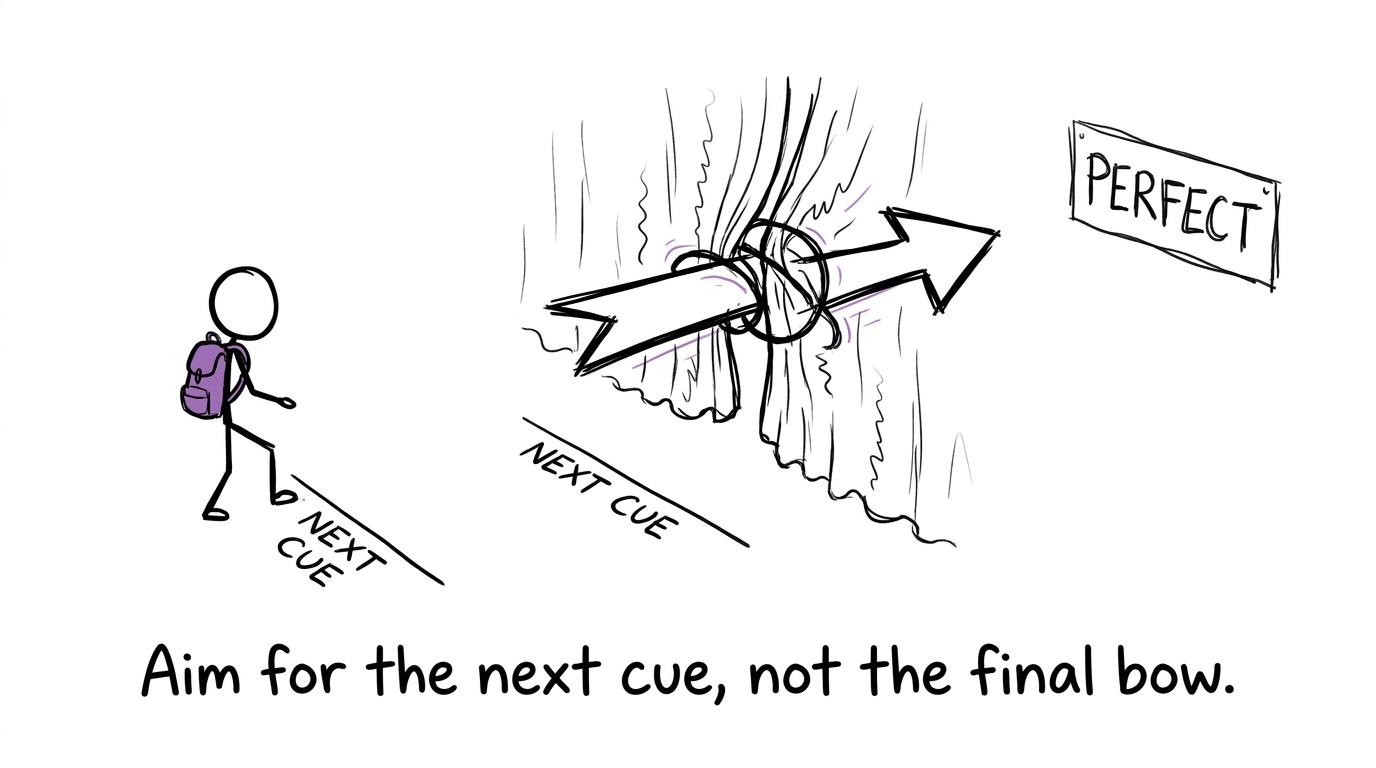 A student follows the next cue while the route to perfection tangles in curtains
You do not need to catch up emotionally before you begin
Students often wait to feel confident before taking action. Usually, confidence arrives afterwards. It grows when a missing page becomes a completed page, an uncertain scene becomes a rehearsed scene, or a vague worry becomes a clear conversation with a teacher.
Feeling behind in GCSE Drama does not prove that you will remain behind. It tells you that you need better information and a smaller next step. Confirm the requirement. Choose the task. Complete it. Then protect enough time to keep the rest of your GCSE revision moving.
For maths, make MathsGenie your free revision base. Use revision lessons to rebuild weak methods, practice questions and mini tests to check them, then move to past papers and predicted papers. Mark your work carefully, use video solutions when a method is unclear, and let the evidence, not comparison, decide what you do next.











