Extra Practice Material GCSE Italian: Is It Worth It?
Extra practice material GCSE Italian advice: learn what to request, how to ask your teacher politely and how to turn each task into better exam revision.

A difficult part of revision is admitting that the work in front of you is not quite enough. You may understand lessons, complete your homework and still feel exposed when an unfamiliar listening task begins. Asking for extra practice material GCSE Italian students can use is usually worth it, provided you ask for something focused and show that you intend to use it.
Your teacher is unlikely to interpret a thoughtful request as evidence that you are not trying. Quite the opposite. A student who can identify a weak skill, explain what they have already attempted and ask for an appropriate next step is taking responsibility for their revision.
The key is not to ask for more work. Ask for the right work.
A quick checklist before you ask
Use this checklist to make your request useful for both you and your teacher:
- Confirm your exam board, specification and tier.
- Identify one weak skill: listening, speaking, reading or writing.
- Bring evidence, such as a marked task or repeated error.
- Explain what you have already done independently.
- Ask for a small, specific resource rather than a folder of everything.
- Agree how or when you can check your answers.
- Complete the material and follow up briefly.
That final step matters. Asking creates an intention; returning with completed work turns it into trust.
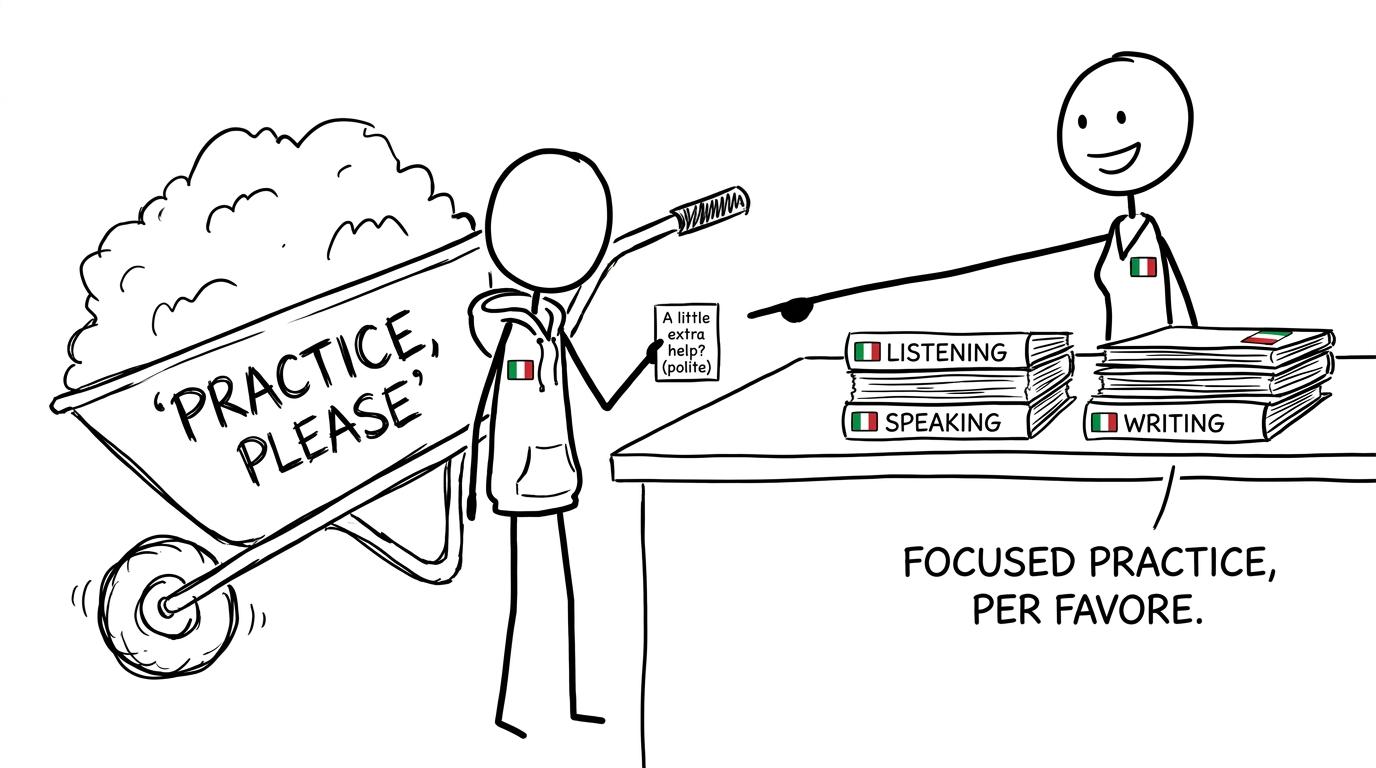 A student makes a focused request for Italian practice
Why extra Italian practice can be worthwhile
GCSE Italian assesses several distinct forms of performance. Current AQA and Pearson Edexcel courses include listening, speaking, reading and writing, although the precise tasks, timings and themes depend on the specification and examination series. Students normally take one tier across the qualification, so any material should also match foundation or higher tier.
This matters because being generally “good at Italian” does not guarantee equal confidence in every paper. You might remember vocabulary accurately when reading but struggle to recognise the same words at natural speaking speed. You might produce a well-planned written response but hesitate during an unprepared conversation.
Extra material is most valuable when it closes one of these gaps.
It gives you practice in the format you find difficult
Revising vocabulary cannot fully reproduce a listening assessment. Writing model paragraphs does not provide the spontaneity needed for speaking. Each skill needs some practice in its own form.
A targeted request might therefore be for:
- a short listening activity with a transcript;
- an additional role-play or conversation prompt;
- a reading text with exam-style questions;
- a translation task;
- a writing question with the relevant marking criteria;
- a grammar exercise based on errors in your recent work.
The smaller and clearer the request, the easier it is for your teacher to recommend something suitable.
Your teacher can match material to the specification
Random worksheets can feel productive while missing the language, themes or task types required by your course. Your teacher knows which specification your class follows and can help you avoid material intended for another board, tier or qualification.
This is particularly important during periods of specification change. Italian does not necessarily follow the same timetable or assessment arrangements as French, German and Spanish, so do not assume that a resource labelled simply “GCSE languages” matches your Italian course. Check the date, exam board and specification with your teacher.
Extra practice can reveal a smaller underlying problem
Sometimes the apparent weakness is not the real weakness. A low listening mark might come from unfamiliar vocabulary, difficulty distinguishing sounds or losing concentration after one missed answer. Weak writing might result from insecure verb forms rather than a lack of ideas.
Your teacher may therefore suggest something narrower than you expected. That is useful. Revision becomes manageable once “I am bad at listening” turns into “I need to recognise past-tense verbs more quickly”.
The same diagnostic principle works in maths. MathsGenie’s guide to finding your weakest GCSE topics explains why specific evidence is more useful than a vague feeling that an entire subject is going badly.
How to ask without sounding as though you are not trying
The safest approach is to make your effort visible without giving your teacher a long defence. You do not need to prove that you work every evening. You only need to provide enough context for a useful recommendation.
Use an effort, evidence, request structure
Build your question from three parts:
- Effort: say what you have already attempted.
- Evidence: identify the difficulty you noticed.
- Request: ask for one suitable next step.
For example, you could say:
I have revised the vocabulary from this unit and redone the last reading task. I am still losing marks when I have to identify opinions and reasons. Could you recommend one extra higher-tier reading task for me to practise?
For speaking, you might ask:
I have practised my answers aloud, but I hesitate when the question is phrased differently. Do you have an extra conversation prompt I could use for unprepared speaking practice?
These requests do not sound lazy. They show preparation, diagnosis and a willingness to act.
Ask at a sensible time
Avoid raising a complicated request while your teacher is beginning a lesson, supervising a corridor or dealing with another student. Ask after the lesson if appropriate, during an agreed support session or through the school’s normal email or online system.
Keep the first message brief. Your teacher may already have a suitable worksheet, past-paper section or shared resource. If not, they can suggest an alternative without feeling that they must create an entire pack especially for you.
Make the request easy to answer
“Can I have more Italian work?” leaves several decisions with the teacher. A focused question is easier:
- “Could I have one foundation listening task on school or future plans?”
- “Is there another translation task at the same level as our last assessment?”
- “Which grammar area should I practise before attempting another writing question?”
- “Could you suggest a role-play prompt for ten minutes of practice?”
You are not requesting unlimited marking. You are asking for direction.
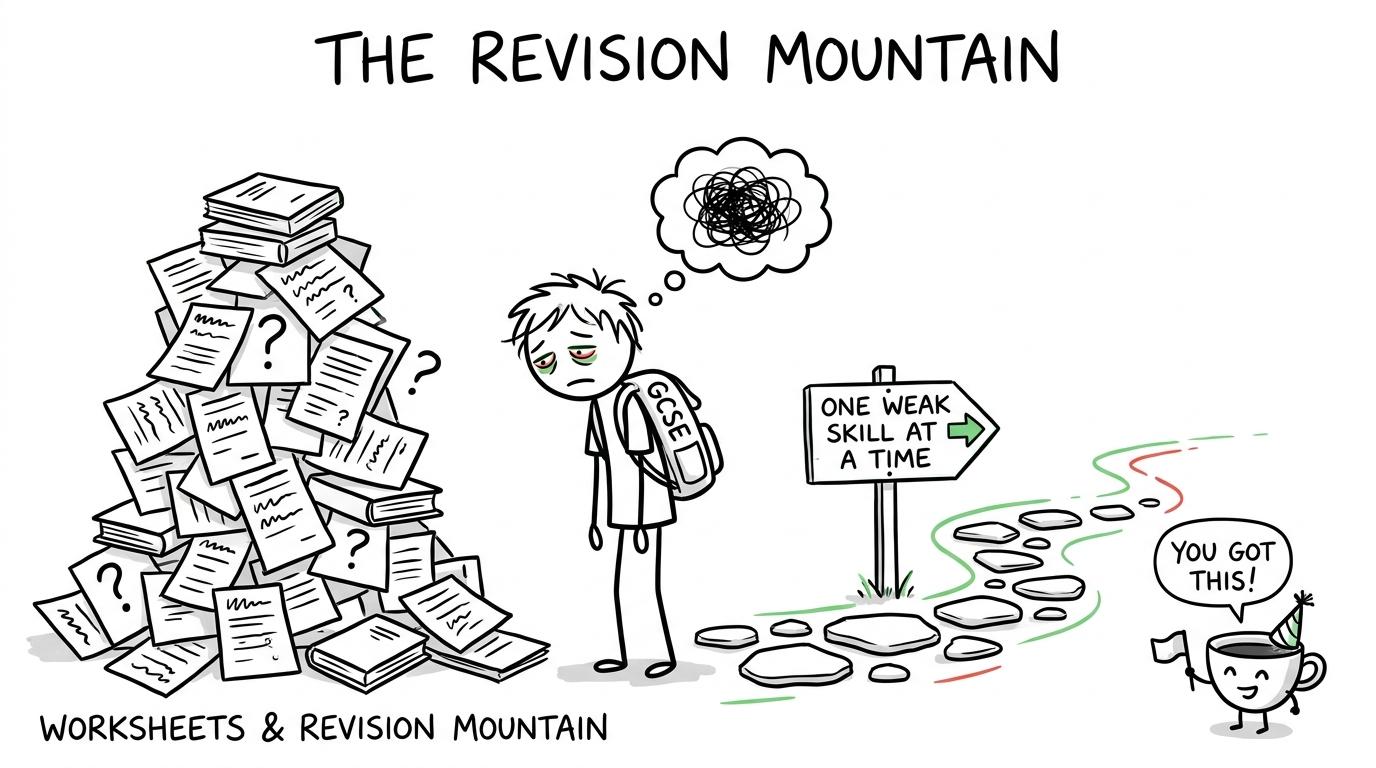 A sensible revision path avoids the mountain of worksheets
What extra material should you request?
Choose the resource according to the problem, not according to what looks most impressive.
Listening practice
Ask for audio that includes questions and, where possible, a transcript or answer guidance. A transcript lets you check whether the difficulty was vocabulary, sound recognition or comprehension.
Do not ask only for long listening papers. Short extracts can be better when you are repairing one precise weakness, such as recognising negatives, time phrases or changes of opinion.
Speaking practice
Useful material includes role-play cards, picture prompts, general conversation questions and unfamiliar follow-up questions. Ask whether your teacher can clarify what the mark criteria reward, but be realistic about their time. A short practice conversation may be more useful than asking them to mark numerous written scripts.
Reading and translation practice
Request texts and translations at the correct tier. If you repeatedly misunderstand instructions or question words, say so. Your teacher may recommend learning the exam language before giving you another full reading paper.
Writing and grammar practice
For writing, ask for a task plus the appropriate mark scheme or criteria. Completing five answers without understanding why marks were lost may reinforce the same errors.
A focused grammar exercise can sometimes produce more improvement than another long response. Your recent marked work should guide the choice.
Turn each resource into a feedback loop
A worksheet is not automatically revision. Its value comes from what happens after you complete it.
Use this sequence:
- Attempt the task without notes where appropriate.
- Mark it using answers or teacher feedback.
- Record the exact reason for each important error.
- Correct the answer.
- Practise the weak vocabulary or grammar separately.
- Return to a similar task later.
MathsGenie recommends the same rhythm for using GCSE past papers properly: attempt, mark, diagnose, repair and retest. The subject changes, but the learning principle does not.
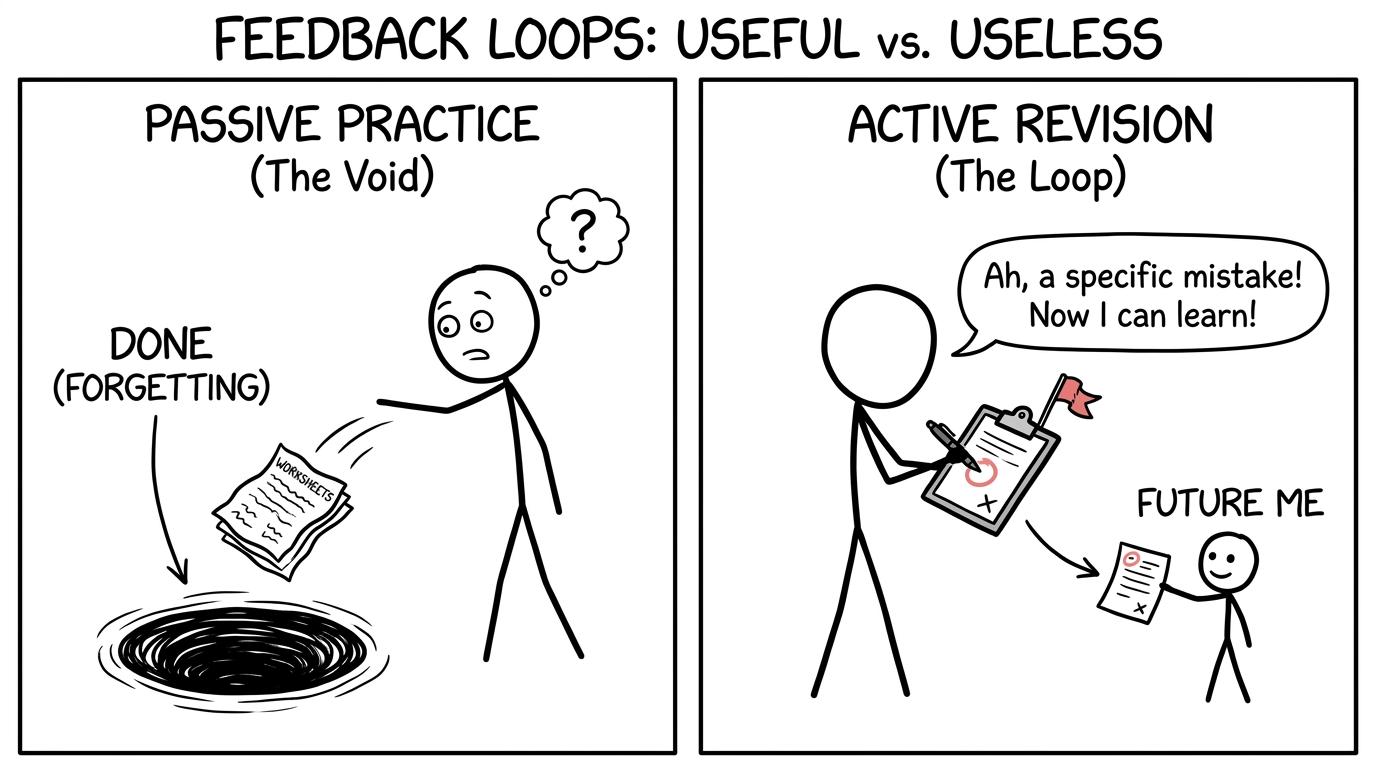 One student files work as done while another uses feedback
Balance Italian practice with GCSE maths revision
Extra Italian work should strengthen your revision plan, not overwhelm it. If maths exams are also approaching, avoid allowing one enthusiastic request to produce an unrealistic pile of tasks.
Ask for one resource, complete it and then decide whether another is needed. You can organise both subjects with the free MathsGenie revision planner, giving Italian a precise skills slot while protecting regular maths practice.
For maths, begin with the GCSE maths revision hub, choose your board and tier, and move from revision lessons into practice questions. If you follow Edexcel, the Edexcel GCSE maths revision pathway brings topic resources and examination practice together.
Short checks can prevent maths methods from going cold during a language-heavy week. Use GCSE maths mini tests for focused recall, then move to the MathsGenie past-paper library when you need full examination practice. Nearer the exams, Edexcel GCSE maths predicted papers can provide fresh timed practice, but they should complement rather than replace real past papers.
Common mistakes when requesting extra material
Asking for everything at once
A large pack feels reassuring but often becomes a source of guilt. Ask for one weak skill and one manageable task.
Saying only that you “don’t get Italian”
This is honest, but too broad to guide your teacher. Bring a marked task and identify where your understanding breaks down.
Choosing material from the wrong board or tier
Check whether you follow AQA or Pearson Edexcel and whether you are entered for foundation or higher tier. Do not assume every online GCSE Italian worksheet matches your assessment.
Expecting unlimited individual marking
Teachers have many students and significant workloads. Ask whether answers, a transcript or a mark scheme are available so that you can review some work independently.
Completing tasks without reviewing errors
Finishing another paper is not the goal. The goal is to change what you do next time.
Never returning to the teacher
A brief follow-up closes the loop: explain what helped, mention one remaining difficulty and thank your teacher. This shows that their recommendation was used rather than collected.
Extra practice is useful when it has a purpose
Yes, it is worth asking your teacher for extra GCSE Italian practice material. The best request is calm and specific: show what you have tried, identify the skill that is costing you marks and ask for one appropriate next task.
Then complete it. Mark it. Learn from it. That sequence matters more than the number of worksheets in your bag.
Keep the rest of your GCSE preparation equally focused. Use MathsGenie’s free revision lessons and practice questions to repair individual maths topics, mini tests to check recall, and past papers, predicted papers, mark schemes and video solutions to build exam readiness. Start with one honest gap in Italian and one honest gap in maths, then take the next useful step.