Extra Practice Material GCSE Food and Nutrition
Extra practice material GCSE Food and Nutrition advice: ask your teacher confidently, target weak areas and strengthen the maths used across your course.
There is an awkward moment many students recognise. You want more work, but you worry that asking for it will sound as though you ignored the work already given. The short answer is that requesting extra practice material GCSE Food and Nutrition support is worthwhile, provided your request is specific and you can show what you have already tried.
A thoughtful request does not say, “Give me more because I have done nothing.” It says, “I have identified a gap, attempted to fix it and would value your guidance on what to practise next.” That distinction matters.
It is particularly useful when Food Preparation and Nutrition questions involve the same numerical skills that appear in GCSE maths: proportion, percentages, averages, interpreting data, time calculations and unit conversions. Better practice can therefore support both subjects.
A quick checklist before asking your teacher
Before approaching your teacher, make sure you can answer these questions:
- What exact topic or question type is causing difficulty?
- What material have you already completed?
- Have you marked it or checked the feedback?
- Can you describe the mistake you keep making?
- Do you want questions, a model response, a revision checklist or feedback?
- Do you have enough time to complete anything new?
If you can answer most of these clearly, asking for more material will come across as purposeful rather than performative.
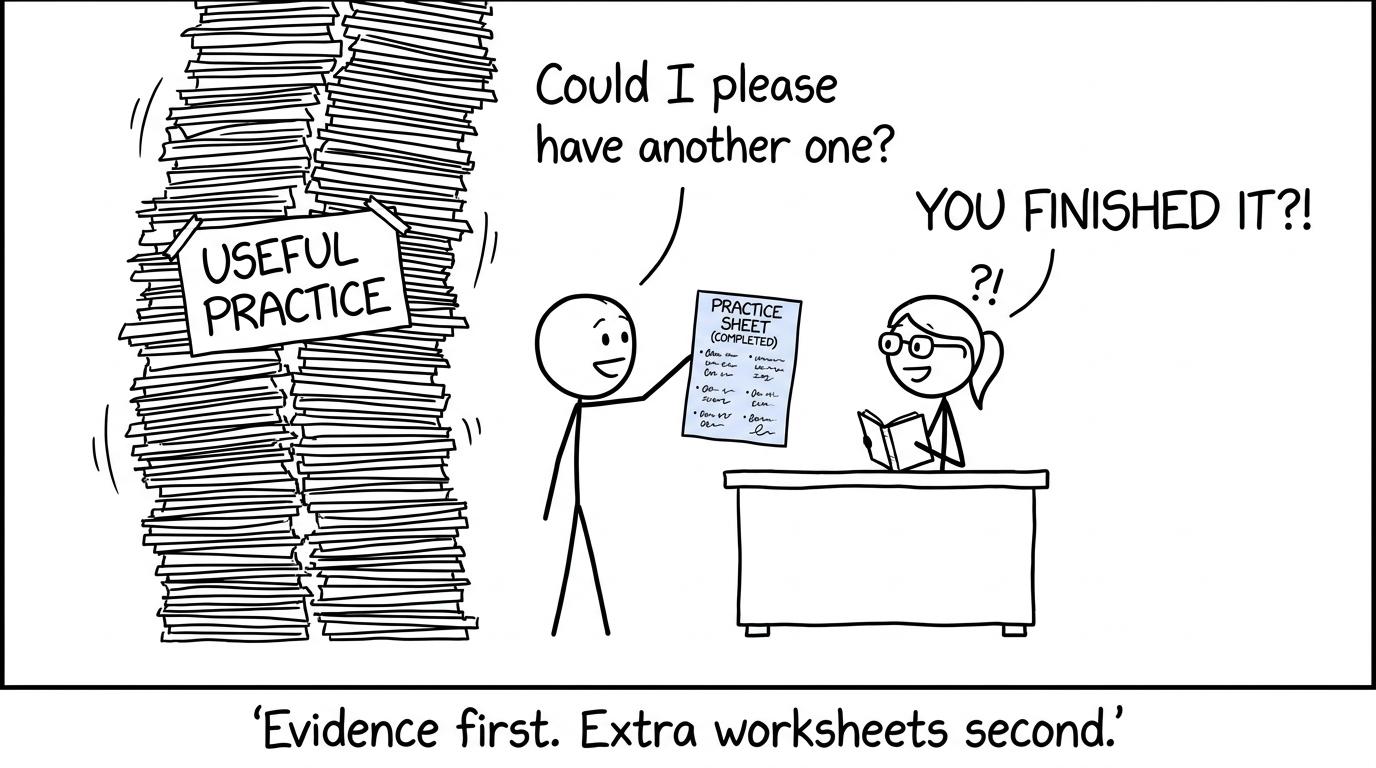 A student shows completed work before requesting another practice sheet
Why extra practice can be worth requesting
Official GCSE Food Preparation and Nutrition requirements combine examination and non-examination assessment. Ofqual requires half of the total marks to come from assessment by examination and half from non-exam assessment. The precise paper structure and NEA arrangements depend on your specification, so check whether your school follows AQA, OCR or Eduqas rather than assuming that every course works identically.
Across the qualification, students need more than factual recall. The assessment objectives cover knowledge, application, practical planning and preparation, and analysis and evaluation. That means practice should not consist only of memorising nutrients or reading notes.
Useful additional material might include:
- short retrieval questions on nutrition, food science and food safety;
- questions requiring knowledge to be applied to a particular person or situation;
- data interpretation tasks using tables, charts or nutritional information;
- planning prompts for practical work;
- evaluation questions requiring evidence and a justified conclusion;
- specification-matched exam questions and mark schemes.
The word matched is important. A large bundle of generic worksheets may create activity without addressing the assessment demands of your board.
How to ask without sounding as though you are not trying
The best request contains three parts: evidence, diagnosis and a manageable next step.
Show what you have already done
Bring the completed worksheet, revision notes or marked question that revealed the problem. You do not need a perfect folder. You simply need something that makes your effort visible.
You could say:
“I completed the questions from last lesson and checked the feedback. I am still losing marks when I have to apply the information to a new situation. Is there another short set I could try?”
This works because you are not asking the teacher to diagnose your learning from nothing. You have already narrowed the problem.
Ask for a particular kind of resource
“Can I have more revision?” is difficult to answer. A teacher may not know whether you need factual recall, extended writing, calculations or practical-planning support.
A stronger request would be:
“Could I have a few more questions involving nutritional data and percentages? I understand the facts, but I am less confident when the information is presented in a table.”
Specific requests are easier for a teacher to fulfil. They also show that you are thinking about how you learn.
Keep the request realistic
Ask for a short task first. One targeted question set that you complete and review is more valuable than a thick pack that remains in your bag.
Offer a reasonable timescale: “Could I bring it back next Thursday?” This turns your request into a small agreement. When you return the work, ask about one or two errors rather than expecting your teacher to reteach the entire topic immediately.
Choose the right moment
Avoid asking while your teacher is starting a lesson, supervising practical equipment or dealing with several students. Ask at the end of a lesson, during an agreed support session or through your school’s normal messaging system.
A calm moment improves the chance of a useful answer. It also signals that you respect the teacher’s workload.
Ask for the right type of Food and Nutrition practice
Extra material is valuable only when it matches the weakness.
| Your difficulty | A useful request |
|---|---|
| Remembering content | Retrieval questions or a specification checklist |
| Applying knowledge | Scenario-based exam questions |
| Understanding command words | Questions grouped by command word with mark schemes |
| Analysing results | Tables, graphs and investigation data to interpret |
| Writing evaluations | An evaluation prompt and marking criteria |
| Managing exam time | A short timed section rather than another full paper |
| Numerical accuracy | Questions involving units, proportion, percentages or averages |
If you are unsure where the problem lies, ask your teacher to look at one marked response and identify the highest-priority improvement. Teachers can often distinguish between missing knowledge and weak application more quickly than a student can.
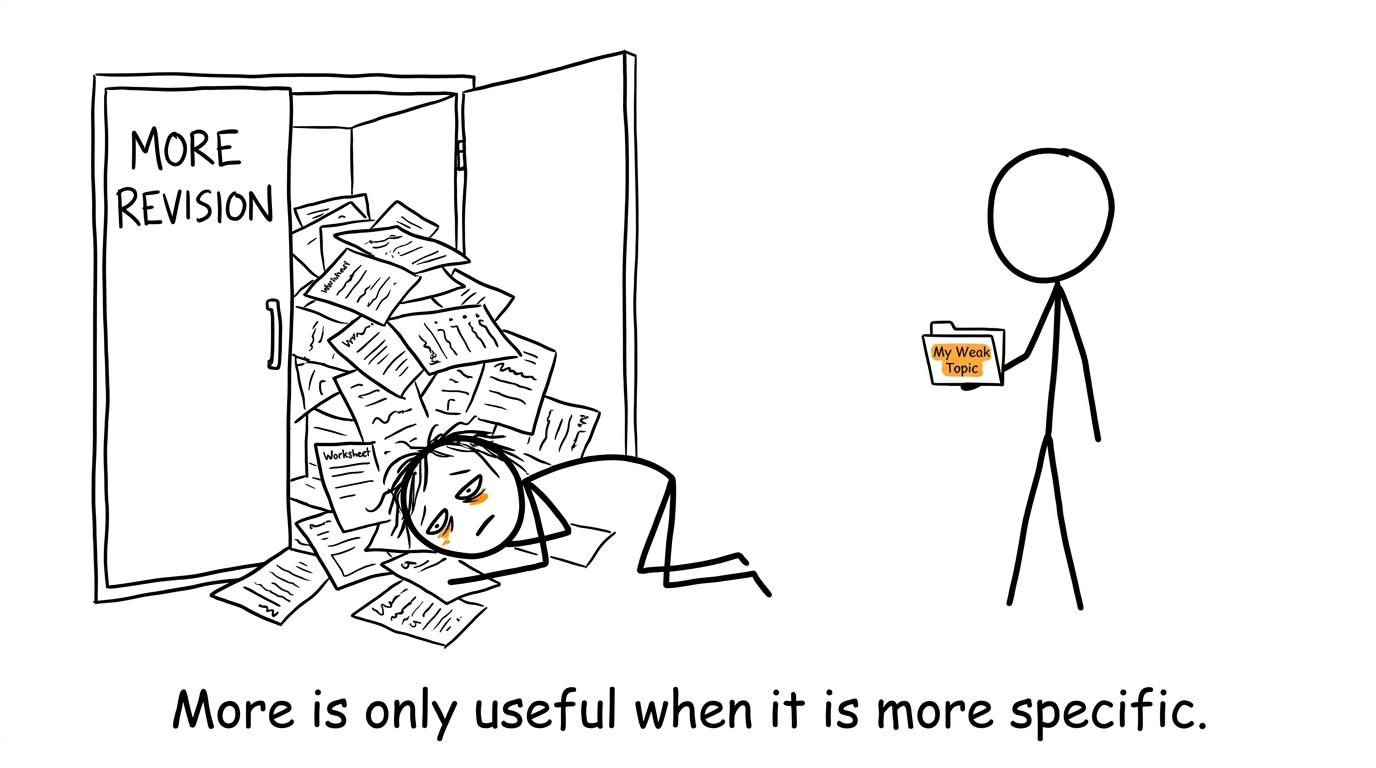 One student is buried in random revision while another chooses one targeted folder
Use GCSE maths to strengthen Food and Nutrition
Food Preparation and Nutrition is not a second maths qualification, but numerical confidence helps with several common contexts. You may need to scale ingredient quantities, compare nutritional values, work with times and temperatures, calculate proportions or interpret experimental results.
Ratio and proportion
Scaling a recipe depends on multiplicative reasoning. If a recipe designed for s1s_1s1 servings must be adjusted to s2s_2s2 servings, the scale factor is:
scale factor=s2s1\text{scale factor}=\frac{s_2}{s_1}scale factor=s1s2Each ingredient quantity is then multiplied by the same factor. If this feels uncertain, use MathsGenie’s ratio revision guide and the topic questions available through the GCSE revision topic list.
Percentages and nutritional information
Percentages allow quantities with different totals to be compared fairly. The central relationship is:
percentage=partwhole×100\text{percentage}=\frac{\text{part}}{\text{whole}}\times 100percentage=wholepart×100Do not assume that a percentage automatically refers to one serving. Read whether the data is given per portion, per package or per 100 g100\text{ g}100 g. MathsGenie’s AQA GCSE maths revision hub includes percentages, ratio, proportion and data skills for both foundation and higher tier.
Conversions and units
A sound method can still produce the wrong answer if grams, kilograms, millilitres, litres, minutes or hours are mixed carelessly. Keep the unit attached throughout the calculation and convert before comparing values. The conversions and units revision guide explains the principles, while the OCR conversions and units resources provide lessons, questions and revision support.
Averages and interpreting results
Food investigations may generate repeated measurements or observations. The mean is calculated using:
mean=sum of the valuesnumber of values\text{mean}=\frac{\text{sum of the values}}{\text{number of values}}mean=number of valuessum of the valuesBut calculation alone is not analysis. You should also notice patterns, variation and anomalous results, then connect the evidence to relevant food science. A mathematically correct average cannot rescue a conclusion that ignores the investigation.
 A calculator and kitchen timer supervise revision while a saucepan guards the units
Turn extra material into useful revision
Receiving a worksheet is only the beginning. Use a simple cycle:
- complete the task without copying from notes where possible;
- mark it using the available answers or mark scheme;
- label each error as knowledge, application, calculation, wording or time pressure;
- revisit the weakest skill;
- attempt a similar question later without support.
This is also an effective routine for maths revision. If your wider GCSE preparation feels scattered, the GCSE maths revision timetable guide explains how to combine topic learning, question practice and timed papers. The best order for learning GCSE maths topics can help when weak ratio or percentage knowledge is making cross-curricular questions harder.
Keep Food and Nutrition NEA work separate from ordinary practice. Your teacher must follow your exam board’s supervision and authentication rules. Ask for practice activities and feedback, but do not ask anyone to produce assessed writing, analysis or portfolio content for you. If you are uncertain about permitted help, check with your teacher before acting.
Common mistakes when requesting extra material
Asking for “anything”
A vague request often produces vague practice. Identify a topic, command word or question style.
Collecting resources without completing them
A folder full of untouched sheets is not revision. Ask for less, complete it carefully and return for feedback.
Hiding the original attempt
Students sometimes fear that showing mistakes makes them look weak. In reality, the failed attempt is useful evidence: it shows the teacher exactly where support is needed.
Requesting another full paper too soon
If one skill is causing most of the trouble, another complete paper may repeatedly expose the same gap. Use targeted practice first, then test the improvement under timed conditions.
Using the wrong specification
AQA, OCR and Eduqas do not package every assessment in exactly the same way. Confirm your exam board and current specification before using external worksheets or past questions.
Neglecting the underlying maths
If scaling, percentages or conversions are the real obstacle, more Food and Nutrition notes may not solve it. Repair the numerical skill directly through MathsGenie, then return to the subject context.
Make your next request small and specific
Asking for help is not evidence that you have failed to try. An unfocused request can sound passive, but a specific request backed by completed work communicates something different: you are taking responsibility for the next step.
Show your attempt. Name the difficulty. Ask for one manageable task. Complete it and return for feedback.
Alongside your teacher’s specification-matched Food and Nutrition support, use MathsGenie’s free GCSE and A Level maths revision resources to strengthen the calculations underneath the subject. Revision lessons, practice questions, mini tests, past papers, mark schemes and video solutions can help you close individual maths gaps. As the exams approach, GCSE predicted papers can then help you apply those skills under realistic pressure.
More material is not automatically better. The right material, used honestly and reviewed properly, usually is.