Do GCSE History Class Sets Matter?
GCSE history class sets matter less than knowledge, analysis and practice. Learn what sets can change, what they cannot, and how to improve your grade now.

A set number can feel like a prediction. Move up and it seems that somebody has raised your ceiling; move down and it can feel as though the final grade has already been decided. But do GCSE history class sets matter enough to determine your result?
The short answer is no. Your History set may affect the pace of lessons, classroom expectations and the support you receive, but GCSE History is untiered. Students are not restricted to particular grades because of their class. Your eventual outcome depends much more directly on what you know, how well you analyse evidence and interpretations, how clearly you answer each question, and how effectively you respond to feedback.
That does not mean sets have no effect at all. It means a set is part of your learning environment, not a verdict on your ability.
The quick answer: what actually matters?
Keep this checklist in mind whenever your set begins to feel more important than the examination itself:
- GCSE History is an untiered qualification, unlike foundation and higher tier GCSE Maths.
- A lower set does not impose a maximum History grade.
- A higher set does not guarantee a strong result.
- Your exam board assesses historical knowledge, explanation, analysis, sources and interpretations.
- Teaching pace, classroom climate and expectations can influence learning indirectly.
- Attendance, deliberate revision, feedback and repeated exam-question practice remain within your influence.
- If your class is not covering the specification adequately, raise the issue with your teacher rather than trying to solve everything alone.
The important distinction is between influence and control. A class can influence your preparation. It does not control what you write in the examination.
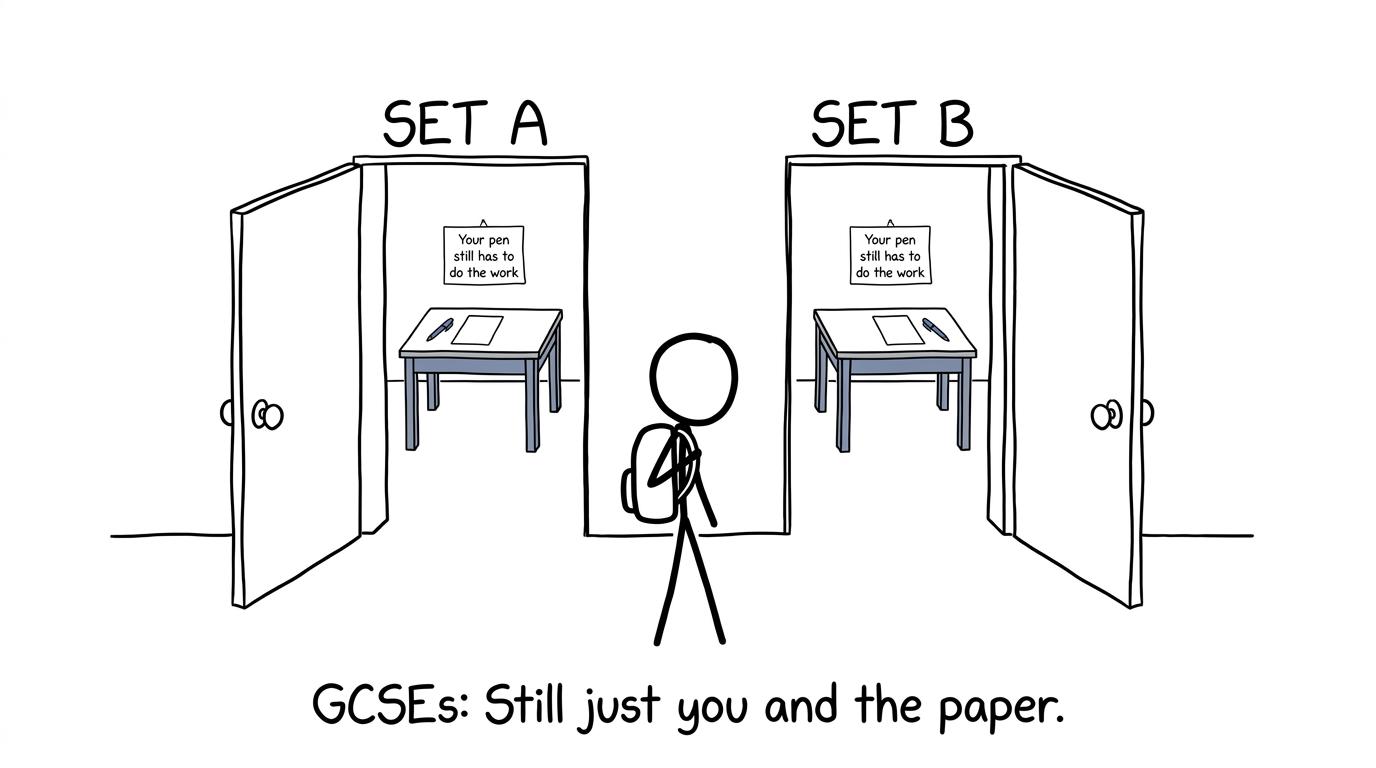 Two class-set doors leading to the same examination desk
Why GCSE History sets are different from maths tiers
Students often combine two separate ideas: the class they are taught in and the examination paper they sit.
In GCSE Maths, foundation and higher tiers genuinely affect the available grade range and the content that can be assessed. MathsGenie's guide to GCSE Maths topics by exam board and tier explains that distinction clearly.
GCSE History in England is different. The qualification is untiered. Whether your school uses Edexcel, AQA, OCR or Eduqas, being placed in a lower teaching set does not automatically enter you for an easier paper with a restricted grade range. Students following the same specification and option combination face the relevant common assessment.
That makes the label on your classroom door less powerful than it may appear. An examiner does not know your set, your latest school report or where you sat in the room. The examiner marks the evidence in your answer.
Across the regulated GCSE History framework, the assessment objectives give approximately:
- 35%35\%35% to knowledge and understanding;
- 35%35\%35% to explanation and analysis using historical concepts;
- 15%15\%15% to analysing and evaluating contemporary sources;
- 15%15\%15% to analysing and evaluating historical interpretations.
Those proportions reveal something useful: remembering facts matters, but recall alone is not enough. About half of the weighting specifically concerns sources and interpretations or analytical thinking, while knowledge must also be selected and used effectively.
What research says about setting
Setting groups students by their current attainment in a particular subject. Streaming usually groups them similarly across most or all subjects. Neither term should be treated as a scientific measurement of fixed ability.
The Education Endowment Foundation's review of setting and streaming reports no average progress advantage over mixed-attainment teaching. Its evidence suggests a small positive effect for higher-attaining pupils and a small negative effect for lower-attaining pupils, but the overall effect is negligible and the evidence base is rated as very limited.
This research is not specific enough to prove what will happen in one GCSE History classroom. Schools organise groups differently, teachers differ, and students experience setting in different ways. It does, however, challenge the idea that placing somebody in a particular set automatically creates a particular result.
A set may reflect previous attainment. Previous attainment can help predict future performance, but prediction is not destiny. The useful question is not, "What does my set say about me?" It is, "What evidence would show that I am improving now?"
How your set can affect your outcome indirectly
A set does not place a formal cap on your History grade, but the classroom experience can still matter.
Pace and depth of teaching
One class may move through content quickly and spend longer debating interpretations. Another may spend more time securing chronology, vocabulary and core knowledge. Either approach can be helpful when it matches what students need.
Problems arise if a class moves so slowly that important specification content is rushed or omitted, or so quickly that students never secure the foundations. Check your exam board, option topics and assessment structure with your teacher. Do not assume that a revision guide for a different board or option covers your course.
Expectations and confidence
Labels can quietly become stories. A student in a high set may think success will happen automatically. A student in a low set may stop attempting ambitious responses because they assume those marks belong to somebody else.
Both stories are dangerous. High expectations should mean that every student is expected to improve from their current position. They should not mean pretending everyone has identical gaps or needs identical support.
Access to feedback
The most valuable classroom difference is often not the label but the feedback. Useful feedback identifies why marks were lost: inaccurate knowledge, undeveloped explanation, weak source evaluation, an unsupported judgement, poor timing or a response that did not answer the precise question.
You can use the same diagnostic mindset in maths. MathsGenie's guide to finding your weakest GCSE topics shows how to turn lost marks into specific next actions rather than a vague judgement about talent.
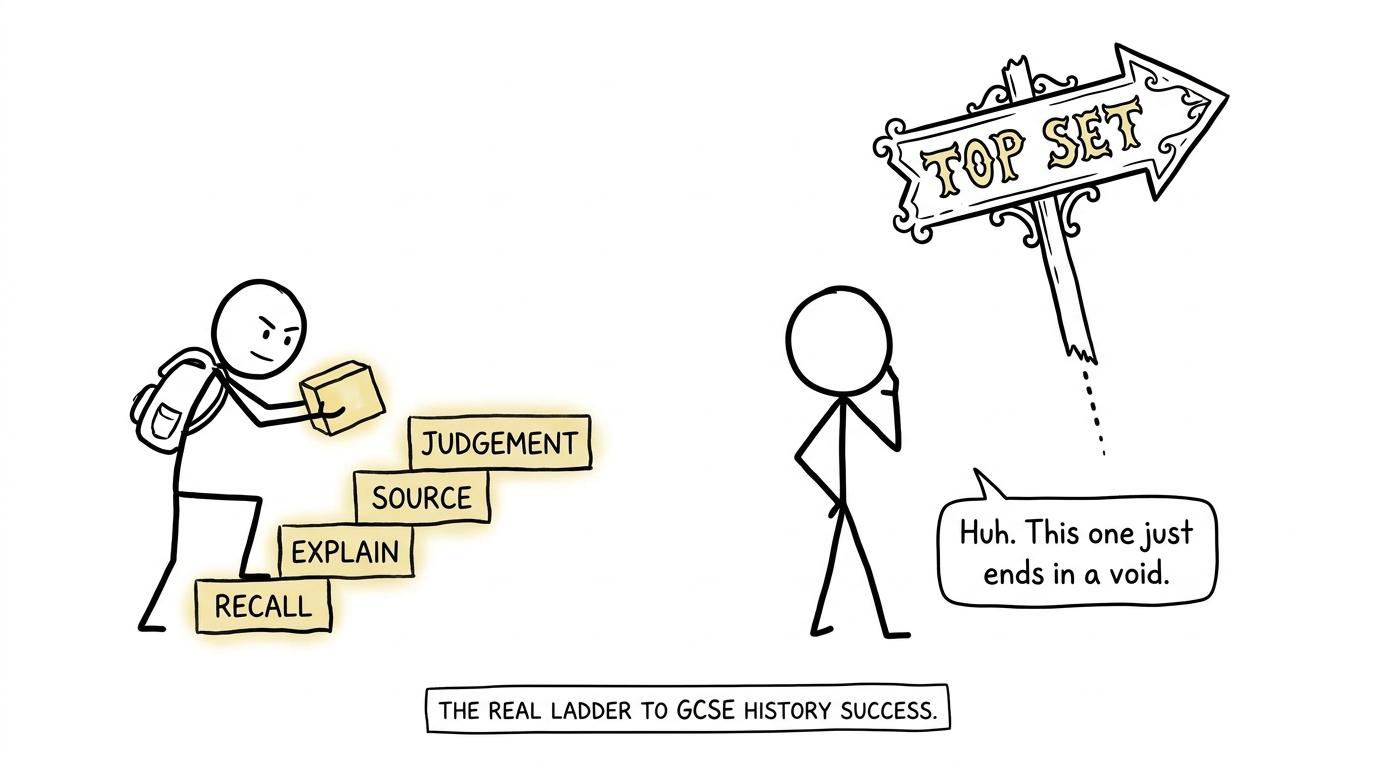 A skills staircase succeeding while a set label goes nowhere
Effort matters, but effective effort matters more
It is tempting to replace one oversimplification with another: if sets do not decide results, perhaps everything comes down to effort. That is not quite fair either.
Students have different teaching, time, health, responsibilities, prior knowledge and access to support. Working hard cannot guarantee a particular grade. Yet your revision choices still matter enormously because they determine whether your available time produces useful feedback.
Reading notes repeatedly may feel industrious, but it does not prove that you can retrieve precise evidence or construct an argument under time pressure. A stronger History revision cycle is:
- choose one specification section;
- recall key people, events, developments and chronology without notes;
- answer an exam-board question;
- mark it using the correct mark scheme or teacher guidance;
- identify one precise weakness;
- improve or rewrite the relevant part;
- return to the skill after a short gap.
Maths students can use the same loop through the free GCSE Maths revision hub: learn a method, complete practice questions, check the solution and revisit the error. The content differs, but the principle is identical. Improvement comes from closing feedback loops.
How to improve from any History set
Know exactly what your board assesses
Edexcel, AQA, OCR and Eduqas organise papers, option topics and question types differently. Find out your full exam-board specification and the exact options selected by your school. Then make a checklist that separates content knowledge from exam skills.
Do not revise "medicine" or "Germany" as a shapeless mass. Break each study into manageable enquiries, key developments, turning points, causes, consequences and debates.
Collect evidence from marked work
Treat mocks and timed questions as information rather than labels. After each marked response, record:
- the question type;
- the marks available and marks achieved;
- the assessment skill being tested;
- the reason marks were lost;
- the next action;
- the date you will attempt a similar question again.
This is also why past papers are so useful in maths. The guidance on when to start GCSE past papers explains how shorter sections can diagnose weaknesses before full-paper practice becomes useful.
Ask specific questions
"How do I get better at History?" is difficult to answer. "My judgement repeats my introduction and does not weigh the factors: what should I change?" gives your teacher something concrete to address.
If you want to move sets, ask what evidence the school uses: assessment results, classwork, homework, teacher judgement or available space. Then ask what improvement would demonstrate readiness. Set movement policies belong to individual schools, so your teacher or head of department is the authoritative source.
Protect your other GCSE subjects
History revision should not swallow the time needed for maths, English and science. Build a balanced timetable around actual weaknesses. For maths, use board-specific resources such as Edexcel GCSE Maths past papers, AQA GCSE Maths past papers or OCR GCSE Maths past papers.
Short tasks are easier to sustain during a crowded GCSE week. The Edexcel GCSE Maths mini tests, for example, can keep maths recall active without taking over an evening that needs to include History.
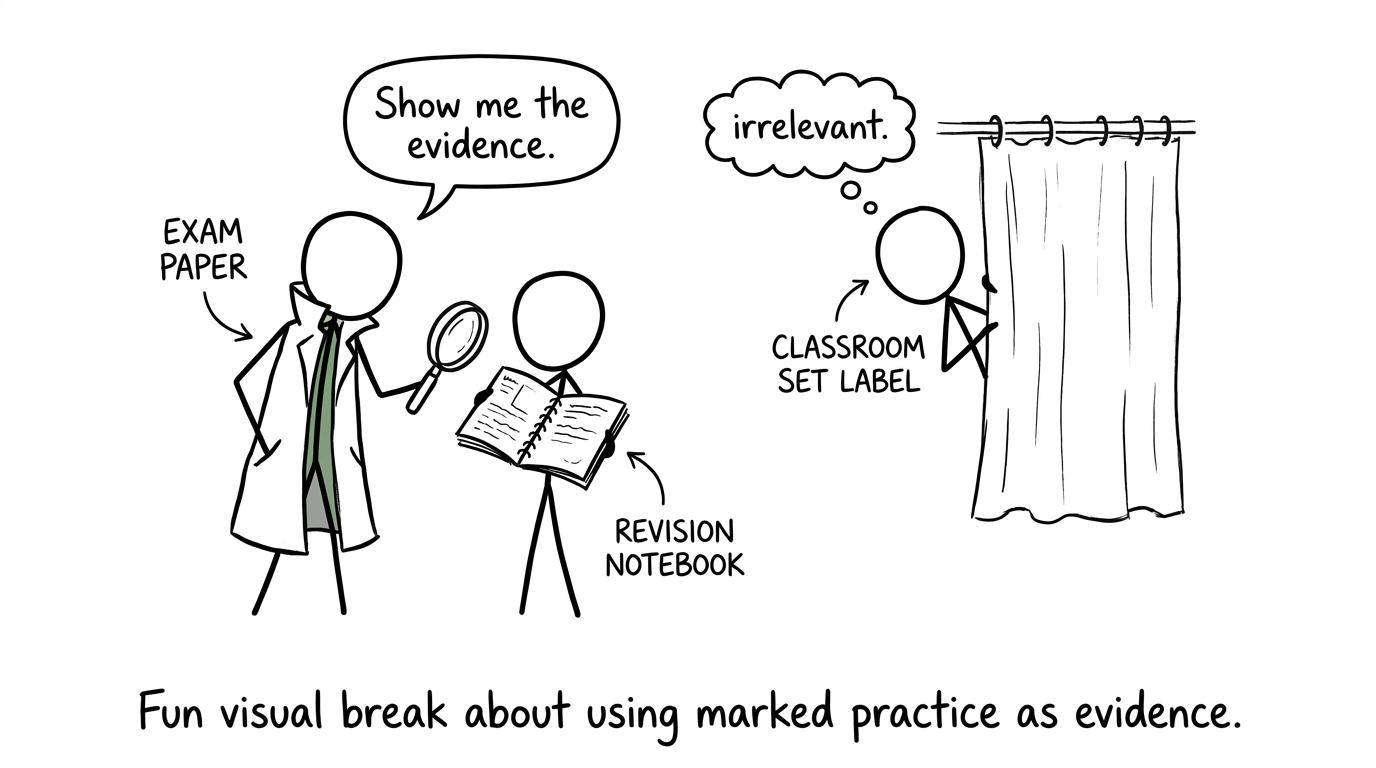 An exam-paper detective asking for evidence
Common mistakes when thinking about History sets
Treating the set as a grade boundary
A lower History set is not the equivalent of foundation tier Maths. GCSE History is untiered, so the class label itself does not restrict your available grade.
Assuming top set means automatic success
Fast lessons and strong classmates do not replace revision. A high-set student who relies on recognition rather than retrieval can still struggle to select evidence or finish an examination paper.
Confusing more facts with better answers
Knowledge is essential, but an unexplained list of facts rarely completes an analytical task. Learn to connect accurate evidence to the wording of the question and sustain a reasoned judgement.
Revising another school's topics
The same exam board can offer several option combinations. Check your precise studies before downloading materials or borrowing notes.
Waiting for a set move before changing anything
A move may help, make little difference or not be available. Begin improving the evidence now: attendance, completed work, accurate recall, timed answers and thoughtful use of feedback.
Your set is a starting position, not a final result
So, do GCSE History class sets matter? They can shape the pace, support and expectations around you, which means they should not be dismissed completely. But they do not impose a grade ceiling, and the wider research does not support the belief that setting automatically raises attainment overall.
Focus on the things an examiner can actually reward: secure knowledge, accurate evidence, clear analysis, careful evaluation and substantiated judgement. Ask for help if your course coverage or feedback is inadequate, and measure progress through marked responses rather than classroom labels.
Then bring the same calm system to maths. Start with MathsGenie's free GCSE Maths revision resources, use revision lessons and practice questions to repair gaps, mini tests to check recall, and past papers, predicted papers, mark schemes and video solutions to build examination confidence. Your set may describe where school placed you. Your repeated actions provide better evidence of where you can go next.