

Do GCSE Art and Design Class Sets Matter?
GCSE art and design class sets matter less than your portfolio evidence. Learn how teaching, effort, feedback and assessment affect your final grade.
A set label can feel like a prediction. Move into a lower class and it is easy to imagine that your grade has already moved with you. Sit in a higher class and the opposite illusion appears: perhaps the result is now secure.
If you are asking whether GCSE Art and Design class sets matter, the short answer is not directly. GCSE Art and Design is not divided into foundation and higher tiers, and your class or set does not place a ceiling on the grade you can achieve. Your submitted work is assessed against the same published assessment objectives, regardless of which teaching group produced it.
Yet the fuller answer is more useful. A class can affect the feedback, pace, resources and atmosphere around you. Those things may influence your progress. But the set name itself earns no marks. The evidence in your portfolio and externally set task does.
The quick answer: what actually affects your result?
Keep this checklist in mind:
- GCSE Art and Design is an untiered qualification graded from 999 to 111.
- A higher or lower set does not create a different mark scheme.
- The four assessment objectives are common across GCSE Art and Design specifications.
- Your grade depends on the evidence presented in your assessed work.
- Teaching quality, feedback, attendance and access to materials can matter indirectly.
- Effort helps, but productive effort must address the assessment objectives.
- School decisions about classes are separate from exam-board grading.
That distinction matters. Your environment can shape the work, but the environment is not what the moderator assesses.
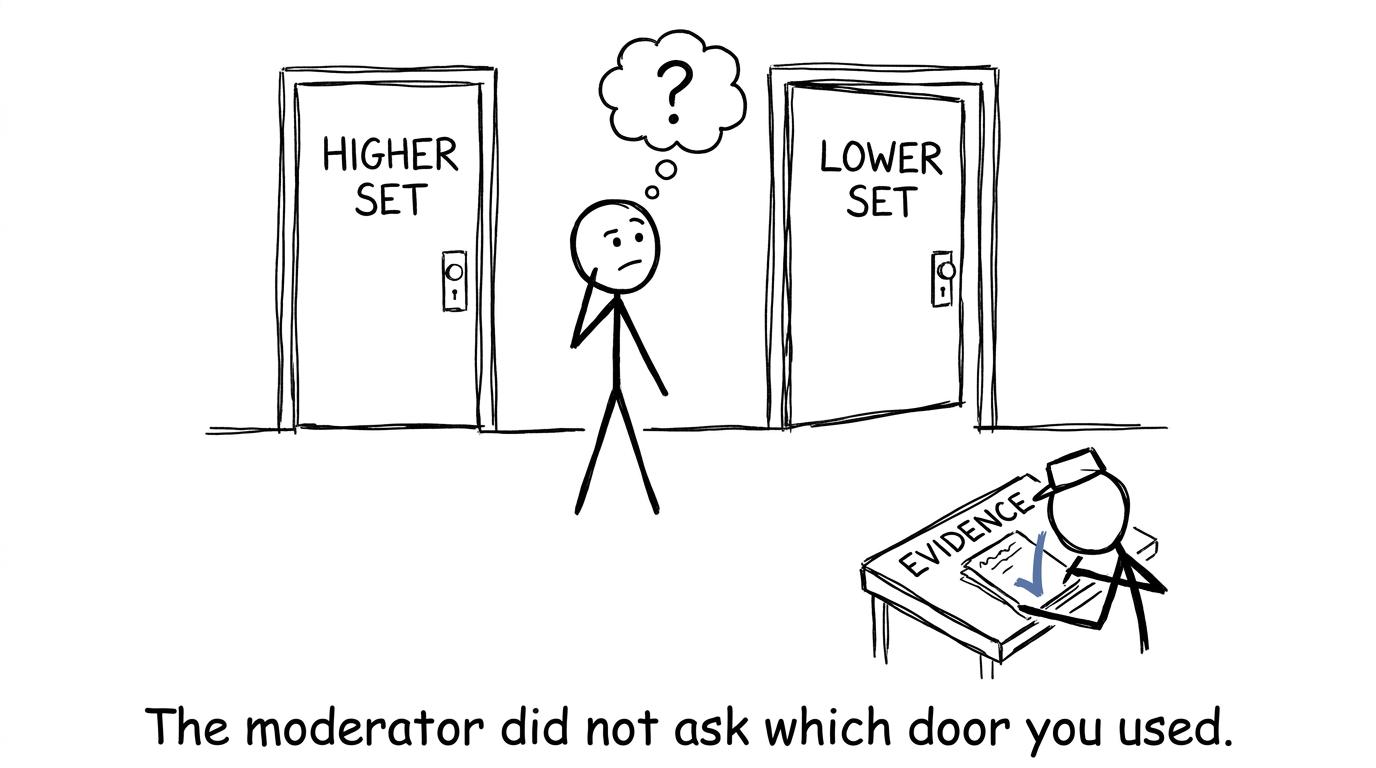 An examiner inspecting portfolio evidence rather than class-set doors
Why your set does not determine your GCSE Art grade
In GCSE Maths, foundation and higher tier affect the questions available and the range of grades that can be awarded. Art and Design does not work that way. There is no separate lower-set Art paper with a restricted grade range.
Schools may organise Art classes according to timetable needs, prior attainment, behaviour, working speed or available staffing. Some schools may not use sets for Art at all. These are internal arrangements rather than nationally defined assessment categories.
Across exam boards such as AQA, Pearson Edexcel and OCR, students normally complete two assessed components: a portfolio and an externally set assignment or task. The portfolio contributes 60%60\%60% of the qualification and the externally set component contributes 40%40\%40%. Students are assessed through non-exam assessment rather than a conventional written Art paper.
The marks are based on four assessment objectives:
- AO1: Develop: investigate sources and develop ideas with critical understanding.
- AO2: Refine: explore, select and experiment with appropriate media, techniques and processes.
- AO3: Record: record observations, ideas and insights as the work progresses.
- AO4: Present: produce a personal and meaningful response that realises your intentions.
Each objective contributes 25%25\%25% overall. None asks whether you sat in the highest class.
Your class can still matter indirectly
Saying that sets do not directly determine grades is not the same as saying every classroom experience is identical.
A productive class may give you regular specialist feedback, purposeful deadlines and opportunities to experiment with unfamiliar materials. A difficult classroom may involve disrupted lessons, limited access to equipment or less individual attention. These differences can affect how easily you build convincing evidence.
There is also a psychological effect. A student placed in a lower group may mistakenly interpret the decision as proof of limited ability. That belief can reduce ambition long before the assessment process does. A student in a higher group may become complacent for the opposite reason.
Broader educational evidence on setting and streaming does not show a meaningful average attainment advantage for all pupils, although the evidence is limited and is not specific to GCSE Art and Design. It also suggests that lower-attaining pupils can experience less favourable outcomes. The sensible conclusion is not that grouping never matters. It is that the label itself is a poor substitute for looking at the teaching, expectations and work produced.
Ask practical questions instead:
- Am I receiving feedback linked to each assessment objective?
- Can I access the materials needed for my chosen direction?
- Do I know what evidence is missing from my project?
- Are deadlines and supervised sessions clearly explained?
- Can I ask for support if my class conditions are affecting my work?
These questions lead to action. Worrying about the number on the classroom door usually does not.
Does it simply come down to effort?
Effort matters, but “work harder” is incomplete advice.
A student can spend hours decorating sketchbook pages while leaving major gaps in idea development. Another can produce an impressive final piece without showing enough experimentation, recording or refinement. Both have worked. Neither has necessarily supplied the full evidence the assessment requires.
Productive effort has direction. It means responding to feedback, testing alternatives, explaining decisions and showing how an idea changed. It also means protecting time for the whole creative journey rather than relying on one polished outcome.
Think of the difference between hours and evidence. Hours are an input. Assessment objectives measure the visible result of those hours. The two often relate, but they are not interchangeable.
 A sketchbook tower built from the four Art assessment objectives
What exam-board moderation means for class fairness
GCSE Art and Design work is generally marked by teachers within the school or college and externally moderated by the exam board. Centres must standardise marking between teachers. The awarding organisation then checks a sample to judge whether the published standard has been applied accurately and consistently.
If a centre's marking is found to be too generous or too severe, the exam board can adjust marks. This process cannot make every classroom experience identical, but it does mean that your teacher's personal expectations are not intended to operate in isolation.
For GCSE non-exam assessment, schools must also tell students their teacher-assessed marks before submitting them to the awarding organisation, allowing time for an internal review request under the centre's procedure. If you are uncertain about your marks or the process, ask your teacher or exams officer for the school's policy rather than relying on rumours between classes.
How to improve from any Art and Design set
Turn feedback into a four-part audit
Create headings for AO1, AO2, AO3 and AO4. Under each, note what your current project already demonstrates and what remains weak or absent. Ask your teacher to check whether your interpretation is accurate.
This is similar to diagnosing weak topics in maths. The MathsGenie guide to finding your weakest GCSE topics explains why evidence is more useful than a vague feeling that you are “bad” at a subject.
Ask specific questions
“Is this good?” invites a broad answer. Better questions include:
- Which assessment objective is least convincing here?
- Where does my development become difficult to follow?
- Have I evaluated why an experiment succeeded or failed?
- Does my final response clearly connect with my preparatory work?
Specific questions make limited teacher time more valuable.
Keep a realistic weekly rhythm
Art coursework can expand to fill every evening, especially when maths exams are approaching. Plan small, defined tasks: complete an observational study, annotate one experiment or compare two possible compositions.
For your other exam commitments, the GCSE maths revision timetable and one-month maths revision plan can help you balance portfolio deadlines with regular exam practice.
Use the same feedback loop in maths
Art and maths look different, but improvement in both depends on visible evidence and correction. In Art, you develop, test, evaluate and refine. In maths, you attempt, mark, diagnose and retry.
Use the GCSE Maths revision hub for lessons and practice questions, then test your progress with Edexcel GCSE Maths mini tests or the appropriate resources for your exam board. When you need full-paper practice, the AQA GCSE Maths past papers show how marks are awarded through official mark schemes and available solutions.
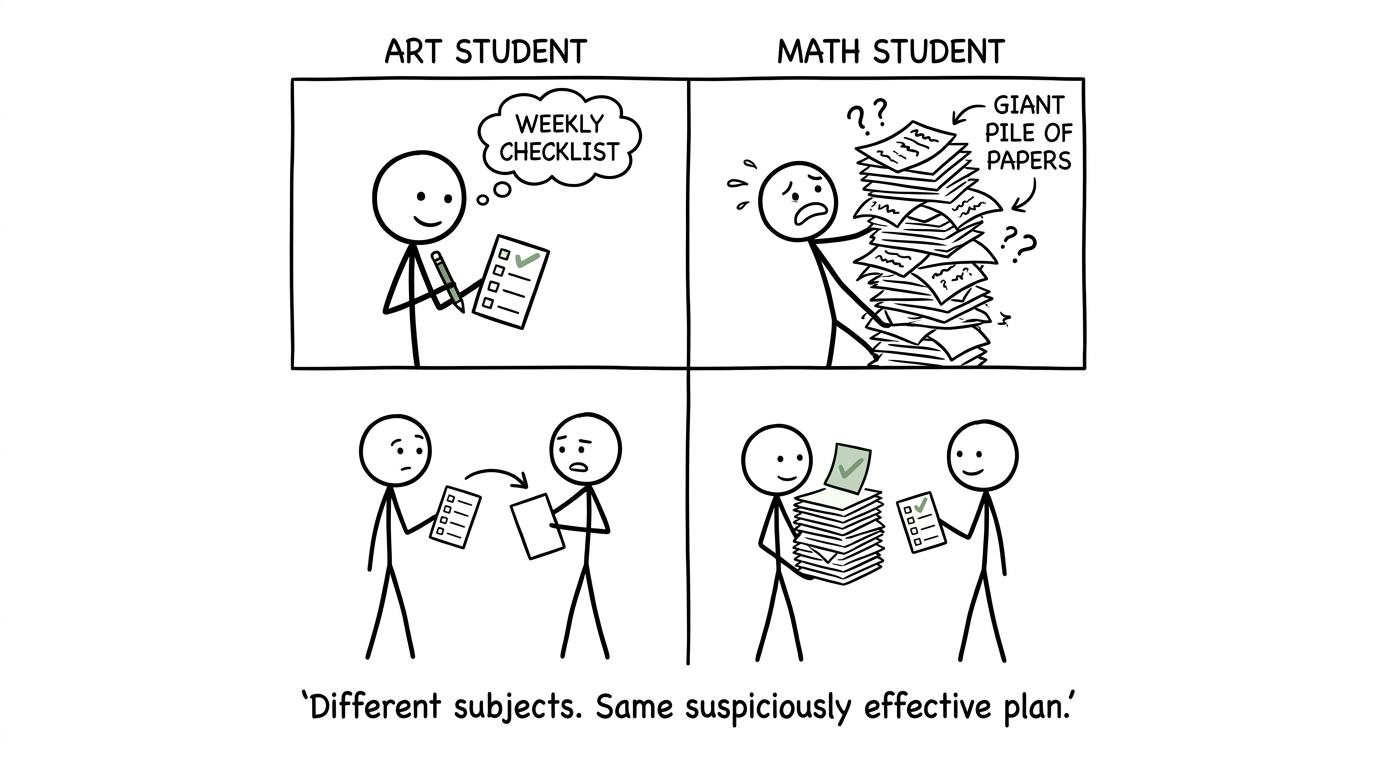 Art and maths students discovering the same effective weekly checklist
Common mistakes when thinking about Art class sets
Assuming a lower set caps your grade
It does not. Art and Design has no foundation or higher tier. Your grade is determined by assessed evidence, not the class label.
Assuming a higher set guarantees success
A strong group may provide useful pace and discussion, but it cannot replace your own portfolio development. Being surrounded by impressive work is not itself an assessment objective.
Comparing final pieces only
The finished outcome is only part of the submission. Examiners also need evidence of investigation, experimentation, recording and development. A visually striking final piece cannot automatically repair an undocumented journey.
Confusing effort with mark-worthy evidence
Long hours are valuable when they improve the submission. Repeating decorative tasks or remaking work without reflection may consume time without addressing a weakness.
Ignoring problems until the deadline
If you lack materials, do not understand feedback or feel that classroom disruption is affecting your progress, raise it early. Speak to your teacher, head of department, tutor or another appropriate member of staff. A solvable problem becomes harder when the final deadline is close.
Your set is context, not destiny
A class affects the conditions in which you work. It may give you more or less confidence, challenge or support. Those conditions deserve attention, particularly if they are stopping you from accessing the course properly.
But your set is not printed into the assessment criteria. The same four objectives remain in front of every student: develop, refine, record and present. The most useful question is therefore not “What does my set say about me?” It is “What evidence can I improve next?”
Carry that habit into maths revision too. Start with the free MathsGenie GCSE resources, learn through revision lessons, practise with topic questions and mini tests, then use GCSE predicted papers, past papers, mark schemes and video solutions to turn feedback into better marks. Your current group may describe where you are taught. It does not have to describe where you finish.











