

Degree Apprenticeships After A-Levels: Entry Routes
Degree apprenticeships after A-levels explained: compare entry requirements, GCSE maths expectations, application routes and next steps for UK students.

A university offer can feel like a single door. In reality, it is one of several. Degree apprenticeships after A-levels offer another route: you work for an employer, earn a salary and complete degree-level study as part of the job.
For GCSE students, this may sound distant. It is not. The maths and English grades you secure now can remain part of the entry requirements several years later. Your GCSE choices, post-161616 qualifications and early career research all help determine which doors stay open.
Degree apprenticeship checklist
Before applying, check:
- the apprenticeship level and qualification awarded
- required GCSE grades, particularly maths and English
- required A-level subjects, grades or UCAS Tariff points
- whether equivalent qualifications such as a T Level or BTEC are accepted
- the employer's location, salary and working arrangements
- how study is divided between the workplace and training provider
- the application deadline and selection stages
Requirements vary between vacancies. Always treat the current employer listing as the final authority.
What is a degree apprenticeship?
In England, an apprenticeship is a paid job combined with structured training. Degree apprenticeships sit at Level 666 or Level 777:
| Apprenticeship level | Broad educational equivalent |
|---|---|
| Level 333 | A-level standard |
| Levels 444 and 555 | Higher education or foundation degree level |
| Level 666 | Bachelor's degree level |
| Level 777 | Master's degree level |
The employer and apprenticeship funding system cover eligible training costs, so the apprentice does not take out a standard undergraduate tuition fee loan for that training. You are also an employee with workplace responsibilities. This is not simply university with an occasional placement.
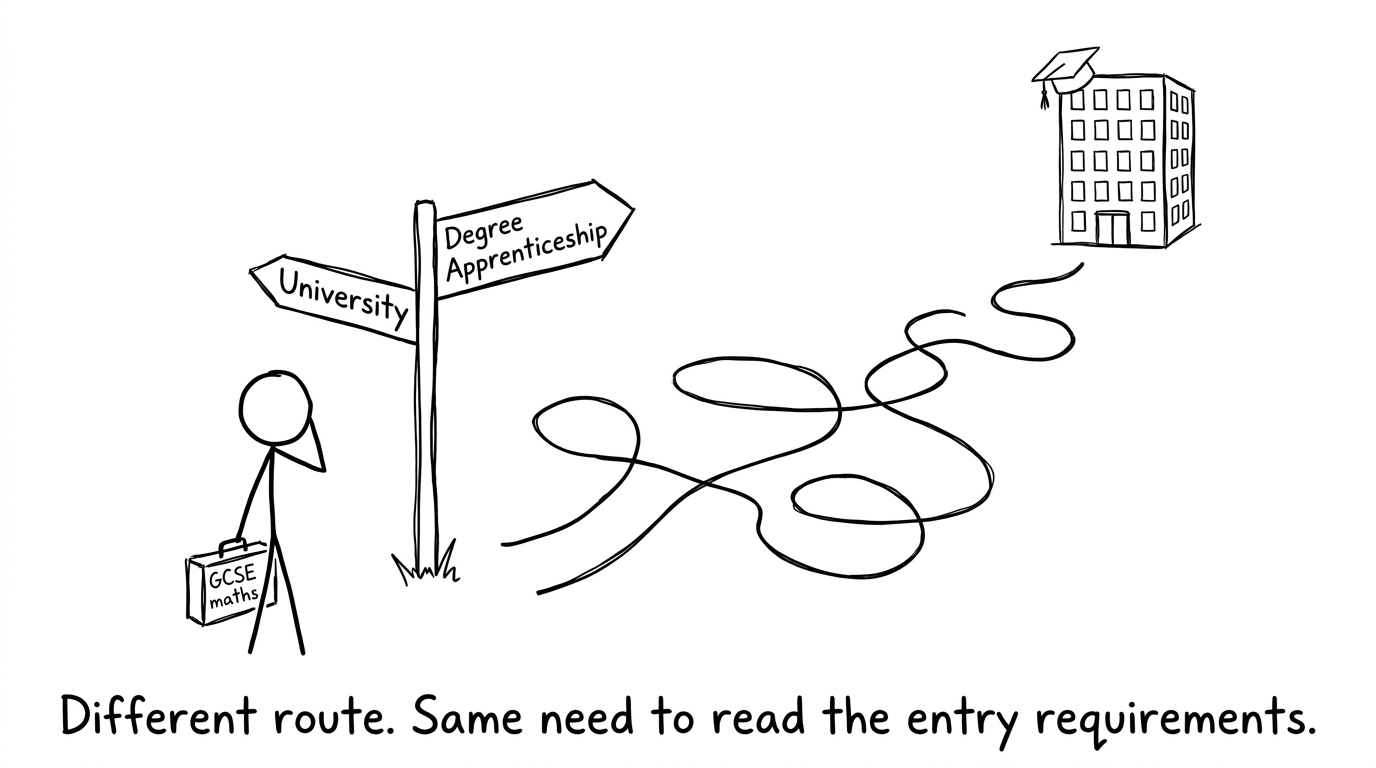 Student choosing between university and a degree apprenticeship
Rules and names differ across the UK. Scotland uses Graduate Apprenticeships, while Wales offers Level 666 degree apprenticeships in selected priority areas. Northern Ireland has Higher Level Apprenticeships. Search through the official service for the nation in which you will work.
Entry requirements for degree apprenticeships after A-levels
There is no universal grade requirement. Each employer sets criteria for its role, often with input from a university or training provider.
A vacancy may ask for:
- several GCSEs at grades 999 to 444
- GCSE maths and English at grade 444 or above
- particular A-level grades or a UCAS Tariff total
- an A-level in maths or another relevant subject
- a T Level, BTEC or equivalent Level 333 qualification
- evidence of communication, teamwork and interest in the occupation
Technical routes can be more specific. An engineering programme might require A-level maths or physics, while a digital role may accept a broader combination but test logical thinking. Business, surveying, healthcare and public-sector programmes can have different subject expectations.
That is why GCSE maths matters. A grade 444 may satisfy the minimum for some vacancies, but competitive or mathematically demanding programmes may ask for more. Use the GCSE Maths revision hub to choose your board, including Edexcel, AQA, OCR or Eduqas, and check the resources available for your tier.
Routes into a degree apprenticeship
Applying directly after sixth form or college
The most direct route is to complete A-levels or another accepted Level 333 qualification and apply to an employer. Unlike a conventional university application, you are applying for a job. UCAS can help you discover opportunities, but applications are normally completed through the employer or the service to which UCAS redirects you.
Selection may involve an application form, online assessments, interviews or an assessment centre. Employers are considering academic readiness and whether you understand the occupation.
Progressing through another apprenticeship
Going directly to Level 666 is not the only sensible path. A student may begin with a Level 333, 444 or 555 apprenticeship and later progress. This can be valuable where an industry expects practical competence to develop gradually.
For example, someone interested in engineering could explore technician-level training before progressing towards a degree-level standard. Someone considering accountancy or digital technology might find both higher and degree apprenticeship routes. These are route illustrations, not guaranteed progression ladders; each vacancy has its own conditions.
Applying with vocational qualifications
Many employers consider T Levels, BTECs and other Level 333 qualifications, but acceptance is not automatic. Check the required subject, overall grade and any separate GCSE conditions. “Equivalent qualification accepted” does not always mean every qualification in every subject will qualify.
Planning the A-level results apprenticeship route
An A-level results apprenticeship route needs more preparation than waiting for results day. Apprenticeships can be advertised throughout the year, and some competitive programmes recruit many months before their start date.
A practical timeline is:
- research occupations before your final A-level year
- create vacancy alerts and monitor employer recruitment pages
- apply to several suitable roles rather than relying on one
- keep revising for the grades in any conditional offer
- maintain a university, college or alternative apprenticeship plan
- contact the employer promptly if your results miss a stated condition
An employer may reconsider an applicant who narrowly misses an offer, but it does not have to. Apprenticeships do not operate through university Clearing in the usual sense. The safest approach is to keep several routes alive.
Students taking A-level maths can use the A Level Maths revision hub, including board-specific support such as Edexcel A Level Maths revision. GCSE students deciding whether the subject suits them can first read the GCSE to A Level maths curriculum guide.
 Recruiter examining grades, skills and motivation
How to prepare while studying GCSEs
Start with the qualification that is directly in front of you. Strengthening percentages, ratio, graphs, algebra and statistics supports both exam performance and the numerical reasoning used in many workplaces.
A reliable revision cycle is to learn a topic, practise focused questions, complete a timed assessment and correct every lost mark. The Edexcel GCSE Maths revision area brings lessons, questions and papers together, while students approaching exam season can use GCSE predicted papers as realistic practice.
Do not merely collect scores. Follow the process in MathsGenie's guide to using past papers: mark carefully, identify the weak topic and retest it. That habit is useful beyond exams because apprenticeship recruitment rewards people who can respond constructively to feedback.
Common mistakes to avoid
Assuming every programme wants the same grades. Requirements differ by employer, occupation and training provider.
Looking only after results day. Some vacancies close early or when enough suitable applications have arrived.
Confusing a higher apprenticeship with a degree apprenticeship. A higher apprenticeship may be degree level without necessarily awarding a degree. Check the qualification stated.
Ignoring GCSE requirements once A-levels begin. Employers may still require evidence of GCSE maths and English.
Applying as though it were only a course. It is also employment. Your application should explain why the role, organisation and occupation interest you.
Build the next step from the one in front of you
You do not need to decide your entire career during GCSE revision. You need to preserve useful options. Strong GCSE results, informed post-161616 choices and early vacancy research make the later decision calmer.
Use the MathsGenie GCSE and A Level resource hub as the academic part of your careers plan. Start with a revision lesson, practise the topic, then move through mini tests, past papers and predicted papers. Mark schemes and video solutions show where marks were lost, and what to improve next. The route may be vocational, academic or a mixture of both. Your next good decision begins with preparation today.











