

Degree After A-Level Psychology: Course Guide
Degree after A-Level Psychology: compare UK courses, entry grades, accreditation, quantitative content and the routes that different choices open.
Results day can make a long-term decision feel strangely small: a few grades on a screen, followed by one question: what now? If you are choosing a degree after A-Level Psychology, the short answer is that your options extend well beyond a standard psychology degree. Psychology, neuroscience, counselling, criminology, education, marketing and data-focused social science courses can all build on what you have learnt.
The right choice depends less on the title and more on three things: what you want to investigate, how comfortable you are with scientific and quantitative work, and whether you may eventually want to become a professional psychologist.
Your degree decision checklist
Before accepting an offer or searching for alternatives, check:
- the course modules, especially statistics and research methods;
- the current entry requirements, including GCSE maths and science grades;
- whether British Psychological Society accreditation matters for your plans;
- the balance between examinations, coursework, placements and laboratory work;
- whether the course supports the career or postgraduate route you have in mind;
- the total experience, location, cost, support and opportunities, rather than the course name alone.
Entry requirements change between application cycles. Treat every grade below as an illustration based on published 2026 course information, then confirm the requirements for your own year directly with the university.
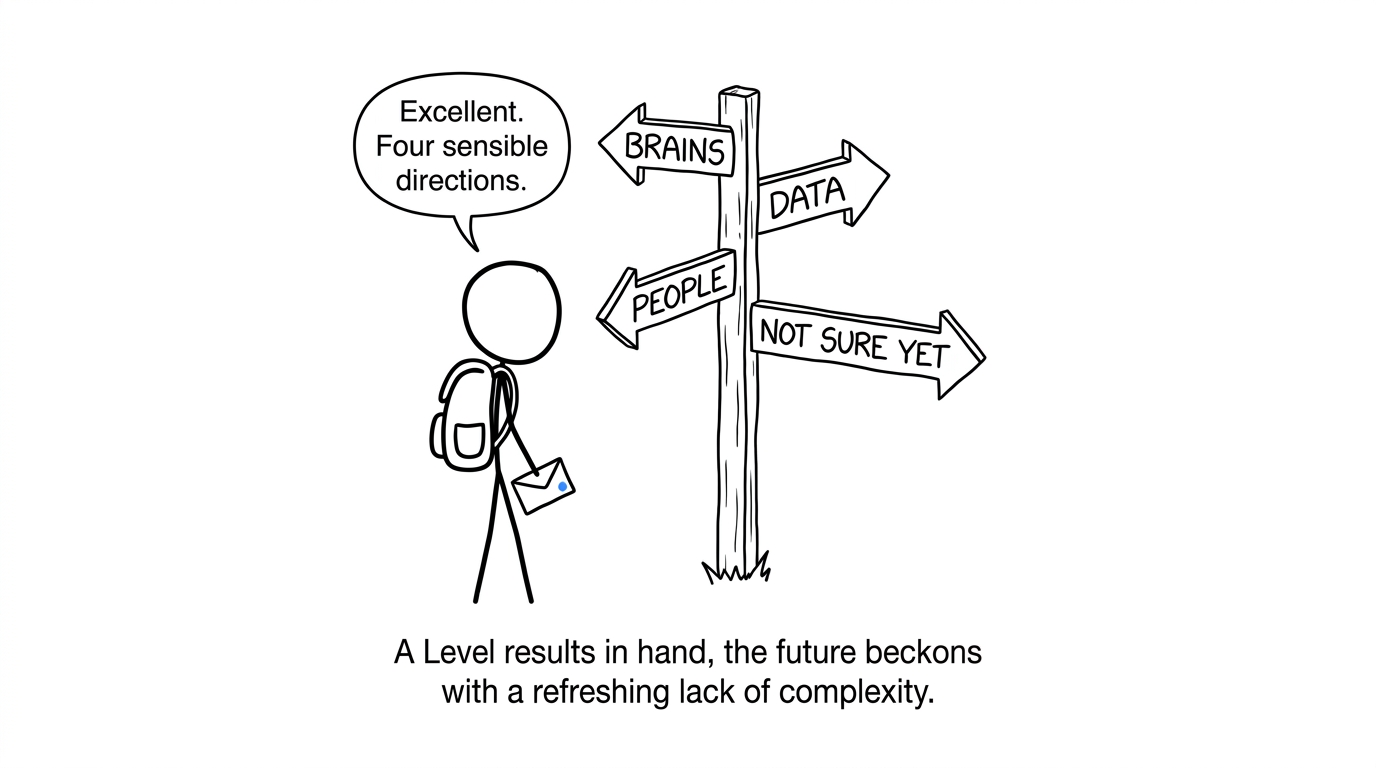 A student choosing between sensible university directions
Psychology degrees: the broadest direct route
A BSc Psychology is the most obvious route from A-Level Psychology to degree study. It normally covers cognitive, biological, developmental and social psychology alongside research design, data analysis and an independent project.
The last part matters. University psychology is not simply a longer collection of memorable studies. It is a scientific discipline, so you will be expected to evaluate evidence, interpret results and understand concepts such as correlation, significance, validity and reliability. MathsGenie's free guide to A-Level Psychology correlation analysis gives a useful picture of this quantitative thinking.
If you might want to become a chartered psychologist, investigate accreditation before enrolling. A British Psychological Society accredited undergraduate course can provide eligibility for Graduate Basis for Chartered Membership, normally provided that you complete the specified pathway, pass the psychology project and achieve at least a 2:22{:}22:2. This is an academic foundation for later professional training; it does not qualify you to practise as a psychologist by itself.
Example psychology entry grades
Published offers show why you should build a balanced shortlist rather than assuming every psychology course asks for similar results.
| Example 2026 course | Published typical A-Level offer |
|---|---|
| University of Bath Psychology BSc | A∗AAA^*AAA∗AA |
| University of Manchester Psychology BSc | AAAAAAAAA, including an accepted subject such as psychology, biology, statistics or maths |
| University of Leicester Psychology BSc | BBBBBBBBB |
Some providers also specify GCSE maths, English or science grades. Your GCSE results therefore remain relevant even when an A-Level offer receives most of the attention.
Specialist courses related to psychology
A general psychology degree is not the only sensible answer. Specialist courses let you move closer to a particular interest, although course titles can hide significant differences in content.
Neuroscience and cognitive science
These routes suit students interested in memory, perception, the brain and biological explanations of behaviour. They may involve more biology, laboratory work, programming or mathematical analysis than A-Level Psychology. Some universities require A-Level biology, chemistry, maths or another science, so psychology alone may not meet the subject requirements.
Psychology with counselling
These courses combine core psychology with counselling theories or interpersonal skills. However, an undergraduate degree with “counselling” in its title does not automatically qualify you as a counsellor or counselling psychologist. Read the professional recognition and postgraduate progression information carefully.
Forensic psychology and criminology
Forensic psychology focuses on behaviour in legal and criminal justice settings, while criminology more broadly explores crime, institutions, policy and society. If becoming a forensic psychologist is your goal, check whether the psychology content provides the accredited foundation needed for later professional training.
MathsGenie's criminological psychology research methods guide shows how evidence and evaluation remain central in this area.
Education, sociology and social policy
These subjects can suit students drawn to development, inequality, schools, families or public services. They use psychology's transferable skills without necessarily following a professional psychology pathway. Joint honours courses may offer flexibility, but you should check whether combining subjects affects accreditation.
Marketing, business and human resources
A-Level Psychology develops useful insight into decision-making, group behaviour and research. Marketing, consumer behaviour, human resources and business psychology can build on these interests. They are particularly worth exploring if you enjoy applying behavioural ideas to organisations rather than clinical or laboratory settings.
Why maths matters for psychology at university
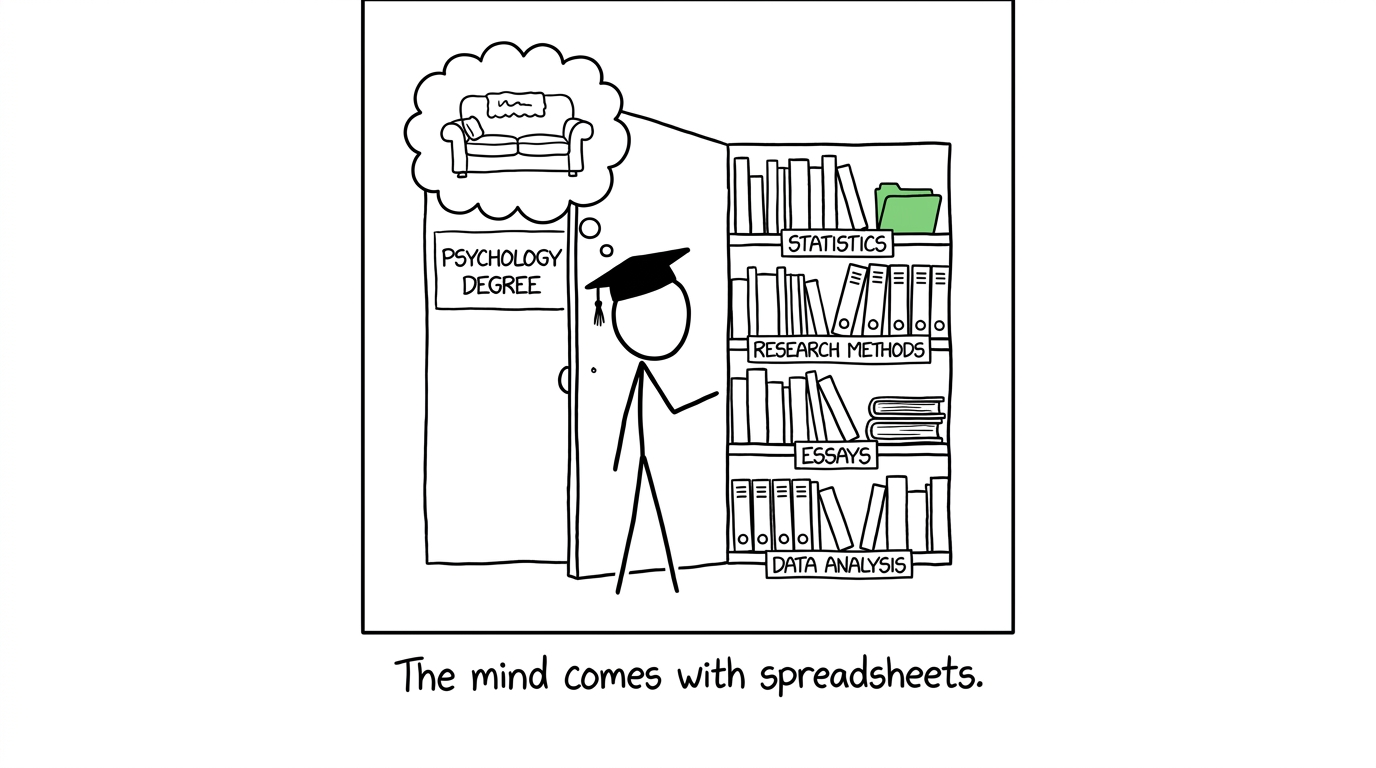 A psychology cupboard unexpectedly full of statistics
The surprise for some students is not that psychology contains statistics. It is how often statistics shape the conclusions you are allowed to make.
You may study averages, standard deviation, probability, hypothesis testing, experimental design and levels of measurement. Strong quantitative skills help you distinguish a genuine pattern from an attractive but unsupported claim. Review levels of measurement and psychology research methods before university if this is a weaker area.
GCSE students considering this route should not treat maths as a qualification to abandon once grade 4 is secured. A stronger foundation in percentages, graphs, averages and probability makes later research methods less intimidating. MathsGenie's GCSE Statistics revision resources and GCSE predicted papers can help develop that confidence.
Common mistakes when choosing a course
Choosing only by course title. Two degrees called Psychology can contain different optional modules, placement opportunities and assessment methods.
Ignoring accreditation. It may not matter for careers such as marketing or policy, but it can be crucial if you want to pursue chartered psychology training.
Assuming A-Level Psychology is always required. Many psychology degrees accept applicants without it, while some courses prioritise science or quantitative subjects. Check each provider.
Underestimating statistics. Avoiding quantitative modules may close off research opportunities. Use A-Level Maths revision resources to strengthen relevant skills where appropriate.
Treating one disappointing grade as the end of the route. Published offers range widely, and foundation years or later psychology conversion courses may provide alternative pathways. Check availability and eligibility rather than making assumptions.
Make the next decision smaller
You do not need to map your entire career on results day. You need to choose the next environment in which you can learn well. Compare modules, entry grades, accreditation and destinations, then decide whether you are most interested in people, brains, evidence, institutions or applications.
As you prepare, use MathsGenie's AQA A-Level Psychology revision hub for practice questions and past papers, then revisit difficult areas through revision guides and mark schemes. For broader exam preparation, MathsGenie also brings together free revision lessons, predicted papers, mini tests and video solutions. The course choice may be personal, but the next revision step can be practical: identify one gap, practise it, mark it and improve it.










