

Degree After A-Level Politics: Results Day Guide
Degree after A-Level Politics: compare politics, PPE, law and international relations, check example entry grades, and choose your next step with confidence.
Results Day compresses years of work into a few letters on a screen. Then comes a much bigger question: what should those letters lead to?
If you are considering a degree after A-Level Politics, the direct route is a Politics degree, but it is far from your only option. International Relations, PPE, law, public policy, economics, history, sociology and journalism can all build on the subject. The right choice depends on what you enjoyed, the career direction you want and the entry requirements you can realistically meet.
Your quick degree-choice checklist
Before accepting an offer or entering Clearing, check:
- the compulsory modules, not just the course title;
- the published A-Level and GCSE entry requirements;
- whether your achieved grades meet the standard or contextual offer;
- how much economics, statistics, philosophy or legal study is involved;
- assessment methods, including essays, examinations and projects;
- placement, study-abroad and internship opportunities;
- the careers and postgraduate routes the course supports.
Entry requirements change between universities and application cycles. Treat the examples below as a starting point, then verify the live course page before making a decision.
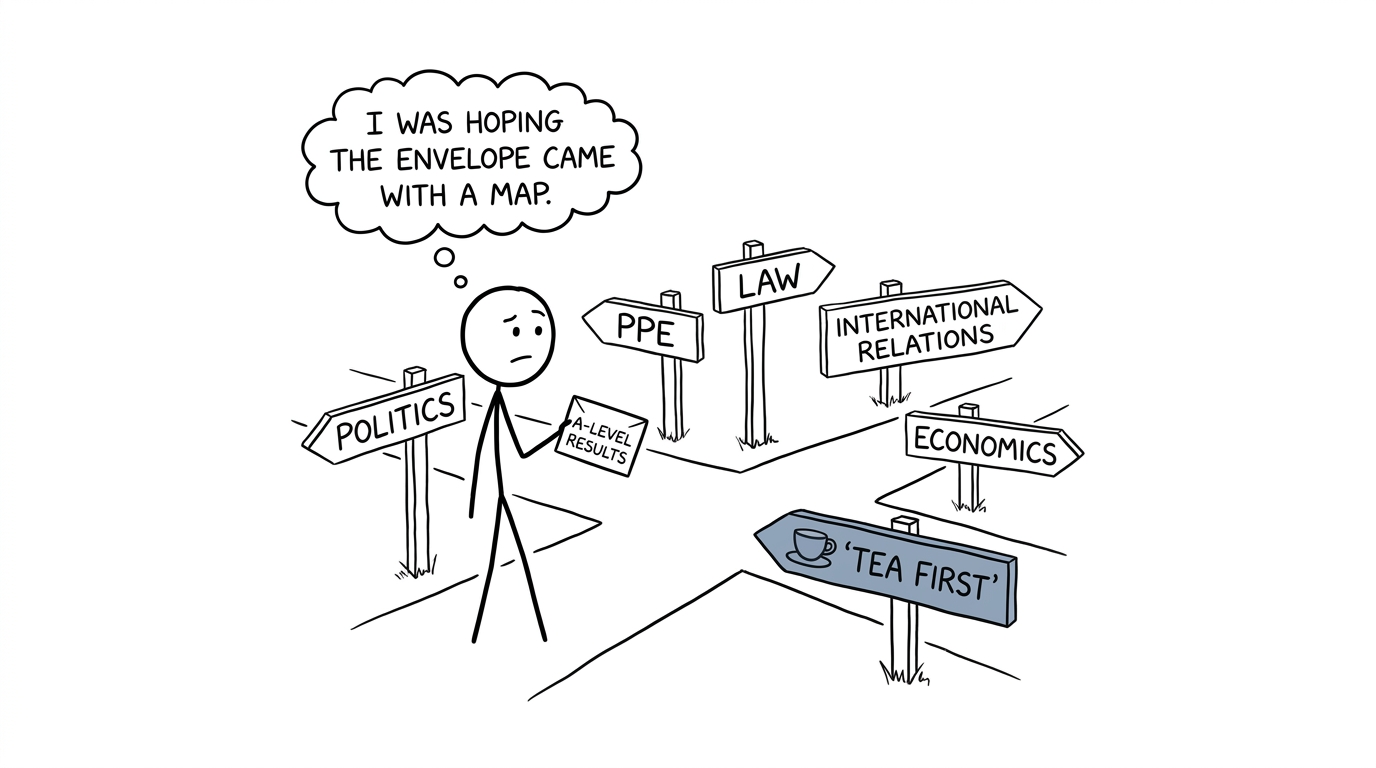 A student facing a humorous crossroads of university courses
University courses for Politics A-Level students
Politics
A Politics degree is the clearest continuation. Courses commonly cover political ideas, comparative politics, British government, public policy, political analysis and international affairs.
Choose this route if you enjoyed comparing ideologies, evaluating evidence and constructing balanced arguments. Do not assume every Politics degree is identical: one may emphasise political theory, while another focuses on elections, policy or quantitative research.
Politics A-Level is often helpful rather than compulsory. Universities frequently accept applicants with a broad range of humanities and social science subjects.
International Relations
International Relations shifts attention towards relationships between states, international organisations, security, conflict, diplomacy and global political economy.
It may suit you if foreign policy and global politics were the most engaging parts of your A-Level course. Some universities combine Politics and International Relations, giving you room to explore domestic and international questions before specialising.
Politics, Philosophy and Economics
PPE examines public decisions through three different lenses: political power, philosophical reasoning and economic consequences. It can prepare students for policy, government, consultancy, finance and research, but its mathematical expectations vary considerably.
Read the entry conditions carefully. Some PPE-style courses require a strong GCSE Maths grade even when A-Level Maths is not required. If economics is a substantial part of the course, confidence with graphs, percentages, data and algebra will help.
Students still strengthening those foundations can use the free GCSE Maths revision hub or preview the transition through A-Level Maths revision.
Law
Politics develops useful preparation for law: careful reading, evidence-based argument and an understanding of institutions. An undergraduate law course, however, is not simply more politics. It requires detailed analysis of cases, legal principles and precise language.
Check whether the degree meets your intended professional or postgraduate route. You should also compare compulsory modules and assessment styles rather than choosing law solely because it appears career-specific.
Public policy, economics and social sciences
Public policy degrees focus on how governments identify problems, select interventions and evaluate outcomes. Economics adds more mathematical and statistical analysis, while sociology examines institutions, inequality and social change.
History, criminology, development studies and social policy can also be sensible choices. The link is not always the course title. It is the habit of asking who has power, how decisions are made and what evidence supports a conclusion.
Journalism and communications
If you enjoyed explaining political events more than analysing political theory, journalism or communications may deserve consideration. Look for courses offering practical reporting, media law, digital production and work experience rather than relying on the title alone.
Example entry grades for 2026 courses
These published examples show how widely requirements can vary. They are indicative, not guaranteed offers.
| Example course | Published typical A-Level entry requirement |
|---|---|
| Exeter BA Politics | AAB |
| Leicester BA Politics | BBB |
| Queen Mary Politics and International Relations | ABB |
| Portsmouth International Relations and Politics | BBC-CCC |
| Birmingham Policy, Politics and Economics | AAB, plus GCSE Maths grade 7 |
| Manchester Politics, Philosophy and Economics | AAA, plus GCSE English Language and Maths grade 6 |
Some institutions publish reduced contextual offers for eligible applicants. Foundation years may provide another route when standard requirements are not met, although they add an extra year and have their own entry conditions.
Your Results Day decision should therefore be based on the exact university response shown in your application, not on an old prospectus or an entry range remembered from months ago.
How to choose between similar courses
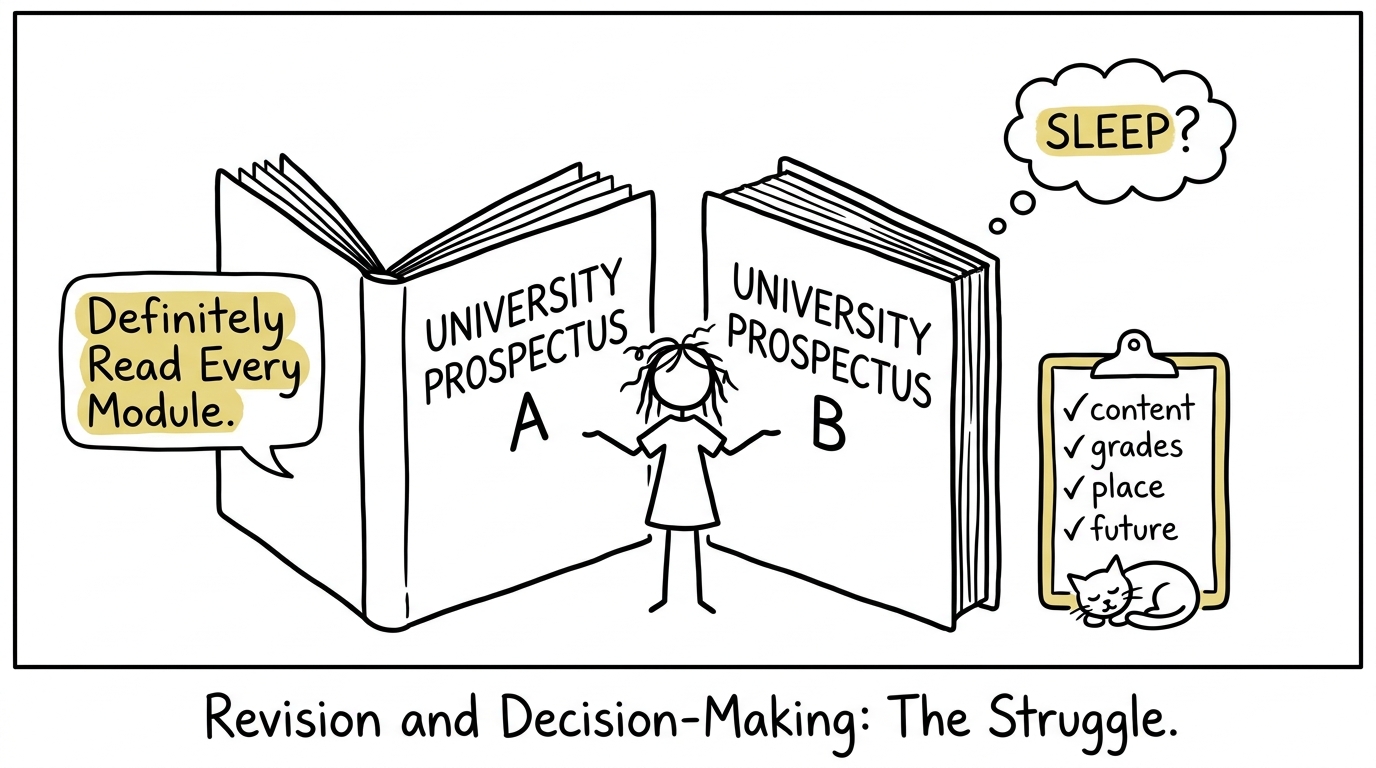 A student comparing enormous university prospectuses with a tiny checklist
Compare the first-year modules
Course names are marketing shorthand. Modules reveal what you will actually study each week.
Open two course pages side by side. Highlight compulsory modules, research methods, optional topics and dissertation requirements. If one course contains substantial economics or data analysis, ask whether that is an exciting challenge or an unwelcome surprise.
Work backwards from possible careers
Politics-related graduates enter areas including public policy, the Civil Service, local government, charities, public affairs, communications, journalism and business. Some graduate schemes accept many degree subjects, so there is rarely one compulsory degree for a policy career.
Focus on transferable evidence: research, concise writing, data interpretation, presentations, teamwork and relevant experience. Placements, volunteering and student journalism may matter alongside the degree title.
Keep a balanced shortlist
A sensible shortlist includes ambitious, realistic and safer options. On Results Day, compare each available place against the same criteria: content, grades, location, cost, student support and future opportunities.
Do not let urgency erase judgement. A place available through Clearing is still a major commitment.
Why GCSE Maths still matters
Politics is essay-based, but many university courses include research methods, polling, charts, statistics or economic analysis. Universities may also specify a minimum GCSE Maths grade, particularly for PPE and economics-related programmes.
If you are still choosing A-Levels, read how to choose your three A-Level subjects before closing off a route accidentally. Current GCSE students can build the required foundation through Edexcel GCSE Maths revision, GCSE predicted papers and the guide to finding your weakest GCSE topics.
Common mistakes when choosing a degree
- Choosing by title alone: similarly named courses can contain very different modules.
- Treating the typical offer as permanent: requirements and course availability can change each year.
- Ignoring GCSE conditions: meeting the A-Level offer may not override a required Maths or English grade.
- Assuming Politics A-Level limits you to politics: the skills transfer to several humanities and social science routes.
- Selecting a career before understanding it: investigate the daily work, not merely the job title.
- Using rankings as the whole decision: course content, teaching, location, cost and support also matter.
- Panicking on Results Day: read the full offer and speak to the university before accepting a course you have not researched.
Make your next decision from evidence
A-Level Politics teaches that important choices are rarely about one fact. They are about weighing competing priorities without losing sight of the evidence. Choosing a university course works the same way.
Compare modules, confirm current requirements and think honestly about the work you want to do for three years. If maths forms part of that route, make MathsGenie your free revision base. Use revision lessons and practice questions to repair gaps, then build confidence with mini tests, past papers, predicted papers, mark schemes and video solutions.
Your results open the conversation. A thoughtful course decision determines where it goes next.










