How to Choose Your Three A Level Subjects
Level subject choices made clearer. Learn how to balance enjoyment, ability, workload and university requirements before choosing three A Levels.

Choosing three subjects can feel strangely permanent. One form asks you to compress your interests, strengths and half-formed plans for adulthood into three boxes. That is a lot to ask of anyone in Year 11.
The reassuring answer is that a good Level subject choice does not require you to predict your entire future. Choose subjects that you enjoy, can realistically succeed in and need for any university courses or careers you are seriously considering. Check the entry requirements first, then think about workload and how the subjects fit together.
Your choices matter, but they are not a verdict on the rest of your life. They are simply the next useful decision.
Your A Level subject checklist
Before submitting your choices, make sure you can answer yes to most of these questions:
- Do I genuinely enjoy learning this subject?
- Am I achieving the GCSE results required by my school or college?
- Do I understand how the A Level differs from GCSE?
- Have I checked whether future courses require it?
- Does the combination keep sensible options open?
- Can I manage the assessment style and weekly workload?
- Have I spoken to subject teachers or current sixth-form students?
- Have I checked the exact subjects and exam boards offered locally?
Do not worry if you cannot answer everything immediately. The purpose of the checklist is to reveal what you need to investigate, not to produce instant certainty.
 A student choosing between enjoyment, ability and future plans
Understand what an A Level involves
In England, Wales and Northern Ireland, an A Level is a Level 3 qualification. GCSE grades nine to four are generally classed as Level 2 qualifications. The change is not merely a new label: A Levels involve greater depth, more independent work and more demanding application of knowledge.
Most students take three A Levels over two years, although arrangements vary between schools and colleges. Some students begin with four subjects or add an AS Level, Core Maths or an Extended Project Qualification. Taking more is not automatically better. University offers are commonly based on three full A Levels, and a fourth subject should not weaken performance across the others.
Entry requirements for sixth form also vary. A school might ask for particular GCSE grades overall and a higher grade in the subject you want to continue. Never assume that another school’s rule applies to yours. Check the published admissions information and ask what happens if your final GCSE result differs from your predicted grade.
Start with future requirements, not job predictions
You do not need a complete career plan at sixteen. You do, however, need to avoid accidentally closing a door that you already know you may want to use.
Universities set their own course requirements. Some degrees accept a broad range of A Levels, while others require named subjects. Medicine commonly has science requirements. Engineering and physics courses frequently require Mathematics and Physics. Economics requirements differ, but Mathematics is required by some universities. Mathematics degrees usually require Mathematics, and highly selective courses may require or strongly recommend Further Mathematics when it is available.
Requirements can change between universities and admission cycles. Search for several real courses that interest you and record:
- required subjects;
- preferred or recommended subjects;
- typical grade requirements;
- any admissions tests or practical conditions;
- what the university says if your school does not offer a subject.
Required and recommended do not mean the same thing. A required subject is normally essential for consideration. A recommended subject may strengthen preparation without being an absolute condition. Read the wording carefully and check the current course page again when you eventually apply.
If you have no particular degree in mind, favour subjects you enjoy and perform well in while retaining reasonable breadth. Choosing a respected subject you dislike simply because it appears to keep options open can be costly if it drains the time and energy needed by your whole programme.
Balance enjoyment, ability and usefulness
A strong choice usually sits where three things overlap: interest, evidence of ability and future relevance.
Interest must survive ordinary Tuesdays
Enjoyment is not just liking the best lesson of the term. Ask whether you would still want to read, write, calculate, experiment or practise when the work becomes difficult.
Look at the specification rather than relying on the subject name. A Level Psychology, Economics, Computer Science and Law may be new subjects, but they still have defined content and assessment demands. Mathematics continues familiar ideas while introducing much greater algebraic depth, alongside statistics and mechanics.
Ability should be based on evidence
Your current marks matter, but look beneath the headline grade. Which parts of the subject are strongest? Do you improve when you practise? Can you complete unfamiliar problems without being shown every step?
For Mathematics, inspect your higher-tier GCSE experience carefully. Confidence with algebra, graphs, trigonometry and multi-step reasoning provides a more useful signal than liking occasional calculator questions. Use the GCSE Maths revision hub to test your foundations with lessons, question banks and papers before deciding.
One difficult mock does not prove that you cannot succeed. Equally, enjoying a subject does not remove the need to meet your sixth form’s entry requirement. Use several pieces of evidence: classwork, assessments, teacher feedback and your response to independent practice.
Usefulness depends on your direction
There is no universally perfect combination. Mathematics, Physics and Further Mathematics may be coherent for a prospective mathematics degree, but unsuitable for someone whose interests lie in literature and languages. The best combination is the one that prepares you for plausible next steps without ignoring what you can sustain for two years.
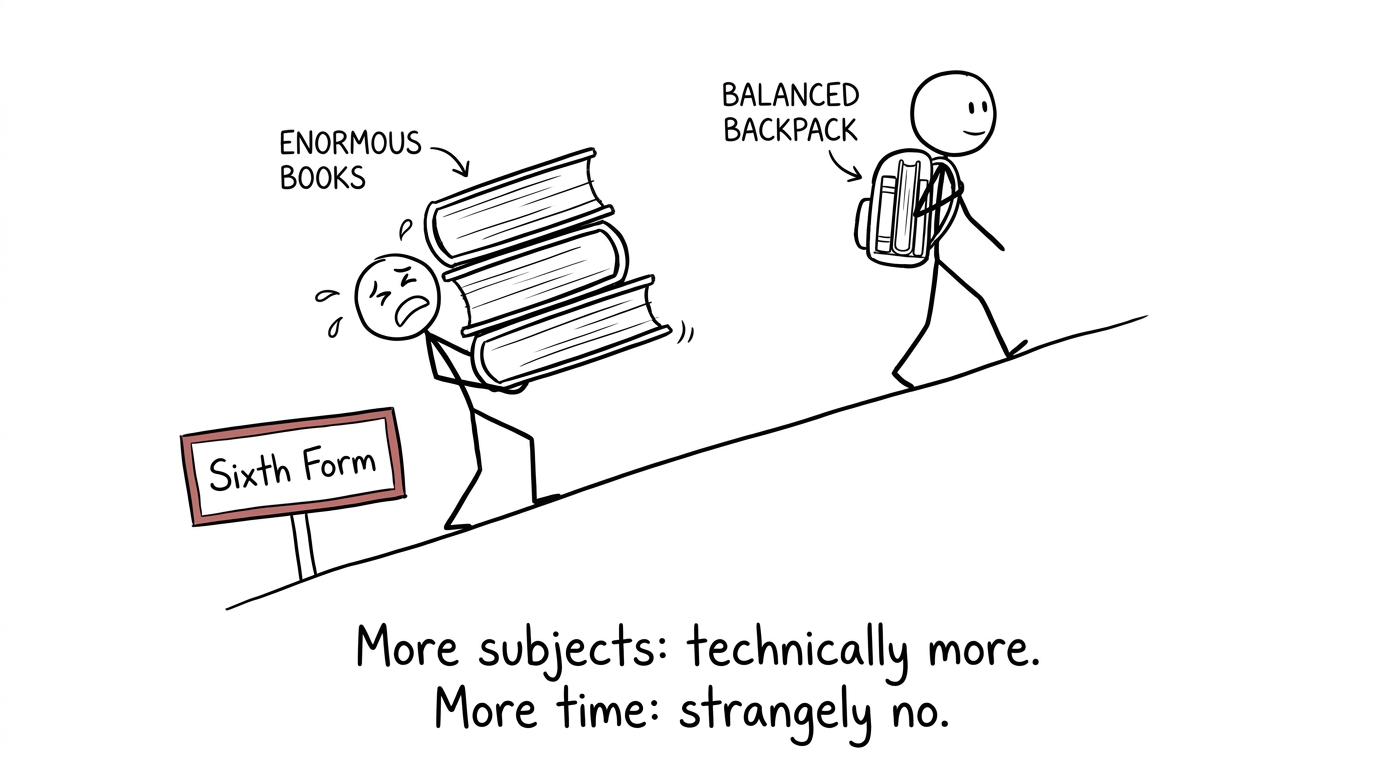 A student comparing the workload of three and four subjects
Should you choose A Level Maths?
A Level Maths is useful for many quantitative routes, including mathematics, engineering, physics, economics, computer science and some science courses. Its value, however, is not a reason to choose it blindly.
Explore the A Level Maths revision hub before committing. Look beyond the first familiar algebra topics and inspect pure mathematics, statistics and mechanics. This gives you a more honest picture of the course than its title alone.
Your exam board may be Edexcel, AQA or OCR, depending on your school. The core mathematical content is nationally regulated, but paper structures and resources are board-specific. You can preview the relevant support through:
If you are considering Further Mathematics, investigate university requirements particularly carefully. Some selective mathematics courses expect it when a school offers it. If it is unavailable, universities may provide separate guidance, so contact admissions teams rather than assuming you are automatically excluded.
Further Mathematics is a separate A Level, but Mathematics and Further Mathematics naturally overlap in style. Your third subject can add useful breadth or support a likely direction, such as Physics for engineering. There is no single third subject that suits every applicant.
Compare the real workload and assessment style
Students often compare subjects using vague labels such as “hard” or “easy”. Those labels hide the question that matters: hard in what way, and for whom?
Find out whether each course involves:
- extended essays;
- frequent problem solving;
- practical work or coursework;
- substantial reading;
- memorisation of detailed content;
- performance, portfolios or fieldwork;
- mainly final examinations.
Three subjects with similar deadlines may create pressure at the same point in the year. Conversely, mixed assessment styles can provide variety, but switching repeatedly between essays, calculations and practical preparation has its own cost.
Ask departments to show you the specification, a typical homework task and an examination paper. For maths, browse the AQA A Level revision guides or the equivalent page for your board. You are not trying to understand every topic yet. You are checking whether the work itself interests you.
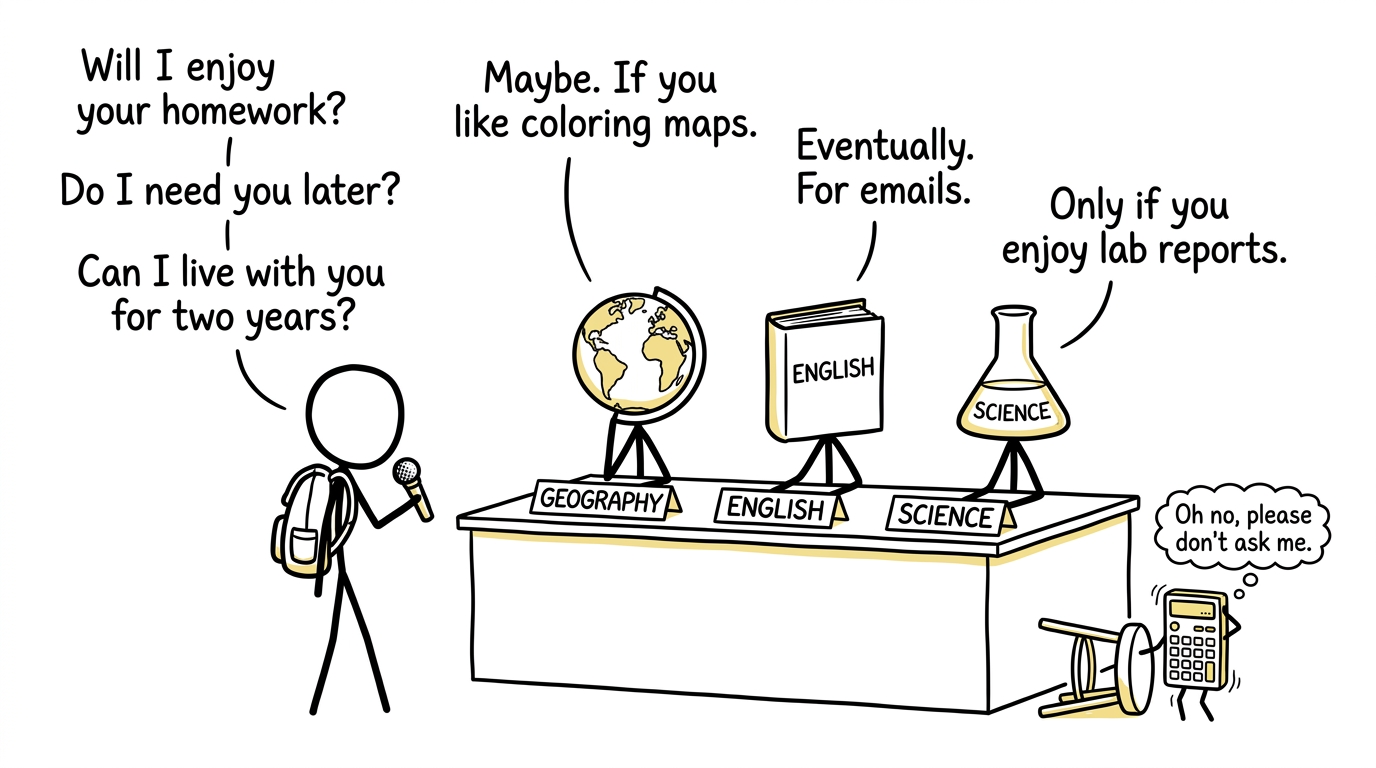 A student interviewing prospective A Level subjects
Test your choices before you commit
Treat subject selection as a small investigation rather than a personality quiz.
Attend taster lessons and open evenings. Speak to teachers about the gap between GCSE and A Level. Ask current students what their weekly work actually contains, while remembering that one person’s experience is not universal.
Then complete a short, representative task in each subject. For Mathematics, revisit a demanding GCSE topic and try unfamiliar higher-tier questions. MathsGenie’s Edexcel GCSE revision guides can help you identify whether a weak area needs repair or reflects a broader dislike of algebraic problem solving.
Finally, write one sentence explaining why each subject belongs in your combination. “My friends are taking it” is weak evidence. “It is required for courses I am considering, I enjoy its central skills and my assessments show I can meet the entry standard” is much stronger.
Common mistakes when choosing three A Levels
Following friends
Friends can make sixth form feel less intimidating, but timetables change and classes may be split. Choose subjects you would still take if nobody you knew selected them.
Choosing only by GCSE grade
A strong grade is useful evidence, not a complete decision. Course content and assessment style can change significantly at A Level. Investigate what you will actually study.
Assuming four subjects always impress universities
More workload does not guarantee a stronger application. Three excellent results commonly matter more than stretching yourself so far that every grade suffers. Take a fourth only when there is a clear reason and your school supports the plan.
Trusting outdated university advice
Entry requirements differ by course, institution and year. Do not rely on a forum post, an old prospectus or somebody else’s application. Check official course information for your likely entry cycle.
Ignoring the maths foundation
Students sometimes focus on the status of A Level Maths without checking their readiness. Strengthen GCSE gaps now through MathsGenie’s free GCSE resources, rather than carrying avoidable weaknesses into September.
Treating the first choice as irreversible
Schools and colleges set their own change deadlines, and switching may depend on timetable space and missed content. Ask about the policy before term starts. If a subject is clearly wrong, raise it early rather than waiting for the workload to compound.
Make the decision, then support it
A sensible choice is not the combination that looks most impressive on paper. It is the combination that connects your strengths, interests and possible destinations while leaving you enough capacity to perform well.
Once you have chosen, turn uncertainty into preparation. Repair GCSE weaknesses, preview the specification and establish a manageable routine. The MathsGenie revision planner can help you organise that transition without trying to learn the entire course before it begins.
If Mathematics is one of your three, make MathsGenie your free revision base. Begin with revision lessons and topic practice, then build towards mini tests, past papers, predicted papers, mark schemes and video solutions. Choosing the subject opens the door. Consistent, well-directed practice is what carries you through it.