

Degree After A-Level Physics: Courses to Consider
Degree after A-Level Physics choices explained, including physics, engineering, data science, entry grades and practical results-day advice for students.
Results day has a strange way of making years of work feel like one decision. Yet choosing a degree after A-Level Physics is not about identifying one perfect course. Physics can lead towards pure science, space, engineering, mathematics, computing and data. Your task is to compare what you enjoy, what each course teaches and whether your achieved grades meet its current requirements.
The short answer is this: consider physics or astrophysics if you enjoy explaining the universe, engineering if you want to design useful systems, and mathematics, computer science or data science if modelling and problem-solving interest you most.
Your degree decision checklist
Before accepting a place or entering Clearing, check:
- the compulsory modules, not just the course title;
- required A-Level subjects and achieved grades;
- whether a contextual offer applies;
- laboratory, programming and mathematical content;
- accreditation by a relevant professional body;
- placement years, study abroad and research opportunities;
- whether you prefer a bachelor's degree or integrated master's;
- the university, accommodation and financial commitment.
Entry requirements change between courses and admission cycles. Always confirm them on the university's official course page before acting.
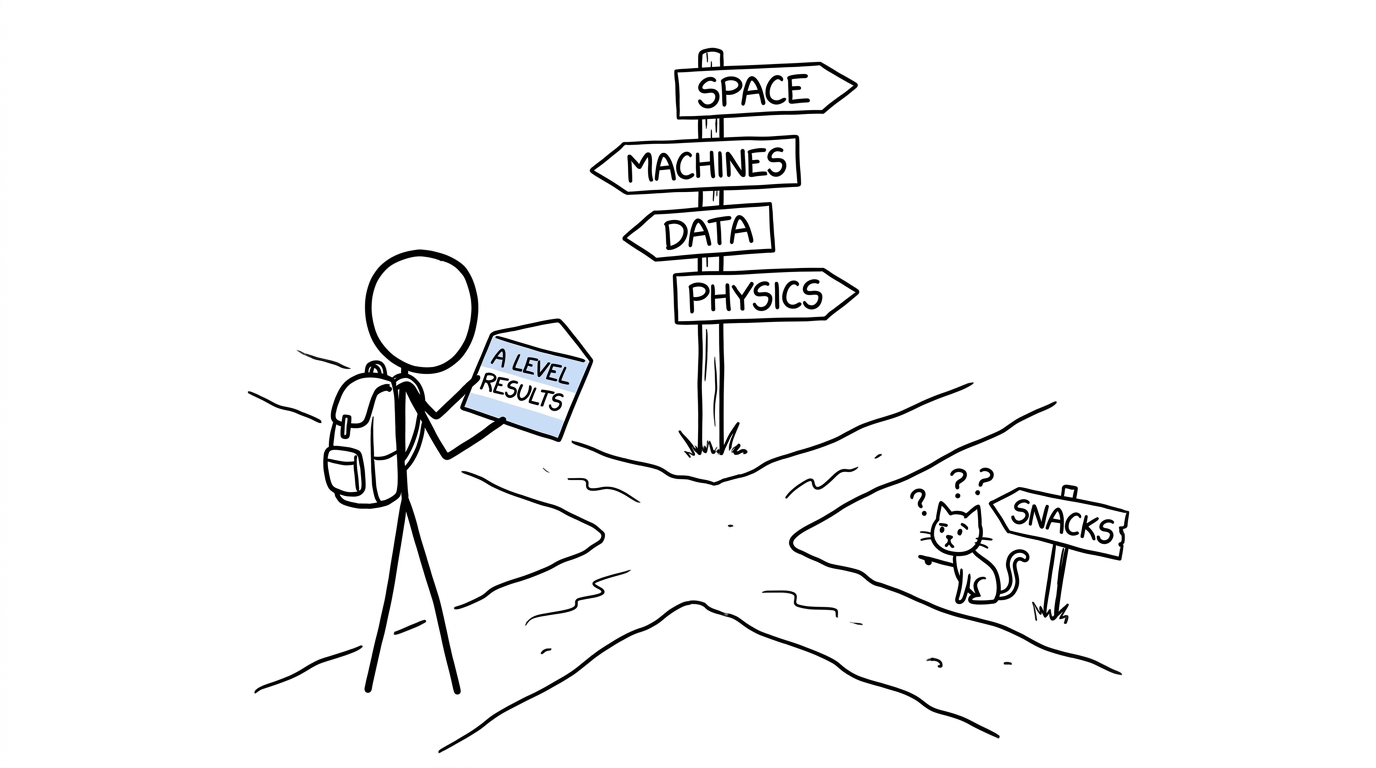 A student choosing between physics-related university routes while a cat recommends snacks
University courses for Physics A-Level students
Physics and theoretical physics
A physics degree develops mechanics, electromagnetism, thermodynamics, quantum physics, laboratory work, mathematical modelling and often programming. Theoretical physics usually places greater emphasis on advanced mathematics and abstract models.
For 2026 entry, published physics offers illustrate how widely requirements vary. Manchester's MPhys listed a typical offer of AAA, including demanding grades in Physics and Mathematics or Further Mathematics. Leicester's Physics BSc listed ABB including Physics and Maths, while Portsmouth advertised ranges around BBB to BBC for its BSc. These are examples, not universal thresholds.
Most direct-entry physics courses require or strongly value A-Level Mathematics alongside Physics. If you are still choosing sixth-form subjects, read MathsGenie's guide to choosing three A-Level subjects.
A BSc is normally the more flexible undergraduate route. An MPhys or MSci is an integrated master's with an additional year and more advanced study. Institute of Physics accreditation can also matter: an accredited integrated master's fulfils the educational requirements for progression towards Chartered Physicist status, although professional registration requires further development and experience.
Astrophysics and space science
Astrophysics suits students fascinated by stars, galaxies, planetary systems and cosmology. The romantic image is a telescope under a dark sky; the everyday reality also includes substantial mathematics, coding, data analysis and fundamental physics.
Current examples again show variation. Leicester's Physics with Astrophysics BSc listed ABB including Physics and Maths for 2026, while Bristol listed A*AA with high grades in both subjects. Compare module lists carefully because some courses begin with broad physics before specialising, while others introduce astronomy earlier.
Engineering
Engineering turns physical principles into designed systems. Possible routes include:
- mechanical and aerospace engineering;
- electrical and electronic engineering;
- civil and structural engineering;
- materials science;
- robotics and mechatronics;
- renewable or energy engineering.
Physics is valuable, but Mathematics is commonly the decisive subject requirement. For example, Southampton's 2026 Mechanical Engineering BEng listed A*AA including Mathematics and Physics, while Exeter listed AAB to ABB with Mathematics and another accepted science subject. Some engineering degrees accept Physics as that second science without requiring it specifically.
If forces and motion appeal to you, explore MathsGenie's A-Level Physics revision hub and Newton's laws revision guide. They offer a useful glimpse of the reasoning that engineering develops further.
Mathematics, data science and computing
Moving from A-Level Physics to a degree does not mean keeping “physics” in the title. Physics builds logical reasoning, modelling and confidence with data are all useful in mathematics, computer science and data science.
However, universities often specify A-Level Mathematics. Exeter's 2026 Data Science BSc, for example, listed AAA to AAB with at least grade B in Mathematics. Physics may strengthen your preparation but will not automatically replace a required Maths qualification.
These routes suit students who enjoy turning complicated situations into models, testing assumptions and interpreting evidence. Strengthen that foundation through A-Level Maths revision, where you can choose resources for AQA, Edexcel, OCR, WJEC and other specifications.
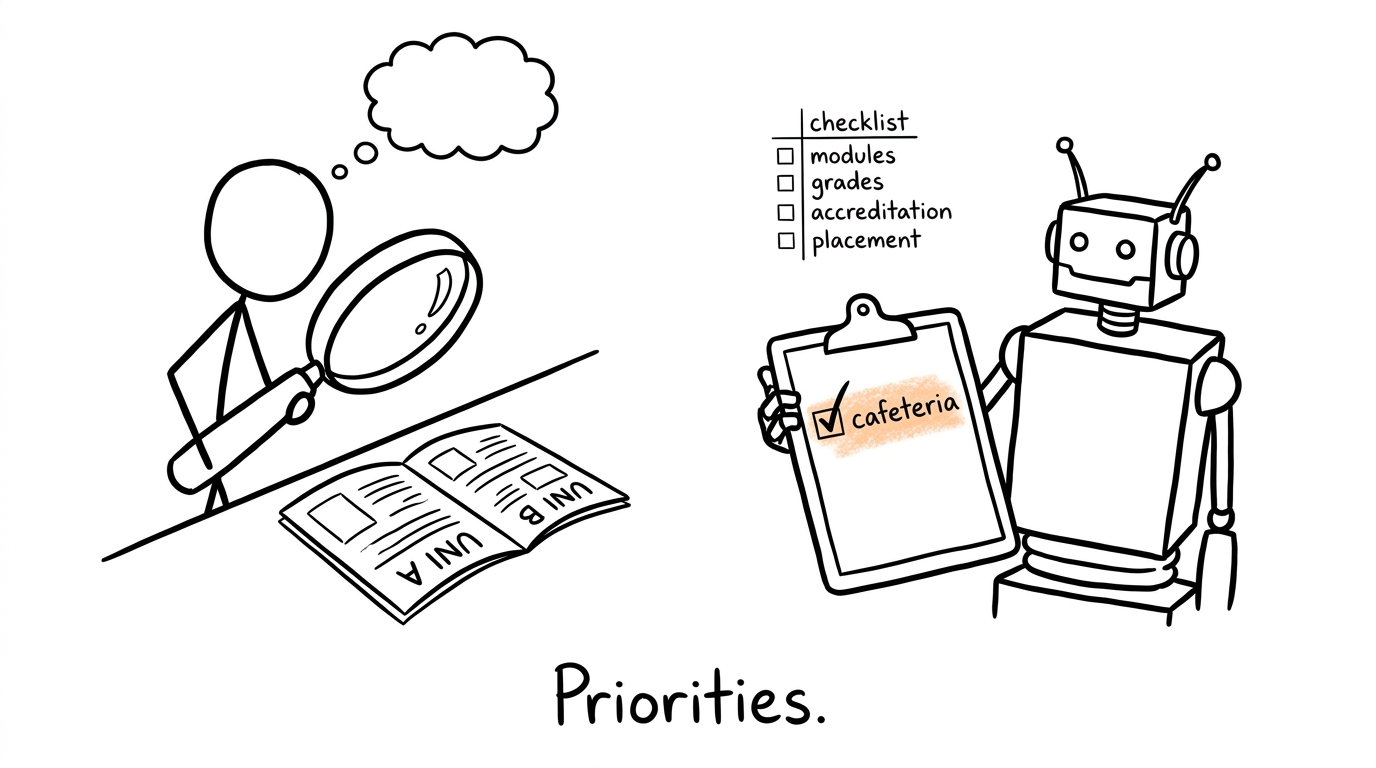 A student carefully comparing course details while a robot checks only the cafeteria
How to choose between similar courses
Course titles are labels; modules reveal the experience. Open several course pages and compare the first two years side by side. Look for the balance between laboratories, lectures, mathematical methods, computing, design projects and optional modules.
Ask yourself which kind of difficult work you prefer. A laboratory can be frustrating because equipment behaves imperfectly. A proof can be frustrating because every logical step matters. Programming can be frustrating because one small instruction changes the result. The best course is rarely effortless. It is the one whose challenges still seem worthwhile.
You should also investigate placements and professional accreditation. Physics applicants can check Institute of Physics accreditation, while engineering applicants should identify the relevant engineering institution and whether the course supports a route towards professional registration.
What to do on A-Level results day
For 2026, A-Level results day is Thursday 13 August. Check your UCAS application before assuming that a missed grade means rejection; a university may still confirm your place.
If your place is confirmed, reread the course and accommodation information before celebrating with the accept button. If it is not confirmed, contact the university calmly and use the official UCAS Clearing vacancy search. Clearing runs from 2 July to 19 October 2026, but available courses can change quickly. Contact a university before adding its Clearing choice and only add the choice once it has given permission.
Have your results, UCAS ID, course codes and questions ready. Ask what modules remain available, whether accommodation is guaranteed and whether transferring between BSc and integrated master's routes is possible later.
Common mistakes when choosing a physics-related degree
Choosing by university name alone. A famous institution cannot compensate for modules you do not want to study.
Treating example grades as permanent. Requirements can differ by year, qualification, contextual eligibility and course variant.
Ignoring Mathematics requirements. Physics is relevant to many quantitative degrees, but it may not substitute for A-Level Mathematics.
Assuming every physics degree is identical. Laboratory time, computing, specialisms and assessment methods vary significantly.
Making a panicked Clearing decision. Speed matters, but so do course content, accommodation, costs and accreditation.
Build the skills behind your next step
A university decision may happen in a morning, but readiness is built through ordinary revision sessions. Use the AQA Physics question bank, Edexcel A-Level Physics resources or OCR A Physics revision for your specification. Pair topic work with mark schemes, video solutions and timed practice.
MathsGenie provides free revision lessons, practice questions, mini tests, past papers and A-Level predicted papers. Start with the course routes that genuinely interest you, check their current requirements, then make your next revision target serve that destination.











