

Degree After A-Level Chemistry: Course Choices
Degree after A-Level Chemistry: compare UK course routes, entry-grade examples, subject requirements and practical questions to help you choose confidently.
Opening an A-Level results envelope can make several years of work feel compressed into three letters. Yet those letters are not a final destination. They are information, and often the beginning of a more useful question: which degree after A-Level Chemistry fits the way you like to think and work?
The main routes include chemistry, chemical engineering, pharmacy, medicine, biochemistry, pharmacology, materials science and environmental science. Your best option depends on more than your grade. Consider the required subjects, amount of maths, balance between laboratory and theoretical work, professional accreditation and careers the course is designed to support.
Your course decision checklist
Before comparing university names, answer these questions:
- Do you enjoy laboratory chemistry itself, or mainly its medical and industrial applications?
- Would you prefer to investigate molecules, design large-scale processes or work with patients?
- Have you taken A-Level Maths or Biology alongside Chemistry?
- Do you want a broad scientific degree or a route towards a regulated profession?
- Do your achieved grades meet both the overall offer and each subject-specific requirement?
- Would you consider a foundation year, contextual offer or different institution?
- Have you compared compulsory modules rather than relying on course titles?
That last point matters. Two degrees with similar names can contain noticeably different modules, assessment methods and amounts of practical work.
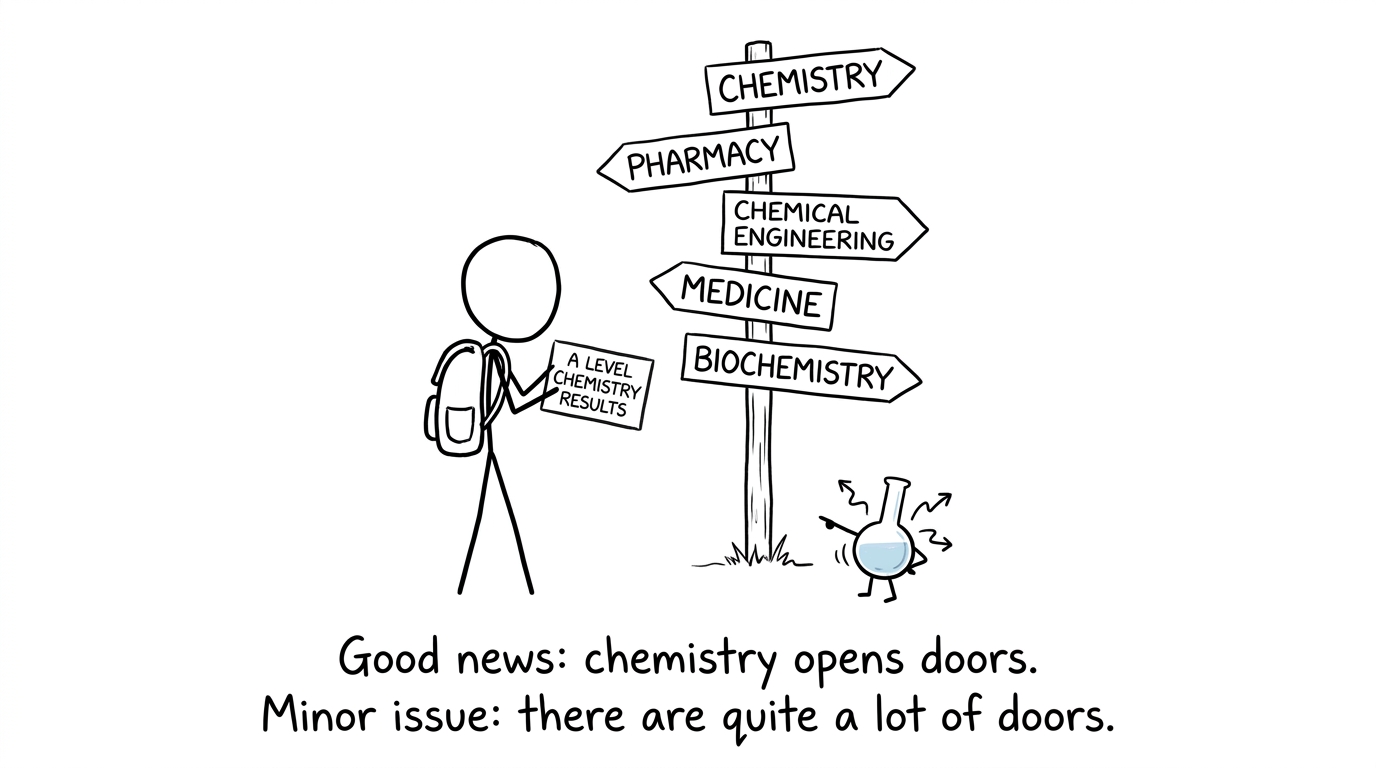 A student facing many university course signposts while a laboratory flask offers enthusiastic directions
University courses for Chemistry A-Level students
Chemistry and medicinal chemistry
A chemistry degree is the most direct continuation from A-Level Chemistry. Typical content includes organic, inorganic and physical chemistry, spectroscopy, analytical methods and extended practical work. Medicinal chemistry adds a stronger focus on designing, synthesising and analysing compounds with potential biological uses.
You may see both BSc and integrated master's courses such as an MChem. The longer route generally includes more advanced study and a substantial research component, but compare the individual programme structure before deciding.
Entry standards vary considerably. For 2026 entry, published examples ranged from BBC to BCC, including Chemistry at grade C, at Huddersfield to AAA, including Chemistry, at Bristol. Bristol also published a contextual offer of ABB, including grade A in Chemistry. These are examples, not a national range or guarantee.
If you are preparing for the subject now, the free A-Level Chemistry revision hub brings together exam-board resources, questions and papers. You can also use the AQA A-Level Chemistry course page or Edexcel Chemistry revision guides to strengthen specification-specific knowledge.
Chemical engineering
Chemical engineering is not simply chemistry with harder calculations. It is concerned with turning scientific ideas into safe, efficient processes that can operate at industrial scale. Courses can cover thermodynamics, fluid flow, heat transfer, process control and plant design.
Maths is usually central. Manchester's published 2026 BEng offer was AAA, including Mathematics and either Chemistry or Physics. Other institutions set different grades, but A-Level Maths is commonly required even when Chemistry is one of the accepted sciences.
Choose this route if you enjoy modelling, optimisation and solving large-scale practical problems. Students considering it should investigate the A-Level Maths revision resources and Edexcel A-Level Maths course hub, rather than assuming strong chemistry alone will cover the quantitative demands.
Pharmacy
An MPharm combines chemical and biological science with the safe and effective use of medicines. It is a professional course rather than a general chemistry degree, so expect patient-focused learning alongside pharmaceutical chemistry, pharmacology and practical training.
Bath's published 2026 entry requirement was AAB, including Chemistry and another science or Mathematics. Manchester also published AAB, requiring Chemistry and either Mathematics or Biology. Selection arrangements and professional requirements vary, so read the current course page carefully.
Pharmacy may suit you if medicines interest you but you also want direct responsibility for supporting patients. If your interest is mainly discovering or manufacturing compounds, medicinal chemistry, pharmacology or pharmaceutical science may be a closer fit.
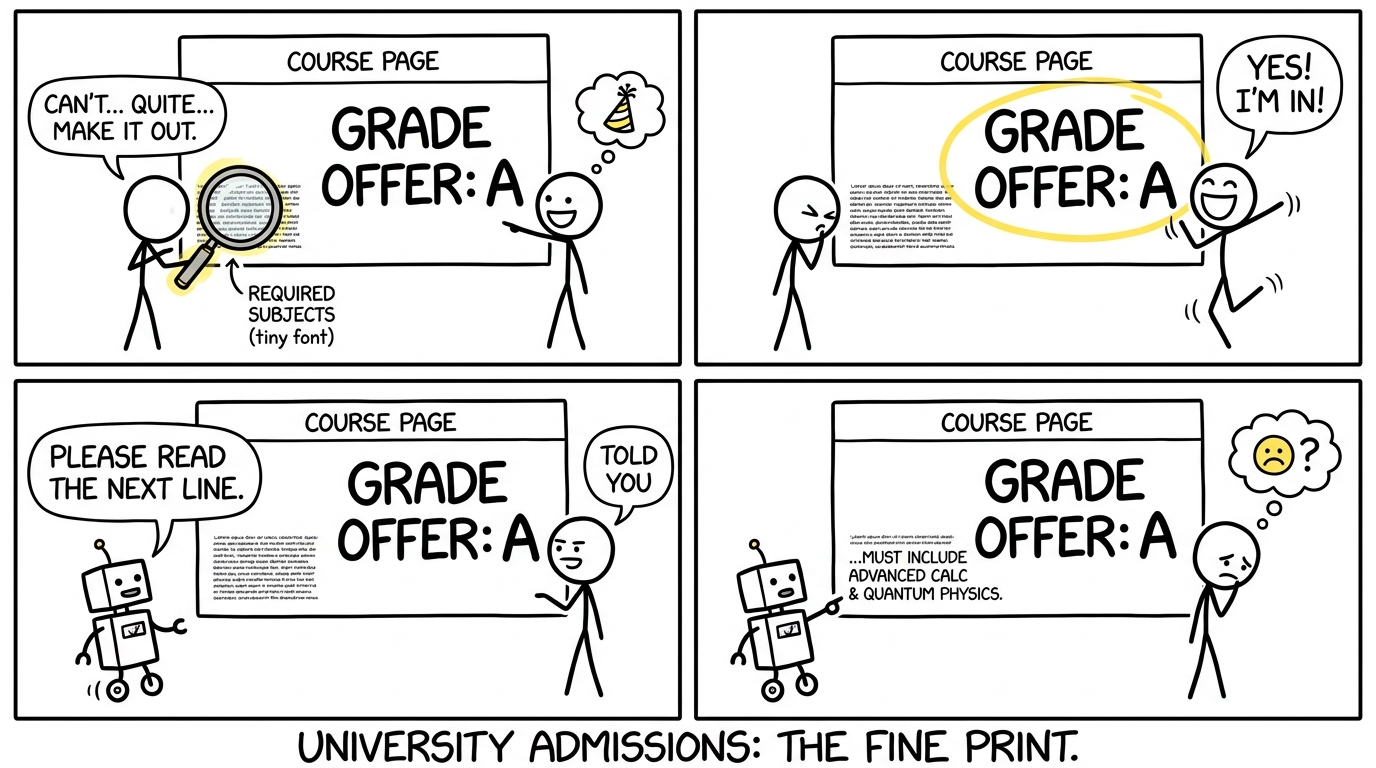 Students discovering that the subject requirements are written underneath the headline entry grades
Medicine
Chemistry is an important entry subject for many medical degrees, but it is rarely the only consideration. Some medical schools require both Chemistry and Biology; others accept Chemistry with another science or Mathematics.
For example, UCL's published 2026 standard offer was AAA, requiring Biology and Chemistry, with either subject at A. Applicants also had to take the UCAT in the year of application. Requirements elsewhere differ, and medicine normally involves admissions testing, interviews and earlier application planning as well as academic grades.
Medicine is therefore not an automatic next step for every strong chemistry student. Consider it only if clinical work, communication and responsibility for patients genuinely appeal to you.
Biochemistry, pharmacology and related sciences
Biochemistry explores chemical processes within living organisms. Pharmacology focuses on how drugs interact with biological systems. Other possibilities include biomedical science, materials science, forensic science, toxicology and environmental chemistry.
These can be excellent routes from A-Level Chemistry, although Biology or Maths requirements vary. Check whether a course is laboratory-heavy, computational, clinical or research-led. For an early look at how subject choices preserve these options, read A-Level after GCSE Chemistry and how to choose three A-Level subjects.
How to use your results on results day
Start with the exact conditions of your offer. Meeting the headline grades is not enough if the course also specifies a particular grade in Chemistry, Maths or Biology.
If your results differ from your plan, compare live course information rather than making assumptions. Universities may have vacancies, alternative courses or foundation-year routes, but availability can change quickly. Ask what modules you would study, whether transfer between related courses is possible and whether the programme has relevant professional accreditation.
A slightly lower entry requirement does not automatically mean a poor course. Equally, a prestigious name cannot rescue a course whose content and working style do not suit you.
Common mistakes when choosing a degree
Choosing by title alone. Read the compulsory first-year modules and assessment information.
Checking grades but not subjects. Chemical engineering may require Maths; medicine may require Biology; chemistry courses may specify a Chemistry grade or practical endorsement.
Treating pharmacy and pharmacology as interchangeable. Pharmacy is a professional patient-facing route, while pharmacology is the scientific study of drug action.
Ignoring the amount of maths. Physical chemistry, data analysis and engineering all demand quantitative confidence. Use A-Level Maths past papers to judge your current fluency honestly.
Using old entry requirements. Offers, contextual policies and admissions tests can change. Always check the page for your intended entry year.
Turn the result into a direction
The move from A-Level Chemistry to a degree is not one fixed staircase. Chemistry can lead towards molecules, medicines, industrial systems, living organisms or environmental problems. A sensible decision comes from matching the course content to your interests, subjects and preferred kind of work.
Then protect your options by preparing properly. Use MathsGenie's free revision lessons, practice questions, mini tests, past papers, predicted papers, mark schemes and video solutions. Begin with the A-Level Chemistry revision centre, identify the topics costing you marks and practise until your results support the degree route you want.










