Comparing GCSE Statistics Progress With Friends
Comparing GCSE Statistics progress with friends can distort confidence. Learn what to track instead and build a calm, evidence-led revision plan for exams.
It can happen in a few seconds. A friend mentions finishing three past papers, understanding histograms or scoring highly in a mock. Suddenly, your own revision feels smaller than it did before.
The short answer is that comparing GCSE Statistics progress with friends usually does more harm than good when it becomes a judgement about your ability. Your classmates may have different starting points, targets, teachers, revision time and exam entries. Their progress is not a reliable measure of yours.
Comparison is only useful when it gives you a specific action, such as borrowing a revision technique or discussing a difficult concept. For an accurate picture of progress, compare your latest performance with your previous attempts and with the requirements of your own specification.
A quick checklist for healthier progress tracking
Use these questions instead of asking whether you are ahead of your friends:
- Am I practising content from the correct exam board and tier?
- Can I answer questions without looking at notes?
- Are my marks becoming more consistent?
- Do I understand why I lost each mark?
- Can I interpret results in context, not merely calculate them?
- Have I retested topics that previously caused difficulty?
- Is my timing improving under exam conditions?
Start from the GCSE Statistics revision hub to choose resources matching your course. If you are taking Edexcel GCSE Statistics, the Edexcel Statistics revision pathway brings together lessons, questions, worksheets and paper practice.
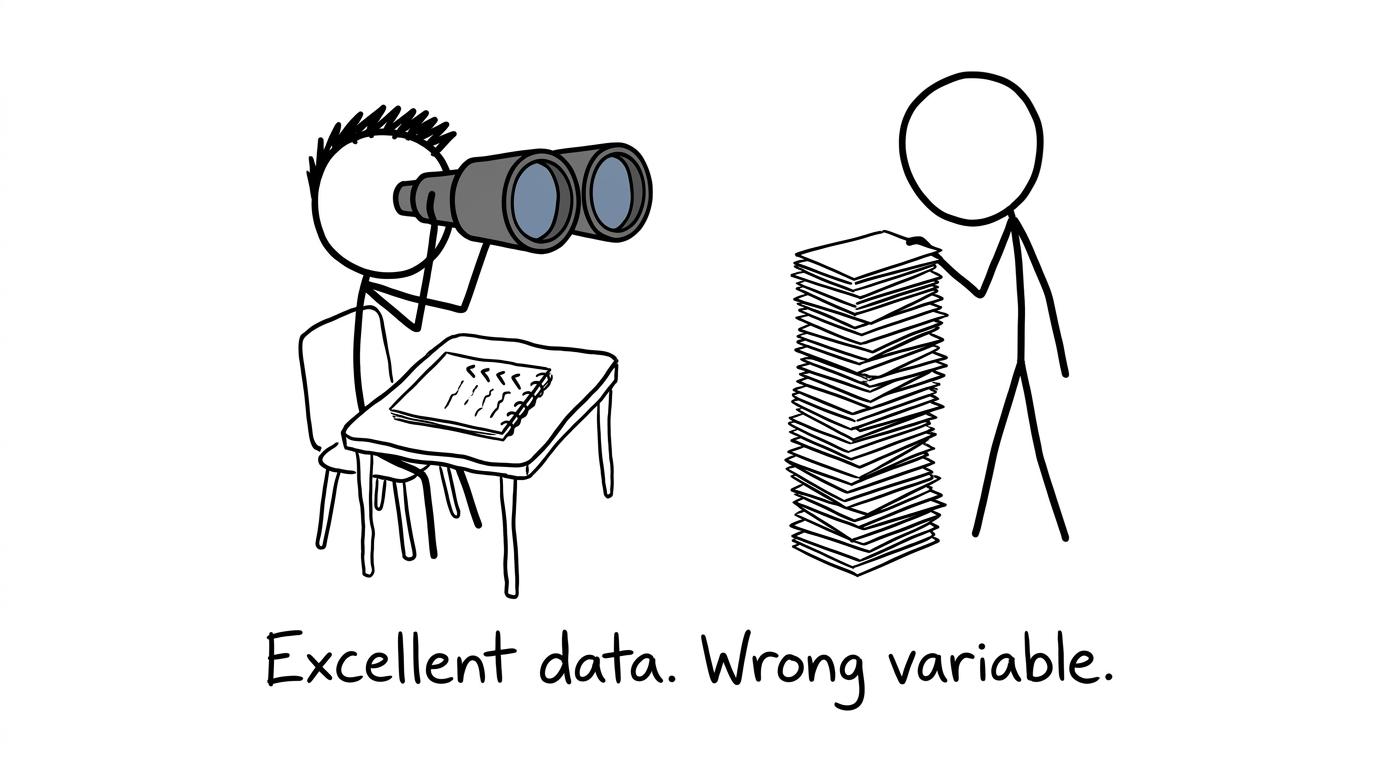 A student gathers impressive but unhelpful data about a friend's revision
Why comparing progress feels convincing
Comparison feels useful because it produces an immediate answer. If your friend has completed more papers, they appear to be ahead. If you receive a higher mark, you feel reassured.
But the answer is usually built from incomplete data.
You may know your friend's latest mock mark without knowing how much help they received, which topics appeared, whether they used extra time or what they could reproduce a week later. You may compare the number of hours revised without comparing concentration, question difficulty or the quality of marking.
Statistics teaches an important lesson here: a conclusion is only as trustworthy as the data and method behind it. A classmate's comment is one observation, not a complete measure of your readiness.
Research into academic social comparison also suggests that classroom achievement can influence how students judge their own ability. That does not mean every comparison is harmful. It means the feeling created by comparison should not be mistaken for objective evidence.
Why comparison usually does more harm than good
You are comparing different starting points
Two students can complete the same worksheet and experience entirely different levels of challenge. One may have studied the topic recently. Another may be rebuilding knowledge after an absence. One may be aiming to secure core marks, while another is concentrating on the most demanding questions available at their tier.
Progress is change from a starting point, not simply your present position beside somebody else.
This is especially important if one student is taking dedicated GCSE Statistics while another is discussing the statistics content within GCSE Maths. These overlap, but they are not interchangeable courses. Students taking GCSE Maths should match practice to their own board, such as Edexcel, AQA, OCR or Eduqas, through the GCSE Maths revision hub.
Visible effort is not the same as effective learning
A large stack of completed papers is easy to see. The quieter parts of revision are not.
You cannot see whether someone reviewed the mark scheme, corrected weak explanations or returned to the same topic several days later. Completion measures activity. It does not automatically measure learning.
A more useful revision cycle is:
- attempt questions without support;
- mark them carefully;
- identify the reason for each lost mark;
- revisit the relevant lesson or worksheet;
- answer a fresh question later;
- check whether the weakness has actually improved.
The guide to using GCSE past papers properly explains how to turn a paper into diagnosis, repair and retesting rather than another item on a checklist.
Comparison can distort confidence in both directions
Looking upwards can make genuine improvement feel inadequate. Looking downwards can create false confidence.
Neither response is particularly useful. Feeling behind may tempt you to rush through new topics instead of repairing foundations. Feeling ahead may persuade you to avoid the questions that would expose your weaknesses.
The better question is not, "Am I better than my friend?" It is, "What does my evidence say I should practise next?"
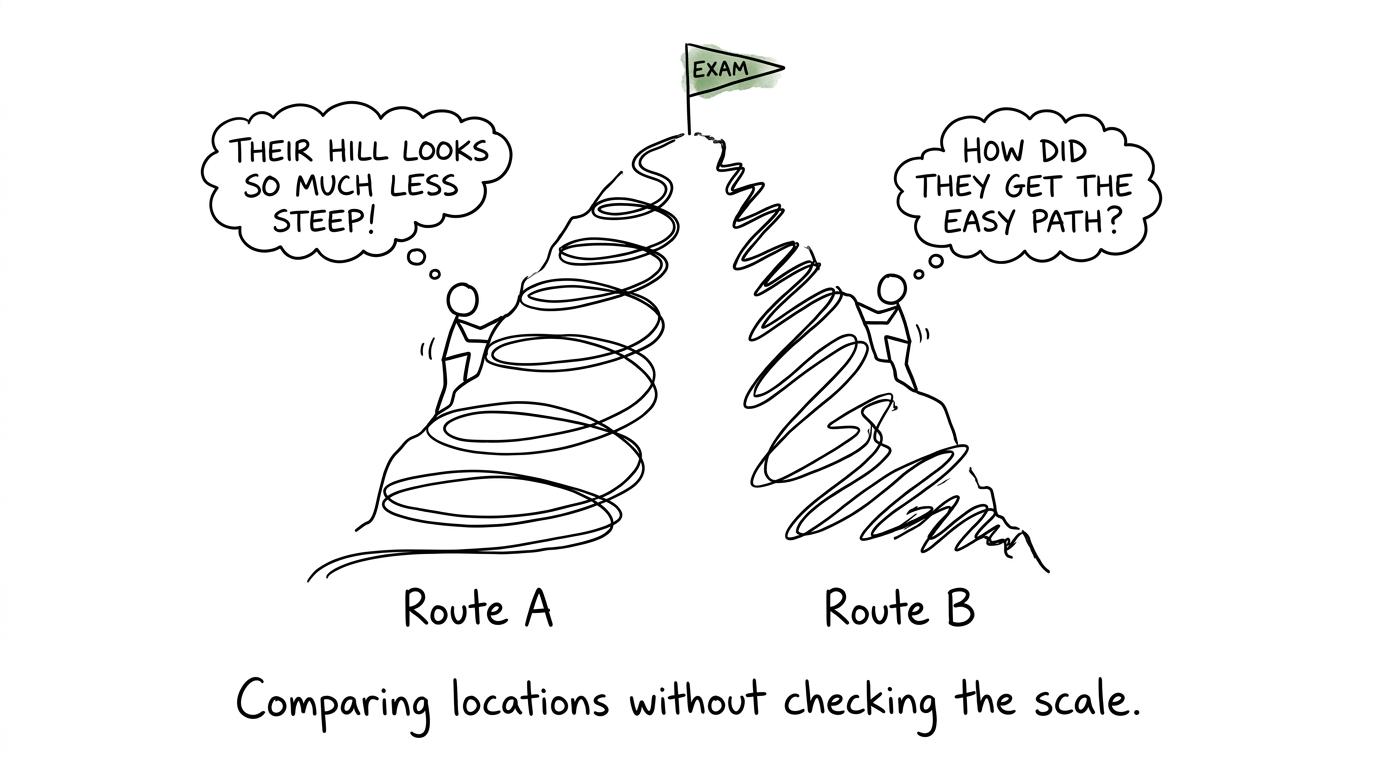 Two students compare positions while following entirely different routes
GCSE Statistics progress is broader than one mark
For the dedicated GCSE Statistics qualification, Ofqual's assessment objectives cover three broad demands. Approximately 55%55\%55% concerns knowledge and understanding of standard statistical techniques, 25%25\%25% concerns interpretation and reasoning in context, and 20%20\%20% concerns evaluating methodologies and conclusions through the statistical enquiry cycle.
That matters because two identical totals can hide different needs. One student may calculate accurately but write weak conclusions. Another may interpret data well but make mistakes with statistical techniques. A total mark cannot tell you which student is "better", and it cannot tell either student what to revise next.
Track progress across separate dimensions:
- collecting and representing data;
- calculating summary statistics and probabilities;
- interpreting findings in context;
- evaluating sampling, methodology and conclusions;
- communicating reasoning clearly;
- working accurately under time pressure.
The point is not to create an elaborate spreadsheet. It is to stop one number carrying more meaning than it deserves.
What to focus on instead of your friends
Compare your current work with earlier evidence
Use a baseline from a past paper, mini test or mixed set. Record the date, resource, conditions and marks available. Your accuracy can be tracked as
Accuracy=marks earnedmarks available×100%.\text{Accuracy}=\frac{\text{marks earned}}{\text{marks available}}\times 100\%.Accuracy=marks availablemarks earned×100%.Do not overreact to one result. Question difficulty and topic coverage vary, so look for a pattern across several comparable attempts. Raw marks are most informative when the papers, timing and marking conditions are reasonably consistent.
You can use Edexcel GCSE Statistics past papers with mark schemes and available solutions. If Statistics is part of your GCSE Maths course rather than a separate qualification, use the paper collection for your own board and tier instead.
Track mistakes, not just totals
For every lost mark, choose a useful category:
- knowledge: the fact or technique was missing;
- selection: you knew methods but chose the wrong one;
- execution: the approach was sound but the calculation went wrong;
- interpretation: the answer did not address the context;
- evaluation: the conclusion ignored limitations, bias or reliability;
- exam technique: you misread the question, omitted working or ran out of time.
This turns disappointment into instructions. If interpretation errors keep recurring, another page of calculations may not solve the problem. You need questions requiring conclusions in context.
The MathsGenie guide to finding weak GCSE topics offers a practical method for converting lost marks into focused revision.
Measure independence
A topic is not secure merely because it makes sense while a teacher or video is explaining it. Ask whether you can:
- begin a question without a prompt;
- choose an appropriate method;
- complete it without notes;
- explain the result in context;
- repeat the skill on another day.
This is a more demanding measure than "I have covered it", but it is much closer to what the exam requires.
Build a revision plan from evidence
After each test, select a small number of priorities. Give each one a lesson, targeted practice and a later retest. Put those sessions into a realistic timetable rather than responding to whatever your friends happen to mention that day.
A structured GCSE maths revision timetable can be adapted for Statistics by replacing broad topic blocks with your own identified gaps. Short, focused tests can also help, although you must choose resources appropriate to your qualification; the Edexcel GCSE Maths mini tests are useful when you are revising the statistics strand within Edexcel GCSE Maths.
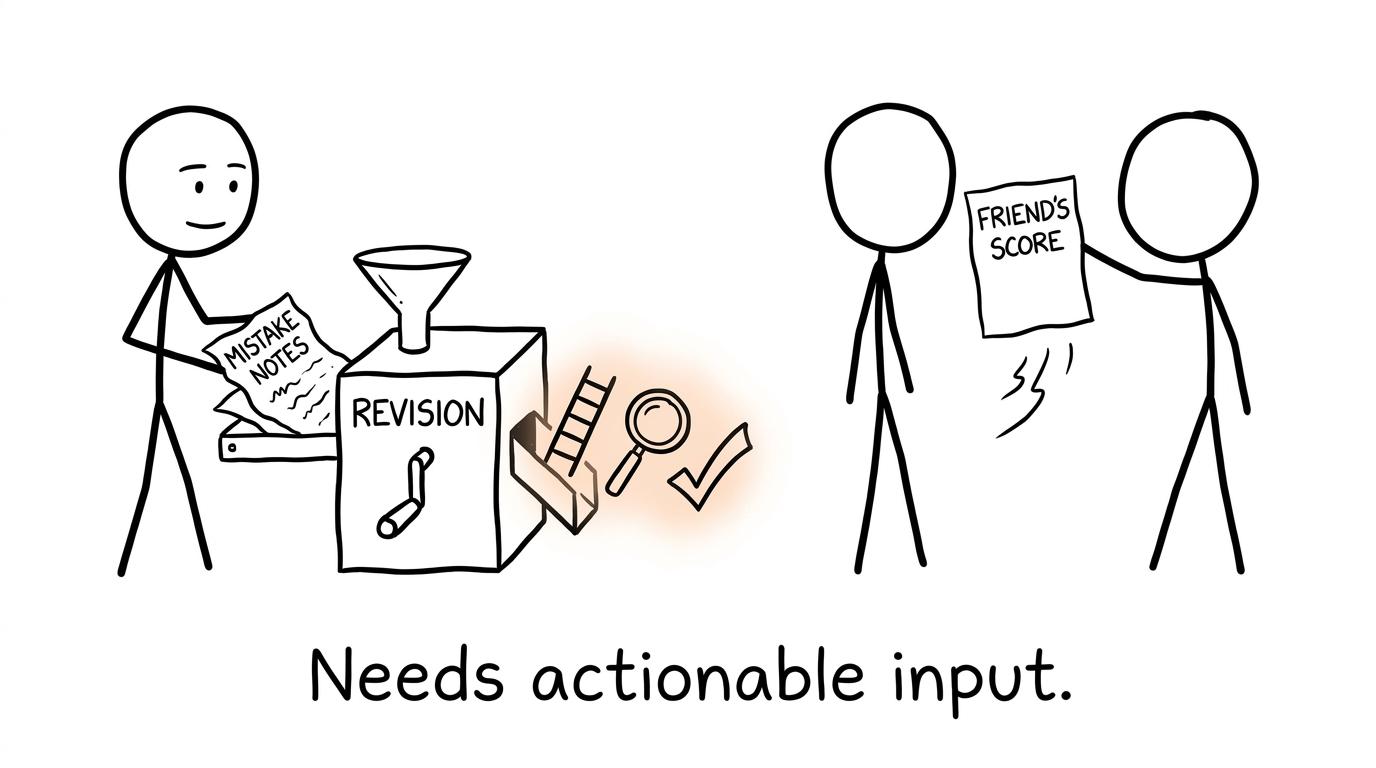 A revision machine accepts mistake notes but rejects a friend's score
When comparing with a friend can help
Comparison becomes constructive when you compare processes, not identities.
You might ask a friend how they organise an error log, remember conditions for choosing a sampling method or structure an evaluation. You can mark the same question separately and discuss why the mark scheme rewards particular statements. You can also quiz each other, provided both people still attempt the material independently.
Keep three boundaries:
- compare techniques rather than labelling one person as naturally better;
- use the discussion to choose a concrete next step;
- return to your own specification, errors and revision plan afterwards.
A friend can offer information. They should not become your unofficial grade boundary.
Common mistakes when judging your progress
Counting hours instead of outcomes
Revision time matters, but an hour spent correcting misconceptions may be more valuable than several hours of passive rereading. Record what you can now do, not only how long you sat at a desk.
Comparing scores from different papers
Marks from different tiers, boards, topics or levels of difficulty are not directly comparable. Even two papers from the same course may test different combinations of content.
Treating one mock as a final verdict
A mock is evidence from one moment. Use it to locate gaps. Do not turn it into a permanent statement about your ability or final grade.
Ignoring written statistical reasoning
Students sometimes track calculation marks while overlooking interpretation and evaluation. GCSE Statistics requires more than obtaining numerical answers; conclusions must respond to the context and quality of the evidence.
Copying a friend's revision plan
A timetable built around somebody else's weaknesses can leave your own untouched. Borrow useful habits, but choose topics from your results and teacher feedback.
Build progress that belongs to you
Your friend may move faster through one topic. You may retain another more securely. Neither fact predicts the whole exam.
The most reliable form of confidence comes from evidence you can reproduce: a method remembered without notes, an interpretation written clearly, a repeated mistake corrected and a timed paper handled more calmly than the previous one.
Start with MathsGenie's free GCSE Statistics revision resources. Choose the correct exam board, use revision lessons and practice questions to repair gaps, then test yourself with past papers, mark schemes, video solutions, mini tests and predicted papers where available. Add each identified weakness to your revision planner and retest it.
You do not need to win somebody else's revision race. You need a process that tells you what to do next and the patience to keep following it.