Comparing GCSE English Progress With Friends: Is It Bad?
Comparing GCSE English Language and Literature progress with friends can mislead. Learn what to track instead while protecting confidence and revision.
A friend finishes a Literature essay and announces that it was “definitely grade 888”. Someone else has memorised dozens of quotations. Another student says they barely revise English but always scores highly. Suddenly, your own progress feels smaller than it did five minutes ago.
If you are comparing GCSE English Language and Literature progress with friends, the short answer is this: occasional comparison can provide useful information, but repeated score-checking usually gives you a distorted picture. Your classmates may study different texts, have different starting points, receive different feedback or be better at sounding confident than measuring progress.
The healthier question is not, “Am I ahead of them?” It is, “What can I do now that I could not do reliably last month?” That shift also matters when English revision competes with GCSE maths for your time and attention.
A quick comparison checklist
Before treating somebody else's result as evidence about your own ability, ask:
- Did we answer the same question under the same conditions?
- Was the work marked by the same teacher or using the same mark scheme?
- Are we following the same exam board specification?
- Are we comparing English Language with English Language, rather than Language with Literature?
- Does the comparison reveal a useful next action?
- Do I feel informed afterwards, or merely discouraged?
If the comparison cannot guide your next revision session, it is probably noise rather than feedback.
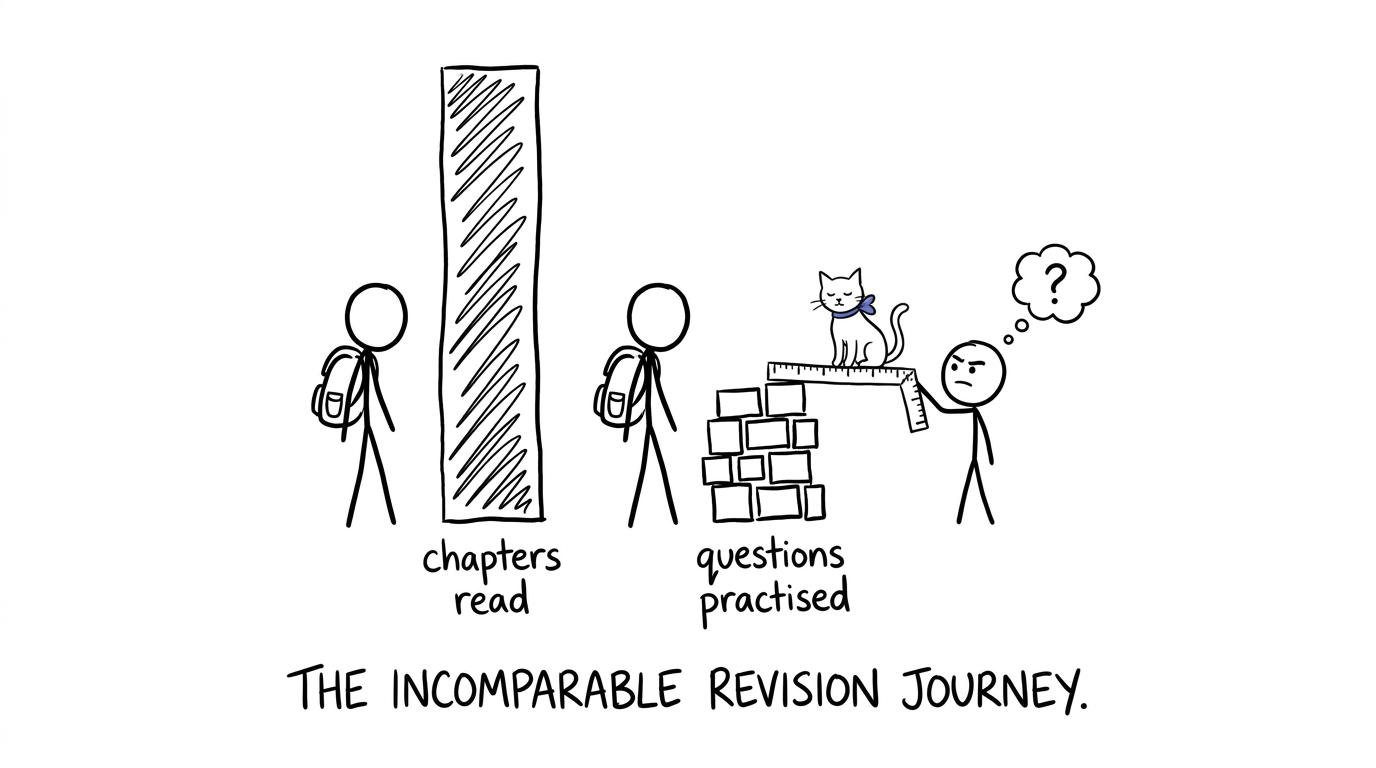 Two students try to compare completely different revision progress bars with a tiny ruler
Why comparing English progress is often misleading
GCSE progress looks precise from a distance. Students mention marks, predicted grades and mock results as though each number measures exactly the same thing. It rarely does.
English Language and English Literature are separate qualifications. Language assesses skills such as interpreting unseen material, analysing writers' choices, comparing perspectives and writing for particular purposes. Literature requires detailed responses to studied texts, analysis of language, form and structure, and understanding of relevant context. Exact papers, texts and mark allocations depend on your exam board, whether that is AQA, Edexcel, OCR or Eduqas.
A student may therefore be strong at imaginative writing but less secure when evaluating an unseen text. Another may remember quotations accurately but struggle to develop an interpretation. A single total mark hides those differences.
The same problem appears in maths. Two students can receive the same mock grade while having completely different gaps: one loses marks on algebra, while the other struggles with probability and timing. That is why the MathsGenie GCSE maths revision hub organises revision around topics, questions and exam-board resources rather than encouraging students to chase somebody else's score.
Comparison changes the measuring stick
Research into academic social comparison suggests that the achievement level of a class can affect how students perceive their own ability. A capable student surrounded by very high-performing classmates may feel weak, even when their actual work is strong. Comparison can sometimes supply motivation or useful strategies, but its emotional and academic effects depend on how it is used.
The danger is allowing another student's performance to become your measuring stick. Their result then changes how you feel without necessarily changing what you know.
There is another complication: students usually display outcomes, not processes. You hear the mock grade, but not every earlier draft, forgotten quotation, teacher conversation or evening spent correcting paragraphs. You see the finished notes, not whether the student can use them under timed conditions.
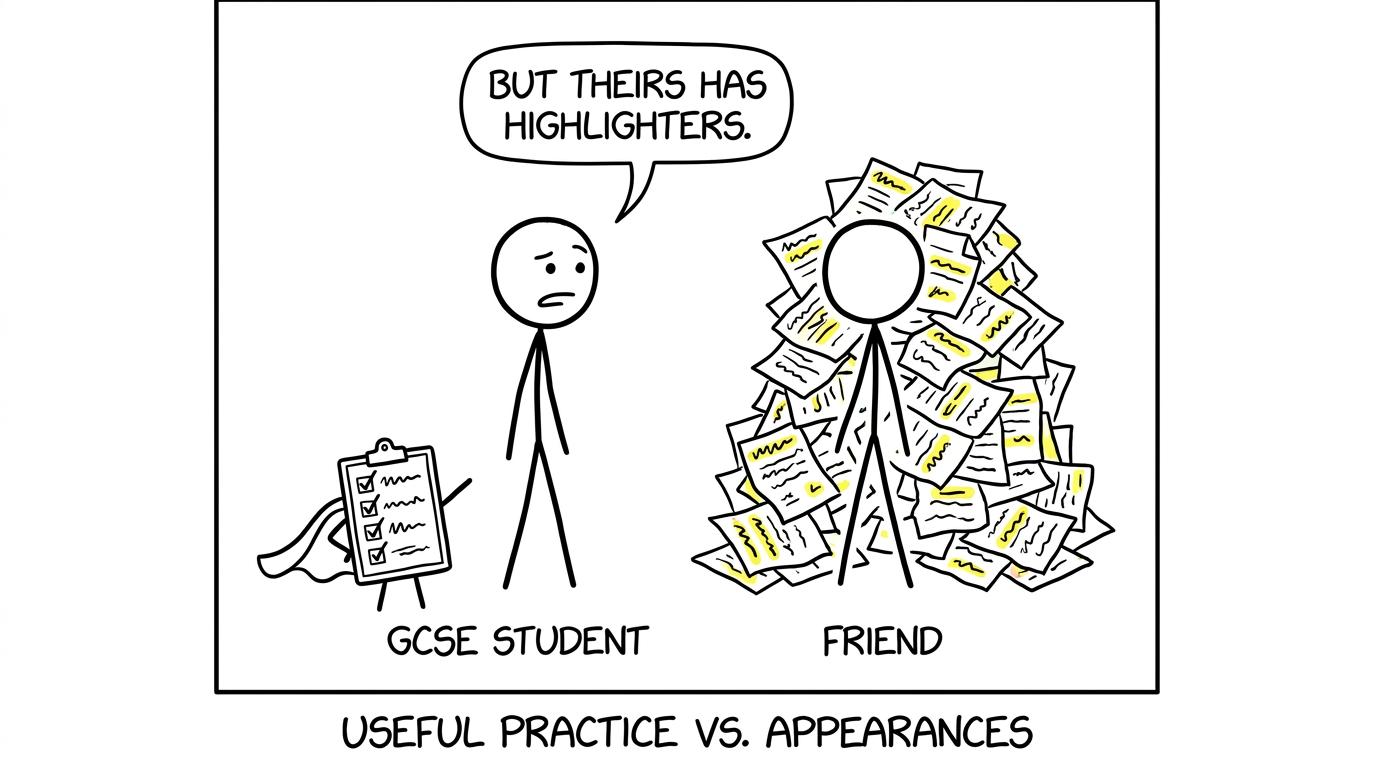 A small completed checklist quietly defeats an enormous pile of highlighted revision notes
English Language and Literature progress differently
Progress in English is rarely a smooth climb. A student can understand a novel more deeply while temporarily receiving a lower mark because the new essay question exposes a different weakness. Language responses can also fluctuate with the source, purpose, timing and question type.
Official assessment objectives help explain why. Across GCSE English Language specifications in England, students are assessed on distinct reading, comparison, evaluation and writing skills. English Literature similarly separates interpretation, textual support, analysis of methods, context and technical accuracy. Exam-board paper structures differ, so always use the current specification and materials supplied by your school.
This means “better at English” is too broad to be a useful diagnosis. Replace it with something observable:
- selecting concise evidence;
- explaining the effect of a writer's choice;
- building a clear argument across an essay;
- comparing ideas rather than listing similarities;
- adapting tone to audience and purpose;
- planning and completing a response within the available time.
These are skills you can practise. A friend's overall grade does not tell you which one should come next.
What to focus on instead of your friends
Compare your current work with earlier work
Self-comparison gives you a fairer baseline. Keep one marked response from each month and look for changes in specific areas. Are your points clearer? Is your evidence better selected? Do you explain effects rather than simply naming techniques? Can you finish within the time limit?
The aim is not to prove that every mark is rising. It is to identify a trend and choose the next repair.
Track controllable evidence
A useful progress record might contain:
- the question or task attempted;
- the assessment objective being practised;
- the mark or teacher comment;
- one feature that worked;
- one repeated weakness;
- the date for another attempt.
You could record a simple completion rate as:
Completion rate=tasks completedtasks planned×100%\text{Completion rate}=\frac{\text{tasks completed}}{\text{tasks planned}}\times 100\%Completion rate=tasks plannedtasks completed×100%Do not turn this into another competition. The figure measures whether your plan is realistic, not whether you are intelligent.
Metacognition means thinking deliberately about how you learn: planning an approach, monitoring it and evaluating the result. Evidence reviewed by the Education Endowment Foundation supports explicit metacognitive and self-regulation strategies, although their success depends on careful use rather than merely filling in a tracker. In practical terms, reflection must lead to a decision.
For maths, MathsGenie's guide to finding your weakest GCSE topics applies the same principle: diagnose with evidence, practise the smallest weak skill and retest it.
Use mark schemes as maps, not verdicts
A mark scheme shows what an assessment rewards. It should help you inspect your response, not decide your worth.
Ask where your work meets the relevant descriptor and where the evidence disappears. If you cannot identify the sentence containing your analysis, comparison or evaluation, that is a practical revision target. The guide to using GCSE mark schemes to improve explains how to convert lost marks into specific action.
The same discipline is valuable in maths. When using Edexcel GCSE maths past papers, AQA GCSE maths past papers or OCR GCSE maths past papers, examine method marks and worked solutions rather than recording only the final total.
Build a revision system that includes maths
Comparison becomes especially expensive when it steals time from another subject. Ten minutes checking class messages, worrying about predicted grades and reorganising notes can easily consume the session intended for algebra or geometry.
Use the MathsGenie revision planner to give each subject a defined place. For maths, a reliable cycle is:
- choose one weak topic;
- use a revision lesson to rebuild the method;
- complete practice questions;
- mark the work honestly;
- record the exact error;
- retest with a short set or mini test.
When you are ready for longer exam practice, follow the guide to using GCSE past papers properly. A paper should generate a repair plan, not become a public scoreboard.
When comparison can be useful
Not all peer comparison is harmful. It becomes useful when you compare strategies rather than identities.
A productive conversation sounds like this:
- “How did you plan that response?”
- “What did your teacher say made the paragraph effective?”
- “How do you remember which evidence supports each theme?”
- “How did you decide when to move to the next question?”
This turns another student's success into information you can test. It does not require you to copy their timetable, target grade or volume of notes.
Set a boundary too. Discuss the method once, choose one action and return to your own work. If comparison consistently leaves you anxious or unable to revise, step away from score conversations and speak to a teacher, parent, carer or another trusted adult.
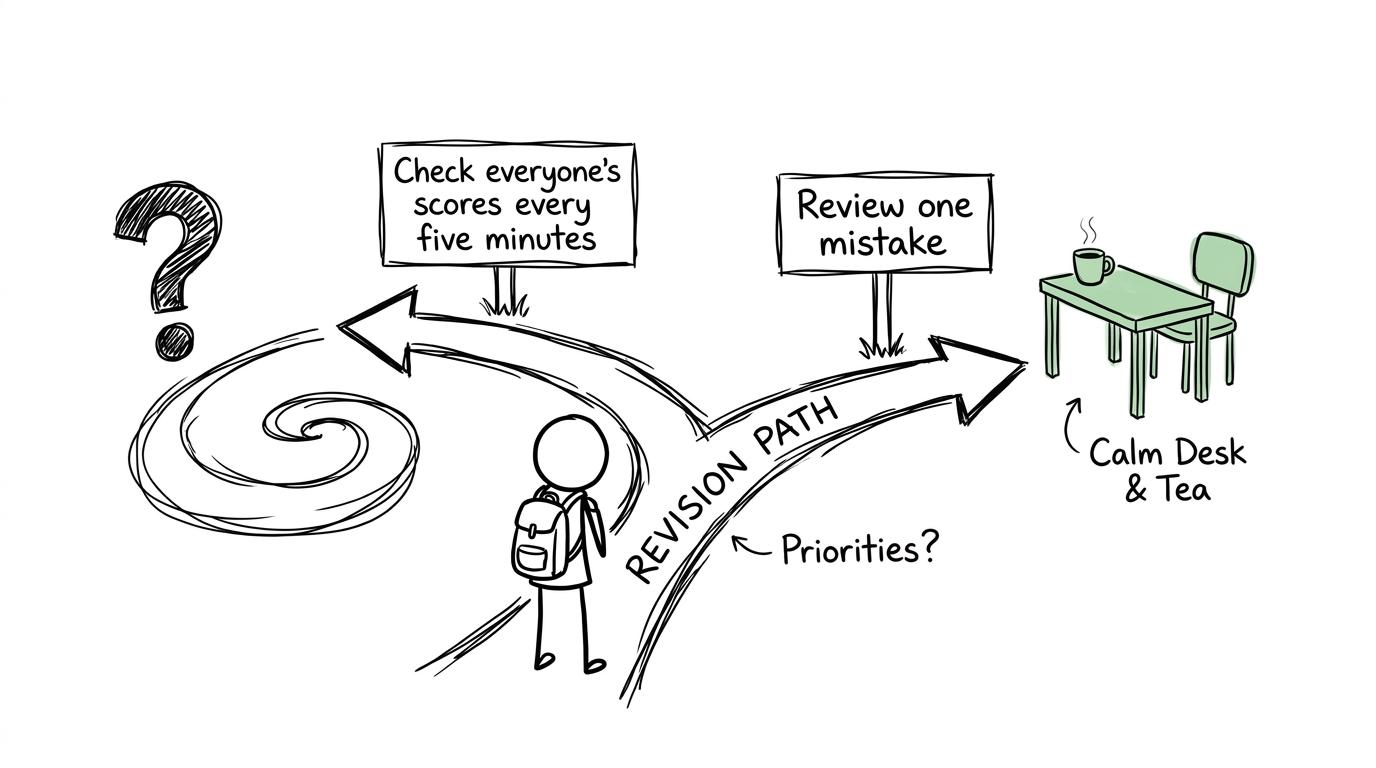 A revision path towards checking everyone's scores loops back, while reviewing one mistake leads to a calm desk
Common mistakes when judging GCSE progress
Treating predicted grades as promises
Predicted grades and mock results are snapshots based on available evidence. They are not guaranteed final outcomes. Use the feedback beneath the grade to decide what to practise.
Comparing different assessment conditions
An open-book Literature essay completed at home is not directly comparable with a timed, closed-book classroom response. Keep the conditions consistent before drawing conclusions.
Assuming grade boundaries never change
For qualifications regulated by Ofqual in England, exam boards set grade boundaries after marking and boundaries can vary to reflect paper difficulty while maintaining standards. Last year's raw mark is therefore not a guaranteed boundary for your exam series.
Measuring revision by appearance
A thick folder, long quotation list or elaborate timetable can look impressive without producing secure recall. Test what you can retrieve and apply without help. In maths, short focused resources such as GCSE maths mini tests provide clearer evidence than hours spent rereading notes.
Turning every lower mark into a judgement
A disappointing mark may identify a narrow issue: weak planning, limited evidence, unfinished writing or misunderstanding one question. Diagnose the cause before making a broad claim about your ability.
Make your next comparison fair
Your friends can be companions, sources of ideas and people who understand exam pressure. They do not need to be your measuring system.
Compare your work with the assessment objectives. Compare today's response with an earlier one. Compare the mistakes in your latest maths paper with the mistakes you make after targeted practice. Those comparisons produce decisions, and decisions produce progress.
Start with one honest piece of evidence today. Then use MathsGenie's free revision lessons, practice questions, mini tests, past papers, predicted papers, mark schemes and video solutions to turn that evidence into a focused plan. Your classmate's progress belongs to them. Your next useful step belongs to you.