

College Applications After GCSE Results Day
College applications after GCSE results: confirm your course, handle missed grades and complete college enrolment with this calm step-by-step guide.
The envelope opens, the grades become real, and suddenly the next two years feel as though they depend on one morning. They do not. For college applications after GCSE results, your immediate job is simple: compare your grades with your offer, contact the college, and complete its enrolment instructions promptly. If you missed an entry requirement, speak to the admissions team before assuming that you have lost your place.
College is not merely sixth form in a different building. It may offer A Levels alongside vocational courses, T Levels, apprenticeships or programmes combining a main qualification with GCSE English or maths. That range gives you options, but it also means each provider has its own application and enrolment process.
Your results-day checklist
Keep these essentials together:
- Your official GCSE statement of results
- Your college offer and course entry requirements
- Your enrolment email, time and location
- The identification and residency documents requested by your college
- Admissions contact details
- Evidence of access arrangements or an EHCP, where relevant
- Details of one suitable back-up course
For the June 2026 examination series, GCSE results are released to candidates on Thursday 20 August 2026. Your school decides how and when you receive them, while your college sets its own enrolment deadlines.
Step one: compare your grades with the offer
Read the exact conditions rather than relying on memory. A course may require a particular number of GCSEs, specified grades in English and maths, or a stronger result in a related subject. Requirements vary between colleges and courses.
If you met every condition, follow the enrolment instructions immediately. Do not assume that holding a conditional offer enrols you automatically.
If you are still deciding between A Levels and another programme, use MathsGenie’s GCSE to A Level subject choice guidance to understand how the academic demands change. Students considering A Level maths can also explore the Edexcel A Level Maths revision hub before making a final choice.
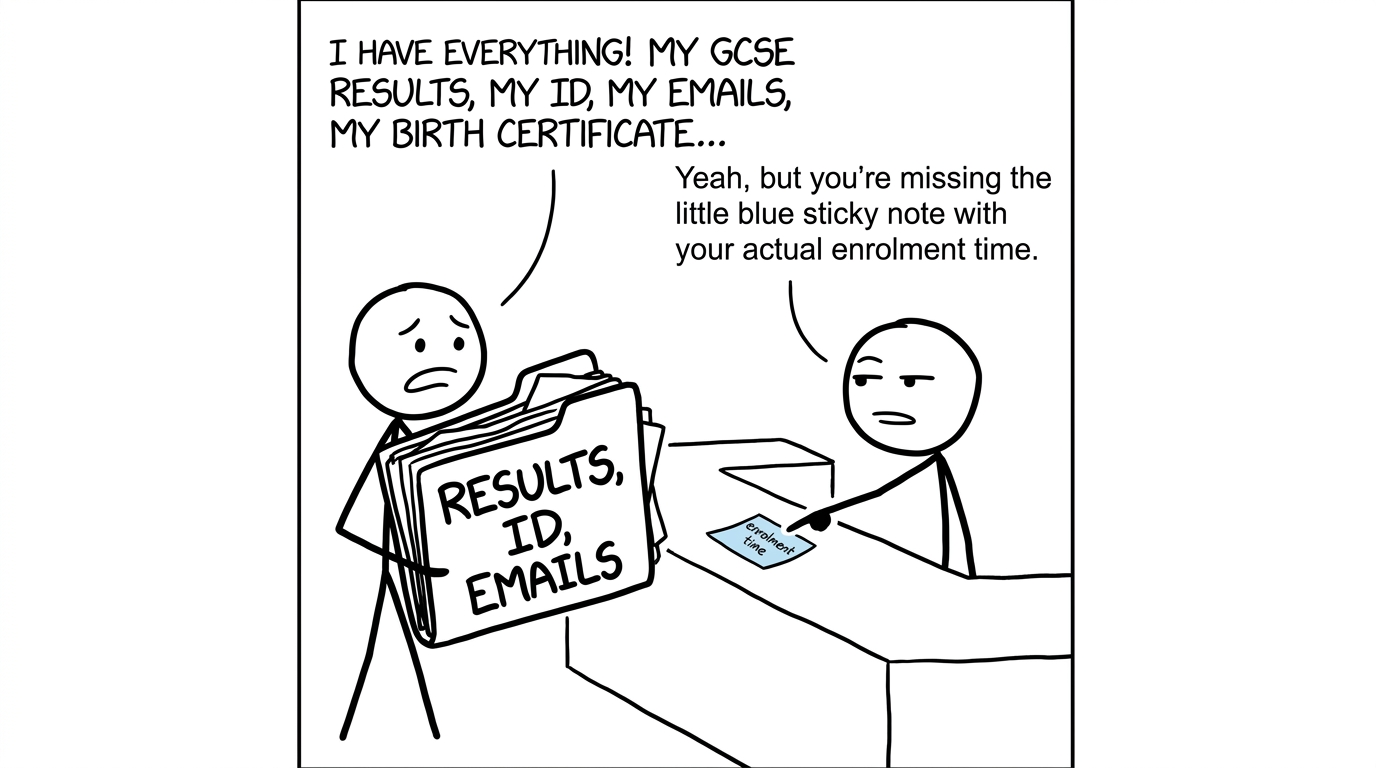 A student arrives at college enrolment with an enormous folder but needs one tiny missing detail
Step two: contact the college if your grades differ
Missing a condition does not automatically settle the decision. Contact admissions, give your name and application reference, state your results accurately, and ask whether the college can:
- confirm your original course;
- offer a related course at another level;
- combine your programme with a GCSE resit; or
- discuss another available route.
Act quickly, but do not accept an alternative simply because it is available. Ask what qualification it leads to, how it is assessed, what progression routes it supports and whether extra equipment or placements are required.
In England, students on many 16-to-19 study programmes who have not achieved grade 444 or above in GCSE English or maths must continue studying the relevant subject. The programme and resit route depend on the provider and your circumstances. MathsGenie’s guide to what happens after a GCSE maths grade below 444 explains the next steps calmly.
Step three: apply directly if you have no place
Applying to college after GCSE results is still possible where courses have spaces. This is normally handled directly through the further education college rather than through the university application process.
Search local college course pages, check current availability, and contact admissions on results day. Be ready to explain:
- the course you want;
- your GCSE grades;
- why the subject suits your plans; and
- whether you need learning, financial or accessibility support.
In England, young people must remain in education or training until at least their 181818th birthday, although that does not mean remaining at school. Full-time college, an apprenticeship, or employment combined with approved part-time education or training can meet the participation requirement.
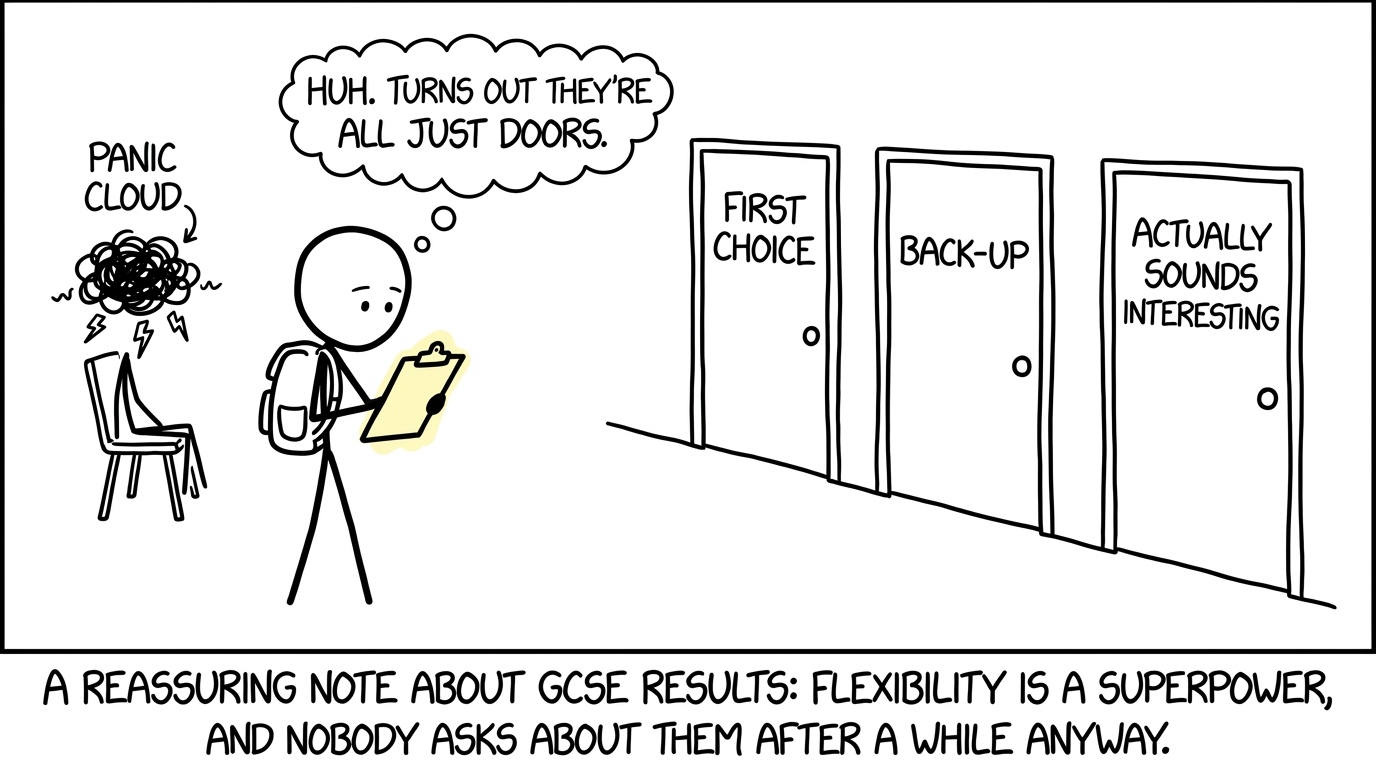 A calm student considers three college course doors while a panic cloud waits unused
Step four: complete college enrolment
Check the college’s email or applicant portal carefully. Providers commonly ask for your results and proof of identity, but the required documents and deadlines differ. Some also request residency evidence, a National Insurance number, access-arrangement records or documents connected with financial support.
Upload clear copies where requested and attend at the stated time. Keep screenshots or confirmation emails. If you cannot attend, contact the college rather than silently missing the appointment.
Step five: keep your maths ready for the next course
Results day closes one chapter, but it does not erase the skills behind the grade. Technical courses, sciences, business and A Levels can all rely on confident number, graphs, ratio and algebra.
Use the GCSE Maths revision hub to maintain those foundations. You can diagnose gaps with GCSE past papers, repair them through revision lessons and practice questions, then use predicted papers and mini-test resources for focused practice.
Common mistakes when applying to college
- Assuming the offer is automatic: conditional offers still require results and enrolment.
- Giving up after one missed grade: ask the college before deciding the place is gone.
- Ignoring messages: enrolment deadlines can be short, so check email folders and portals.
- Choosing only by course title: compare content, assessment, placements and progression.
- Forgetting support documents: tell the college early about access or learning needs.
- Dropping maths completely: a secure GCSE foundation can matter throughout further education.
Move forward one decision at a time
A results sheet is important, but it is not a complete plan. Confirm what your grades allow, ask direct questions and choose a course whose content supports your next step.
Then let MathsGenie handle the revision structure. Begin with a revision lesson, practise targeted questions, check the mark scheme or video solution, and build towards mini tests, past papers and predicted papers. Start with the subject choice and GCSE-to-A-Level guide, then make your college decision with evidence rather than panic.











