Choosing A-Level Subjects After GCSE Results
Choosing A-Level subjects after GCSE results? Use your grades, interests and future plans to decide confidently, including whether A-Level Maths fits.
Results day has a strange way of making several years of work feel like one sheet of paper. Relief, pride and disappointment can arrive together. Yet choosing A-Level subjects after GCSE results should not be a snap judgement based on your strongest grade or one difficult exam. The best choice sits where three things overlap: the subjects you can access, the work you genuinely enjoy and the routes you may want later.
Your GCSE results provide evidence. They do not make the entire decision for you. Use them alongside sixth-form entry requirements, teacher advice and an honest look at what each course involves.
Your results-day decision checklist
Before confirming your subjects:
- check the general entry requirements for your sixth form or college;
- check the separate grade requirement for every subject;
- identify which kinds of lessons and tasks you enjoy;
- read the course content and assessment structure;
- investigate requirements for any university course or career already in mind;
- ask what happens if you narrowly miss an entry grade;
- choose an alternative combination you would still be happy to take.
Government careers guidance says that students normally need at least five GCSEs at grades 999 to 444, with around grade 666 in subjects they want to continue. These are only general guidelines. Individual schools and colleges set their own requirements, and some subjects have higher thresholds.
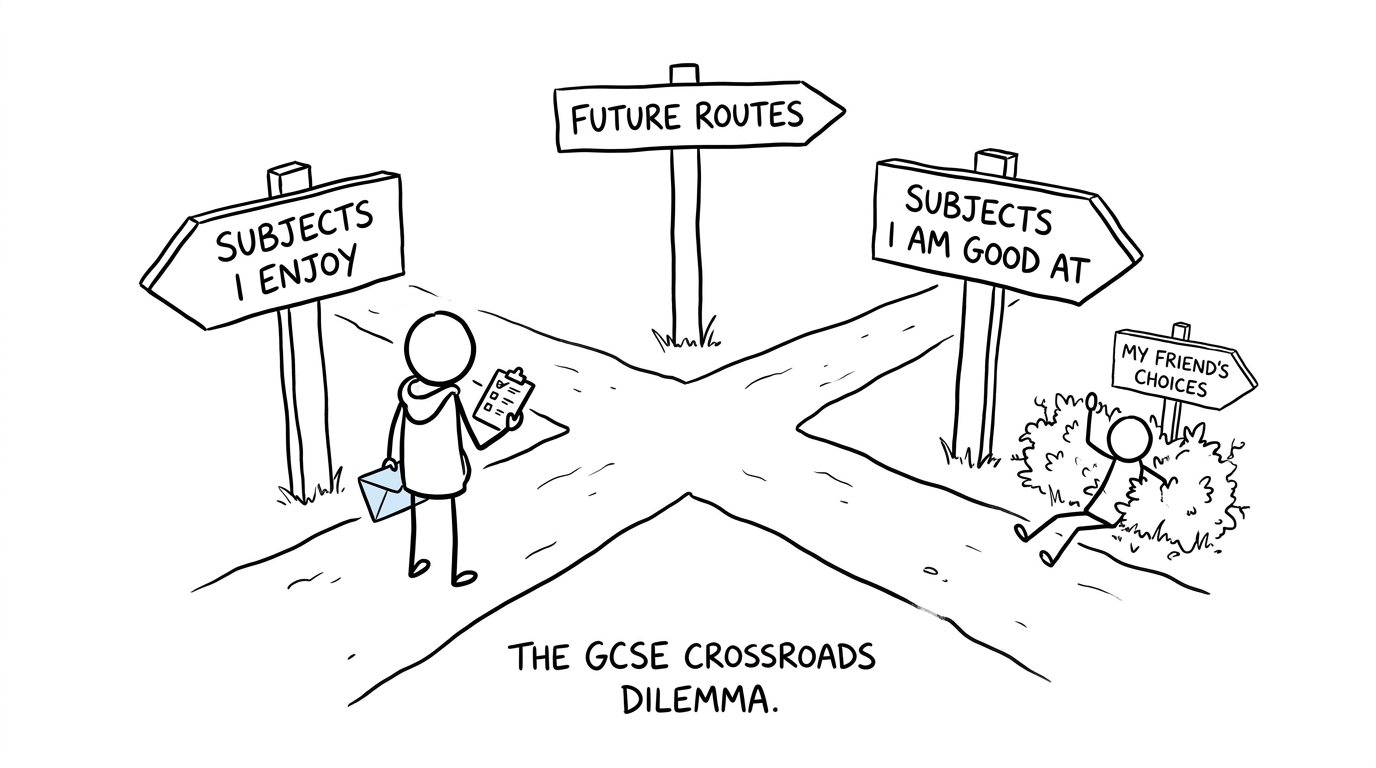 A student choosing between interests, strengths and future routes
Use GCSE grades as evidence, not identity
An A-Level subject choice and GCSE grades naturally belong in the same conversation. A strong grade suggests that you have useful foundations. It may also satisfy an entry condition. But a grade cannot tell you everything about motivation, consistency or whether you will enjoy two more years of the subject.
Sort your possible choices into three groups:
- Ready: you meet the published requirement and feel secure in the core skills.
- Borderline: you are close to the requirement or your performance varied considerably.
- Alternative: you do not currently meet the requirement, so you need another route or a conversation with the provider.
If a result is lower than expected, speak to the sixth form before abandoning the subject. Ask whether it has a review process, bridging work or another suitable course. Do not assume that flexibility exists, but do not reject yourself before asking either.
For GCSE Maths, use evidence beyond the final grade. Review your topic performance through the GCSE Maths revision hub or follow the MathsGenie method for finding your weakest GCSE topics. A grade tells you where you finished; your error pattern tells you what starting A-Level study may feel like.
Put interest under a brighter light
“Do I like this subject?” is useful, but too broad. Ask what you actually like doing.
Do you enjoy constructing arguments, interpreting evidence, designing investigations, solving unfamiliar problems or writing extended responses? Two subjects can sound connected while demanding very different habits.
Interest matters because A-Level courses go deeper and require more independent work. Choose the weekly reality, not merely the subject name. Read the specification, inspect sample material and ask current teachers which GCSE activities most closely resemble the A-Level course.
A hypothetical student who enjoys algebraic reasoning, graphs and multi-stage problem solving has a stronger reason to consider Maths than someone choosing it only because it is viewed as impressive. Another student may have an excellent GCSE grade but dislike sustained mathematical practice. The grade opens the door; it does not oblige them to walk through it.
Check where your combination can lead
If you already have a possible degree or career in mind, work backwards from its entry requirements. Some routes require particular A-Levels, while others accept a broad range. Requirements also vary between universities, so check several courses rather than relying on one conversation or an old prospectus.
If you are undecided, favour a combination that:
- contains subjects you can realistically succeed in;
- develops more than one type of academic skill;
- leaves several routes open;
- creates a workload you can sustain.
Avoid choosing a subject solely because friends are taking it. Timetables change, classes separate and motivation becomes personal very quickly.
Think about the combination, not three isolated choices
Three individually sensible subjects may still create an unsuitable combination. Consider how much coursework, essay writing, practical work and problem solving will appear across the week.
A student considering Maths, Physics and Computer Science might value the shared analytical thinking. Someone considering Maths, Economics and History may prefer the mixture of quantitative reasoning and written argument. Neither combination is automatically better. The right one depends on entry requirements, interests and future plans.
Should you choose A-Level Maths?
A-Level Maths develops GCSE ideas into a more connected course involving pure mathematics, statistics and mechanics. Algebra becomes a language used throughout rather than one topic among many.
Entry thresholds vary. Many providers ask for a strong higher-tier GCSE Maths grade, often grade 666 or 777, while more selective programmes may ask for more. Further Maths commonly has a higher requirement. Always use the published criteria for your chosen sixth form rather than treating a typical grade as a guarantee.
Before deciding, ask yourself:
- Do I enjoy algebra and reasoning, not only routine calculation?
- Am I prepared to practise regularly when a method is not immediately clear?
- Did I usually understand higher-tier content, even if mistakes cost marks?
- Is Maths required or useful for a route I am considering?
Explore the free A-Level Maths overview to see the available exam-board resources. You can also inspect the depth of the course through the Edexcel A-Level Maths revision hub and compare it with the topic progression in the Edexcel GCSE Maths revision guides.
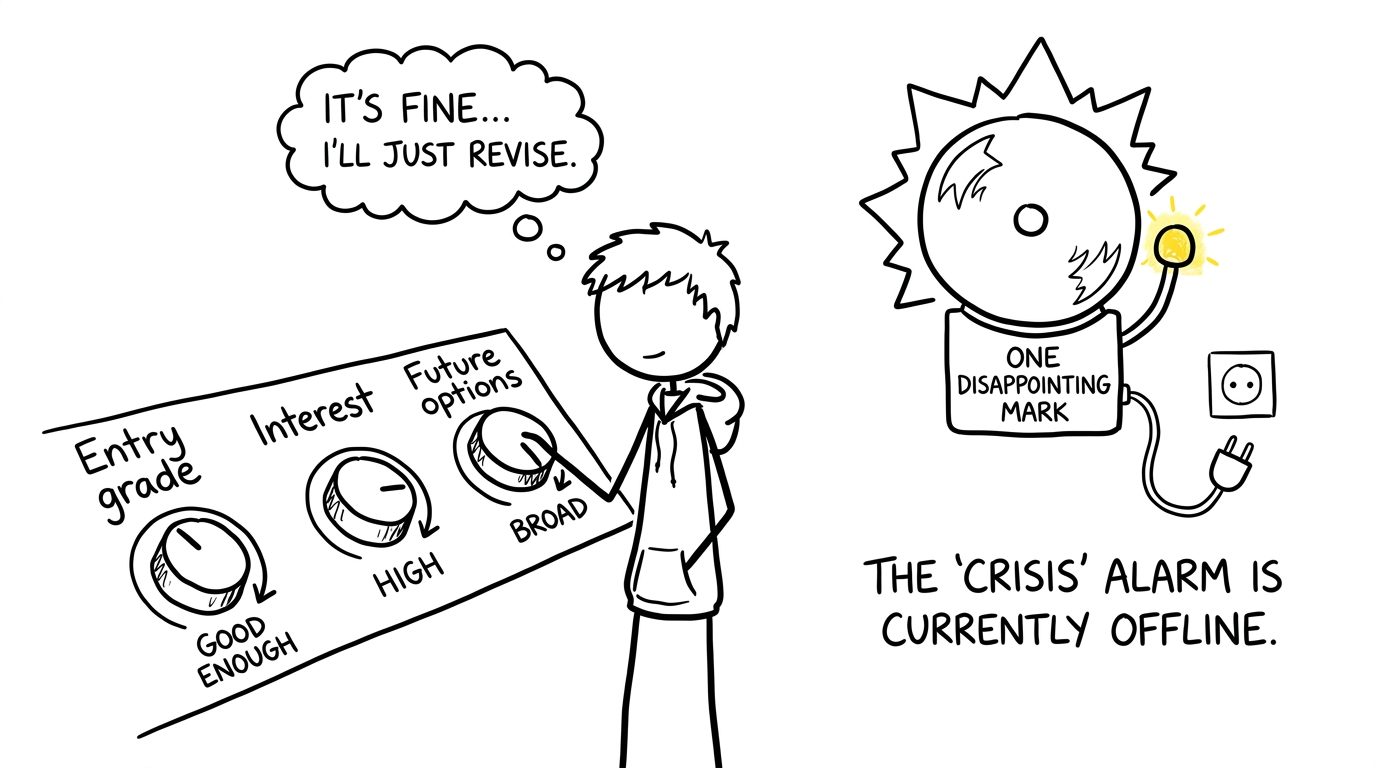 A calm student checks entry grade, interest and future options
Build a first choice and a resilient backup
A good plan survives imperfect news. Write down:
- your preferred three-subject combination;
- one acceptable substitute for each uncertain choice;
- the entry grade required for every course;
- the person or admissions team you need to contact;
- any deadline for confirming or changing subjects.
If Maths is part of your plan, use the period before sixth form to strengthen algebra, graphs, trigonometry and problem solving. MathsGenie's GCSE predicted papers can provide broad practice before results, while the guide to using GCSE past papers properly explains how to turn mistakes into targeted revision.
Once the course begins, Edexcel A-Level Maths past papers can show how knowledge is assessed, although early topic lessons and practice questions should come before full timed papers.
Common mistakes when choosing A-Levels
Letting one grade make the whole decision
A result matters, especially where it determines entry, but consider your performance across the course and your willingness to improve.
Choosing for status
A respected subject is still a poor choice if you dislike its central tasks or cannot meet the entry criteria.
Ignoring exact local requirements
General advice cannot replace your provider's current prospectus. Check both overall sixth-form entry and subject-specific conditions.
Assuming the A-Level resembles GCSE
The title may be familiar while the depth, pace and assessment change considerably. Examine course content before enrolling.
Having no acceptable backup
A backup is not pessimism. It prevents a disappointing result from forcing a hurried decision.
Make the choice, then support it
Results day feels decisive because the numbers are visible. Your later habits are less dramatic, but they matter for much longer. Choose subjects by balancing eligibility, genuine interest, course demands and future routes. Then give that decision the steady work it deserves.
If A-Level Maths is on your list, start with the MathsGenie A-Level Maths overview. Free revision lessons, practice questions, past papers, predicted papers, mark schemes, video solutions and mini tests can help you understand the course and build confidence from the first term. Use the revision planner to turn that resource library into a routine you can maintain.