How to Catch Up GCSE Arabic After Absence
Catch up GCSE Arabic after absence with a realistic plan for missed themes, vocabulary and four skills, while keeping GCSE maths revision on track.
Missing several weeks of school creates a strange kind of pressure. You return to a classroom where everyone appears to know what is happening, while your folder seems to begin halfway through a conversation. If you need to catch up GCSE Arabic after absence, the answer is not to copy every missed page or attempt weeks of work in one weekend. First identify what was taught, then rebuild the essential vocabulary and grammar, practise all four language skills, and ask your teacher to check your priorities.
The same principle applies if you are also preparing for GCSE maths: recovery works best when it is selective, active and realistic. You are not trying to recreate every missed lesson. You are trying to become ready for the next one.
Your GCSE Arabic catch-up checklist
Start with these actions:
- Confirm your qualification, specification and tier with your teacher.
- Ask for a list of the themes, vocabulary and grammar covered during your absence.
- Collect missed assessments, speaking prompts and teacher feedback.
- Diagnose gaps in listening, speaking, reading and writing separately.
- Choose two or three priorities for the first week.
- Use short daily sessions rather than one exhausting catch-up day.
- Keep your existing GCSE maths revision in the timetable.
- Review progress with your teacher after one or two weeks.
This turns a vague fear, “I have missed everything”, into a finite list of tasks.
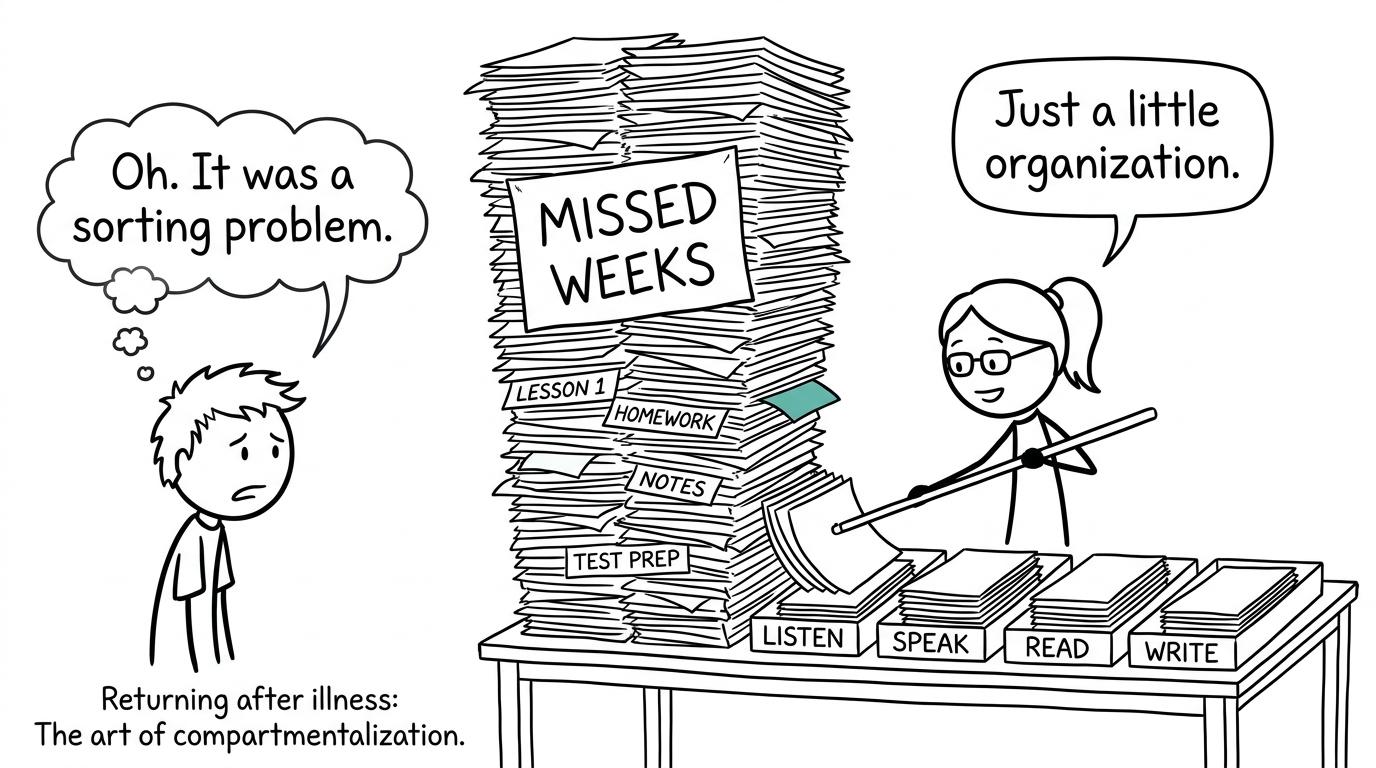 A student discovers that missed lessons are easier to manage when sorted into four language skills
Establish exactly what you have missed
Do not begin by revising random Arabic vocabulary. Your first job is to establish the size and shape of the gap.
Ask your teacher for the dates and content of the lessons you missed. Useful questions include:
- Which specification themes did the class cover?
- Which grammar structures were introduced?
- Was new vocabulary issued?
- Did the class complete any listening or reading assessments?
- Were speaking answers prepared or recorded?
- Is there a deadline that now matters more than the others?
- Which work is essential, and which work can be left for later?
Classmates can help you collect worksheets and lesson titles, but your teacher should decide the academic priorities. A complete pile of photocopied notes is not yet a catch-up plan.
Also check that you are preparing for the correct qualification. GCSE Arabic and International GCSE Arabic are different qualifications with different assessment structures. For the current Pearson Edexcel GCSE Arabic qualification, students take listening, speaking, reading and writing papers. Each contributes 25%25\%25% of the qualification, and students are entered for one tier across all four papers. Dictionaries are not permitted in the assessments. Your school should confirm the specification and tier rather than leaving you to infer them from an online resource.
Diagnose the four skills separately
A language gap is rarely even. You might still understand familiar written Arabic but struggle to follow speech at normal speed. Or you may know the vocabulary passively but find that you cannot retrieve it during a conversation.
Use a simple red, amber and green audit for each area:
- Listening: Can you identify the topic, key details, opinions and time frames?
- Speaking: Can you respond without reading a complete script?
- Reading: Can you understand short and extended texts, including unfamiliar words in context?
- Writing: Can you communicate accurately across different time frames and complete translation tasks?
Then audit the content. Pearson Edexcel’s current GCSE Arabic course is organised around five broad themes: identity and culture; local area, holiday and travel; school; future aspirations, study and work; and the international and global dimension.
Your teacher may have covered only part of one theme while you were away. That is good news. “Missed three weeks” can sound enormous; “need vocabulary for travel problems and practice using the past tense” is something you can schedule.
MathsGenie uses the same evidence-first idea in its guide to finding your weakest GCSE topics. Although the questions there are mathematical, the principle transfers neatly: diagnose before you revise, record the exact weakness, then retest it.
Build a realistic two-week recovery plan
After illness, a plan should respect your current energy rather than the energy you wish you had. If you are still recovering, discuss workload and reintegration with your family, school and relevant medical professionals.
In England, schools and local authorities have responsibilities to support pupils whose education is disrupted by illness. Government guidance says that a school should inform the local authority when a pupil is likely to miss more than 15 school days because of illness, and arrangements should support education and reintegration. If your absence was lengthy or recurring, ask your head of year, pastoral lead or special educational needs co-ordinator what support is available.
The first three days
Keep the opening phase administrative and diagnostic:
- Collect the missed materials.
- Confirm the urgent deadlines.
- Complete one short task in each language skill.
- Mark or review it with your teacher.
- Create a priority list containing no more than three gaps.
Do not attempt a full past paper immediately unless your teacher recommends it. A full paper can identify weaknesses, but it may also consume energy while telling you what you already know: you have missed some content.
The rest of the first week
Use short sessions with one purpose each. A manageable pattern might be:
- one vocabulary retrieval session;
- one grammar repair session;
- one listening or reading task;
- one short speaking or writing task;
- one feedback session to correct errors.
Keep each task small enough to complete properly. Twenty focused minutes followed by careful correction is more valuable than an hour spent highlighting a vocabulary list.
The second week
Begin mixing old and missed content. Revisit vocabulary without looking, answer a new question on the same theme, and practise retrieving useful structures under light time pressure. Arrange a brief teacher check so that errors do not become habits.
If you need a broader routine across several GCSE subjects, adapt the structure in the GCSE one-month revision plan. Its diagnose, practise, mark and revisit cycle is useful well beyond maths.
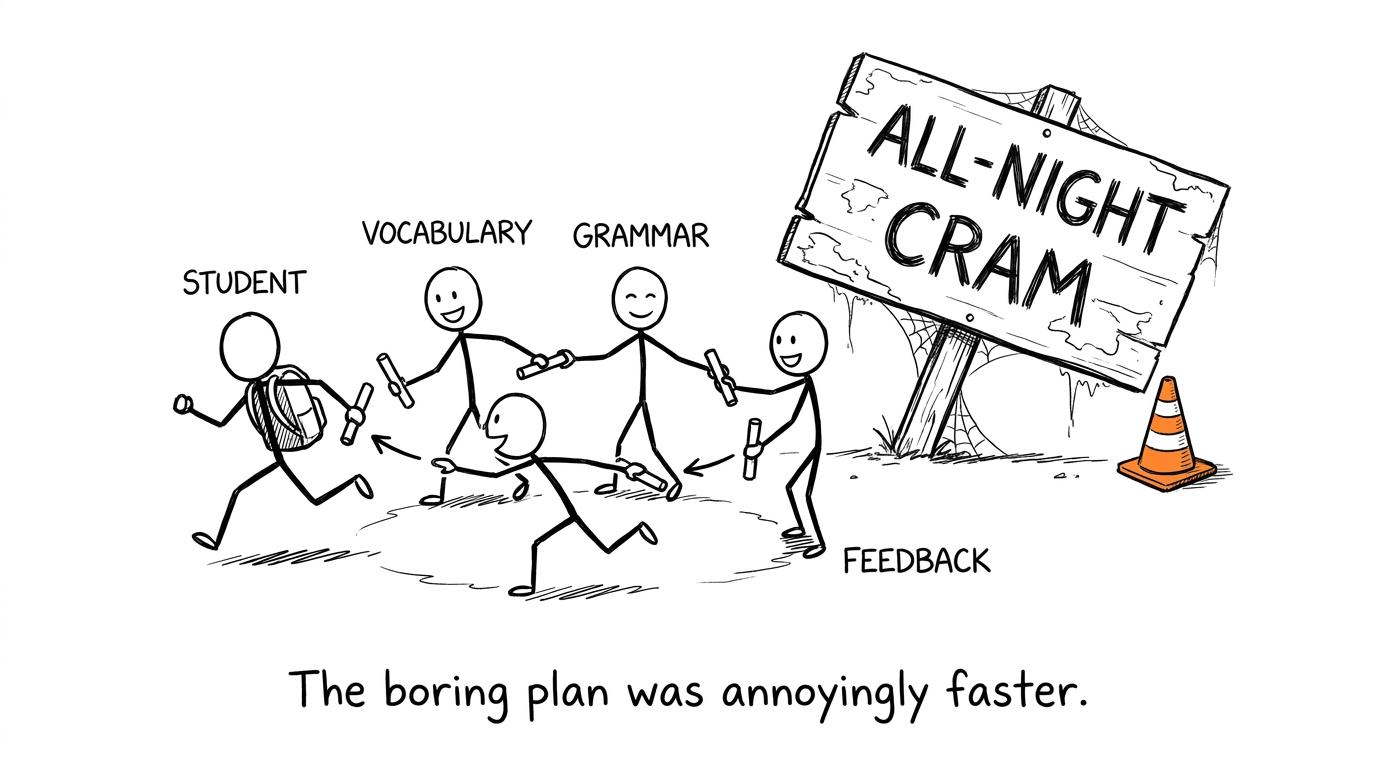 A revision relay defeats the tempting but ineffective all-night cram
Catch up vocabulary and grammar efficiently
Vocabulary needs retrieval, not recognition. Reading the same list repeatedly can make words look familiar without making them available when you speak or write.
Use both directions: see the English meaning and produce the Arabic, then see the Arabic and recall the English. Include nouns, verbs, opinion phrases, connectives and time expressions. Say items aloud so that vocabulary practice also supports pronunciation and listening.
Grammar should be tied to communication. Prioritise the structures your class has actually covered and those your teacher identifies as important. These may include verb forms and time frames, agreement, pronouns, negatives, comparisons, questions and sentence linking. Avoid downloading a huge grammar checklist and assuming every item is equally urgent.
For each structure:
- review the rule briefly;
- identify it in a sentence or examination text;
- use it in your own short response;
- get feedback;
- revisit it on another day without notes.
The sequence matters. Explanation without use feels productive but remains fragile. Practice without correction can make the same error more fluent.
Rebuild listening, speaking, reading and writing
Listening and reading
Begin with material linked to the missed theme. On the first attempt, identify the overall message. On the second, listen or read for names, opinions, reasons, time references and changes of viewpoint.
Do not stop whenever you meet an unknown word. GCSE comprehension often depends on extracting enough meaning from context rather than understanding every item. Afterwards, record only the vocabulary that genuinely blocked the answer.
Speaking
Speaking confidence fades quickly after time away, but it also returns through frequent, low-pressure practice. Prepare ideas rather than memorising an inflexible essay. Practise short answers, then add a reason, detail or contrasting opinion.
Ask whether you missed preparation for a role play, picture-based task or conversation theme. Under the current Edexcel GCSE structure, the speaking assessment contains these three tasks in that order, so missing speaking preparation deserves early attention.
Writing
Start with short responses that you can check carefully. Focus on answering every part of the prompt, communicating clearly and controlling familiar language. Only then increase length and time pressure.
Keep an error log with three fields: the error, the correction and the rule for next time. This resembles the method explained in how to use GCSE past papers properly: the completed task provides evidence, but improvement happens during correction and retesting.
Keep GCSE maths revision moving
Catching up in Arabic should not quietly remove maths from your week. Maths is cumulative, so a long pause can create a second backlog.
Open the GCSE Maths revision hub and choose resources for your exam board, whether that is Edexcel, AQA, OCR, Eduqas, WJEC or CCEA. Match your foundation or higher tier and keep two or three modest maths sessions in the week.
A balanced recovery timetable could contain:
- short Arabic sessions on most days;
- two focused maths topic sessions;
- one weekend review for both subjects;
- protected rest and catch-up space.
The GCSE maths revision timetable guide can help you build a schedule that does not depend on perfect days. If examinations are very close, use the more selective one-week GCSE revision plan.
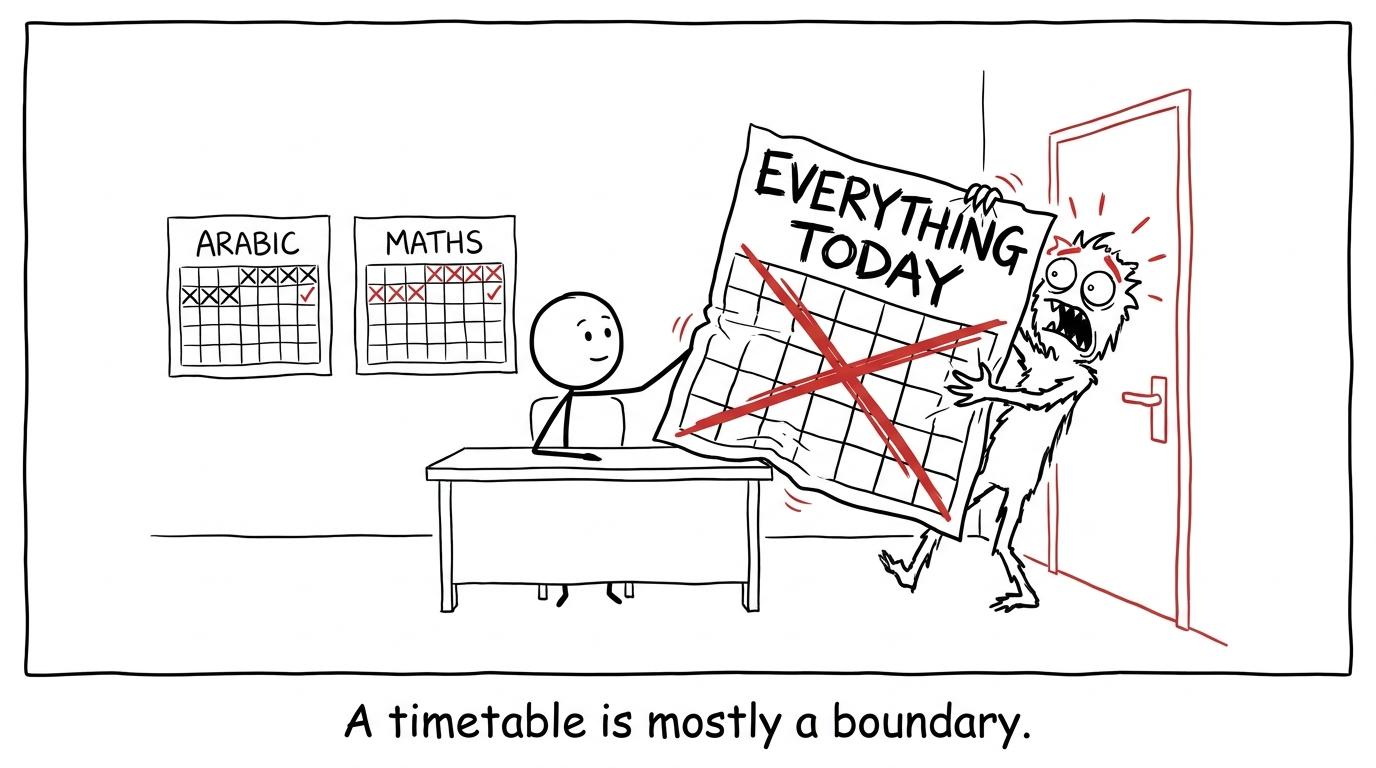 A student protects separate Arabic and maths revision blocks from the everything-today panic monster
Common mistakes when catching up after absence
Trying to complete everything chronologically
The oldest worksheet is not automatically the most important. Prioritise prerequisite knowledge, upcoming assessments and gaps identified by your teacher.
Copying notes instead of retrieving knowledge
Neat notes can hide weak recall. Close the book and test what you can understand, say or write independently.
Revising only your strongest skill
Reading may feel safer than speaking, particularly after an absence. However, all four skills contribute to the current Edexcel GCSE Arabic qualification, so your plan must include each one.
Memorising one perfect response
A memorised answer can collapse when the wording or theme changes. Learn adaptable vocabulary, structures and ideas instead.
Using full papers too early
Past papers are valuable once you have repaired the main content gaps. Begin with focused tasks, then move towards timed sections and complete papers.
Sacrificing sleep and other subjects
An overloaded plan is not ambitious; it is difficult to repeat. Use the GCSE topics by exam board and tier guide to keep your maths priorities visible while Arabic receives temporary extra attention.
Return to class with a system, not a perfect folder
To catch up GCSE Arabic after absence, you need a map more than a marathon. Confirm the missed content, diagnose each language skill, repair a few high-priority gaps, seek feedback and revisit them. A calm two-week plan will usually tell you more than an anxious weekend surrounded by every sheet you have ever received.
Keep your wider GCSE preparation moving at the same time. MathsGenie gives you a free, organised place to continue with maths revision lessons, practice questions, mini tests, past papers, predicted papers, mark schemes and video solutions. Start at the GCSE Maths revision hub, choose your board and tier, and schedule one manageable session today. Catching up begins when the next action becomes clear.