

Can Adults Retake GCSE French? How It Works
Adults retake GCSE French through colleges or as private candidates. Learn about centres, speaking tests, fees, funding options and revision planning.
A qualification can sit unfinished in your mind for years. Perhaps French was dropped at school, the original grade no longer reflects your ability, or a course or career has given you a reason to return. The practical question is simpler: can adults retake GCSE French?
Yes, adults retake GCSE French by enrolling on a suitable course or entering through an approved exam centre as a private candidate. There is no requirement to return to your old school. However, GCSE French includes a compulsory speaking assessment, so you must find a centre able to conduct every part of the qualification, not merely the written papers.
The route is entirely possible. It just rewards early organisation.
GCSE French retake checklist
Before opening a textbook, settle the administrative details:
- Decide whether you want a taught course, distance learning or independent revision.
- Find out which exam boards local centres accept for GCSE French.
- Confirm that the centre can conduct the compulsory speaking assessment.
- Choose foundation or higher tier with advice from a tutor or centre.
- Ask for the complete fee, internal entry deadline and assessment dates.
- Discuss access arrangements before registering, if you need them.
- Check your statement of entry carefully once the centre issues it.
- Build a revision plan covering listening, speaking, reading and writing.
The order matters. There is little value preparing for one specification and then discovering that your available centre only enters candidates for another.
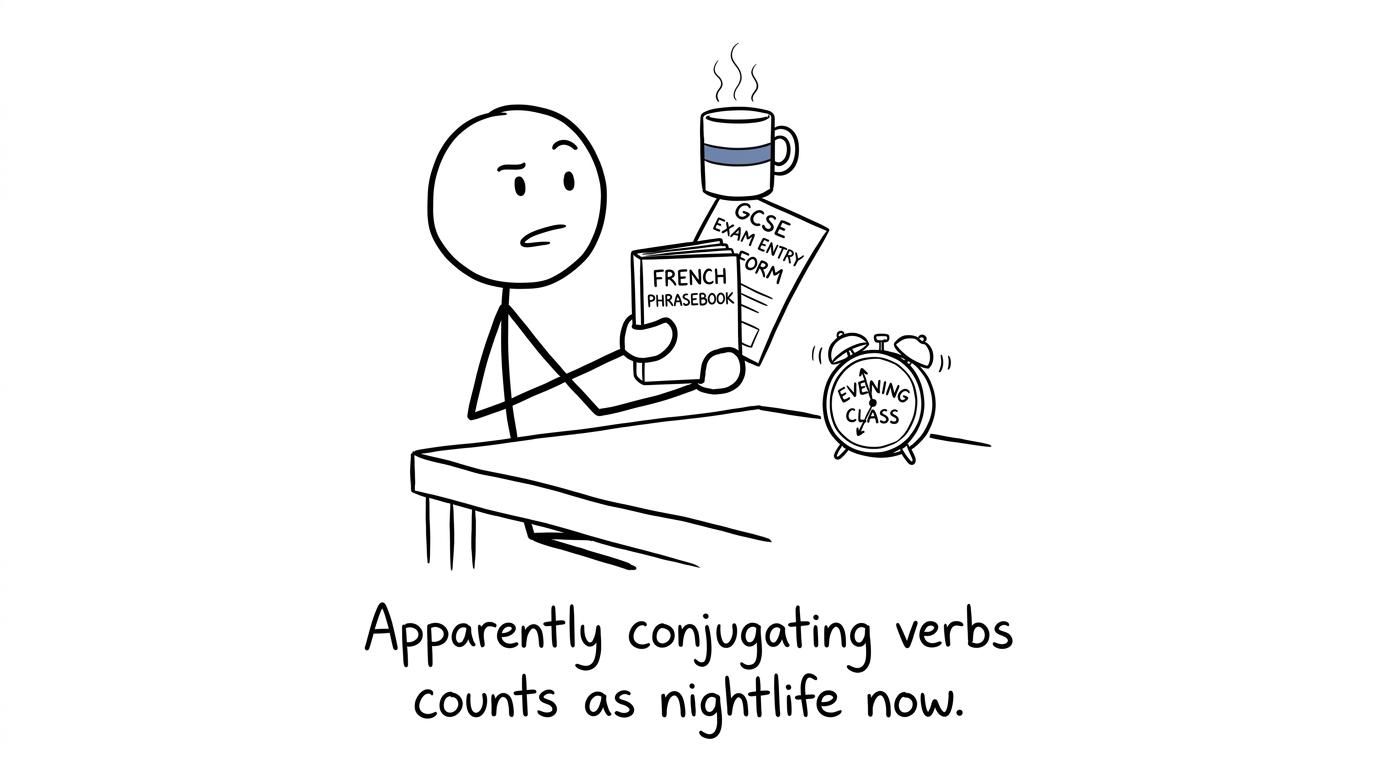 An adult learner discovers that French verbs now count as nightlife
How adults can retake GCSE French
There are three main routes. The best one depends on how much teaching you need, your timetable and whether nearby providers offer the qualification.
Join an evening or adult education class
An evening class at a further education college, adult learning service or community provider offers the most familiar structure. You attend regular lessons, receive feedback and usually practise speaking with a teacher and other learners.
This route can be particularly helpful if your French has become rusty. Listening and pronunciation improve through frequent exposure, while scheduled lessons remove some of the decisions that make independent revision difficult.
Do not assume that every conversational French class leads to a GCSE. Before enrolling, ask:
- Is this an accredited GCSE French course?
- Which exam board and specification does it follow?
- Does the provider make the exam entry?
- Are examination and speaking-assessment fees included?
- Is the course foundation, higher or able to support both tiers?
Some adult courses build general language confidence without entering learners for a qualification. They may still be useful, but they do not serve the same purpose.
Use distance learning with an examination centre
A distance-learning course can provide lessons, assignments and tutor feedback without requiring weekly travel. It suits adults whose work or caring responsibilities make an evening timetable difficult.
The important distinction is between teaching and examination entry. An online course provider may prepare you for GCSE French without being the approved centre where you sit the assessments. Ask who arranges the entry, where the speaking assessment takes place and whether any advertised fee includes the examination centre's charges.
Enter as a private candidate
A private candidate sits a qualification through an approved school, college or examination centre without being enrolled there as a regular student. You can prepare independently, work with a tutor or follow a distance-learning course.
The centre makes the formal entry on your behalf. You are normally responsible for finding that centre, providing the requested identification and candidate information, meeting its internal deadline and paying its fees.
JCQ maintains a private-candidate centre search tool, but availability must be confirmed directly. A centre may accept private candidates for GCSE maths while declining modern languages because French requires specialist arrangements for the speaking assessment.
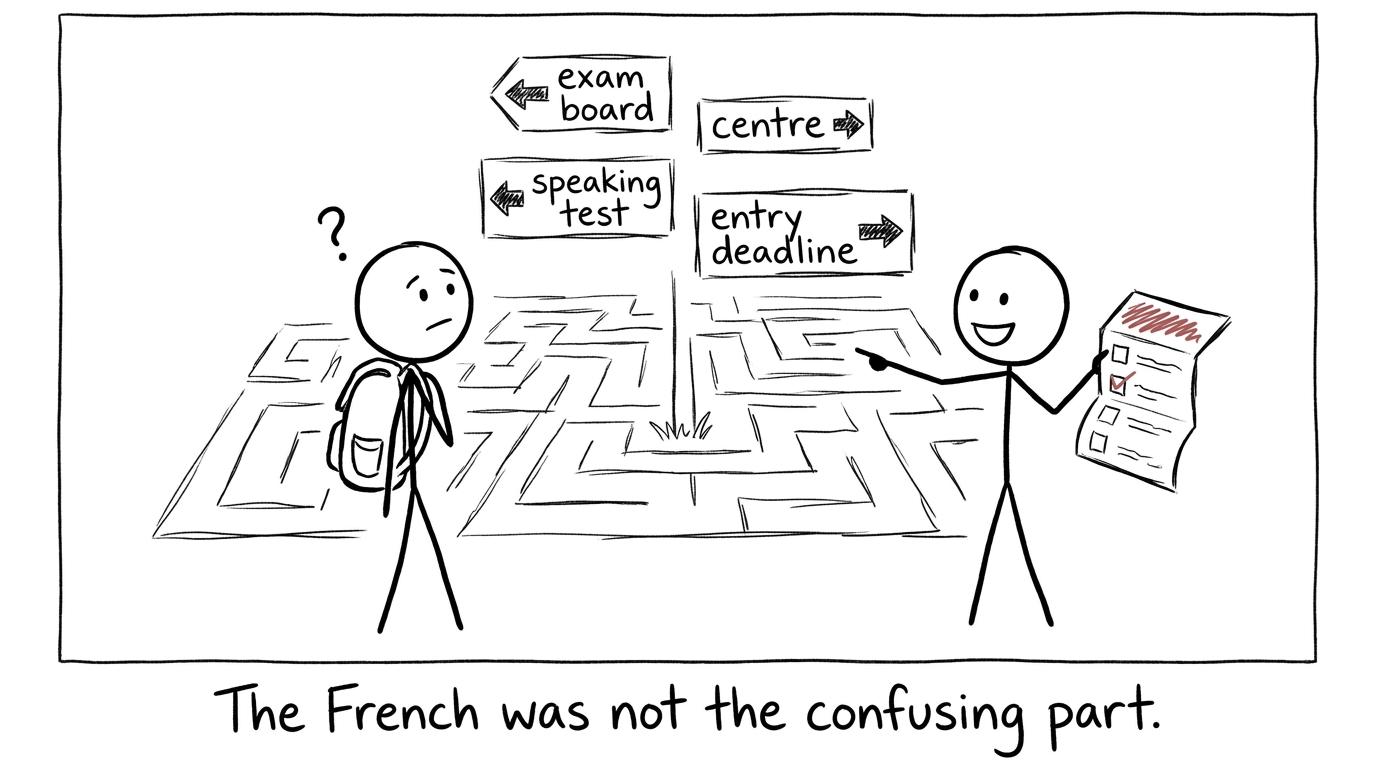 A private candidate navigates exam boards, centres and deadlines
What the GCSE French assessment involves
Current GCSE French specifications assess four skills:
- listening
- speaking
- reading
- writing
For current AQA and Pearson Edexcel specifications, each skill contributes 25%25\%25% of the qualification. The assessment is linear, meaning the required components are completed for certification in the same examination series.
Both foundation and higher tiers are available. On the current AQA specification, foundation offers grades 1-5 and higher offers grades 4-9. Candidates take the same tier across all four assessments. Other boards should always be checked against their current specification before you register.
The speaking assessment is the detail that catches independent learners by surprise. It is conducted face to face by a suitable teacher-examiner during a prescribed window and recorded for assessment. Current specifications include tasks such as reading aloud, role play and responding to visual material or conversation prompts, although the precise format depends on the board.
You therefore need more than a desk for the written papers. When contacting a centre, ask explicitly whether it accepts private candidates for your exact GCSE French specification and conducts the associated speaking assessment.
When can adults sit GCSE French?
GCSE French is normally available in the summer examination series. Unlike GCSE English language and GCSE maths, which have November opportunities for eligible post-16 candidates, French should not be assumed to have an autumn resit series.
Exact dates and entry deadlines change each year. Centres also set their own internal deadlines, often earlier than the awarding organisation's final deadline. Contact potential centres during the autumn or early winter before the summer in which you hope to sit the qualification. Starting early gives you more time to compare fees, arrange access support and reserve a speaking-assessment place.
Once registered, check the statement of entry, speaking window, written-paper timetable and any national contingency date. Keep the whole examination period available until your centre confirms every appointment.
How much does a GCSE French retake cost?
There is no single national price for a private GCSE French entry. The total may include the awarding organisation's entry fee, administration, invigilation and the staff and recording arrangements required for speaking.
Ask each centre for a written total and whether late-entry charges could apply. A low headline price is not useful if the speaking assessment, venue or administration fee is added later.
Funding also varies. In England, the automatic adult legal entitlement is especially clear for eligible English and maths qualifications, not for GCSE French in every circumstance. French may be funded locally through a wider adult skills programme, included within a college course fee or require self-funding. Rules differ across England's devolved areas and across Wales, Scotland and Northern Ireland, so ask the provider or local adult learning service rather than assuming the course will be free.
Choosing the right exam board and tier
Your centre often narrows the decision. AQA and Pearson Edexcel have current GCSE French specifications first assessed in 2026, while Eduqas may also be available through some centres. What matters is not the most familiar logo but the specification your chosen centre can administer properly.
Compare:
- prescribed vocabulary and grammar
- speaking-task format
- sample assessment materials
- foundation and higher expectations
- available teaching support
- the centre's experience with private candidates
If you previously sat a different specification, do not revise from memory alone. Formats and prescribed content change. Download the current specification and sample materials for the exact entry code supplied by your centre.
Tier choice should reflect evidence rather than ambition alone. Foundation provides access up to grade 5, while higher is intended for grades 4-9 on current specifications. Complete sample tasks across all four skills and discuss the results with a qualified teacher where possible. Strength in reading does not automatically mean that listening or spontaneous speaking is ready for higher tier.
A revision plan that works around adult life
Adult revision often fails for logistical reasons rather than intellectual ones. The ambitious plan assumes quiet evenings every day; the useful plan survives a busy Tuesday.
Build a weekly routine with separate sessions for each skill:
- short vocabulary and grammar retrieval
- regular listening without subtitles or transcripts at first
- spoken responses recorded and reviewed
- timed reading tasks
- writing followed by correction and rewriting
Speaking must happen aloud. Silent recognition can create the feeling that you know a phrase, but the examination requires you to retrieve and pronounce it under pressure. A tutor, class partner or language exchange can provide feedback, while recording yourself reveals hesitation that silent revision hides.
If you are also preparing for GCSE maths, keep the two plans distinct but use the same reliable cycle: learn, practise, mark, correct and revisit. The free GCSE Maths Revision Hub brings together revision lessons, practice questions and exam resources across Edexcel, AQA, OCR and Eduqas.
Short sessions can protect progress when another subject is taking most of your attention. Use GCSE maths mini tests for a focused check, or follow the GCSE one-month revision plan to build a sustainable weekly rhythm.
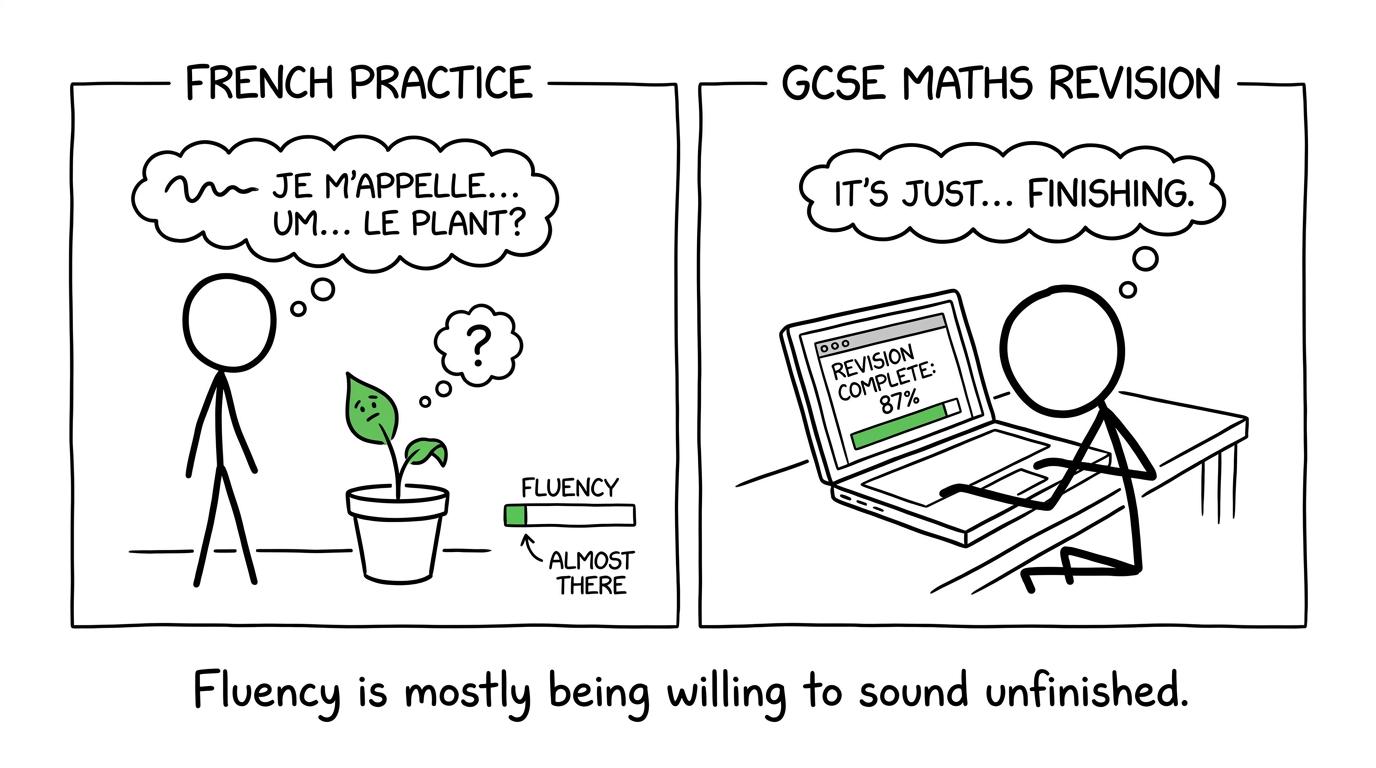 French speaking practice and maths revision make progress side by side
Common mistakes when retaking GCSE French
Revising before confirming the specification
Vocabulary lists, task formats and assessment rules depend on the board. Confirm the specification code, tier and examination series first.
Finding a centre that cannot offer speaking
A centre accepting private candidates does not necessarily accept GCSE French. Obtain written confirmation that it can conduct the compulsory speaking assessment for your board.
Missing the centre's internal deadline
The awarding organisation's published deadline is not necessarily the date offered to candidates. Centres need time to process entries and may stop accepting them earlier.
Assuming an evening class includes the exam
A course may teach French without leading to GCSE certification. Confirm whether entry, speaking assessment and written papers are included in the arrangement and price.
Practising speaking silently
Reading model answers in your head does not prepare you to respond aloud. Frequent, imperfect speaking practice is more useful than waiting until every sentence feels polished.
Treating past papers as the whole revision plan
Past papers diagnose gaps; they do not automatically repair them. This principle applies equally to maths. The guide to using GCSE past papers properly explains how to mark, fix and retest rather than simply collecting scores.
Take the next practical step
Adults can retake GCSE French, but the first move is administrative rather than academic. Decide whether you want an evening class, distance learning or independent preparation. Then find a centre, confirm its exam board and speaking arrangements, ask for the complete fee and register before its internal deadline.
After that, progress becomes quieter: regular listening, regular speaking and honest correction.
If French is part of a wider GCSE retake plan, let MathsGenie make the maths side simpler. Start with the free GCSE maths revision resources, use AQA GCSE maths past papers or OCR GCSE maths past papers for your board, and finish with Edexcel GCSE maths predicted papers where appropriate. Revision lessons, practice questions, mark schemes, video solutions, mini tests and predicted papers are all there to turn a large goal into the next manageable task.










