Best GCSE Sociology Revision Guide: How to Choose
Best GCSE sociology revision guide checklist: compare specification coverage, exam practice, model answers, explanations and feedback before you buy.
A revision guide can look reassuring long before it becomes useful. The cover promises complete coverage. The pages are colourful. Every chapter appears neatly contained. Yet none of that proves it will help when you face an unfamiliar question under exam conditions.
The best GCSE sociology revision guide is accurate for your exam board, covers the current specification, explains ideas rather than merely listing them, and gives you realistic opportunities to recall, apply, analyse and evaluate. It should help you produce better answers without pretending that reading alone is revision.
That distinction matters. A book can contain everything and still teach very little.
The quick revision guide checklist
Before buying or relying on a sociology guide, check whether it:
- names the correct exam board and current specification
- covers every topic and required research method
- distinguishes knowledge, application, analysis and evaluation
- includes exam-style questions with useful answers or marking guidance
- explains how command words affect the response
- uses accurate sociological terminology
- connects theorists, evidence and perspectives to specific issues
- makes retrieval practice possible
- is readable enough to use regularly
- works alongside past papers rather than trying to replace them
If several of these are missing, a polished cover will not repair the problem.
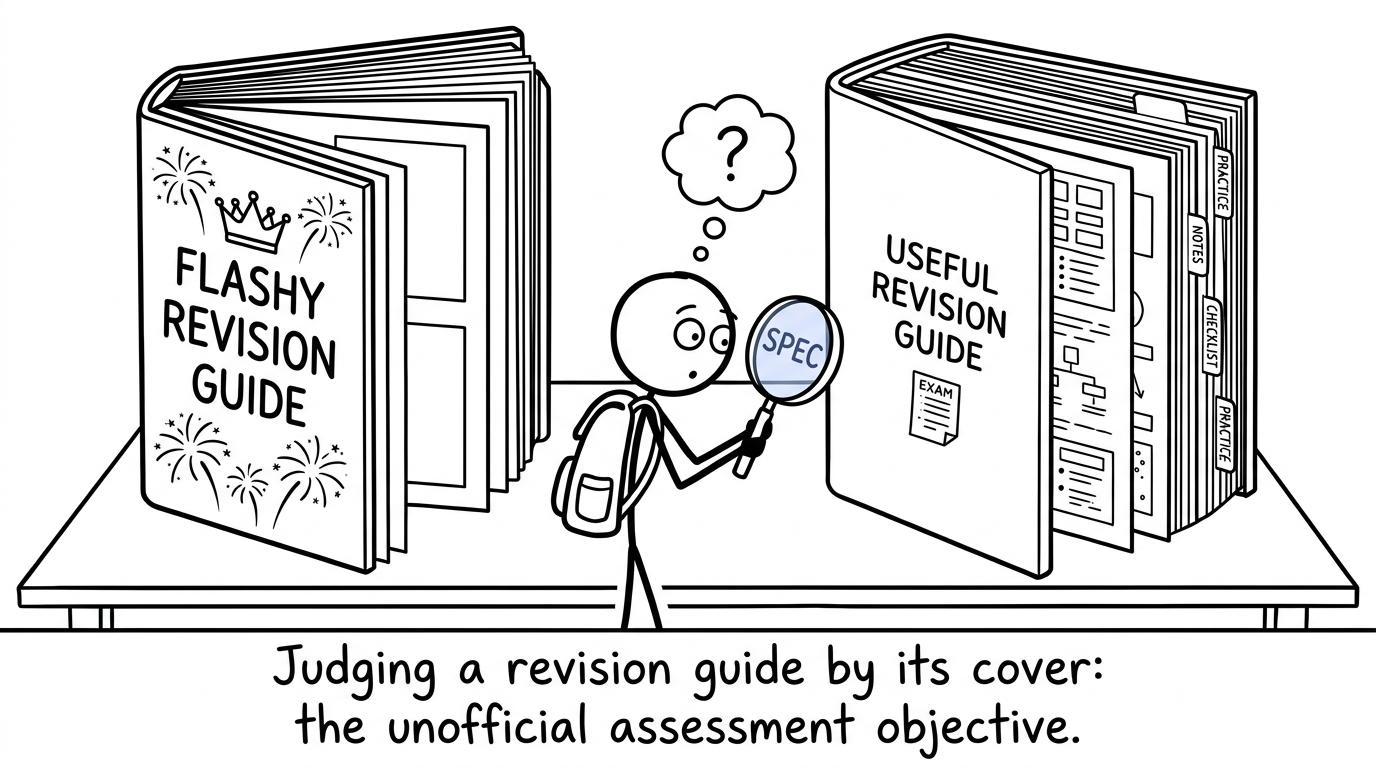 A student inspecting revision guides with a specification magnifying glass
Start with the exam board, not the book cover
A good guide begins by being the right guide.
GCSE Sociology specifications are not interchangeable. In England, students commonly follow AQA or Eduqas, but you should confirm the awarding body and qualification code with your teacher. Do not assume that a general GCSE label means the content, terminology and question structure match your course.
For AQA GCSE Sociology, the course covers families, education, crime and deviance, social stratification, sociological theory and research methods. It is assessed through two written papers, each lasting 111 hour 454545 minutes and carrying 100100100 marks.
Eduqas also uses two written components of 111 hour 454545 minutes and 100100100 marks, but its content is organised differently. It includes cultural transmission, families, education, social differentiation and stratification, crime and deviance, research methods and applied sociological enquiry.
A guide can therefore discuss familiar topics while still arranging or treating them in the wrong way for your paper.
How to check specification coverage
Open the official specification and compare its content list with the guide's contents page. Look beyond broad chapter names. A chapter called “Families” may omit particular theories, debates, studies or aspects of research methods required by your board.
Use three labels while checking:
- Covered clearly: the guide explains the required content and gives usable detail.
- Mentioned briefly: the content appears, but would not support a developed response.
- Missing: you need another reliable source or teacher guidance.
Publication date can be a useful warning sign, but it is not proof of alignment. An older guide may remain accurate when a specification has not changed, while a newly printed book may simply be a reissue. The specification match matters more than the date printed on the cover.
Look for the skills the examiner actually rewards
Sociology is not only a memory test. The assessment objectives require students to know sociological material, apply it appropriately, and analyse or evaluate arguments and evidence.
Across GCSE Sociology specifications, the assessment objectives are:
| Assessment objective | What the guide should help you do |
|---|---|
| AO1 | Demonstrate knowledge and understanding of theories, concepts, evidence and methods. |
| AO2 | Apply that knowledge and understanding to the issue, context or material in the question. |
| AO3 | Analyse and evaluate material to construct arguments, make judgements and draw conclusions. |
For AQA and Eduqas, these are weighted at approximately 40%40\%40% for AO1, 40%40\%40% for AO2 and 20%20\%20% for AO3. A guide filled entirely with definitions is therefore preparing you for only part of the task.
A stronger guide shows the difference between knowing that a perspective exists and using it to answer a particular question. It should also help you compare explanations, examine evidence, identify limitations and reach supported conclusions.
Be cautious if every page reduces evaluation to two generic columns labelled “strengths” and “weaknesses”. Evaluation is most useful when it is specific. A limitation should explain why an argument, method or piece of evidence is less convincing in that context.
Good explanations create connections
Revision guides are compressed by design. Compression becomes a problem when ideas are reduced until their meaning disappears.
A useful sociology guide should help you see connections between:
- theories and the assumptions behind them
- concepts and real social issues
- researchers and the conclusions drawn from their evidence
- research methods and questions of validity, reliability, ethics or representativeness
- arguments and counterarguments
- evidence and the judgement it supports
Imagine opening a page about education. A weak guide may present a row of theorists and one sentence beside each name. A stronger one explains how their arguments differ, what evidence is relevant and how those ideas could answer a question about achievement, school processes or the role of education.
That does not mean the longest guide wins. Detail is useful only when it is organised well enough to retrieve. The ideal page gives you a clear structure first, then enough precision to build an answer.
Check the quality of questions and answers
Practice questions are often advertised prominently because they make a guide feel exam-focused. The important question is whether they generate useful feedback.
Look for a mixture of:
- brief knowledge checks
- definition and identification questions
- questions requiring application to a context or item
- extended responses requiring analysis and evaluation
- prompts covering research methods
- mixed-topic practice that forces you to choose relevant knowledge
Answers matter just as much. A vague paragraph called a “model answer” may show fluent writing without revealing why marks would be awarded. Better support identifies relevant content, application, development, evaluation and judgement. It should reflect the command word and mark tariff used by your board.
Official past papers and mark schemes remain essential because they show the real structure and standard of assessment. A commercial guide should prepare you to use them, not claim to make them unnecessary.
The same principle applies in maths revision. MathsGenie's guide to using GCSE past papers properly explains the productive cycle: attempt, mark, diagnose, repair and retest. The subject changes, but the logic does not.
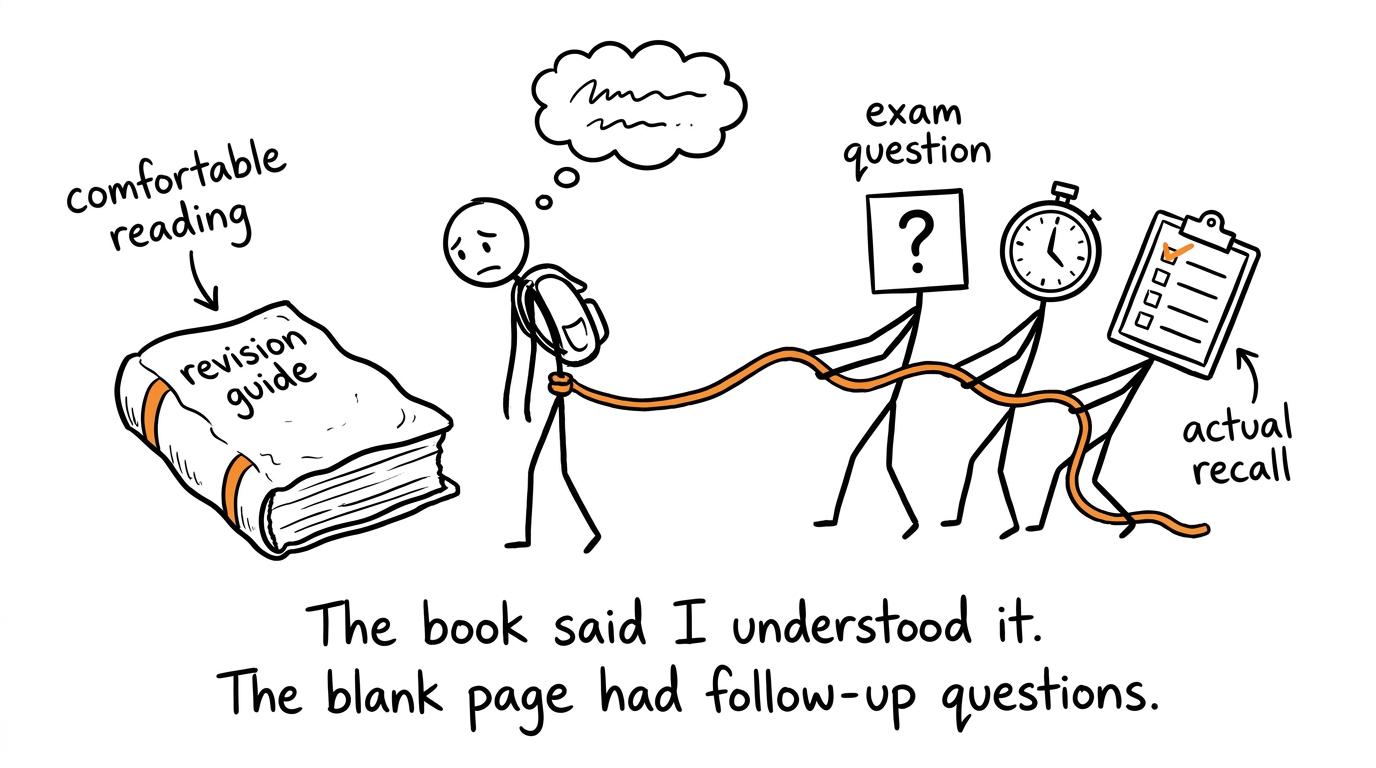 A revision book competing with active recall and exam practice
Test whether the guide supports active revision
Reading creates familiarity. Familiarity can feel like knowledge because the page makes sense while it is open. The exam asks a harsher question: can you produce and use that knowledge when the page is closed?
Before choosing a guide, inspect a typical spread. Can you easily turn its headings into questions? Are there retrieval prompts, blank diagrams, quizzes, concise summaries or end-of-topic checks? Can you cover one side of a comparison and reconstruct it yourself?
A practical revision cycle looks like this:
- read a small section with a clear purpose
- close the guide and recall its key ideas
- answer a relevant question without notes
- compare your response with reliable guidance
- record the precise gap
- revisit it later from memory
The guide is one component of that cycle. It is not the cycle itself.
Students revising several subjects can use the same diagnostic habits. MathsGenie's advice on finding your weakest GCSE topics shows how mistakes can become a focused revision list rather than a reason to reread everything.
Judge usability honestly
A guide you avoid opening has very little practical value.
Readable design matters, but it is not the same as decorative design. Check whether headings reveal a logical structure, key terms are defined where needed, paragraphs are manageable and diagrams genuinely clarify relationships. Colour should signal meaning rather than turn every line into a highlight.
Also consider how you revise. A dense guide may suit a student who likes detailed written explanations. Another student may need shorter summaries supported by teacher notes, flashcards and questions. There is no universally perfect layout.
Try the guide before committing if sample pages are available. Read one section, close it and write down what you remember. Then ask whether you could explain the idea and use it in a response. That small test tells you more than promotional claims.
Price is a constraint, not a quality score
A more expensive guide is not automatically more accurate, complete or usable. You are paying for a particular arrangement of information, questions and explanations. Compare those features directly.
Before buying, check whether your school provides a guide, digital access or department-made materials. Ask your teacher whether a particular publication matches the course. A second-hand copy may be sensible, provided you verify the edition against the current specification and check that important pages have not been removed or heavily completed.
Free resources can also fill gaps, although they should be checked for authorship, accuracy and specification alignment. A structured set of teacher materials plus official assessment resources may be more useful than owning several overlapping books.
A revision guide needs a wider system
The best guide is still only the knowledge leg of a larger revision system. You also need questions and feedback.
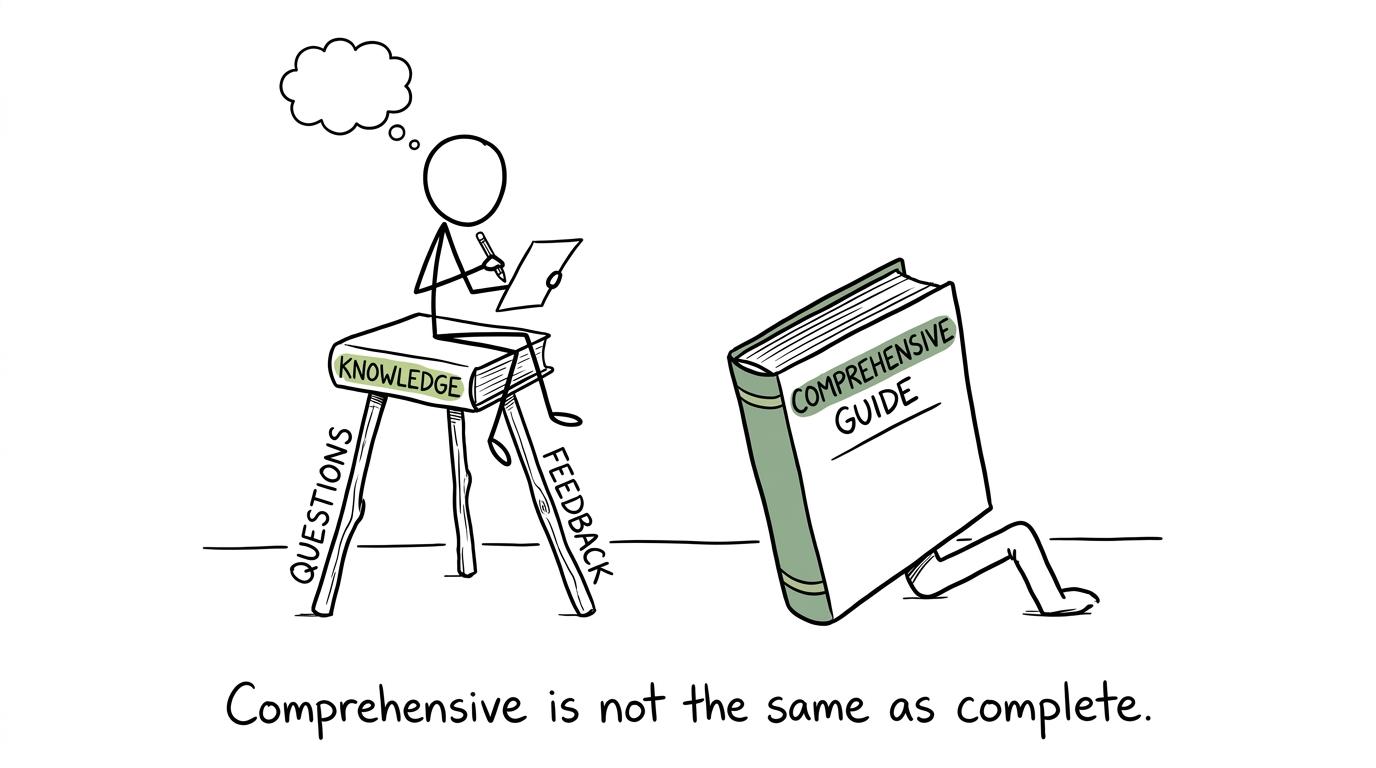 A three-legged revision stool supported by knowledge, questions and feedback
Your weekly sociology plan could combine short recall sessions, one focused topic review, an exam-style response and careful correction. A realistic timetable is more valuable than an ambitious plan you abandon, a principle explored in MathsGenie's GCSE maths revision timetable.
Maths needs the same complete system. Students preparing for maths exams can begin with the GCSE Maths revision hub, choose resources for their board and use revision lessons, worksheets and exam questions. The AQA GCSE Maths revision area provides a board-specific route, while Eduqas GCSE Maths past papers support timed practice with mark schemes.
Near the exam, Edexcel GCSE Maths predicted papers can provide further unseen practice. Predicted papers should sharpen preparation after topic learning; they cannot guarantee what will appear.
Common mistakes when choosing a sociology guide
Buying before confirming the exam board
Similar topic names can hide meaningful differences in structure, terminology and assessment. Confirm the awarding body and specification first.
Treating complete coverage as complete revision
A contents page can prove that a topic appears. It cannot prove that you can recall, apply or evaluate it. Test yourself without the book.
Choosing the shortest summaries automatically
Concise notes are valuable when they preserve the relationships between ideas. If they remove reasoning, evidence and context, they may support recognition but not developed answers.
Trusting model answers without marking guidance
A polished response is not necessarily a high-mark response. Check whether it addresses the command word, applies relevant material and explains its judgement.
Collecting too many resources
Several guides often create duplicated reading and constant switching. Choose one dependable core guide, then add official papers, teacher feedback and targeted resources where a genuine gap exists.
Using the guide passively
Highlighting and rereading may feel productive because both are easy to continue. Retrieval, writing and correction provide better evidence of what you can actually do.
Choose evidence over appearance
What makes one GCSE Sociology revision guide better than another is not the cover, thickness or price. It is the match between the guide and the work your exam requires.
Check the specification. Inspect the explanations. Test the questions. Look for meaningful feedback. Most importantly, make sure the guide helps you move from recognising information to recalling and using it independently.
Then build a revision system around it. For your maths preparation, start at MathsGenie's free GCSE Maths revision hub. Use revision lessons and practice questions to repair weak topics, mini tests to check recall, past papers and mark schemes to understand the examiner's demands, video solutions to correct methods, and predicted papers for focused final preparation.
A guide should reduce uncertainty. Practice should reveal what remains. Together, they turn revision from collecting information into improving performance.