Best GCSE Geography Revision Guide: How to Choose
Best GCSE geography revision guide: check exam-board fit, case studies, fieldwork, geographical skills, practice questions and answers before buying.
A revision guide can look reassuring long before it becomes useful. The cover promises complete coverage. The pages are colourful. Important words sit inside neat boxes. Yet none of that proves it will help you answer an unfamiliar question under exam conditions.
The best GCSE geography revision guide is one that matches your exact exam board and specification, explains rather than merely lists content, covers your required case studies and fieldwork, and gives you questions with answers you can learn from. It should also help you interpret maps, graphs and numerical data. Price, page count and design matter far less than those things.
Here is the quick test:
- Check the exam board, specification and publication date.
- Compare the contents with your school's topic list.
- Look for accurate case studies at the right depth.
- Confirm that fieldwork and geographical skills are included.
- Inspect the quality of the practice questions and answers.
- Choose a layout you can use actively, not just read comfortably.
- Test a sample section before buying, if possible.
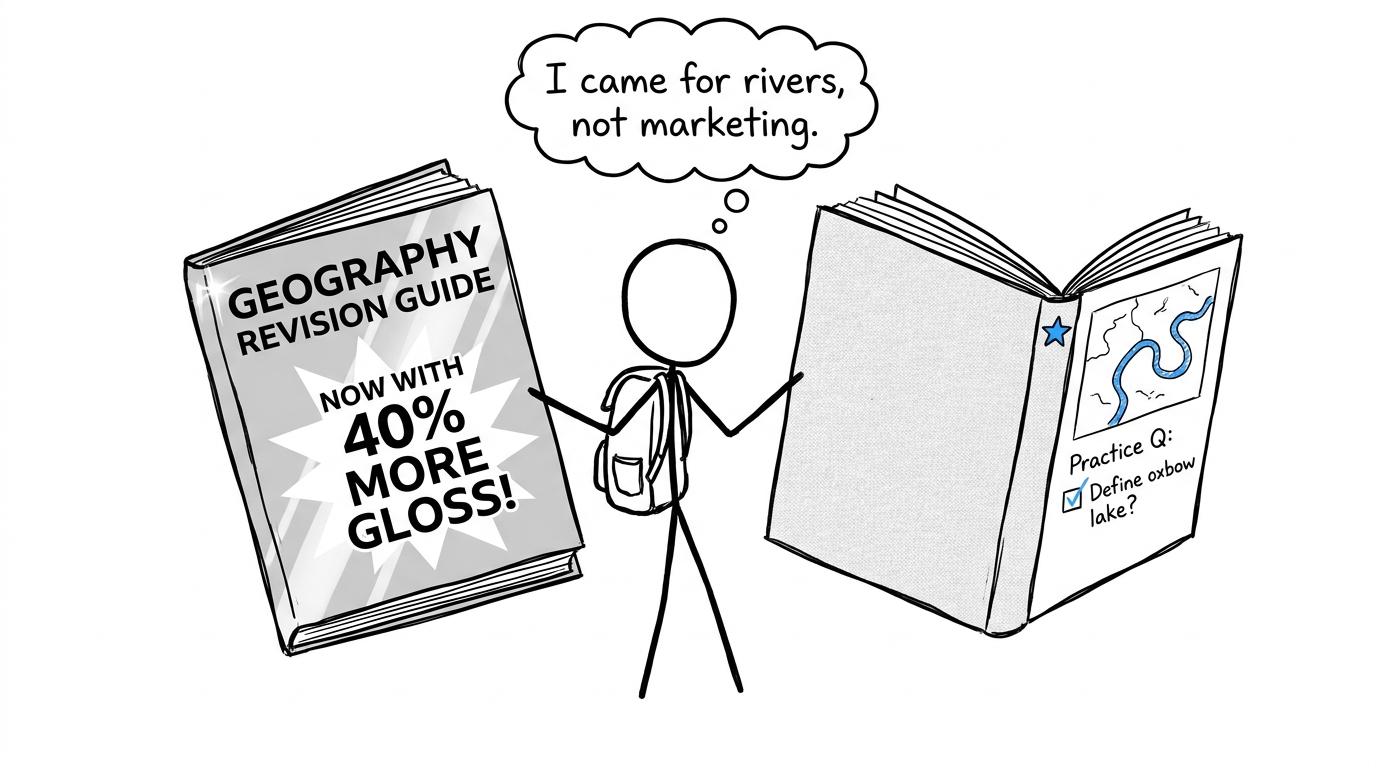 Student comparing a glossy geography guide with a useful one
Start with the specification, not the cover
A good guide begins by answering a plain question: is this the course you are actually taking?
GCSE Geography is offered by exam boards including AQA, Pearson Edexcel, Cambridge OCR and Eduqas. Their courses overlap in broad themes, but topic combinations, named requirements, paper structures and question styles differ. Edexcel also offers Geography A and Geography B, while OCR has distinct specifications. A guide labelled only "GCSE Geography" may therefore be too general.
Check these details on the copyright or information page:
- your precise exam board and qualification;
- the specification code, where shown;
- whether the guide covers the options selected by your school;
- its publication or most recent revision date;
- whether it reflects any current assessment changes.
Official specifications confirm that geographical skills and fieldwork are central parts of the qualification, not optional extras. AQA, for example, assesses geographical skills across all three written exams. Current Pearson Edexcel Geography B materials also include geographical investigations and specified fieldwork requirements. The exact arrangement varies, which is why board matching matters.
Take your school's course outline and compare it with the guide's contents page line by line. A missing option, landscape or case-study requirement is more important than a discount on the cover price.
What the best GCSE geography revision guide contains
Complete coverage without turning into an encyclopaedia
A revision guide should be concise, but concision is not the same as incompleteness. Strong guides organise physical geography, human geography, geographical applications, fieldwork and skills so you can see how ideas connect.
For each topic, look for:
- key processes explained as sequences rather than isolated definitions;
- causes, effects, responses and evaluations kept distinct;
- diagrams that clarify processes;
- named examples and case studies;
- links between physical and human geography;
- command-word guidance for short and extended responses.
The best guide helps you understand why something happens. A page that simply lists the effects of coastal erosion may support recall, but it will not necessarily prepare you to explain relationships or evaluate management choices.
Case studies with usable detail
Case studies often expose the difference between knowing a topic and being able to answer a question about it. A useful guide provides enough located, specific evidence to build an argument, without burying you beneath facts.
However, your class may have used different examples from those in a commercial guide. That does not automatically make the guide wrong. It means you should check whether its examples meet your specification and whether your teacher expects you to use the case studies taught in class.
A strong case-study section should make it easy to identify:
- location and context;
- the geographical process or issue;
- relevant causes and consequences;
- management or responses;
- evidence that supports analysis;
- contrasting viewpoints or an evaluative judgement.
Beware of memorising impressive-looking statistics without context. A smaller collection of accurate facts that you can connect to the question is usually more useful than a dense page of figures.
Genuine fieldwork support
Fieldwork is not just a day out that appears in a photograph near the back of the book. Official GCSE specifications require students to understand elements such as enquiry questions, data collection, presentation, analysis, conclusions and evaluation. Requirements differ by board, so the guide should reflect your course.
Good fieldwork coverage helps you discuss:
- why a method was selected;
- whether a sample was representative;
- how risk and ethics were managed;
- how data could be presented;
- whether evidence supports a conclusion;
- limitations and realistic improvements;
- how methods transfer to an unfamiliar investigation.
A weak guide gives you a generic list of equipment. A better one teaches the reasoning behind an investigation.
Check the geographical and mathematical skills
Geography exams require more than remembered place knowledge. Students may need to interpret maps, photographs, graphs, tables and unfamiliar data. AQA's published skills requirements, for example, explicitly include cartographic, graphical, numerical and statistical skills.
That makes the skills section one of the best ways to judge a guide. Look for coverage of:
- map scales, distance and direction;
- grid references, contour lines and relief;
- percentages, percentage change and ratios;
- averages and range;
- graphs, including scatter graphs;
- interpreting trends, anomalies and correlation;
- sampling and data reliability;
- units, rounding and significant figures.
The guide should explain both the calculation and its geographical meaning. Knowing that percentage change can be calculated using
new value−original valueoriginal value×100\frac{\text{new value}-\text{original value}}{\text{original value}}\times 100original valuenew value−original value×100is only part of the task. You may also need to interpret what the result suggests about population, rainfall, erosion or another geographical variable.
If the numerical side feels less secure, use MathsGenie's free GCSE Maths revision hub alongside your geography guide. Its lessons and practice questions let you repair the underlying skill rather than repeatedly getting stuck on the same geography calculation.
Students following AQA Maths can use the AQA GCSE Maths revision resources, while the Edexcel GCSE Statistics revision hub provides more focused support with data. For relationships between two variables, the scatter graphs revision lesson is useful even when the data itself comes from geography.
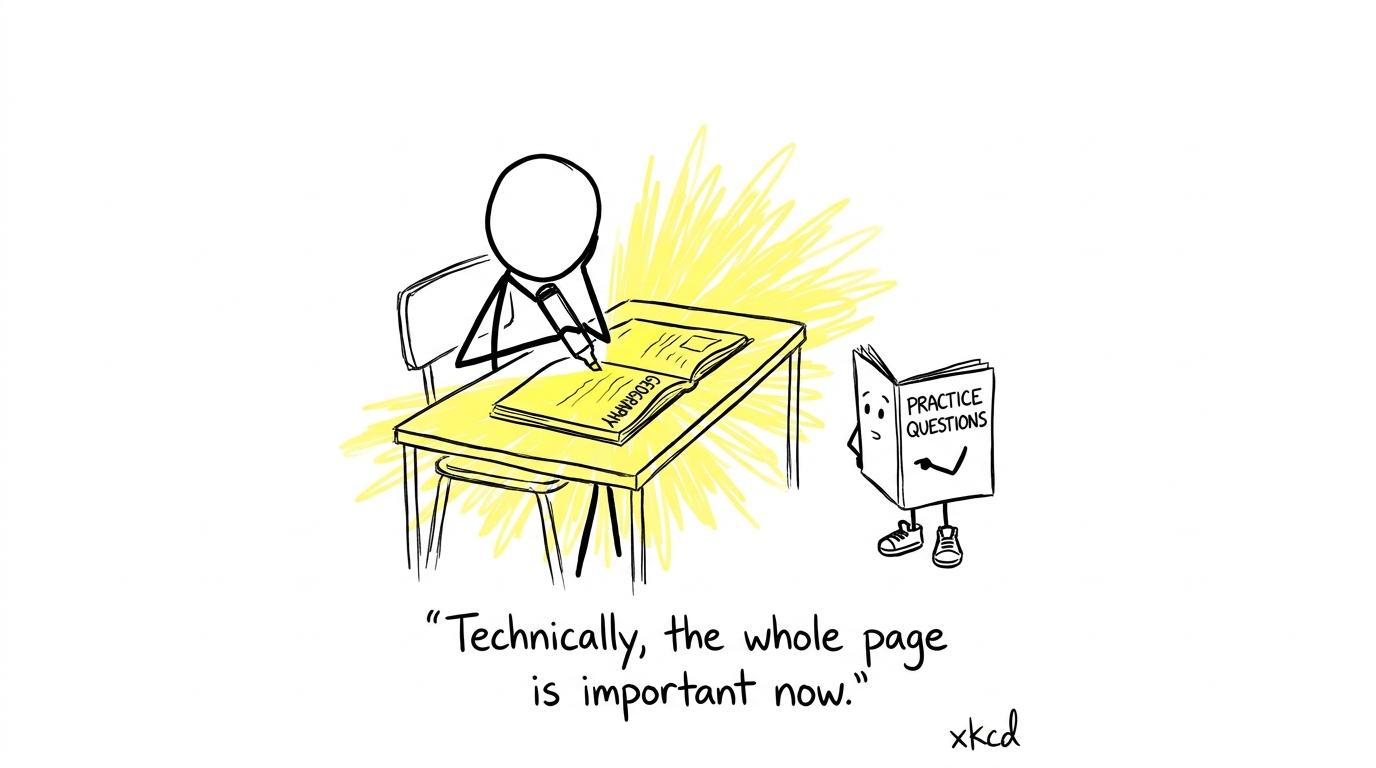 Student highlights an entire revision page
Questions matter more than summaries
Reading creates familiarity. Exams require retrieval, selection and application.
Before choosing a guide, inspect its practice section. Strong questions should include a mixture of short responses, data interpretation and extended writing. They should use realistic command words such as identify, describe, explain, assess and evaluate. Questions based only on copying definitions are not enough.
Answers matter just as much. A one-word answer may check recall, but it cannot show how an extended response develops an argument. Look for model material, clear marking guidance or explanations of why an answer earns credit.
No single book is likely to provide enough exam practice. Pair the guide with your board's official past papers and mark schemes. The same principle works in maths: MathsGenie's guide to when to start GCSE past papers explains how to move from short diagnostic tasks towards full timed papers.
For maths preparation alongside geography, Edexcel GCSE Maths predicted papers provide unseen practice after topic revision. Predicted papers should supplement past papers, not replace them.
Test whether the layout supports active revision
Design is useful when it reduces effort. It becomes a distraction when decoration replaces explanation.
Open a sample topic and ask yourself:
- Can I find the central idea quickly?
- Are diagrams clearly labelled?
- Can I cover the page and recall the content?
- Are examples separated from general principles?
- Is there space, physically or mentally, to add class notes?
- Does the page end with a question or retrieval prompt?
Dense pages are not automatically rigorous, and colourful pages are not automatically clear. The right layout is the one you can return to repeatedly without becoming lost.
Your revision guide should also fit a wider routine. The GCSE one-month maths revision plan uses a useful pattern that transfers well to geography: diagnose a weakness, revisit the content, answer questions, mark the work and return to the same skill later.
Use the guide as one part of a revision system
A book is a reference tool, not a complete revision strategy. Its value comes from what it persuades you to do next.
A productive geography session might follow this cycle:
- Recall a topic from memory before opening the guide.
- Read only to fill specific gaps.
- close the book and reconstruct the process or argument.
- Answer an exam-style question.
- Mark it and record what was missing.
- Revisit that weakness several days later.
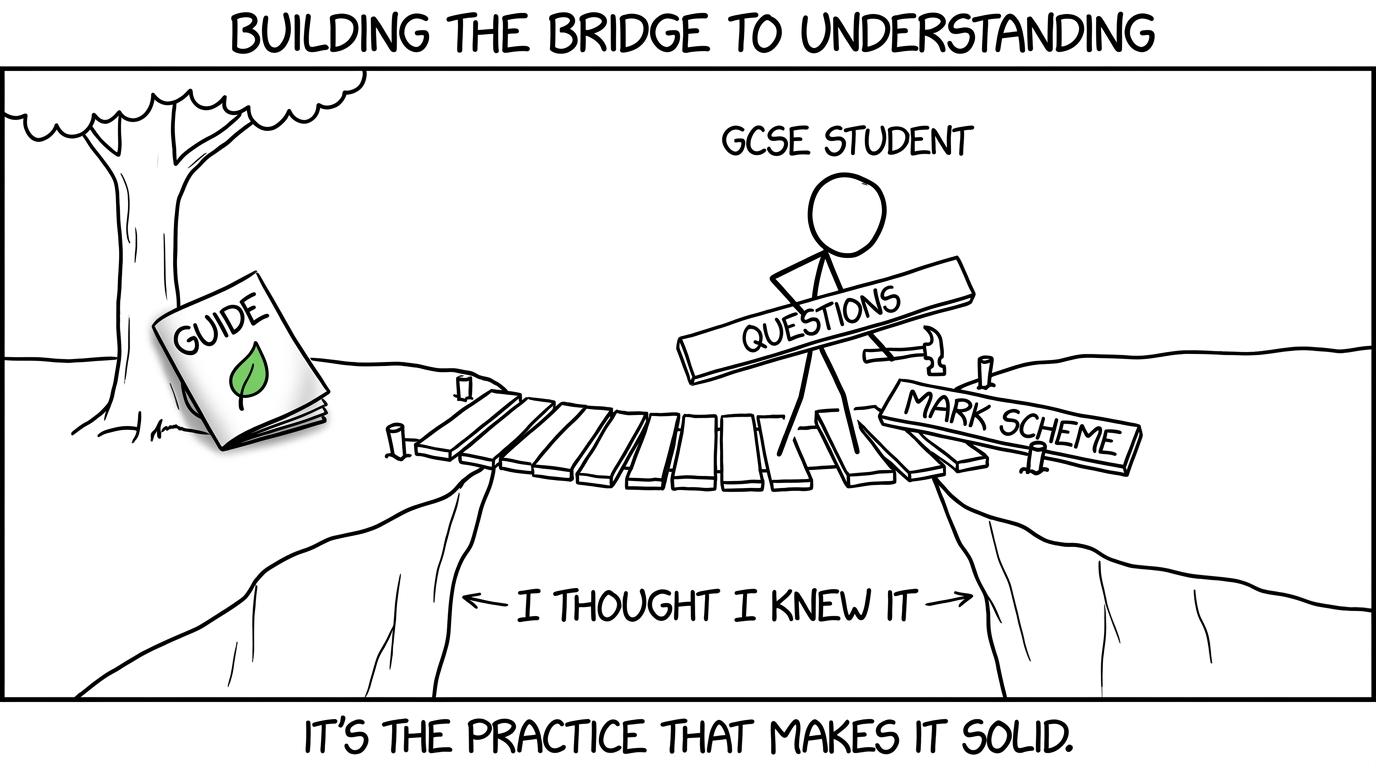 Guide, questions and mark scheme forming a bridge
This is why a modest guide used actively can outperform an expensive guide read passively. Revision quality is often less about owning more resources and more about creating a reliable feedback loop.
Common mistakes when choosing a revision guide
Buying the wrong board or course
Do not assume every GCSE Geography guide covers the same material. Check the exact qualification, including whether your course is Edexcel A or B, or the relevant OCR specification.
Choosing by page count
More pages can mean greater detail, but they can also make retrieval slower. Judge whether each topic has enough depth for your specification and questions, not whether the book looks substantial.
Ignoring fieldwork and skills
A guide that treats fieldwork, maps and data as minor appendices does not reflect how geographical understanding is assessed. Check these sections before buying.
Trusting every case-study fact automatically
Case-study details can become outdated or may not match the examples taught by your school. Cross-check them with your notes and teacher, particularly where data or management responses may have changed.
Confusing recognition with recall
Highlighted pages feel familiar because you have seen them before. Test whether you can explain the content with the book closed and apply it to a new source or question.
Using one resource for everything
A guide can teach and summarise, but official past papers reveal your board's wording and assessment style. Mark schemes, teacher feedback and targeted skills practice complete the picture.
Choose evidence over appearance
The best guide is not necessarily the thickest, newest-looking or most expensive. It is the one that matches your specification, gives case studies and fieldwork the right depth, teaches geographical skills clearly and leads you towards purposeful practice.
Check a sample chapter. Compare the contents with your course. Inspect the questions. Then choose the resource you are most likely to test yourself with, not merely highlight.
And when geography exposes a gap in percentages, graphs, averages, ratio or data handling, make MathsGenie your free maths revision base. Start with GCSE Maths revision, use revision lessons and practice questions to rebuild the skill, then check it with mini tests, past papers, predicted papers, mark schemes and video solutions. A good guide gives you information. A good revision system shows you what to do with it.