Best GCSE Arabic Revision Apps and Resources 2026
Best GCSE Arabic revision apps for 2026, with free videos, official papers and a practical plan for improving listening, speaking, reading and writing.
Revision apps make an attractive promise: open your phone, complete a few activities and watch your confidence rise. The reality is less automatic. The best GCSE Arabic revision apps are useful only when each one has a clear job: learning vocabulary, training your ear, improving pronunciation or testing recall.
For most students, the strongest 2026 toolkit is simple: Anki or Quizlet for vocabulary, carefully selected videos for explanations, a voice recorder for speaking, and official Pearson materials for exam practice. No single app covers the whole qualification.
That matters if you are balancing Arabic with GCSE maths and several other subjects. You do not need another endless stream of content. You need a small system that turns limited revision time into work you can reproduce in an exam.
Your GCSE Arabic revision checklist
Before downloading anything, check whether your resources can help you:
- learn vocabulary from the correct specification;
- hear and understand Modern Standard Arabic;
- retrieve words without seeing the answer first;
- practise speaking aloud and review recordings;
- write accurately under timed conditions;
- complete official reading and listening questions;
- compare answers with mark schemes or assessment criteria.
Pearson Edexcel GCSE Arabic, specification code 1AA0, assesses listening, speaking, reading and writing. Each skill contributes 25%25\%25% of the qualification. Students enter either foundation or higher tier across all papers, and dictionaries are not permitted in the assessments. That makes balanced, closed-book practice essential.
Unlike GCSE maths, where Edexcel, AQA, OCR and Eduqas all offer widely used specifications, you should not assume that an Arabic resource matches your qualification simply because it says “GCSE”. Check the exact specification code with your teacher or examinations officer.
The best GCSE Arabic revision apps at a glance
| App or resource | Best for | Main limitation | Verdict |
|---|---|---|---|
| Anki | Long-term vocabulary recall | Requires careful setup | Best for disciplined daily revision |
| Quizlet | Quick flashcards and class sharing | Public sets can contain errors | Best for ease of use |
| Memrise | General vocabulary and listening exposure | Not built around GCSE Arabic | Useful supplement |
| Duolingo | Maintaining a regular Arabic habit | Does not mirror GCSE exam tasks | Warm-up only |
| Voice recorder | Speaking practice and self-review | Provides no automatic exam feedback | Essential free tool |
| YouTube | Exam explanations and listening support | Quality and syllabus relevance vary | Valuable when selected carefully |
| Pearson materials | Specification, vocabulary and exam practice | Less gamified than an app | The non-negotiable core |
App features and free-access limits can change, so check the current version before relying on a particular study mode.
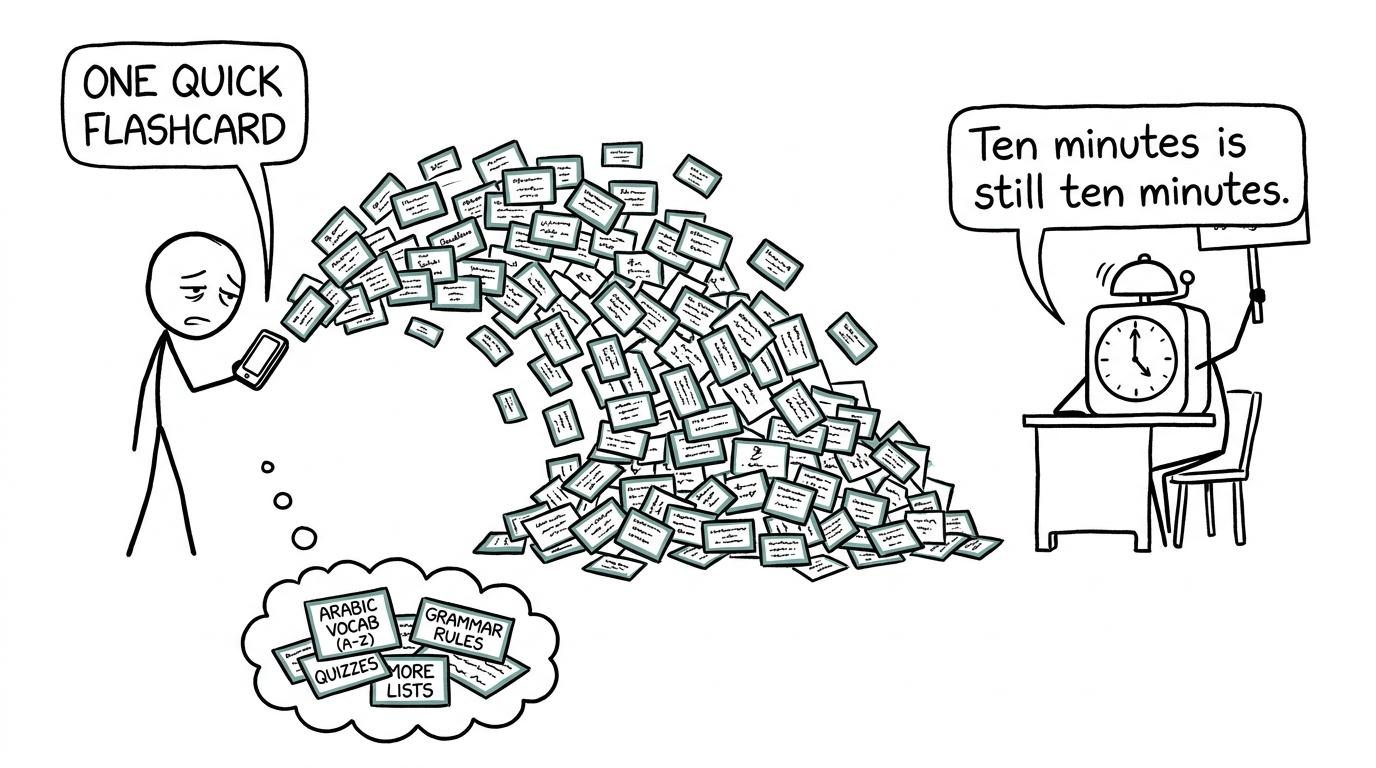 A student discovers that one quick flashcard can become an avalanche
Anki: best for serious vocabulary recall
Anki is the strongest choice if you want a flashcard system that decides when each word should return. It uses spaced repetition, bringing back difficult cards more frequently while delaying words you already know.
The desktop version is free, AnkiDroid is free on Android, and the official iOS app is paid. Anki and AnkiDroid support right-to-left languages, including Arabic, as well as text, images and audio.
Its strength is control. Create separate decks for themes, verbs, connectors, question words and phrases that you repeatedly miss in past papers. Better cards test recall in both directions: Arabic to English and English to Arabic. Audio cards can also support listening, although recordings should come from a reliable speaker or approved source.
The weakness is friction. Downloading a large community deck feels efficient, but an unknown deck may use dialect vocabulary, inconsistent spelling or content outside Edexcel 1AA0. Build from Pearson's vocabulary list and your teacher's materials wherever possible.
Quizlet: best for fast, accessible revision
Quizlet is easier to start. Its official tools allow students to create flashcards, search public sets and use mobile study activities. It is especially convenient when a teacher has shared a checked class set.
Use it for short bursts of active recall: topic vocabulary before a lesson, common verbs while travelling or connective phrases before writing practice. Typing an answer is generally more demanding than merely turning over a card, so choose modes that make you produce the word.
The enormous public library is both the attraction and the risk. Anyone can publish a set. Search results may contain transliteration instead of Arabic script, dialect forms, typing mistakes or vocabulary for a different course. Copy useful material into your own checked set rather than trusting the first result.
Memrise and Duolingo: useful, but not your main plan
Memrise can provide general Arabic vocabulary, audio and exposure to language in context. Duolingo can help beginners maintain a habit and reinforce script recognition or basic sentence patterns. Both can make starting feel easier.
Neither should become the centre of GCSE preparation. Your examination tests defined themes and specific tasks, including translation, extended writing, listening comprehension and a structured speaking assessment. A general language course cannot guarantee that coverage.
Treat these apps as warm-ups. Ten minutes of broad language practice may help consistency, but it should lead into specification vocabulary or an exam task. A streak records attendance. It does not prove exam readiness.
The free resources worth your time
Pearson's specification and assessment materials
The official Pearson Edexcel specification is the best starting point because it defines the qualification rather than interpreting it. It includes the themes, grammar expectations and an extensive core vocabulary list. Pearson also provides sample assessment materials, while its qualification pages host available papers, mark schemes and listening files.
Build every app around this official material. If a flashcard deck cannot be connected to a specification theme, ask whether it deserves your limited time.
Past papers reveal something apps often hide: vocabulary is only one part of performance. You also need to recognise distractors, follow instructions, manage time and communicate the requested information. This is the same reason using GCSE past papers properly matters in maths; questions create evidence about what you can actually do.
YouTube channels and exam-focused videos
YouTube can be valuable when a video explains a precise paper rather than simply teaching general Arabic. Search for current videos covering Pearson Edexcel GCSE Arabic 1AA0 and the individual skills.
Recent Arabex videos have addressed Edexcel reading, listening and writing tasks. Learn Arabic Daily also has syllabus-linked vocabulary videos, including material organised around Edexcel themes. Older videos can still teach useful language, but confirm that the paper structure and specification code remain relevant.
Use videos actively:
- pause before the teacher gives an answer;
- write down the decision you would make;
- replay short audio without subtitles;
- note one exam technique to test immediately;
- finish with a related official question.
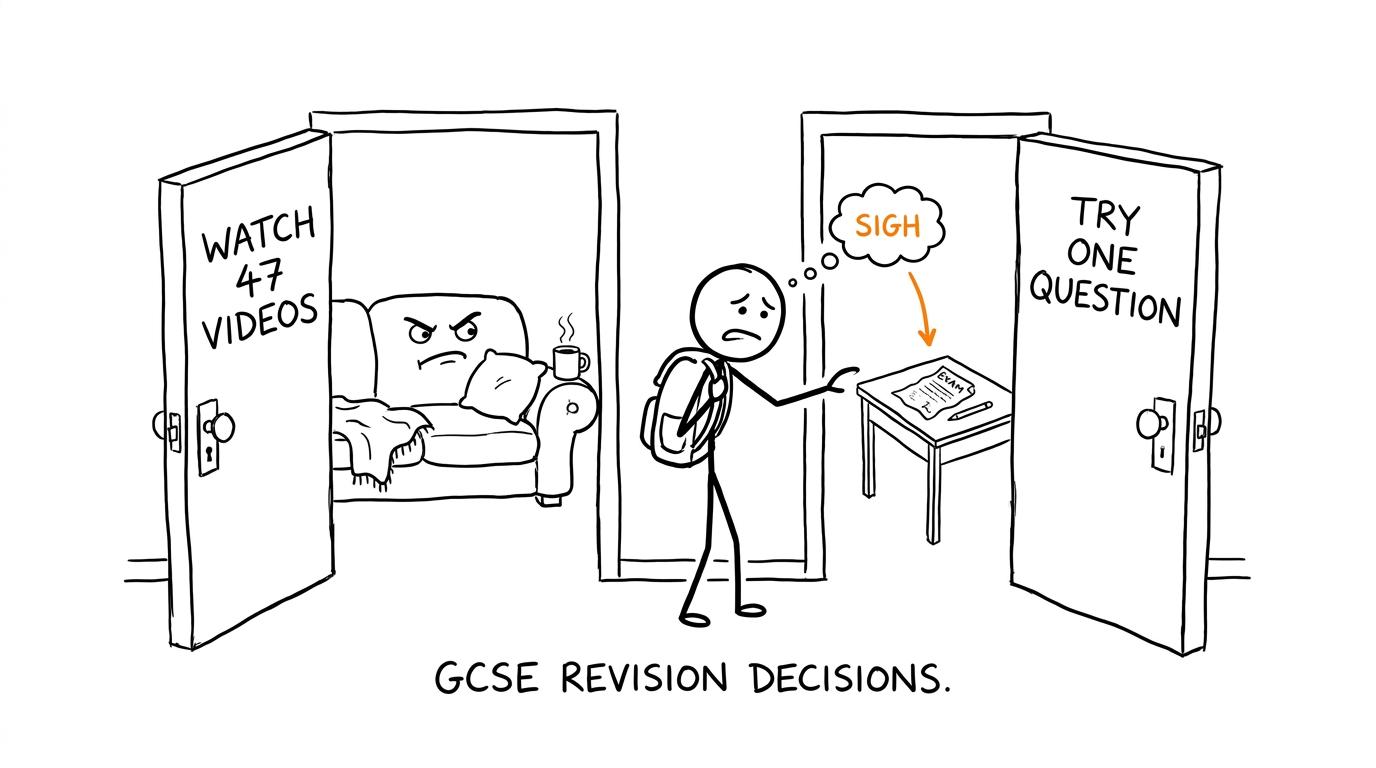 A revision video competes with the less comfortable option of attempting a question
Watching an explanation can feel like progress because everything makes sense while the teacher is speaking. The useful test comes afterwards, when the screen is closed.
Your phone's voice recorder
The least glamorous app may be the most revealing. Record yourself answering a speaking prompt, then listen without looking at your notes.
Check whether you:
- answered the exact question;
- used more than one time frame where appropriate;
- gave and justified opinions;
- pronounced words clearly enough to communicate;
- paused because of missing vocabulary;
- repeated one safe phrase too often.
Automatic speech scores are not a substitute for a teacher's judgement. A basic recorder is still powerful because it exposes hesitation and unclear delivery that silent revision cannot show.
A revision system that works across Arabic and maths
Students often organise each subject differently: flashcards for Arabic, videos for maths and vague rereading for everything else. A more reliable approach uses the same loop:
retrieve, attempt, mark, fix and return.
For Arabic, retrieve vocabulary, attempt an exam task, check the mark scheme or teacher feedback, repair the missing language and revisit it later. For maths, the equivalent is a revision lesson followed by questions, marking and a mini test.
MathsGenie's 20-minute GCSE maths revision routine provides a useful structure for busy school days. Adapt the rhythm for Arabic:
- five minutes of vocabulary retrieval;
- ten minutes on one listening, reading, speaking or writing task;
- five minutes checking errors and preparing tomorrow's review.
Rotate the four skills rather than choosing whichever feels easiest. Use a weekly plan similar to the GCSE maths revision timetable, giving extra sessions to the skill currently costing you the most marks.
Do not wait until you feel “ready” for papers. The guidance in when to start GCSE past papers applies here too: begin with short sections, then build towards complete timed assessments.
How to choose what deserves space on your phone
Keep an app if it passes three tests.
It matches the specification
Look for Modern Standard Arabic, relevant Edexcel themes and the correct task types. General fluency is valuable, but the months before an examination require tighter alignment.
It makes you retrieve language
Recognition is easier than recall. An app that continually shows multiple-choice answers can create confidence without strengthening independent production. Prioritise typing, speaking, translation and closed-book responses.
It produces useful feedback
The app should reveal a next step. That might be a list of forgotten cards, a recording containing hesitant phrases or a marked paper showing weak reading questions.
MathsGenie's approach to finding your weakest GCSE topics transfers neatly: record the error, label the skill, practise the smallest missing part and retest it.
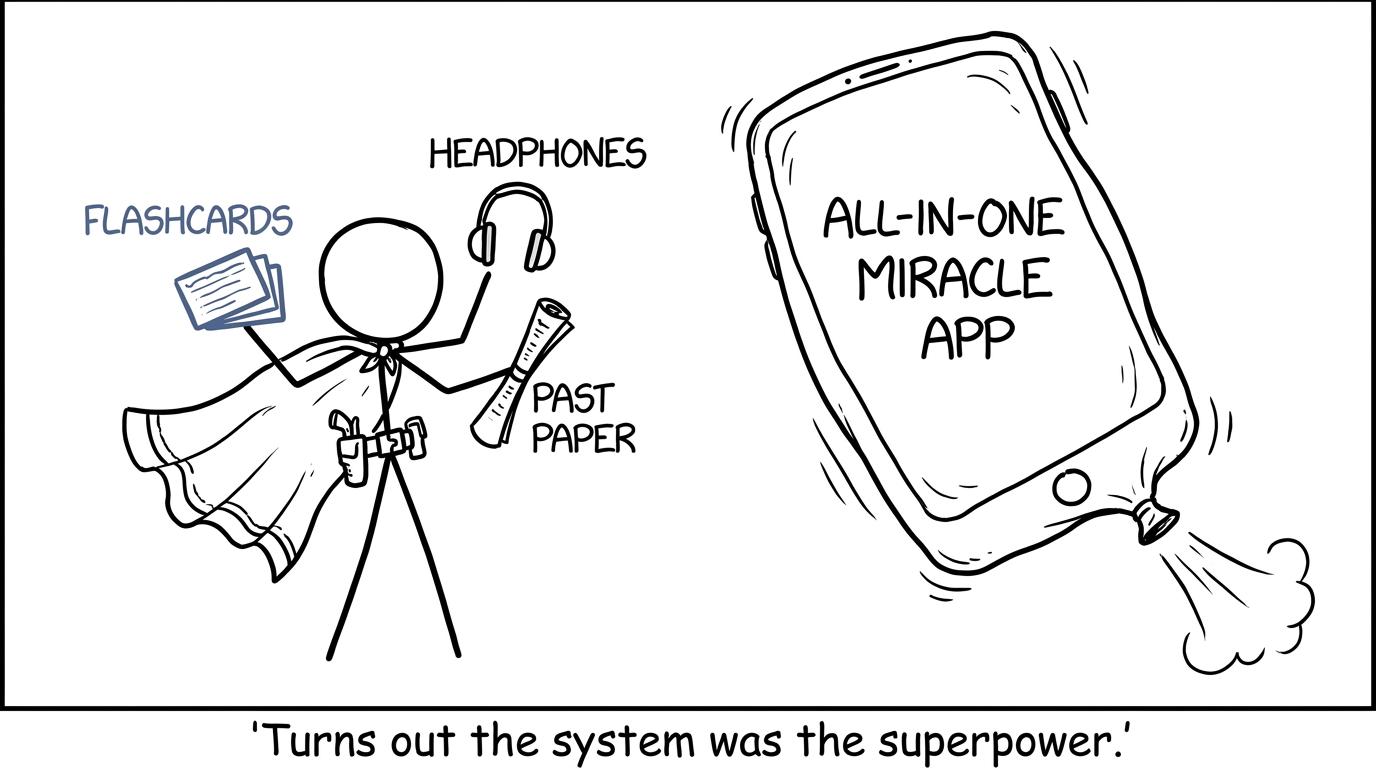 A student equips themselves with flashcards, headphones and a past paper
Common GCSE Arabic revision mistakes
Using dialect when the exam expects Modern Standard Arabic. Spoken dialects are valuable in real life, but check vocabulary and structures against the specification and teacher guidance.
Collecting apps instead of practising. Downloading five platforms creates more choices, not necessarily more learning. One flashcard app, one source of audio and official papers are enough.
Trusting unchecked public decks. Verify spelling, meaning, gender, plurals and verb forms before memorising them.
Revising vocabulary without sentences. Individual words help recognition, but writing and speaking require grammar, opinions, reasons and accurate connections between ideas.
Ignoring listening until late. Reading a transcript is not listening practice. Use the official audio, attempt the questions first and inspect the transcript only afterwards if available.
Watching solutions without attempting the task. The effort before feedback is what makes feedback meaningful.
Completing papers without analysing errors. A mark alone tells you very little. Separate vocabulary gaps, misunderstood instructions, grammar errors, timing problems and careless omissions.
Build a small toolkit and use it consistently
The best revision setup is rarely the one with the most features. It is the one you will use deliberately: Anki or Quizlet for checked vocabulary, exam-focused videos for explanation, a voice recorder for speaking, and Pearson materials for realistic practice.
Then protect time for your other subjects. Use the free GCSE maths revision hub for board-specific lessons, practice questions and papers, or follow a one-week maths revision plan when time is tight. Near the examinations, MathsGenie's Edexcel predicted papers, mini tests, mark schemes and video solutions can turn mistakes into a precise revision list.
Apps are tools, not plans. Choose fewer of them, connect each one to an exam skill and let regular retrieval do the quiet work.