Apprenticeship GCSE Religious Studies Requirement
Apprenticeship GCSE Religious Studies requirement explained: learn which routes may ask for RS, how to check vacancies and what to do if your grade is low.

A list of apprenticeship entry requirements can make one disappointing GCSE result feel larger than it is. You see English, maths and perhaps science. Then you wonder whether every other subject might quietly matter too.
Here is the direct answer: an apprenticeship GCSE Religious Studies requirement is very unusual. There is no general rule requiring a particular GCSE Religious Studies grade for apprenticeships in England, and current national apprenticeship standards do not routinely specify one. Even church ministry and chaplaincy-related routes generally focus on employer selection, suitability, safeguarding, English and maths rather than a named RS grade.
An individual employer can still set its own criteria. The vacancy advert, not a universal list, is therefore the decisive document.
The short checklist
Before worrying about your RS result, check these five things:
- Does the advert name Religious Studies, Religious Education, theology or simply a relevant subject?
- Is the requested grade described as essential or desirable?
- Does it ask for a total number of GCSEs rather than a named RS grade?
- Are English and maths listed separately?
- Can the employer consider equivalent qualifications, predicted grades or relevant experience?
If RS is not named, do not turn it into an unofficial requirement in your own mind.
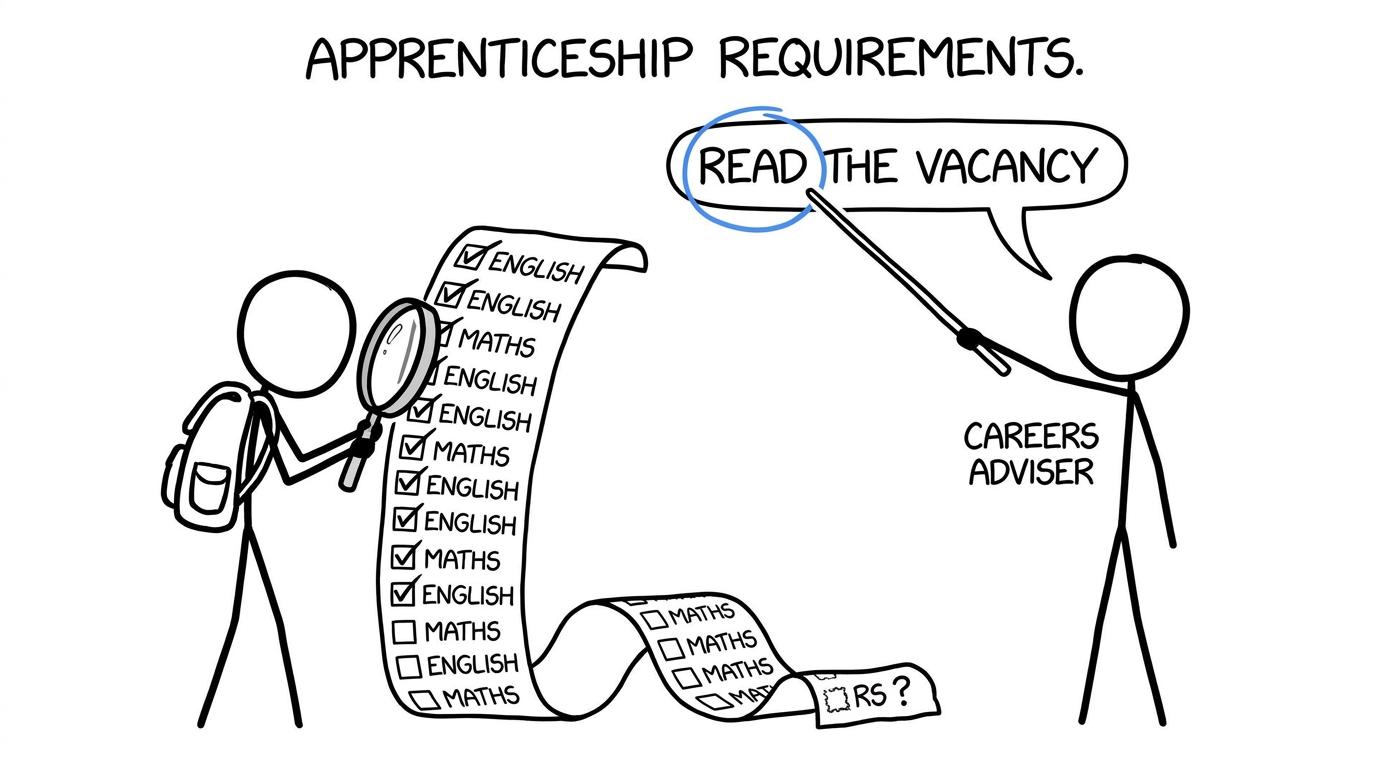 A student searching an apprenticeship checklist for a hidden RS requirement
Which apprenticeship routes require GCSE Religious Studies?
At national route level, none of the mainstream apprenticeship categories has a standard minimum GCSE Religious Studies grade. Engineering, construction, digital, business, finance, healthcare, legal, education and public-service apprenticeships may specify particular qualifications, but those are much more likely to include English, maths, science or a relevant technical subject.
The same distinction applies to apprenticeship levels. A Level 222 route may have different entry expectations from a Level 333, higher or degree apprenticeship, but the level itself does not create an RS requirement. In England, Level 222 is broadly associated with GCSE-level learning, Level 333 with A Level standard, and higher and degree apprenticeships extend from Levels 444 to 777.
Entry criteria are set vacancy by vacancy. One employer may accept applicants without a fixed set of GCSE grades. Another may ask for five GCSEs at grades 999-444, including English and maths. A competitive technical vacancy could ask for a higher maths or science grade. None of those statements automatically means that RS must be one of the five subjects.
Faith, ministry and chaplaincy apprenticeships
These routes are the most obvious place to expect an RS condition, yet even here a specific GCSE RS grade is not normally built into the apprenticeship standard.
For example, the Church Minister Level 666 Degree Apprenticeship leads to a degree in theology and ministry. Its published standard leaves selection criteria to the employer or appointing body. Depending on the denomination, those criteria may involve suitability for ministry, church experience, references, safeguarding checks or eligibility for ordination. The standard addresses English and maths under apprenticeship funding rules, but it does not prescribe a GCSE RS grade.
Individual chaplaincy or youth-ministry programmes can have their own academic expectations. Current examples may request Level 333 qualifications and passes in GCSE English and maths while teaching a religious qualification within the programme. That is different from demanding a previous GCSE in Religious Studies.
This leads to an important conclusion: a religious occupation is not the same thing as an RS-grade requirement. Faith commitment, practical experience, theological learning, references and safeguarding suitability may carry more relevance than one school subject result.
Education and teaching-related routes
An apprenticeship connected to education may ask for GCSEs in English, maths and, for some pathways, science. A role based in a faith school might value knowledge of religion or familiarity with the school's ethos. However, that does not establish a universal GCSE RS threshold.
If the job is specifically connected to supporting Religious Education, an employer could reasonably describe RS as desirable or ask for evidence of subject knowledge. Read the precise wording. “GCSE Religious Studies preferred” gives the employer more discretion than “GCSE Religious Studies at grade 555 or above is essential”.
Roles where RS can still strengthen an application
Religious Studies develops skills that can be useful in many occupations: constructing arguments, weighing evidence, discussing ethical questions and understanding different beliefs. These qualities may support applications for law, policing, healthcare, social care, education, public service and community work.
That makes RS valuable without making a particular grade compulsory. Your application can explain the relevant skill rather than assuming that the subject title speaks for itself.
Why English and maths appear more often
English and maths have a distinct place in apprenticeship rules and employer recruitment. For school-leavers, providers must consider whether the apprentice already holds suitable English and maths qualifications and what further learning may be needed. Exact arrangements depend on age, apprenticeship level, funding rules and individual circumstances.
Employers also use these subjects as evidence of everyday workplace skills. Maths can matter when interpreting measurements, checking costs, reading data or estimating quantities. English supports communication, reports, instructions and customer contact.
This is why protecting your maths grade may open more doors than worrying about a subject the vacancy never mentions. MathsGenie's guide to apprenticeship GCSE grade requirements explains how requirements vary between employers and levels.
If maths is one of the grades standing between you and a route, begin with the free GCSE Maths revision hub. It brings together board-specific support for Edexcel, AQA, OCR and Eduqas, with foundation and higher-tier resources.
How to read an apprenticeship vacancy properly
A vacancy should separate facts from preferences. Your task is to do the same.
Essential requirements
An essential requirement is normally used during shortlisting. If the advert demands GCSE RS at a stated grade and you do not hold it, contact the employer or training provider before applying. Ask whether an equivalent qualification, a pending result or strong relevant experience can be considered.
Do not claim a grade you do not have. A clear question creates a better impression than an inaccurate application.
Desirable requirements
“Desirable”, “preferred” and “advantageous” usually indicate qualities that may strengthen an application but are not necessarily automatic barriers. You can still apply, provided you meet the essential criteria.
Use your application to supply other evidence: volunteering, work experience, participation in a faith or community organisation, reading around the subject, or strong performance in another essay-based GCSE.
A total number of GCSEs
An advert might request five GCSEs at grades 999-444, including English and maths. Unless other subjects are named, RS can usually count as one of the remaining qualifications, but it does not have to be one of them.
Likewise, a low RS result may not matter if your other GCSEs satisfy the required total. Count only qualifications and grades that meet the exact wording.
 A student choosing between essential and desirable requirements
What to do if your RS grade is below the requirement
First, establish whether the requirement is real. Check the current vacancy rather than an old forum post, general careers page or remembered conversation. Apprenticeship vacancies can change between employers and recruitment years.
If the advert genuinely names a higher RS grade, take these steps:
- Contact the named recruiter or provider. Ask whether the threshold is firm and whether equivalent evidence is accepted.
- Mention predicted grades accurately. If you are awaiting results, follow the advert's instructions and make clear that the grade is predicted.
- Show relevant experience. Faith-based volunteering, youth work, community activity or engagement with ethical issues may demonstrate suitability.
- Consider a related vacancy. The same occupation with another employer may have different entry criteria.
- Ask your school about a review or resit. This is sensible only where there is a sound academic reason and a higher grade is genuinely needed.
- Strengthen the compulsory subjects. Better English and maths results can widen the overall range of vacancies available.
A missing desirable grade is not an instruction to reject yourself. Apply honestly and let the employer make the decision.
Turn uncertainty into a maths revision plan
Career requirements can be useful because they turn an abstract target into something concrete. “I should improve at maths” is vague. “This Level 333 vacancy asks for grade 444 in maths” creates a clear destination.
Start by identifying the topics currently costing you marks. The guide to finding your weakest GCSE topics explains how to diagnose gaps using evidence rather than guesswork. Then place those topics into the free MathsGenie revision planner.
Short practice can build momentum. The Edexcel GCSE Maths mini tests provide focused, timed checks with mark schemes and worked solutions where available. When you are ready for full exam conditions, use the Edexcel GCSE Maths past papers, or select the corresponding board through the main GCSE hub.
The important sequence is simple: attempt, mark, diagnose, relearn and retest. MathsGenie's guide to using GCSE past papers properly shows how to turn each lost mark into a revision decision. Predicted papers can then provide additional exam-style rehearsal, but they should complement full specification revision rather than replace it.
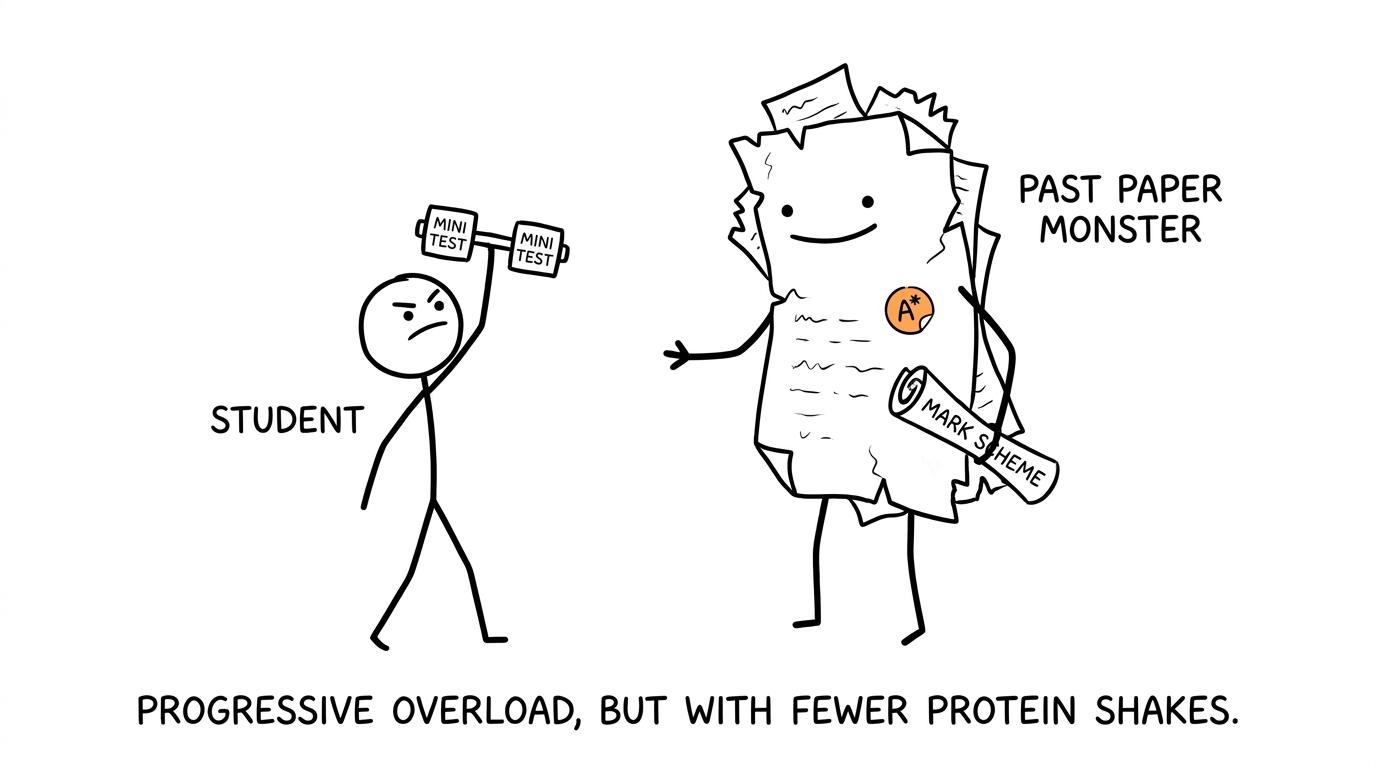 A student building towards a full past paper with mini-test training
Common mistakes when checking GCSE requirements
Assuming every GCSE matters equally
Employers frequently name English and maths because those subjects have particular practical and funding significance. Do not assume that a lower grade in an unnamed subject carries the same weight.
Confusing a useful subject with a required subject
RS may be relevant to ministry, education or community work. Relevance does not automatically create an entry condition.
Treating “desirable” as “essential”
This can stop a suitable student applying. Read the headings and wording carefully before deciding that you are ineligible.
Using general route information instead of the vacancy
A broad careers page can explain what is typical, but only the live advert tells you what that employer currently requires.
Ignoring maths while worrying about RS
For many apprenticeships, maths is much more likely to be explicitly named. If it needs attention, use MathsGenie's GCSE revision resources to work from topic lessons and practice questions towards mini tests, past papers and predicted papers.
Your next step
For almost every student, the answer is reassuring: a specific GCSE Religious Studies grade is not a standard apprenticeship requirement. Even faith-related routes usually use broader selection criteria. The rare exception would come from an individual employer or programme that explicitly names RS in its vacancy.
So read the advert line by line. Separate essential conditions from desirable qualities. Ask when the wording is unclear, and never disqualify yourself because of a requirement that was not actually written.
Then focus your effort where it can create the most options. Open MathsGenie's free revision lessons, practise the topics losing you marks, check your work with mark schemes and video solutions, and build towards mini tests, past papers and predicted papers. One grade need not define the route ahead, but a calm, evidence-based revision plan can widen it.