Apprenticeship GCSE Astronomy Requirement Explained
Apprenticeship GCSE Astronomy requirement explained: see which routes ask for it, what employers want and what to do if your grade falls short.
A careers page can make a small line of text feel surprisingly large. You find an apprenticeship involving satellites, aerospace or space systems, then wonder whether the GCSE subject you chose, or the grade beside it, controls your future.
The short answer is reassuring: an apprenticeship GCSE Astronomy requirement is extremely unusual. Current national apprenticeship standards and the space-related vacancies reviewed for this article do not set a specific minimum GCSE Astronomy grade. Employers are far more likely to request GCSE Maths, English and a science, sometimes alongside relevant A Levels for degree apprenticeships.
However, employers set their own recruitment criteria. You must therefore read the exact vacancy rather than assume that every programme follows the same rules.
The quick answer and application checklist
Before applying, check these five things:
- Does the vacancy name GCSE Astronomy, or does it simply ask for a science subject?
- Is the stated grade essential, preferred or only described as typical?
- Does it accept equivalent qualifications or relevant experience?
- Are there separate requirements for GCSE Maths, English and science?
- Does a university or training provider impose additional entry conditions?
No mainstream apprenticeship route identified in the current official standards reviewed here requires GCSE Astronomy specifically. That includes routes connected with space engineering, space systems and aircraft maintenance. Individual vacancies can still differ, so the advertisement remains the final authority.
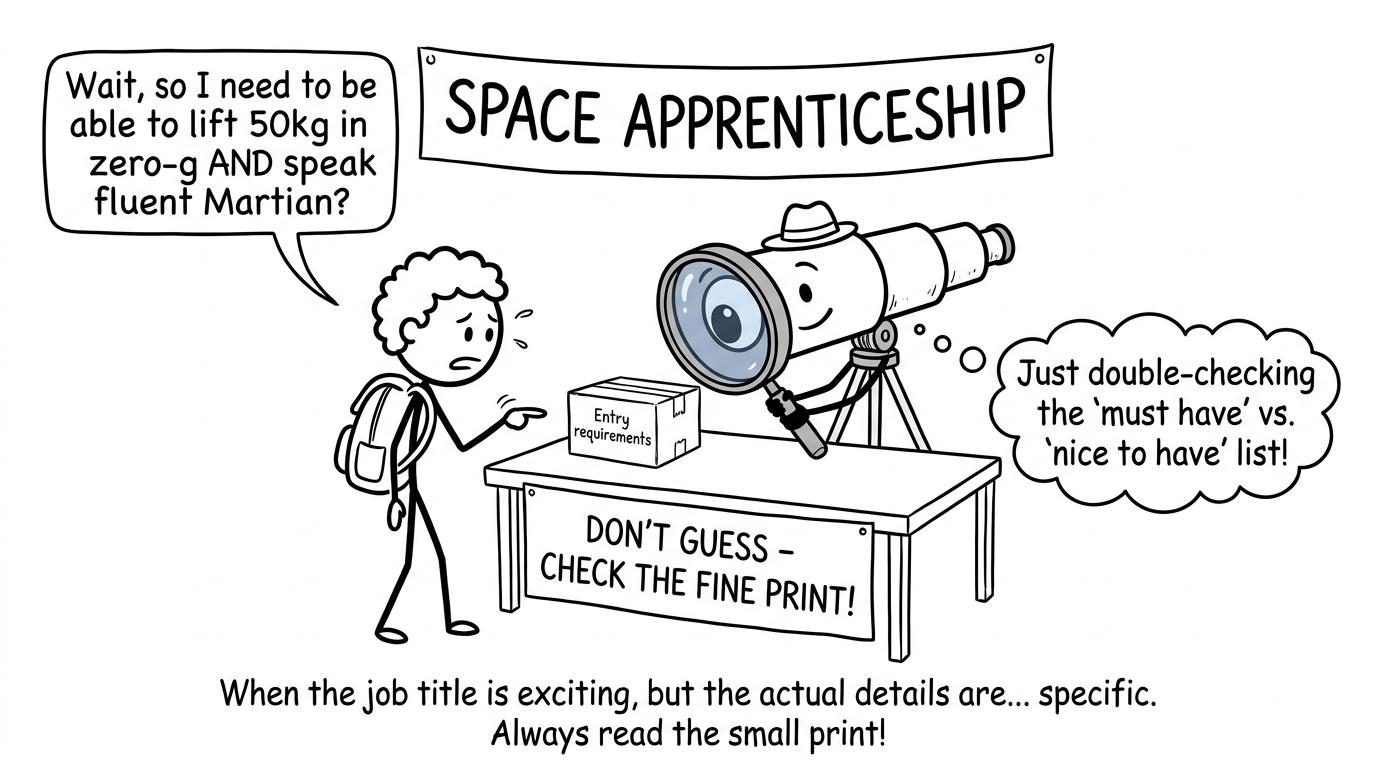 A student and telescope inspect the small print on a space apprenticeship vacancy
Which apprenticeship routes require GCSE Astronomy?
Space engineering technician apprenticeships
This is perhaps the route most likely to make a student worry about Astronomy. Yet the current Level 444 Space Engineering Technician standard gives a typical entry profile rather than a compulsory Astronomy grade.
The profile includes five GCSEs covering English, maths and science-based subjects. It indicates grades 444 to 999 for those subjects, with a stronger typical maths requirement of grades 666 to 999. Individual employers still set their selection criteria.
Astronomy could therefore support an application as a science-based subject, depending on the employer's wording. It is not listed nationally as a compulsory named GCSE.
Space systems engineering degree apprenticeships
Degree apprenticeships usually focus more heavily on Level 333 qualifications. A recent official space systems engineering vacancy required GCSE passes including English, Maths and a science, followed by A Levels including Maths and another science, technology, engineering or maths subject. It did not specify GCSE Astronomy.
This distinction matters. An interest in astronomy may lead you towards the role, but the technical gateway is more likely to be mathematics, physics, engineering or another accepted STEM qualification.
Aerospace and aircraft maintenance apprenticeships
Official guidance for aircraft maintenance technicians says employers set their own recruitment criteria. A typical candidate may have four GCSEs at grade 444 or above, including Maths, English and a science.
Large aerospace employers commonly publish similar expectations for craft and technician programmes: several GCSEs including Maths, English Language and science. Degree routes may also ask for A Levels or equivalent Level 333 qualifications.
Again, GCSE Astronomy may be relevant evidence of scientific interest, but it is not normally the named requirement.
Observatory, laboratory and technical routes
There is no single national “astronomer apprenticeship” with a universal GCSE Astronomy threshold. Work connected with observatories or astronomical research may instead be reached through apprenticeships in engineering, laboratory science, data, software, electronics or digital technology.
Those routes tend to prioritise the subjects needed for daily work. Depending on the role, that may mean Maths, English, science, computing or particular Level 333 qualifications. Always search by occupation as well as by interest: “data technician” or “engineering technician” may reveal more suitable opportunities than searching only for “astronomy”.
Why maths usually matters more than GCSE Astronomy
Space-related work is built on measurement. Engineers interpret graphs, rearrange formulae, work with very large and very small quantities, estimate tolerances and decide whether an answer is reasonable.
Astronomy itself uses many of the same foundations. Scale, ratio, coordinates, trigonometry, statistics and standard form all appear naturally when describing objects and distances that cannot be handled conveniently with ordinary numbers.
That is why an employer may ask for a particular Maths grade even when it does not mention Astronomy. The grade is being used as evidence that you can cope with the programme's technical content.
If this is the part of your application that needs attention, use the GCSE Maths topics by exam board and tier to identify what Edexcel, AQA, OCR or Eduqas expects. For a structured route through the course, the best order for learning GCSE Maths topics helps you build from number fluency towards algebra, graphs and higher-tier skills.
Students interested in scientific careers should pay particular attention to standard form revision. Statistics also matters in technical work, and the Edexcel GCSE Statistics revision hub provides lessons, questions and papers for students taking that qualification.
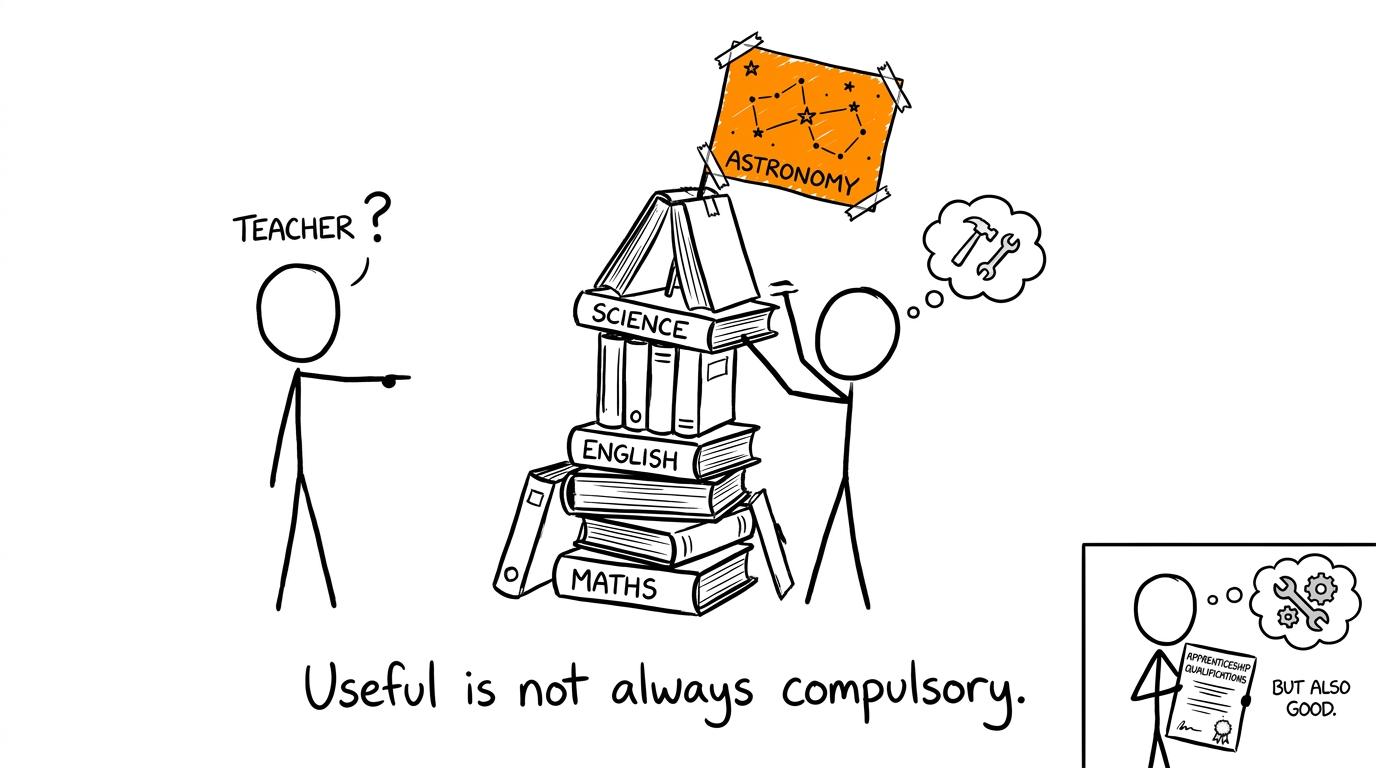 A student builds a revision rocket while Astronomy flies as its flag
Is GCSE Astronomy still valuable?
Yes. “Not compulsory” does not mean “not useful”.
Pearson Edexcel's current GCSE Astronomy is an untiered qualification graded from 999 to 111. Its specification includes observational astronomy, planetary motion, gravity, telescopes, starlight, stellar evolution and cosmology. Students complete two externally examined papers and undertake aided and unaided observations during the course.
That can give you useful evidence for an application:
- sustained interest in space and scientific ideas;
- experience of planning and evaluating observations;
- confidence with data, graphs and calculations;
- the ability to connect mathematical models with physical evidence;
- informed reasons for wanting a space-related career.
Present the subject as evidence, not as a substitute. If a vacancy explicitly requires GCSE Physics or Combined Science, do not assume Astronomy automatically counts. Ask the employer or training provider whether it is accepted as an equivalent science qualification.
What to do if you are short of the stated grade
Check the wording before ruling yourself out
“Must have”, “essential” and “a conditional offer requires” normally indicate a firm threshold. “Preferred”, “desirable” and “typically” leave more room for the employer to consider the whole application.
A typical entry profile in an apprenticeship standard is not always the same as a legal or universal entry requirement. The actual vacancy may be stricter, more flexible or simply different.
Contact the employer or training provider
If GCSE Astronomy is named and you are one grade short, ask a precise question. State your achieved or predicted grade, list your other relevant qualifications and ask whether alternatives are accepted.
Useful evidence might include a stronger Maths or Physics grade, Combined Science, relevant project work, coding, electronics, observational experience or another STEM qualification. The employer decides what counts, so obtain an answer rather than guessing.
Apply where you meet the essential criteria
A near miss does not make every route unavailable. Search for related programmes with broader science requirements, including space engineering, aerospace manufacturing, aircraft maintenance, software, data and laboratory apprenticeships.
In England, foundation apprenticeships are designed as an entry route and do not require specific grades or qualifications, although age and eligibility rules apply. Apprenticeship systems and funding rules differ across England, Scotland, Wales and Northern Ireland, so check the official service for the nation where you live and work.
Strengthen the qualification that appears repeatedly
If ten vacancies ask for Maths and none asks for Astronomy, that is useful information. Put your revision time where it opens the most doors.
Start with revision lessons and focused practice questions, then test whether the skill survives under exam conditions. Edexcel GCSE Maths predicted papers provide fresh exam-style practice, while the advice on when to start GCSE past papers can help you move from short mini tests to complete timed papers.
If you are considering a resit, ask your school, college or training provider about availability, deadlines and funding. Requirements can depend on your age, programme and location.
How to compare apprenticeship requirements properly
Build a simple shortlist for each vacancy. Record:
- apprenticeship title and level;
- employer and training provider;
- essential GCSE subjects and grades;
- required A Levels, T Levels, BTECs or equivalents;
- preferred subjects or experience;
- application deadline;
- any residency, right-to-work, travel or security-vetting conditions.
This prevents one striking requirement from distorting the whole picture. Space and defence vacancies can include eligibility conditions beyond academic grades, while degree apprenticeships may have both employer and university requirements.
Recheck the live advertisement immediately before applying. Recruitment criteria can change between employers and between annual intakes.
Common mistakes when reading entry requirements
Treating “science” as an automatic match
Astronomy is a science qualification, but an employer may use “science” to mean Physics, Chemistry, Biology, Combined Science or a qualification from its own accepted list. Confirm what the wording covers.
Confusing the apprenticeship level with the required grade
A Level 444 apprenticeship is not asking for GCSE grade 444 merely because the numbers match. Apprenticeship levels describe the educational level of the programme; GCSE grades report attainment in a subject.
Looking only at the job title
A glamorous title can hide the most important information. Read the qualifications, duties, training course and eligibility sections before investing time in the application.
Ignoring predicted grades
Some employers accept applications while you are still working towards GCSEs and may make conditional offers. Enter predicted grades accurately and explain when final results will be available.
Revising without learning from mistakes
Completing paper after paper is not enough. Mark each attempt, identify the topics costing marks and return to targeted questions. The guide to revising Edexcel GCSE Maths efficiently explains how to turn each lost mark into a specific next action. Near the exam, use a calm GCSE Maths night-before plan rather than trying to relearn the entire specification.
Keep the requirement in perspective
The evidence is clear: there is no standard apprenticeship route currently identified that sets a universal minimum GCSE Astronomy grade. Space and aerospace programmes usually care more about Maths, English, science and, for higher or degree routes, suitable Level 333 qualifications.
GCSE Astronomy can still make your application richer. It shows curiosity directed with discipline. But the sensible strategy is to check every live vacancy, ask about ambiguous wording and strengthen the qualifications that employers repeatedly name.
MathsGenie can help you do that without adding cost or confusion. Begin with a revision lesson, practise the skill through exam questions and mini tests, then move to past papers and predicted papers. Use the mark schemes and video solutions to find where your method failed, update your revision plan and try again. The stars may inspire the destination, but steady maths revision helps build the route.