

A-Level Sociology Grade Boundaries: Results Day 2026
A-level sociology grade boundaries explained for results day 2026, including total marks, a worked example and what to do if your grade is unexpected.
The few seconds before opening your results can make two years of work feel as though it has been compressed into one envelope. If you are searching for A-level sociology grade boundaries, the essential answer is simple: a boundary is the minimum total mark required for a grade, and the official 2026 boundaries will not be known until results day.
For students in England, A-level results day is Thursday 13 August 2026. Exam boards set boundaries after reviewing how students performed and how demanding the papers proved to be. That is why last year's figures can provide context, but cannot reliably predict this year's grade.
Results day checklist
Before interpreting your Sociology result:
- confirm your exam board and specification;
- find your overall qualification mark, if your school provides it;
- use the official boundary table for the correct 2026 exam series;
- compare your total mark with the qualification boundary, not an isolated paper;
- speak to your school or college before requesting a review of marking.
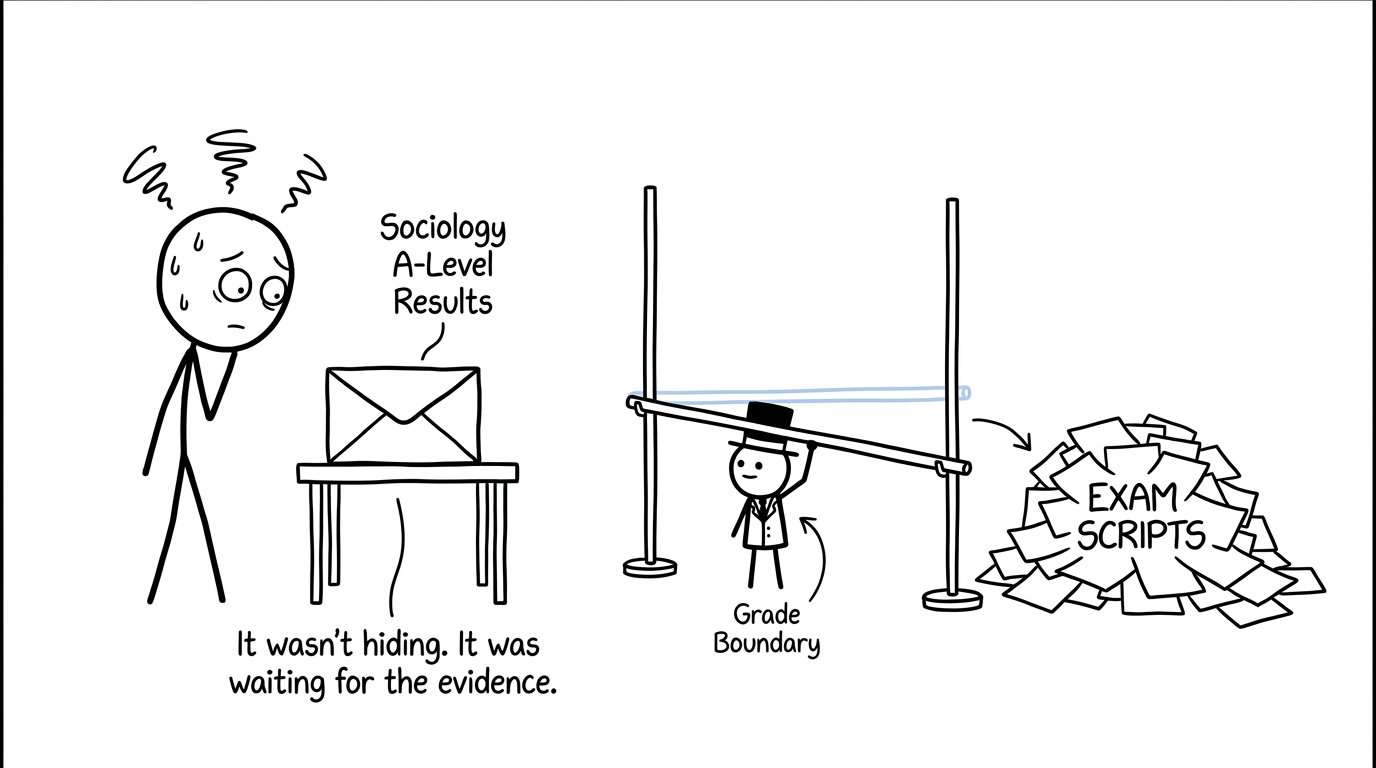 A grade boundary waits for the evidence before moving
How A-level Sociology grade boundaries work
A grade boundary is the lowest mark that earns a particular grade. If an A boundary were 168168168, for example, a total of 168168168 would receive an A, while 167167167 would fall into the grade below unless another process changed the mark.
Boundaries are not fixed percentages that remain unchanged each year. Awarding organisations use evidence from the completed assessments to maintain comparable standards. Broadly, a more demanding set of papers may lead to lower boundaries, while a less demanding set may lead to higher ones. This adjustment is intended to stop students being advantaged or disadvantaged simply because their paper happened to be harder or easier.
The boundary does not add or remove marks from your script. Examiners award marks using the mark scheme; the grade boundary then converts your final qualification mark into a grade.
Sociology A-level grade boundaries 2026
Official Sociology A-level grade boundaries 2026 are not available in advance. Ofqual states that boundaries are set after students have taken the assessments because evidence of actual performance is needed. AQA, OCR and Eduqas publish boundaries on results day, normally from 8 am8\text{ am}8 am.
This means that a boundary circulating on social media before publication is speculation, even if it looks plausible. Previous boundaries can show the range seen in earlier series, but they are not a promise about 2026.
You must also use the table for your own awarding organisation. AQA, OCR and Eduqas assessments have different structures and maximum marks, so their raw boundaries are not interchangeable. MathsGenie keeps previous figures together on its AQA Sociology grade calculator and Eduqas A-level Sociology grade boundaries page.
Your overall grade comes from the whole qualification
A-level Sociology is a linear qualification. Your final grade is awarded for the subject overall, rather than as three separate paper grades.
For AQA Sociology 719271927192, there are three papers worth 808080 marks each. Each contributes approximately one third of the qualification, giving a maximum total of:
80+80+80=24080+80+80=24080+80+80=240OCR Sociology H580\text{H580}H580 also has three examined components. They are worth 909090, 105105105 and 105105105 marks, producing a total of 300300300 marks with weightings of 30%30\%30%, 35%35\%35% and 35%35\%35%. Eduqas A-level Sociology has components worth 120120120, 606060 and 120120120 marks, again totalling 300300300.
Component boundaries may sometimes be published as notional boundaries. These are useful indicators, not separate official grades. It is the overall qualification result that appears on your certificate.
Students following AQA can check the full paper structure on the AQA A-level Sociology revision hub.
Worked boundary example
Suppose an AQA student receives the following raw marks:
| Assessment | Mark |
|---|---|
| Paper 1 | 545454 out of 808080 |
| Paper 2 | 585858 out of 808080 |
| Paper 3 | 595959 out of 808080 |
Their total is:
54+58+59=17154+58+59=17154+58+59=171Now imagine that the boundaries for this hypothetical exam series were:
| Grade | Minimum total mark |
|---|---|
| A* | 190190190 |
| A | 168168168 |
| B | 145145145 |
Because 171≥168171\geq168171≥168 but 171<190171<190171<190, the student would receive an A.
The calculation also shows why judging the result from one paper can be misleading. A weaker mark in one assessment can be balanced by stronger performance elsewhere. The figures above demonstrate the method only; they are not predicted 2026 boundaries.
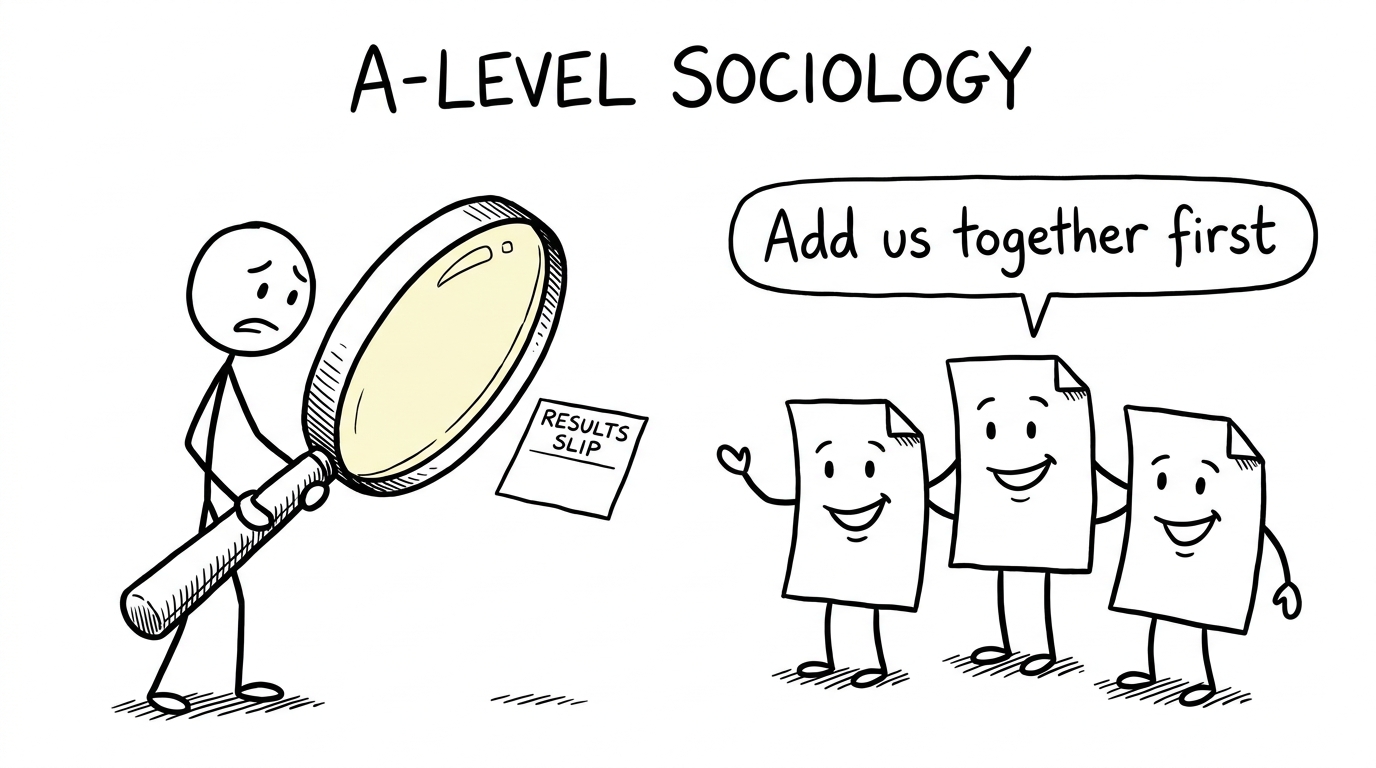 A student investigates three Sociology papers on results day
What to do if your result is unexpected
First, pause. A surprising grade does not always mean that something has gone wrong.
Ask your exams officer or teacher for your component marks and compare the overall total with the correct boundary. If you are close to the next grade, your school can discuss whether accessing the script or requesting a review of marking is appropriate. A review checks whether the mark scheme was applied correctly; it is not an automatic award of extra marks, and marks can rise, stay the same or fall. Deadlines, consent requirements and fees vary, so act through your school or college promptly.
If a university place is involved, follow the instructions from your school and UCAS rather than waiting in silence. Your teachers can help you understand the available post-results services and whether a priority process applies.
Common mistakes when reading grade boundaries
Treating last year's boundary as a forecast
Previous results are historical evidence, not a prediction. The 2026 papers and performance evidence determine the 2026 boundaries.
Looking at one paper in isolation
Your certificate records an overall Sociology grade. Notional component boundaries do not create separate grades for each paper.
Comparing raw marks between exam boards
A mark of 170170170 means different things when qualifications have different totals, structures and boundaries. Always check the board named on your entry or results information.
Assuming one mark below means an error
A boundary has to fall somewhere. Being one mark short can be painful, but it does not by itself show that the marking was incorrect.
Using percentages without checking the specification
If you want a percentage for context, calculate:
percentage=mark achievedmaximum mark×100\text{percentage}=\frac{\text{mark achieved}}{\text{maximum mark}}\times100percentage=maximum markmark achieved×100However, your grade is determined by the published raw or weighted boundary for your qualification, not by an assumed universal percentage.
A calm next step with MathsGenie
Results day turns uncertainty into information. Whatever appears on the page, begin with the correct board, total mark and official boundary. Then decide what the evidence tells you to do next.
If you are preparing for a resit or supporting someone beginning the course, use MathsGenie's AQA A-level Sociology revision guides. You can revisit focused areas such as Sociology and social policy, strengthen core concepts through the Eduqas key concepts guide, and organise your next steps with the MathsGenie revision planner.
MathsGenie brings revision lessons, specification-matched guides, past papers, predicted papers, practice questions, mark schemes and mini tests into one place. Start with the evidence, choose one gap, and make the next session count.











