What you'll learn
- What social policy is and why sociologists study it.
- How sociological research can influence government decisions — and why it often does not.
- How different perspectives, including functionalism, Marxism, feminism and the New Right, view policy.
- How to evaluate this topic using AO1, AO2 and AO3 in essays.
Starting point: what is social policy?
Sociology is the systematic study of society, social relationships, institutions and patterns of inequality. It asks questions such as: Why are some groups more likely to be poor? Why do some pupils achieve more than others? Why are some groups over-policed?
Social policy is about what governments and official organisations do in response to social issues.
Social policy
Social policy means the laws, plans, services, funding decisions and regulations used by governments and official bodies to manage social issues such as education, crime, poverty, health, families, housing and inequality.
Examples include the Equality Act 2010, Universal Credit, free school meals, policing policies, the NHS, education reforms, childcare support and domestic abuse legislation.
A key point: sociology does not simply “tell the government what to do”. Sociological evidence enters a political world shaped by ideology, budgets, elections, media pressure and power.
The relationship is indirect
Sociology can provide evidence about social problems, their causes and possible solutions, but social policy is ultimately made through political choices about priorities, values and resources.
From social problem to social policy
A social problem is a condition or pattern of behaviour that is seen as harmful and needing collective action. Poverty, racism, school exclusion and domestic abuse are examples.
But sociologists also ask: who has the power to define something as a problem? For example, low benefit income might be defined as a problem of poverty, or as a problem of “welfare dependency”, depending on ideology.
The diagram below shows the usual route from sociological research to policy — with important political filters in the middle.
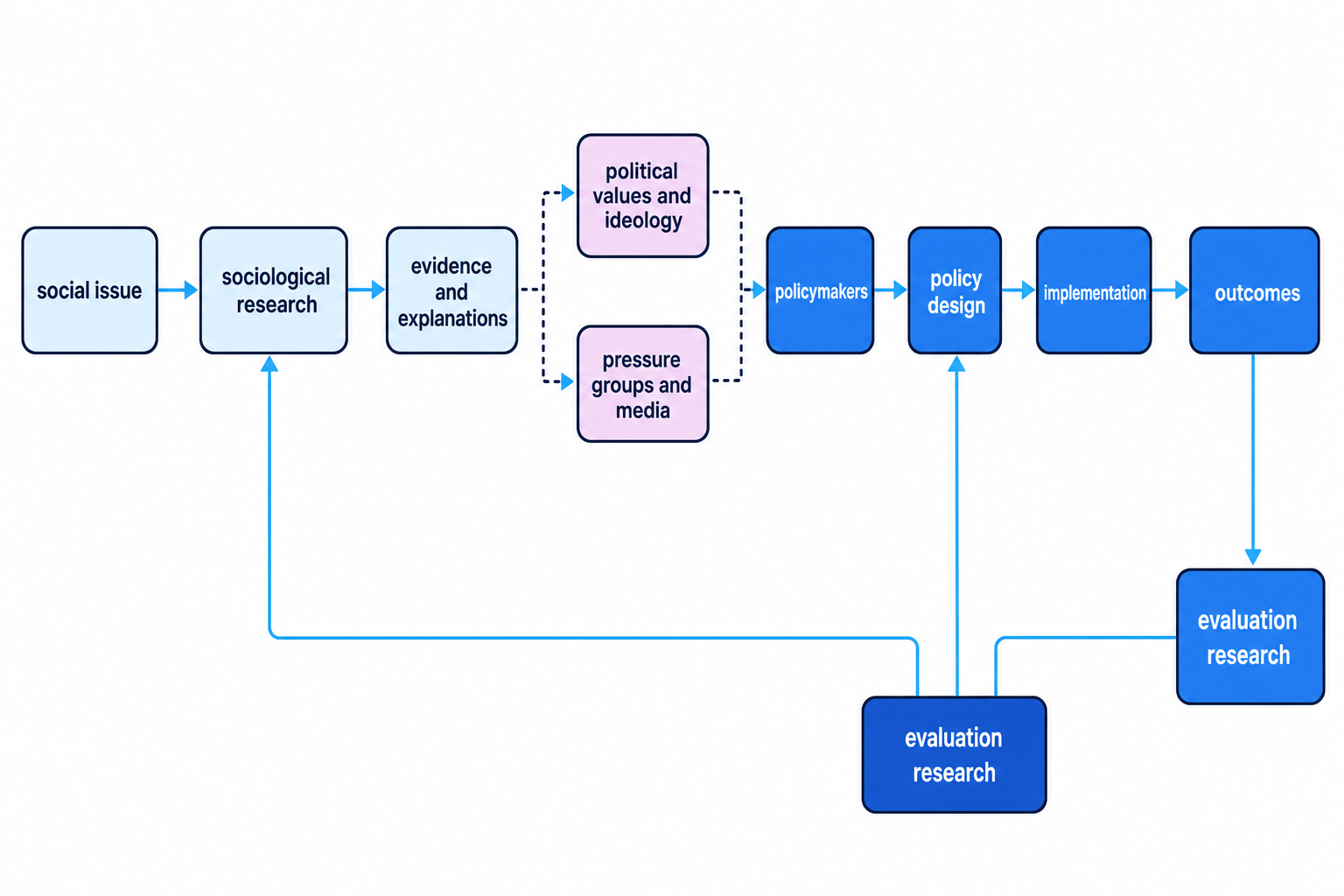
What sociology can contribute
Sociology can help policy by:
- Identifying patterns: for example, class differences in educational achievement.
- Explaining causes: for example, poverty, labelling, racism or patriarchy.
- Evaluating outcomes: for example, whether Sure Start improved children’s life chances.
- Revealing unintended consequences: for example, whether school league tables encourage “teaching to the test”.
- Giving voice to marginalised groups through qualitative research.
Tracing poverty research into policy
-
Townsend (1979) argued that poverty should be understood as relative deprivation: people are poor when they lack the resources needed to participate in normal social life.
-
This shifts policy attention from basic survival to wider inclusion, such as whether families can afford school trips, internet access, decent housing or social participation.
-
Governments can turn this into measurable indicators, such as child poverty statistics, material deprivation measures and income thresholds.
-
However, the policy response depends on ideology: a social democratic government may expand benefits or services, while a New Right-influenced government may focus on paid work and benefit conditionality.
Policy can also shape sociology
The relationship works both ways. Governments fund research, collect official statistics and set priorities for what gets studied.
For example, the Census, the Crime Survey for England and Wales, NHS data, school performance tables and ONS deprivation indices all create data that sociologists use. But those categories are not neutral. If the state changes how it measures unemployment, ethnicity, poverty or crime, it also changes what sociologists can easily study.
This links to research methods:
- Practical issues: government research may have good funding and access, but tight deadlines.
- Ethical issues: research on vulnerable groups must protect confidentiality and avoid harm.
- Theoretical issues: positivists may value large-scale, reliable statistics, while interpretivists may prefer valid accounts of lived experience.
Different sociological perspectives on social policy
Different theories disagree about what policy is for, whose interests it serves, and whether sociologists should try to influence it.
| Perspective | View of social policy | UK application | Evaluation |
|---|---|---|---|
| Functionalism | Policy helps society run smoothly by solving problems and maintaining social order. | Education policy may promote skills, socialisation and shared values. | Can ignore power inequalities and assume the state acts for everyone. |
| Social democracy / Fabianism | Research should expose inequality and support gradual reform through the welfare state. | Policies such as Sure Start, tax credits or child poverty targets aim to reduce inequality. | May overestimate how far capitalism can be made fair through reform. |
| New Right | State intervention can create dependency and weaken individual responsibility, markets and the family. | Welfare reform, benefit conditionality and education marketisation reflect this view. Murray argued welfare can create an “underclass”. | Can blame individuals and underplay structural causes such as low pay, housing costs and discrimination. |
| Marxism | Policy often serves capitalist interests by maintaining the labour force and legitimating inequality. | Welfare may keep workers healthy enough to work while leaving class inequality intact. | Can be too deterministic; some policies have genuinely improved working-class lives. |
| Feminism | Policy can either challenge or reproduce patriarchy, meaning male dominance in society. | Equal pay law, childcare policy and the Domestic Abuse Act 2021 reflect feminist influence. | Feminists disagree: some focus on gender, while intersectional feminists stress class, ethnicity and sexuality too. |
| Interactionism | Policies create labels and meanings that affect identity and behaviour. | Youth justice policies may label young people as “troublemakers”, increasing deviance. | Strong on micro-level effects, but sometimes weaker on large-scale structures. |
| Postmodernism | Society is diverse and fragmented, so one-size-fits-all policies may fail. | Policy must recognise plural identities, lifestyles and local differences. | Can be criticised for offering fewer clear solutions to inequality. |
Ideology
An ideology is a set of beliefs and values about how society works and how it should be organised. Ideology shapes which sociological evidence policymakers accept, reject or reinterpret.
Applying perspectives to free school meals
-
A social democratic view sees free school meals as a way to reduce material barriers to learning and support equality of opportunity, especially during a cost-of-living crisis.
-
A New Right view may support targeted help for the poorest, but criticise universal provision if it is seen as expensive or weakening family responsibility.
-
A Marxist view argues that free school meals help manage poverty but do not remove the class inequalities that produce food insecurity in the first place.
-
A feminist or intersectional view asks who benefits in practice, noting that food poverty often affects mothers, carers and racialised minority families unequally.
Should sociology be value-free?
A major debate is whether sociologists should simply provide evidence or openly campaign for change.
Weber argued that sociologists should try to distinguish facts from values. They can explain the likely consequences of policies, but politicians and citizens decide the moral goals.
By contrast, Becker and Gouldner argued that sociology cannot be fully value-free. Choosing what to study already involves values. Becker suggested sociologists often need to “take sides”, especially with powerless groups.
This matters because different labels lead to different policies. If unemployment is framed as “lack of motivation”, policy may focus on sanctions. If it is framed as “structural inequality”, policy may focus on jobs, training, childcare and regional investment.
Assuming evidence directly creates policy
Do not write as if sociologists discover a problem and the government automatically fixes it. Always include the political filters: ideology, cost, elections, media pressure, pressure groups and power.
Why sociological evidence may be ignored
Even strong research may have limited influence. Reasons include:
Ideology and party politics
Governments are more likely to use research that fits their values. A government committed to market solutions may favour education policies based on competition, even if some sociologists argue this increases inequality.
Cost and practicality
A policy may be supported by evidence but still be expensive or difficult to implement. For example, reducing child poverty may require major spending on housing, childcare, wages and benefits.
Media and public opinion
Media attention can create pressure for quick, visible action. Cohen’s work on moral panics is useful here: some groups may be exaggerated as threats, encouraging punitive policies.
Power and pressure groups
Businesses, charities, unions, think tanks, professional groups and campaigners all compete to shape policy. Some have more access to policymakers than others.
Methodological disagreement
Research findings may conflict. One study may be reliable because it uses a large survey, while another may be more valid because it captures lived experience through interviews. Policymakers may select the evidence that best supports their existing agenda.
Explaining limited influence of evidence
-
Sociological research on knife crime might highlight poverty, school exclusion, youth service cuts, masculinity, fear and poor police-community relationships.
-
However, media pressure and election concerns may encourage policies focused on visible enforcement, such as stop and search or tougher sentencing.
-
AO3 evaluation should ask whether the policy tackles root causes, and whether it creates unintended consequences such as racial disproportionality, labelling or reduced trust in the police.
The two core themes
Socialisation, culture and identity
Social policy shapes how people learn norms and values. Education policy, family policy, citizenship teaching, Prevent, Relationships and Sex Education, and childcare rules all influence culture and identity.
Policies do not just respond to identities; they can help create them. For example, immigration policy may shape who is seen as “British”, while disability policy may influence whether disabled people are treated as dependent or as citizens with rights.
Social differentiation, power and stratification
Policies distribute resources, opportunities and surveillance unequally. This links directly to class, gender, ethnicity, age, disability and sexuality.
For example:
- Welfare policy affects low-income families most directly.
- Policing policy may disproportionately affect young Black men.
- Childcare policy affects women’s ability to work.
- Education policy may advantage middle-class parents with more cultural capital, as Bourdieu would argue.
Policy is about power
Social policy is never just technical problem-solving. It decides whose needs matter, whose behaviour is regulated, and how resources are distributed.
Overall evaluation
Sociology can improve policy by providing evidence, challenging common-sense assumptions and revealing inequalities. It has influenced debates on poverty, education, crime, gender equality, ethnicity, health inequalities and family life.
However, its influence is uneven. Sociologists disagree with each other, research can be politically inconvenient, and governments may use “policy-based evidence” — selecting evidence to justify decisions already made.
A strong conclusion is that sociology has an important but mediated relationship with social policy. It can shape the debate, but policy outcomes depend on ideology, resources, institutions and power.
In the exam
-
Start by defining both sociology and social policy, then state that their relationship is indirect.
-
Use AO1 by outlining perspectives clearly: functionalist, Marxist, feminist, New Right, interactionist or postmodernist.
-
Use AO2 by applying each perspective to a real UK policy area, such as welfare, education, crime, poverty or gender equality.
-
Use AO3 by explaining why evidence may be accepted, ignored or distorted because of ideology, cost, media pressure or power.
Check yourself
-
How would a Marxist and a New Right sociologist interpret the same welfare policy differently?
-
Why might a government ignore sociological evidence even if the research is reliable?
-
How can social policy shape identity as well as respond to social problems?
