What you'll learn
- How to define the six core Component 2 concepts: validity, ethics, reliability, generalisability, representativeness and objectivity.
- How these concepts help you evaluate research methods in Eduqas A-Level Sociology.
- How to apply them to UK examples such as the Census, the Crime Survey for England and Wales, and school or crime research.
- How to build AO1, AO2 and AO3 into methods answers.
Why these concepts matter
In Component 2, you are not just asked to name research methods. You need to judge how good a piece of sociological research is.
A research method is a way of collecting or analysing evidence, such as questionnaires, interviews, observations, official statistics or content analysis. Data means the evidence collected. The key concepts in this topic are your evaluation toolkit: they help you decide whether sociological evidence is trustworthy, meaningful, ethical and useful.
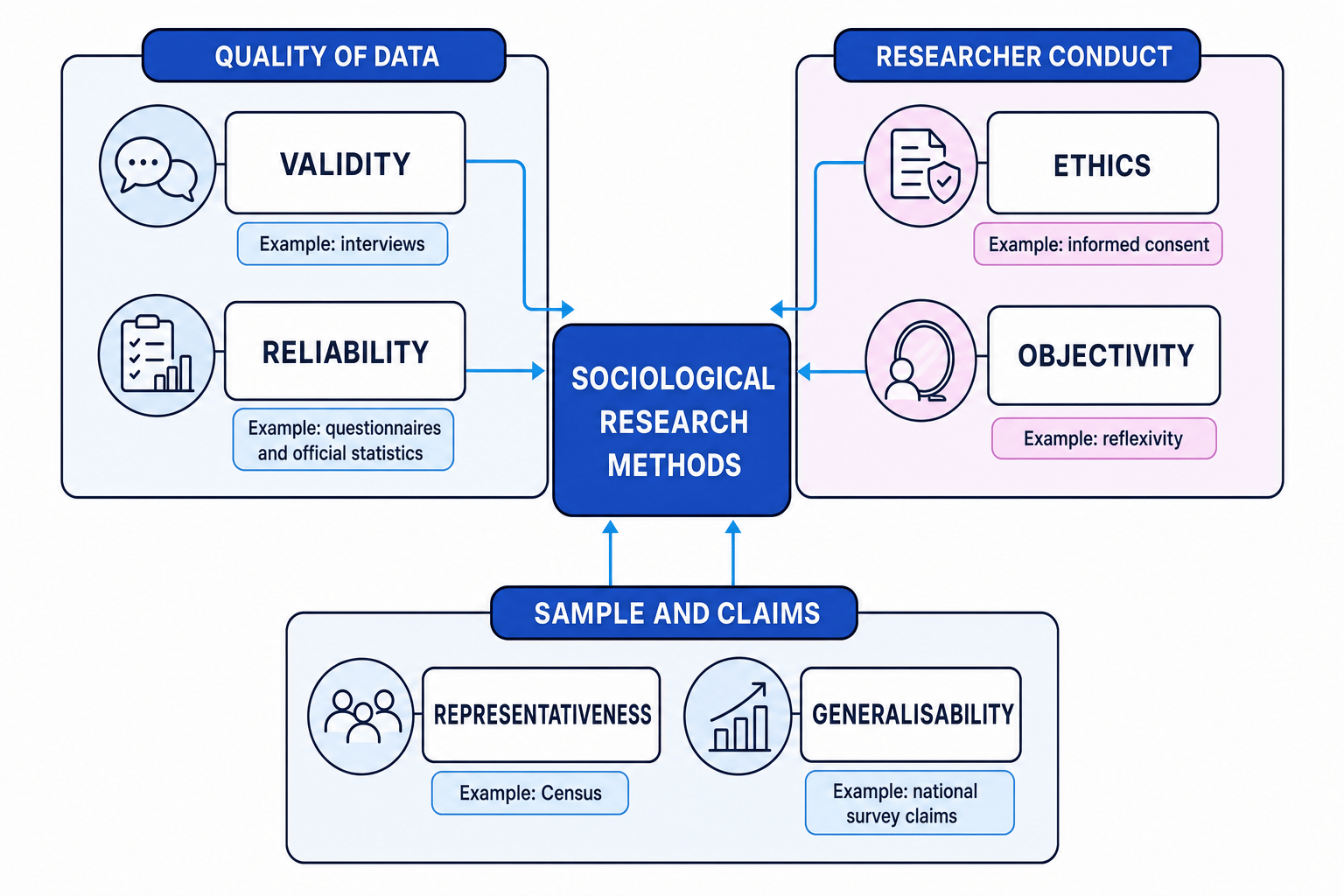
The six concepts fit together: some focus on the quality of the data, some on the sample, and some on the researcher’s conduct.
The big picture
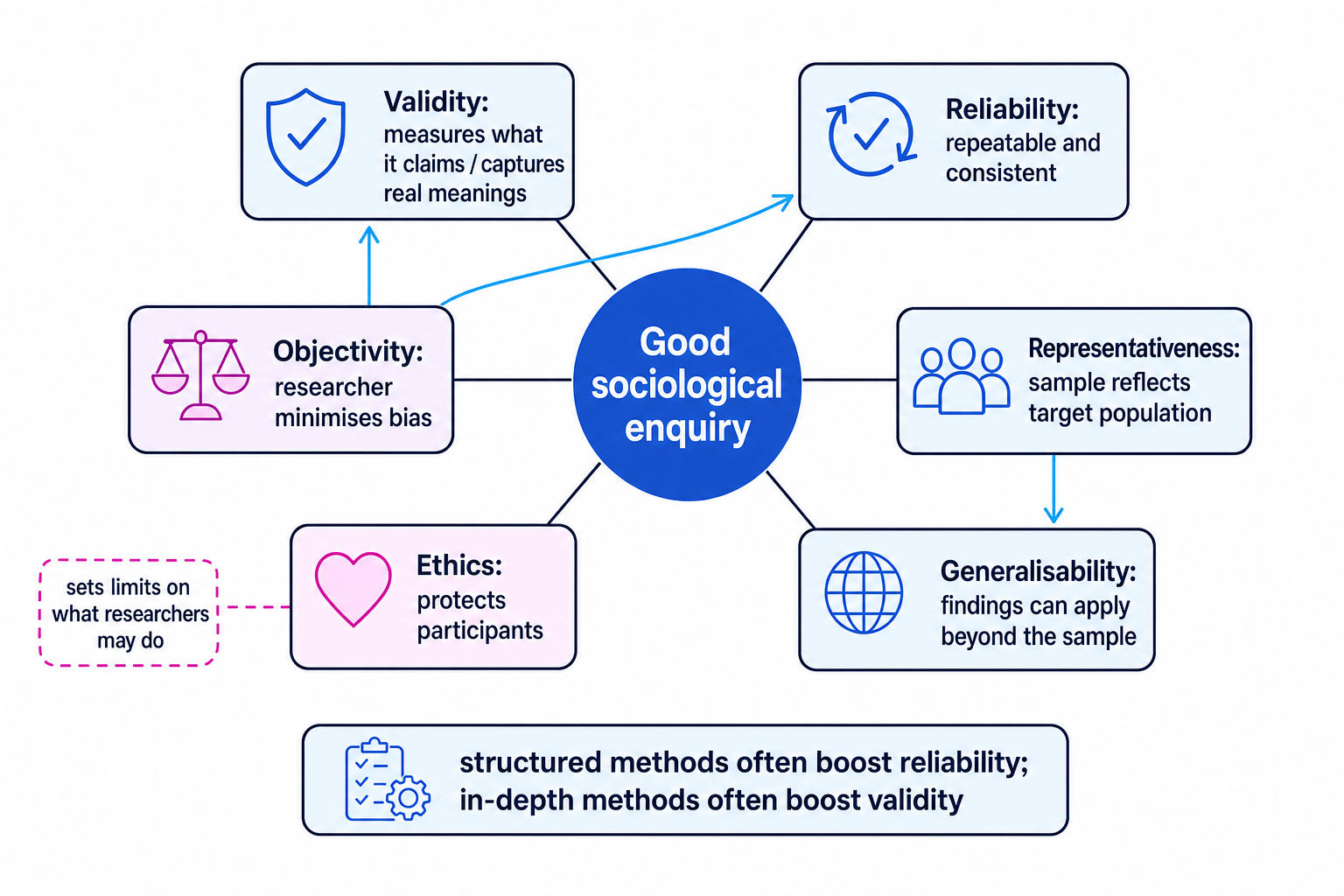
Strong sociological research is not just “accurate”. It should be valid, reliable, ethical, reasonably objective, and clear about whether its findings can be generalised.
Starting terms: sample, population and method
Before the six key concepts make sense, you need three basic terms.
A target population is the whole group the researcher wants to make claims about, such as “all Year 12 students in Wales” or “people who have experienced unemployment in the UK”.
A sample is the smaller group actually studied. Researchers use samples because it is usually impossible, too expensive, or too time-consuming to study everyone.
A sampling frame is a list or source from which a sample can be drawn, such as a school register, electoral roll, or workplace staff list.
These terms matter because many methods questions ask whether the evidence from a sample can tell us something about a wider group.
Validity
Validity
Validity means the extent to which research measures or captures what it claims to measure or capture.
In sociology, validity often means getting close to people’s real meanings, motives and experiences. For example, if you are studying youth identities, an in-depth interview may reveal how young people understand their own style, music, language and friendships.
Interpretivists, such as Weber, value methods that uncover meanings. Weber used the idea of verstehen, meaning empathetic understanding of social action. This links validity to the study of culture and identity, because people’s behaviour only makes full sense when we understand the meanings behind it.
Validity can be a problem when people lie, forget, exaggerate, misunderstand the question, or give answers they think are socially acceptable. This is called social desirability bias: people shape their answers to look better to others.
Durkheim used official statistics on suicide to identify social patterns, but Atkinson later questioned whether those statistics were fully valid because coroners’ decisions affect whether a death is recorded as suicide.
Judging validity in a questionnaire
A researcher asks: “Do you always treat people from all ethnic groups equally?” to measure racial prejudice.
- Compare the question with the concept being measured: prejudice can include unconscious attitudes, stereotypes and actions, not just what someone openly admits.
- Assess the wording: “always” and “equally” encourage respondents to present themselves positively, especially on a sensitive topic.
- Make a validity judgement: the question may under-report prejudice, so anonymous questionnaires, vignettes or interviews may produce more valid evidence.
Validity is not the same as truthfulness
A valid method is one that gets close to what it claims to study. It still needs careful evaluation because participants may misremember, perform an identity, or hide sensitive information.
Reliability
Reliability
Reliability means the extent to which research can be repeated and produce consistent results.
Reliable methods are usually standardised. This means the same procedure is used each time. Structured questionnaires, closed questions and official statistics often aim for reliability because they make comparisons easier.
Positivists prefer reliable methods because they want sociology to identify patterns and trends, a little like the natural sciences. For example, the Crime Survey for England and Wales asks large numbers of people about their experiences of crime using repeated question formats, which helps researchers compare trends over time.
However, reliability does not automatically mean validity. A bathroom scale that is always wrong is reliable but not valid. In sociology, a questionnaire may repeatedly produce the same answer while still missing people’s real meanings.
Comparing crime statistics over time
A researcher wants to compare police recorded crime across two decades.
- Check whether the same counting rules were used across the whole period; if recording rules changed, apparent increases or decreases may reflect administration rather than crime levels.
- Compare police figures with another source, such as the Crime Survey for England and Wales, to see whether both show a similar trend.
- Judge reliability: repeated official recording can be useful, but changes in reporting behaviour, policing priorities or recording standards may reduce consistency over time.
Quick contrast
Structured methods usually improve reliability because everyone is asked the same thing in the same way. In-depth methods often improve validity because they let participants explain meanings in their own words.
Ethics
Ethics
Ethics means the moral rules and responsibilities researchers must follow to protect participants and wider society.
Sociologists usually follow principles linked to the British Sociological Association: informed consent, confidentiality, anonymity, avoiding harm, avoiding unnecessary deception, and allowing participants to withdraw.
Informed consent means participants understand what the research involves before agreeing. Confidentiality means private information is not shared in ways that identify them. Anonymity means names and identifying details are removed.
Ethics is especially important when researching people with less power, such as children, prisoners, disabled people, victims of crime, or workers being studied through their employer. This links directly to power and stratification: researchers must not exploit unequal power relationships.
There can be a trade-off between ethics and validity. Covert observation may reveal behaviour people would hide, but it raises problems of deception and consent. Humphreys’ study of anonymous sexual encounters, Tearoom Trade, is often discussed because it produced sensitive data but raised serious ethical concerns about privacy and deception.
Protecting pupils in a school study
A sociologist wants to interview pupils about bullying and social media.
- Identify the ethical risk: pupils are young people, and bullying may involve distress, embarrassment or safeguarding concerns.
- Build in protection: gain school approval, parental consent where appropriate, pupil assent, anonymity, and a clear right to stop the interview.
- Balance value and harm: the study may help understand peer culture, but findings should be reported without naming pupils, classes or the school.
Representativeness
Representativeness
Representativeness means the extent to which a sample reflects the wider target population in relevant characteristics.
A representative sample should broadly match the target population in features that matter to the research, such as age, gender, ethnicity, social class, region or family type.
For example, if a study claims to represent UK parents but mostly includes middle-class mothers from one London borough, it may not represent fathers, working-class parents, rural families or minority ethnic communities well.
Representativeness is important in research on stratification because under-representing disadvantaged groups can make inequality look smaller or different from reality. The Census and ONS deprivation indices aim to give broad population coverage, which helps policy-makers understand patterns of poverty, housing, health and employment.
Assessing a sample of parents
A researcher studies parental attitudes to homework using an online survey shared through a school parent association.
- Identify the target population: if the claim is about “parents in the UK”, one school’s parent association is far too narrow.
- Compare the sample with relevant characteristics: the survey may over-represent highly engaged parents, middle-class parents, or those with reliable internet access.
- Make the judgement: the sample is unlikely to be representative, so the findings should be limited to that school community or improved using a broader sampling strategy.
Large does not always mean representative
A sample can be very large but still biased. If thousands of people respond to an online poll, it may still exclude people without internet access or those uninterested in the topic.
Generalisability
Generalisability
Generalisability means the extent to which findings from one study can be applied to a wider group, setting or society.
Generalisability depends partly on representativeness, but it is not exactly the same thing. Representativeness is about the sample; generalisability is about the claim you can make from the findings.
A nationally representative survey is often more generalisable than a small case study. However, small qualitative studies can still have theoretical generalisability: they may develop ideas that help explain other cases, even if they cannot statistically represent everyone.
Willis’ study Learning to Labour focused on a small group of working-class boys. It was not statistically generalisable to all pupils, but it offered powerful insights into masculinity, anti-school culture and class reproduction.
Deciding whether a case study travels
A researcher observes one group of working-class boys in one school and argues that all working-class boys reject education.
- Assess the sample: one friendship group in one school is too narrow to represent all working-class boys.
- Assess the context: school culture, local labour markets, ethnicity, gender expectations and time period may affect the findings.
- Refine the claim: the study may offer useful ideas about class and masculinity, but it should not be generalised to all working-class pupils without further evidence.
Objectivity
Objectivity
Objectivity means the researcher tries to minimise personal bias, values or assumptions when collecting, analysing and presenting evidence.
Objectivity is difficult in sociology because researchers are part of the social world they study. Their class, gender, ethnicity, politics and experiences may affect what they notice and how they interpret it.
Weber argued that values may influence the choice of research topic, but researchers should still aim for honesty and fairness in analysis. Becker questioned whether sociology can ever be completely neutral, asking “whose side are we on?” Feminist sociologists such as Oakley criticised detached “objectivity” when it silences women’s experiences or hides unequal power relations.
A useful related term is reflexivity. Reflexivity means the researcher reflects on how their own identity, assumptions and role may influence the research.
Spotting researcher influence
A researcher expects girls to use social media mainly because of beauty pressure, so most interview questions focus on appearance.
- Identify the assumption: the researcher has already framed girls’ social media use around appearance before hearing participants’ meanings.
- Assess the effect on data: participants may talk less about friendship, activism, humour, learning or identity because the questions guide them elsewhere.
- Improve objectivity: use more open questions, keep a reflexive diary, record interviews accurately, and compare findings with other evidence.
How the concepts work together
These concepts often create trade-offs.
- Reliability versus validity: structured questionnaires are easier to repeat, but unstructured interviews may capture deeper meanings.
- Ethics versus validity: covert research may reveal hidden behaviour, but deception and lack of consent are serious problems.
- Representativeness and generalisability: a representative sample makes wider claims stronger, but qualitative research may aim for depth rather than broad coverage.
- Objectivity and reflexivity: researchers should reduce bias, but also be honest about how their background shapes the research process.
For AO1, define the concept accurately. For AO2, apply it to the method, item or UK example. For AO3, evaluate the strength, limitation or trade-off.
Quick comparison table
| Concept | Main question to ask |
|---|---|
| Validity | Does it capture what it claims to study? |
| Reliability | Could it be repeated with consistent results? |
| Ethics | Does it protect participants and avoid harm? |
| Representativeness | Does the sample reflect the target population? |
| Generalisability | Can findings be applied beyond this study? |
| Objectivity | Has the researcher minimised bias? |
In the exam
- Define the key concept first, then apply it directly to the named method or item rather than writing a generic paragraph.
- Build evaluation by using trade-offs: for example, “this improves reliability, but may reduce validity because…”
- Use concrete examples where possible, such as the Census, Crime Survey for England and Wales, school surveys, covert observation, or research on class, gender and ethnicity.
Check yourself
- Why can a method be reliable but not valid?
- How are representativeness and generalisability connected but different?
- What ethical issues might arise when researching a low-power or vulnerable group?