

A-Level Sociology Career Paths After Results Day
A-level sociology career paths explained: connect your results to realistic degrees, apprenticeships and careers, with clear steps for results day.
Results day has a strange way of making one grade feel like a final verdict. It is not. A-level sociology career paths reach into research, public policy, criminal justice, social care, marketing, education and many other fields. Your result may affect which route you take first, but it does not reduce your future to one course or occupation.
For GCSE students considering Sociology, the same lesson matters early: the subject develops transferable skills rather than preparing you for one narrowly defined job. You learn to examine evidence, compare explanations, understand institutions and communicate a reasoned judgement.
Your results-day checklist
Before making a decision, work through these steps:
- Check the status of any university application and read the wording carefully.
- Compare your result with the full entry requirements for each course.
- Speak to your school, college or careers adviser before rejecting an existing option.
- Investigate related degrees, foundation years and apprenticeships.
- Ask what the course teaches, not simply what it is called.
- Consider whether you prefer research, direct work with people, policy or communication.
- Keep GCSE English and maths requirements in view because some courses and apprenticeships specify them.
For 2026 applicants, A-level results day is Thursday 13 August. Entry requirements vary considerably between providers, so always check current details directly before acting.
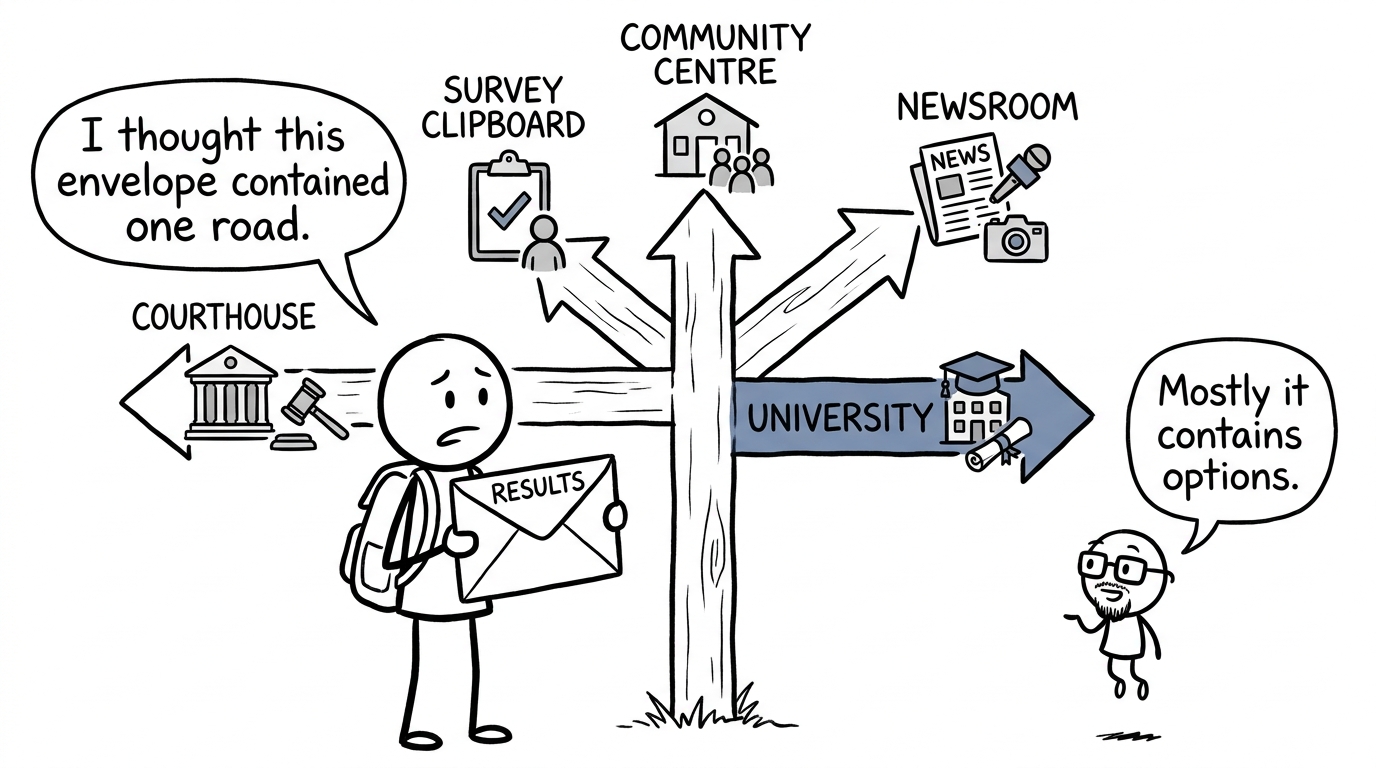 A student discovers that a results envelope contains several possible roads
What skills does A-level Sociology develop?
The strongest answer to “What jobs can I get?” begins with skills. Sociology specifications from exam boards including AQA, OCR and Eduqas assess knowledge, application, analysis and evaluation. Research methods also ask you to think about evidence quality, sampling, ethics and bias.
Those habits transfer well beyond the classroom:
- Critical analysis: comparing competing explanations rather than accepting the first claim.
- Research: understanding questionnaires, interviews, observations and secondary data.
- Written communication: constructing arguments supported by relevant evidence.
- Data awareness: interpreting patterns while questioning reliability and representativeness.
- Social understanding: recognising how institutions, identities and inequalities influence behaviour.
You can strengthen these skills through the AQA A Level Sociology revision guides. If you study another board, the OCR A Level Sociology revision hub and Eduqas key concepts guide keep your revision aligned with the relevant specification.
Realistic A-level sociology career paths
An A level alone does not normally qualify you for regulated professions such as social work or teaching. Instead, it provides a useful foundation for the degree, apprenticeship, training and experience those roles may require.
| Interest | Possible course or training route | Example career direction |
|---|---|---|
| Social patterns and evidence | Sociology, social research, social sciences or a social researcher degree apprenticeship | Social researcher, insight assistant or policy researcher |
| Crime and justice | Criminology, criminal justice, sociology or relevant workplace training | Criminologist, probation services officer or youth justice work |
| Supporting communities | Social work, youth work, community development or an apprenticeship | Social worker, family support worker or community development worker |
| Public institutions | Politics, public policy, sociology or Civil Service routes | Policy officer, local government officer or Civil Service researcher |
| Consumers and communication | Marketing, sociology, business or a market research apprenticeship | Market research executive, communications assistant or audience researcher |
| Education and inequality | Education studies, sociology or teacher training after a degree | Teacher, education researcher or widening-participation officer |
These are pairings, not promises. Government social research, for example, can involve designing surveys, analysing evidence and evaluating public services. Market research may combine qualitative interviews with quantitative data. Probation and social care routes place greater emphasis on communication, safeguarding and experience with people.
The Sociology and social policy revision guide offers a useful bridge between classroom theory and careers concerned with government decisions. For research-focused routes, revisiting concepts such as validity, reliability and representativeness helps you describe your skills precisely.
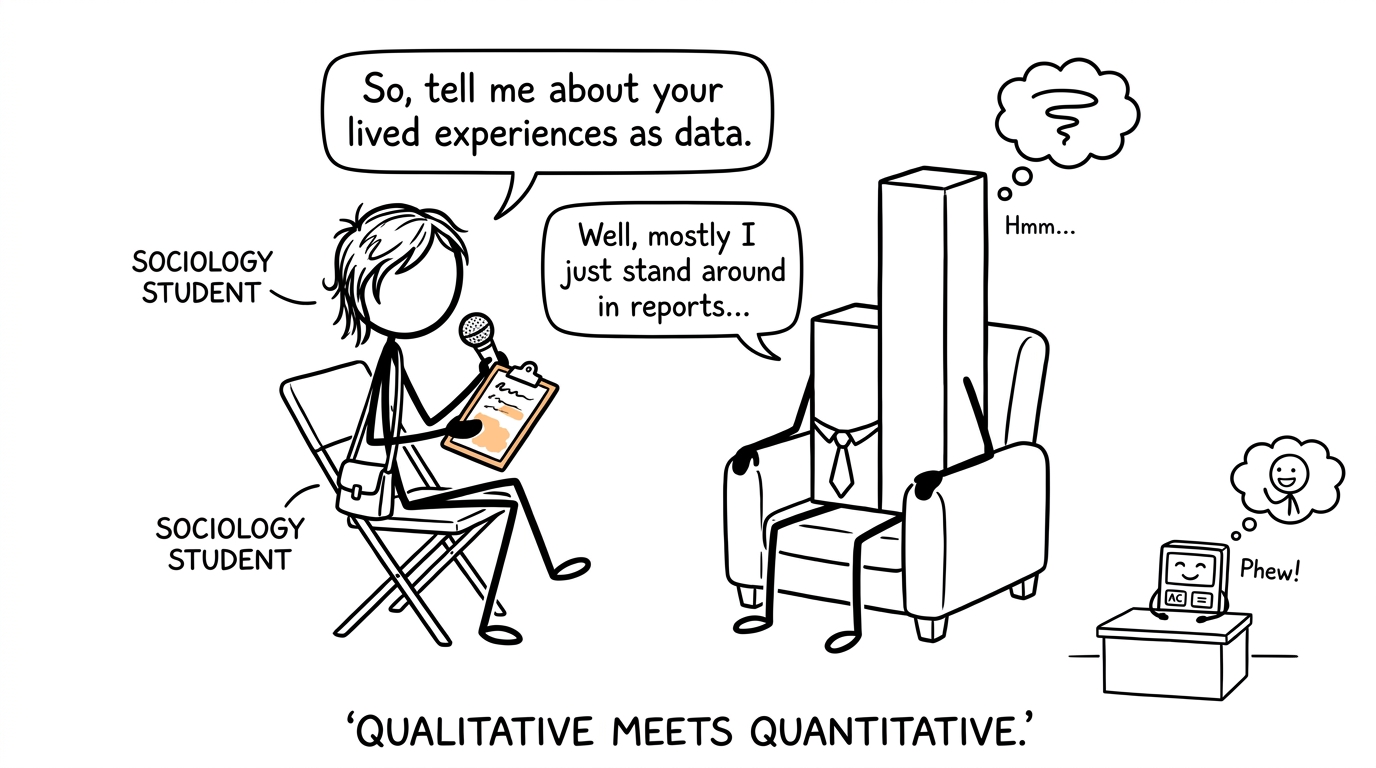 A sociology student interviews a bar chart while a calculator watches
Where maths fits into sociology careers
Sociology is often associated with essays, but many routes use numbers. Researchers may work with survey results, percentages, distributions, charts and measures of central tendency. Market researchers compare groups, while policy teams assess whether an intervention appears effective.
You do not need to become an A-level mathematician to value quantitative confidence. A secure GCSE foundation in percentages, graphs, averages and probability makes research methods less intimidating. MathsGenie's GCSE Maths revision hub, GCSE Statistics resources and Edexcel GCSE Maths lessons can help you close these gaps.
Students interested in more quantitative social research may also benefit from A Level Maths or Core Maths where available. The Edexcel A Level Maths revision hub shows the statistics and data skills involved at the next stage.
What if your Sociology grade is lower than expected?
A disappointing grade changes the immediate decision, not your underlying interests. Your university might still confirm your place. If it does not, you may be able to consider Clearing, a related course with different requirements, a foundation year, an apprenticeship, employment with training or a planned resit.
Compare course modules carefully. Degrees called sociology, social policy, criminology and social sciences can overlap, but their balance of theory, methods, placements and statistics may differ. Ask what graduates learn and which experiences the course provides.
If your result is higher than expected, avoid changing direction simply because a more selective course has become available. A better entry grade does not automatically make another subject a better fit.
Common mistakes when choosing jobs after A-level Sociology
Treating the grade as a career qualification
An A level demonstrates academic skills, but many occupations require a degree, professional training, an apprenticeship or relevant experience. Research the complete route.
Choosing a degree from its title alone
Read the modules, assessment methods, placement options and current entry requirements. Two similarly named courses can offer very different experiences.
Ignoring quantitative skills
Research careers often combine words and numbers. Keep practising statistics, percentages and graph interpretation rather than describing Sociology as purely essay-based.
Assuming there is one correct route
University is only one option. Higher and degree apprenticeships, workplace progression and foundation years can lead towards related work.
Forgetting the value of experience
Volunteering, placements and part-time work can test whether you enjoy supporting people, conducting research or communicating with the public. They also help you discuss your motivation with evidence.
Turn one result into a thoughtful next step
Results day gives you information. It does not write the rest of your career. The most useful response is to connect your interests with the skills you have developed, then compare the training routes that can take you forward.
Start with MathsGenie's free AQA Sociology revision guides or OCR A Level Sociology resources. Use revision lessons to strengthen knowledge, practice questions to sharpen evaluation, and past papers with mark schemes to understand where marks are earned. Alongside predicted papers and mini tests, that steady cycle can improve both your grade and your understanding of where Sociology might lead.










