

A-Level Results Day Backup Plan for Clearing
A-level results day backup plan: research Clearing early, shortlist courses, prepare key details and make calm choices when your grades arrive in 2026.
Results day can make several years of work feel as though they have been compressed into one envelope and one login screen. But the smartest response is not prediction. It is preparation.
An A-level results day backup plan means researching Clearing courses before your grades arrive, identifying options you would genuinely accept and preparing the information needed to contact universities. You are not assuming the worst. You are making sure one surprising result cannot force a rushed decision.
For students currently preparing for GCSEs, this may seem distant. Yet the habit matters now: work towards your preferred outcome, while understanding that good decisions rarely depend on a single route.
Your backup-plan checklist
Before results day:
- research alternative courses, universities and locations
- note typical entry requirements, modules and professional accreditation
- include foundation years or related subjects where appropriate
- prepare your UCAS Personal ID, results details and contact information
- write questions about accommodation, finance and course structure
- arrange access to a charged phone and reliable internet
- know whom you can contact at school or college for advice
- keep results day free so you do not have to decide in a hurry
For 2026 entry, A-level results day in England, Wales and Northern Ireland is Thursday 13 August. UCAS Clearing runs from 2 July to 19 October 2026, although individual vacancies can disappear once courses fill. Always check the current information in your UCAS application and the official vacancy search.
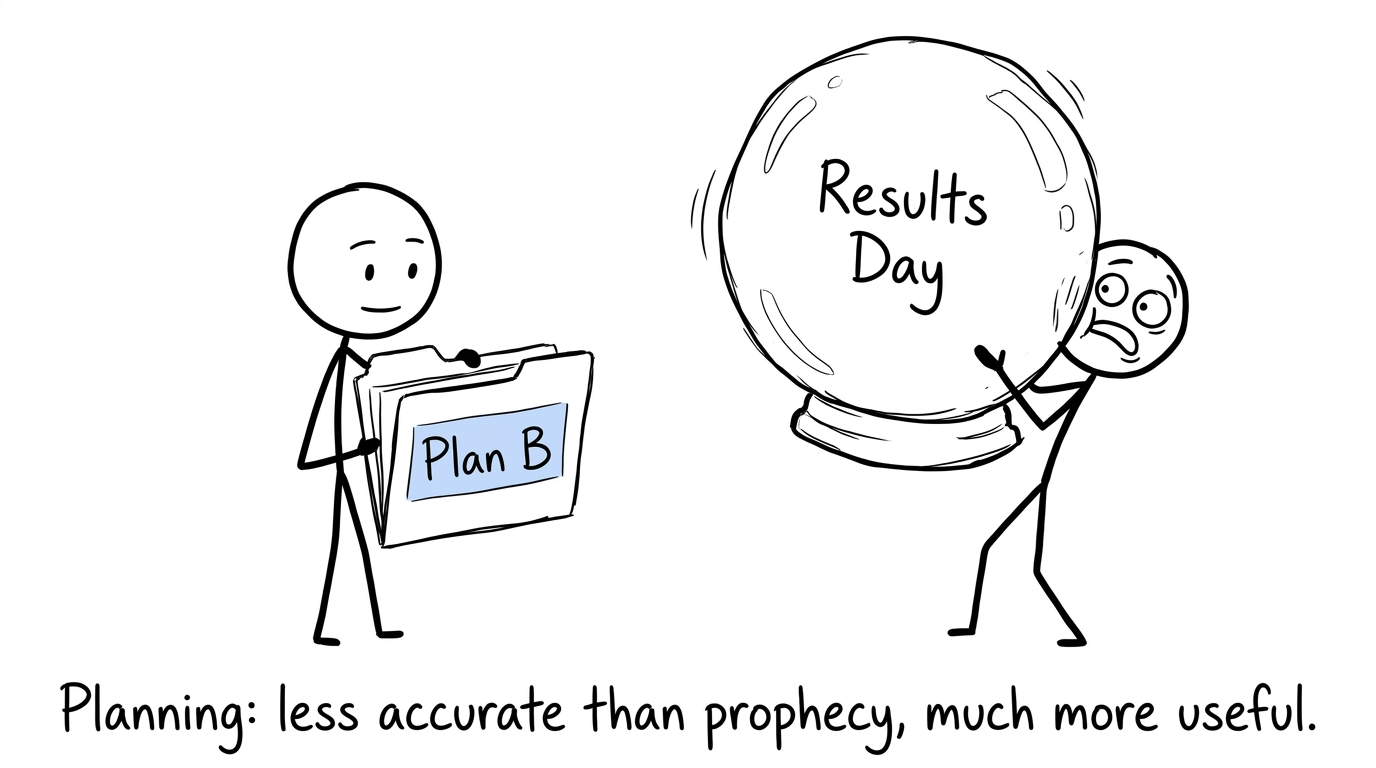 A prepared student chooses a folder instead of a crystal ball
Scenario: your firm choice confirms your place
This is the outcome you hoped for. Check your UCAS application carefully rather than relying only on the grades you expected to need. A university may confirm your place even if you narrowly miss the published conditions.
Once confirmed, read the university's instructions and check accommodation, enrolment and student finance arrangements. Your backup list can be closed without regret. Its value was the calm it gave you before the result, not whether you eventually used it.
This is similar to good exam preparation. You revise for success, but you also rehearse what to do when a question looks unfamiliar. GCSE students can build that resilience through the GCSE Maths revision hub, where lessons, questions and papers turn uncertainty into a repeatable process.
Scenario: you miss your firm offer but reach your insurance choice
First, check whether your insurance university has confirmed your place. Do not enter Clearing simply because your firm choice has not accepted you.
Then ask whether you would still be happy with the insurance course. Revisit the modules, location, accommodation and costs. An insurance choice should be a real destination, not merely a lower set of entry requirements.
If your place is confirmed but you are thinking about declining it, pause. Speak to the university, UCAS or a school adviser before using any option to decline your place. Leaving a confirmed course for Clearing changes your position and should be an informed choice, not an emotional reaction.
Scenario: neither choice confirms a place
This is where an A-level backup plan for Clearing becomes practical.
Check that you are eligible for Clearing in your UCAS application, then search the current vacancies. Compare them with your prepared shortlist, but verify everything again because course availability and requirements can change.
Contact universities directly before adding a Clearing choice. Have these details ready:
- your UCAS Personal ID and Clearing number
- your full results, including relevant GCSE grades
- the exact course title and code
- notes explaining why the course interests you
- questions about modules, accommodation and offer deadlines
A university may give you permission to add its course after discussing your application. UCAS guidance states that you should only add a Clearing choice once the university or college has told you to do so. You can add only one Clearing choice at a time, so do not enter the first course you see merely to make the uncertainty disappear.
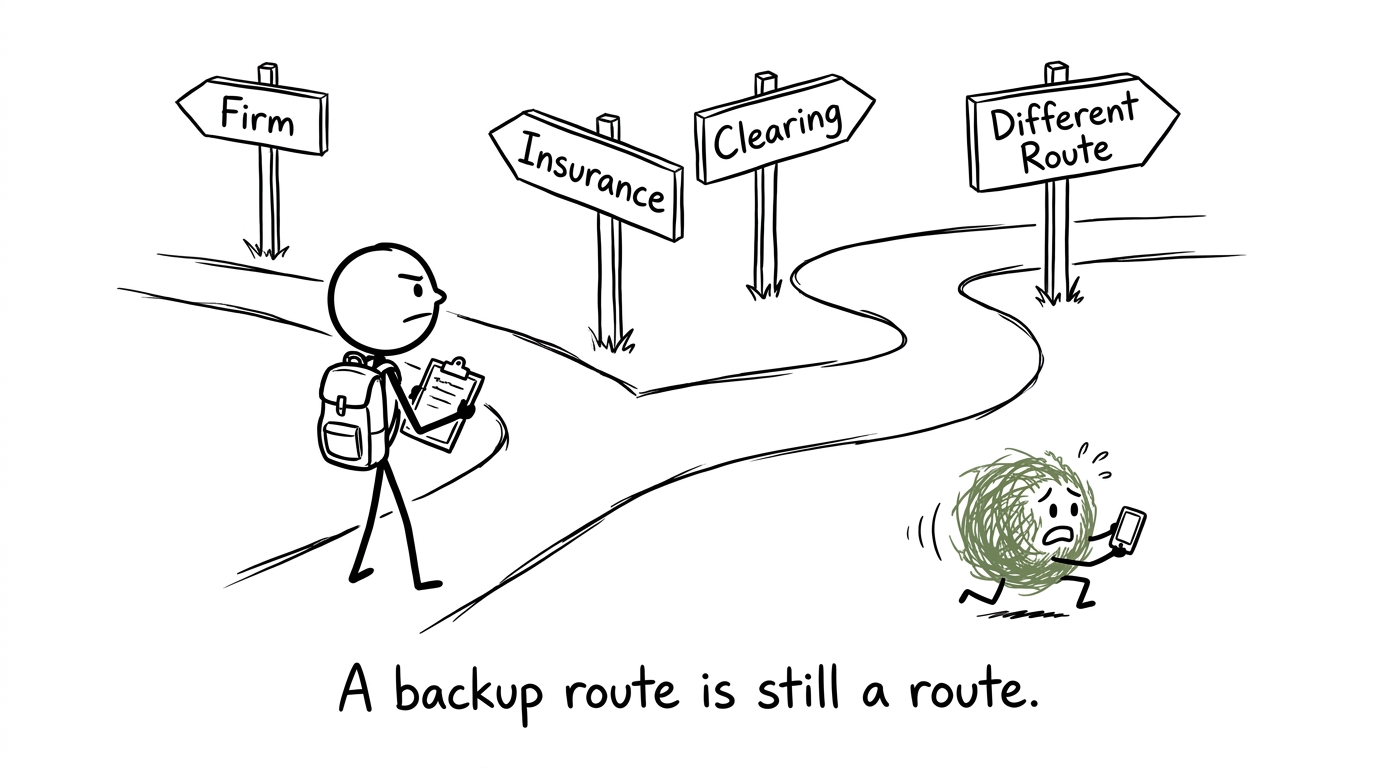 A student calmly considers several routes at a signpost
Scenario: your original subject is unavailable
A backup course should still support a future you want. Look beyond the title and compare:
- compulsory and optional modules
- assessment methods
- placement or year-abroad opportunities
- accreditation required for a particular profession
- travel, accommodation and living costs
- support for progressing from a foundation year
A related degree may be sensible. A random degree chosen under pressure usually is not. You can also consider taking a gap year and reapplying, an apprenticeship, further education or employment. Clearing is an important route, but it is not an instruction to attend university at any cost.
Build the habits before A-level results day
If you are currently sitting GCSE Maths with Edexcel, AQA, OCR or Eduqas, your immediate job is to secure the strongest grades you can. Start with resources matched to your board and tier, such as Edexcel GCSE Maths revision, AQA GCSE Maths revision or OCR GCSE Maths revision.
Use past papers to diagnose gaps, then correct them with targeted practice. The guide to starting GCSE past papers explains how to build up gradually, while using mark schemes as a revision coach helps turn lost marks into specific next steps.
If A-level Maths is already your focus, the same loop continues through Edexcel A-level Maths revision, past papers with mark schemes and A-level predicted papers.
Common mistakes when planning for Clearing
Treating Clearing as failure
Clearing is a formal admissions route used to connect applicants with courses that still have places. It does not erase the work behind your qualifications.
Researching only university names
Course content matters more than a familiar name. Read the modules, assessment structure and entry information.
Waiting until results morning
You cannot know every vacancy in advance, but you can research institutions, course types and questions beforehand.
Adding a choice without permission
Contact the university first. Only add the choice after it has authorised you to do so, and follow any deadline it gives you.
Declining a confirmed place too quickly
A difficult morning can create urgency where none is needed. Ask for advice and understand the consequences before giving up a confirmed place.
Keep ambition and preparation together
A backup plan does not weaken ambition. It protects it. You can aim fully at your preferred university while preparing another route that is thoughtful, affordable and genuinely acceptable.
For your next step, bookmark the MathsGenie revision blog for Clearing and results-day guidance, then return to the work you can control now. Use MathsGenie's free revision lessons, practice questions, mini tests, past papers, predicted papers, mark schemes and video solutions to prepare for your next exam with a plan rather than a guess.











