

A-Level Religious Studies Grade and University Entry
A-level religious studies grade university guide: understand each result, compare current degree offers, and keep GCSE maths from limiting your choices later.
University offers can make one grade feel as though it carries your entire future. It does not. The question behind an A-level Religious Studies grade university search is really this: will your result help you meet the overall offer for the course you want?
Usually, universities consider three A Levels together. Your Religious Studies grade may satisfy part of an offer such as ABB, while some courses also value it as evidence of essay writing and critical thinking. Published requirements vary widely, from foundation routes to highly competitive offers.
The quick university entry checklist
Before judging any individual grade, check:
- the complete A-Level offer, not just Religious Studies;
- whether an essay-based or humanities subject is required;
- GCSE English Language and maths requirements;
- whether you qualify for a contextual offer;
- whether the course requests written work or an interview;
- the requirements for your actual year of entry.
Course pages checked in July 2026 show the range clearly. Cambridge lists A*AA for 2027 Theology, Religion and Philosophy of Religion, while Oxford lists AAA for Theology and Religion. Manchester lists ABB for 2027 Religions, Theology and Ethics, including an essay-based subject, with BBC as its typical contextual offer. Lower offers and foundation years are also available elsewhere.
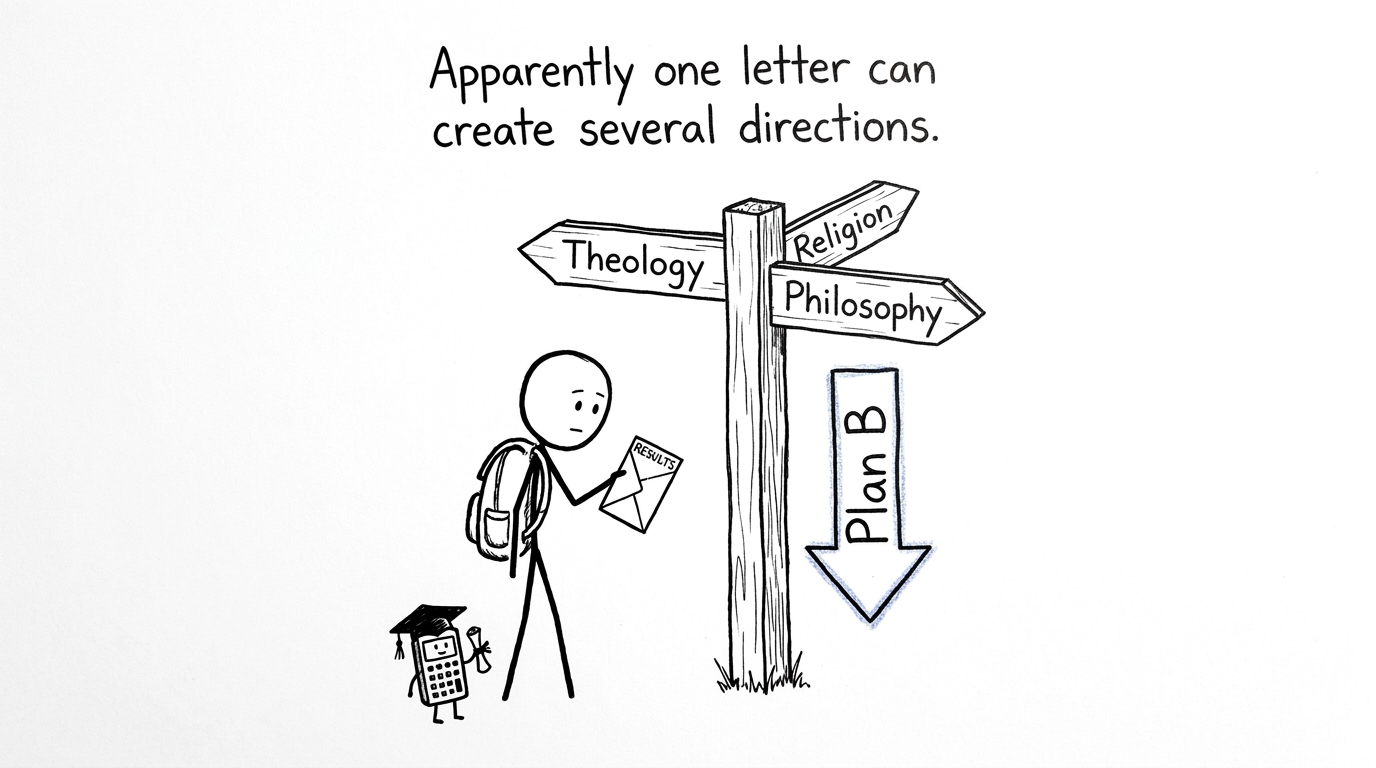 A student choosing between university paths after opening a results envelope
Religious Studies degree entry requirements by grade
An individual grade has a UCAS Tariff value, but many universities state offers as grade combinations instead. UCAS also warns that having Tariff points does not guarantee that a qualification will count towards a particular offer.
| Religious Studies grade | UCAS Tariff value | What it may mean for university |
|---|---|---|
| A* | 565656 | Strong preparation for offers such as A*AA, provided your other grades meet the remaining conditions |
| A | 484848 | Fits comfortably within many AAA, AAB and ABB profiles |
| B | 404040 | Commonly useful within ABB, BBB and BBC offers |
| C | 323232 | Can contribute to BBC, BCC or CCC offers and some contextual routes |
| D | 242424 | May count towards Tariff-based entry or a foundation year |
| E | 161616 | A passing A Level, but direct degree options are more limited |
A* grade
An A* can support an application to the most academically demanding courses, but it does not replace the other required grades. For example, Cambridge's published minimum offer is AAA. Some colleges may specify an A in Religious Studies when the subject is being taken.
A high grade also does not mean that Religious Studies must be compulsory. Cambridge and Oxford state that applicants do not need a particular A-Level subject for their relevant theology courses, although essay-based subjects can be helpful.
A grade
An A places you in a strong position for courses asking for AAA, AAB or ABB. Oxford's Theology and Religion requirement is AAA, while Birmingham and Exeter published ABB offers for relevant 2026 courses.
The important phrase is part of the offer. An A in Religious Studies cannot by itself satisfy an ABB condition; the other two grades still matter.
B grade
A B remains a useful result for a wide range of religion, theology, ethics and philosophy degrees. Manchester's standard ABB offer requires an essay-based subject, so A-Level Religious Studies can be particularly relevant. Exeter's Religion, Culture and Society course also published an ABB typical offer without a required A-Level subject.
A B may also form part of BBB or BBC offers. Contextual admissions can reduce the standard requirement for eligible applicants, but eligibility rules differ between universities.
C grade
A C does not close the university door. It may fit courses offering BBC, BCC or CCC, depending on your other results. Liverpool Hope, for example, has published BBC for Religious Studies, while Chester has advertised a BCC-BBC range for its standard Theology and Religious Studies route.
This is where course research matters more than assumptions. Search broadly by course content, location, contextual eligibility and foundation options rather than treating one league-table position as the only worthwhile destination.
D or E grade
A D or E earns UCAS Tariff points, but direct entry becomes more restricted. Some providers accept lower Tariff totals for foundation years. Chester has published a foundation route requiring 727272 points overall, including at least a D at A Level.
A foundation year is not an automatic fallback. It is a structured additional year with its own requirements, costs and progression conditions, all of which should be checked carefully.
Why GCSE maths still matters
Religious Studies is essay-based, yet numeracy requirements can quietly affect an application. UCAS explains that many courses expect pre-16 qualifications such as GCSE English and maths. Manchester's relevant course, for example, requires the equivalent of GCSE Mathematics grade 444, while requirements at other universities may differ.
That makes your current GCSE preparation part of your future application. Start with the GCSE Maths revision hub, where you can select Edexcel, AQA, OCR, Eduqas, WJEC or CCEA resources. If you are unsure what to revise first, follow the best order for learning GCSE maths topics.
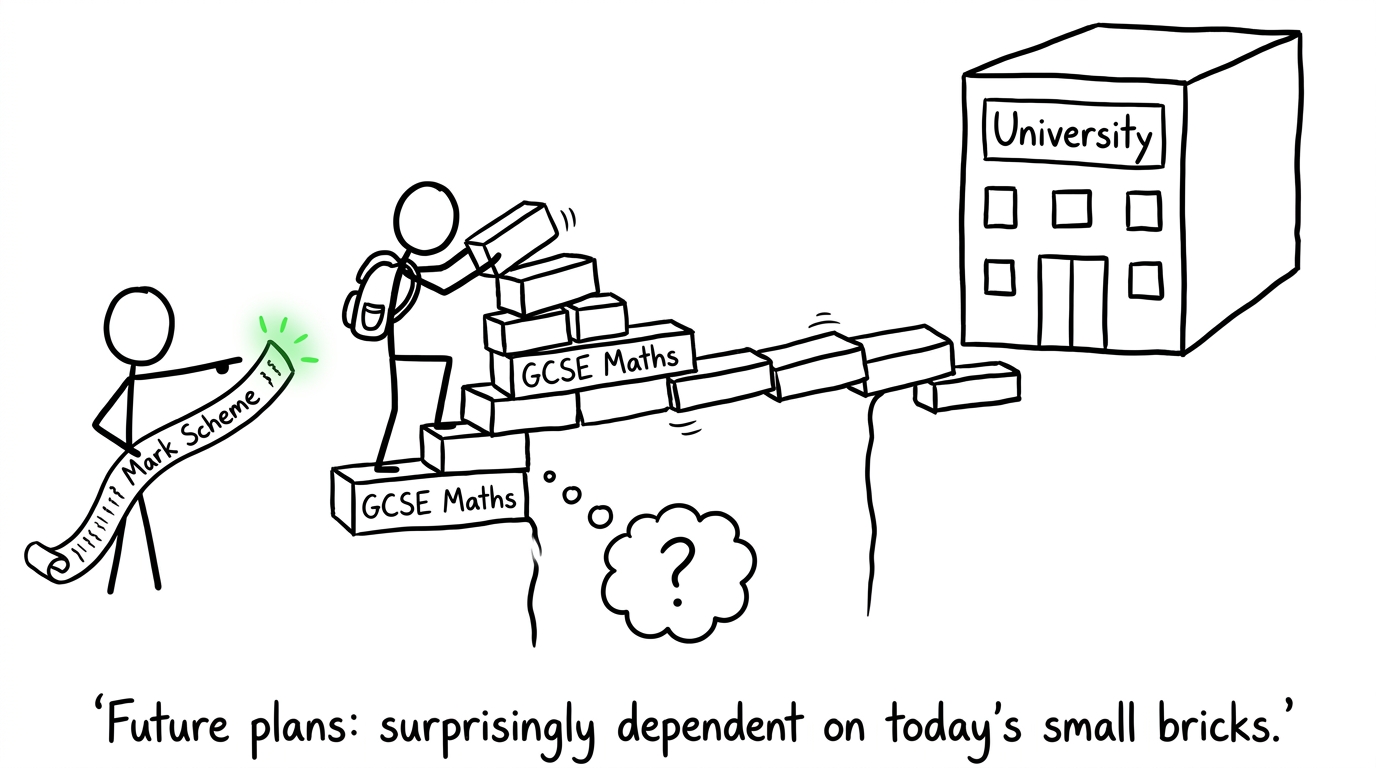 A student building a bridge from GCSE maths books towards university
A simple routine is enough: use revision lessons to recover a method, answer practice questions, then check the mark scheme. Build towards GCSE predicted papers and timed papers when your knowledge is secure. Edexcel students can use the Edexcel GCSE Maths past papers, while the wider MathsGenie resources collection includes mini tests and shorter exam practice.
Common mistakes when interpreting your grade
Looking at Religious Studies in isolation
University offers normally concern an overall grade profile. Compare your predicted combination with the complete offer.
Assuming every university uses Tariff points
Some providers use points; others specify grades and subjects. Always read the detailed conditions.
Ignoring GCSE requirements
A suitable A-Level profile may not compensate for a missing GCSE English or maths condition. Use a realistic GCSE maths revision timetable to protect that part of your application.
Treating contextual offers as guaranteed
Contextual admissions depend on each provider's eligibility criteria. Check them before building your application around a reduced offer.
Using old entry requirements
Offers can change between application cycles. Confirm the year, course title and campus directly before applying.
Turn the grade into a plan
Your Religious Studies result is evidence, not a verdict. Match your full predicted profile to ambitious, realistic and safer course choices, then check subject conditions and GCSE requirements line by line.
Meanwhile, keep the qualifications you can still influence moving forwards. Use MathsGenie's free revision lessons, practice questions, mark schemes, video solutions, mini tests, past papers and predicted papers. If A-Level Maths is also part of your plan, continue through the A-Level Maths revision hub and A-Level past papers.
The future rarely depends on one letter. It depends on understanding what that letter means, finding courses that fit and taking the next useful step.











