

A-Level Psychology Grade Meaning for University
A-level psychology grade university guide: compare grades with typical psychology degree entry requirements and see why GCSE maths still matters.
A university offer can look like a tiny code with an enormous consequence: A*AA, AAB, BBB. If you are trying to understand your A-level psychology grade meaning for university, the direct answer is this: your Psychology grade contributes to your overall offer, but universities normally assess all three A Levels, required subjects and relevant GCSEs together.
For Psychology degrees, published requirements vary widely. Current examples for 2026 entry range from CCC at some universities to A*AA or higher for highly selective courses. A Level Psychology is often accepted as a relevant science subject, although it is not universally required.
Psychology degree entry requirements at a glance
Before comparing grades, check five things:
- the complete A Level offer, not Psychology in isolation;
- whether Psychology counts as an accepted science subject;
- required GCSE Maths, English and science grades;
- whether contextual offers are available;
- whether the degree has British Psychological Society accreditation if you may pursue professional psychology.
Course requirements change between application cycles. The examples below reflect published 2026 requirements found during research, but you should always confirm the entry page for your intended year.
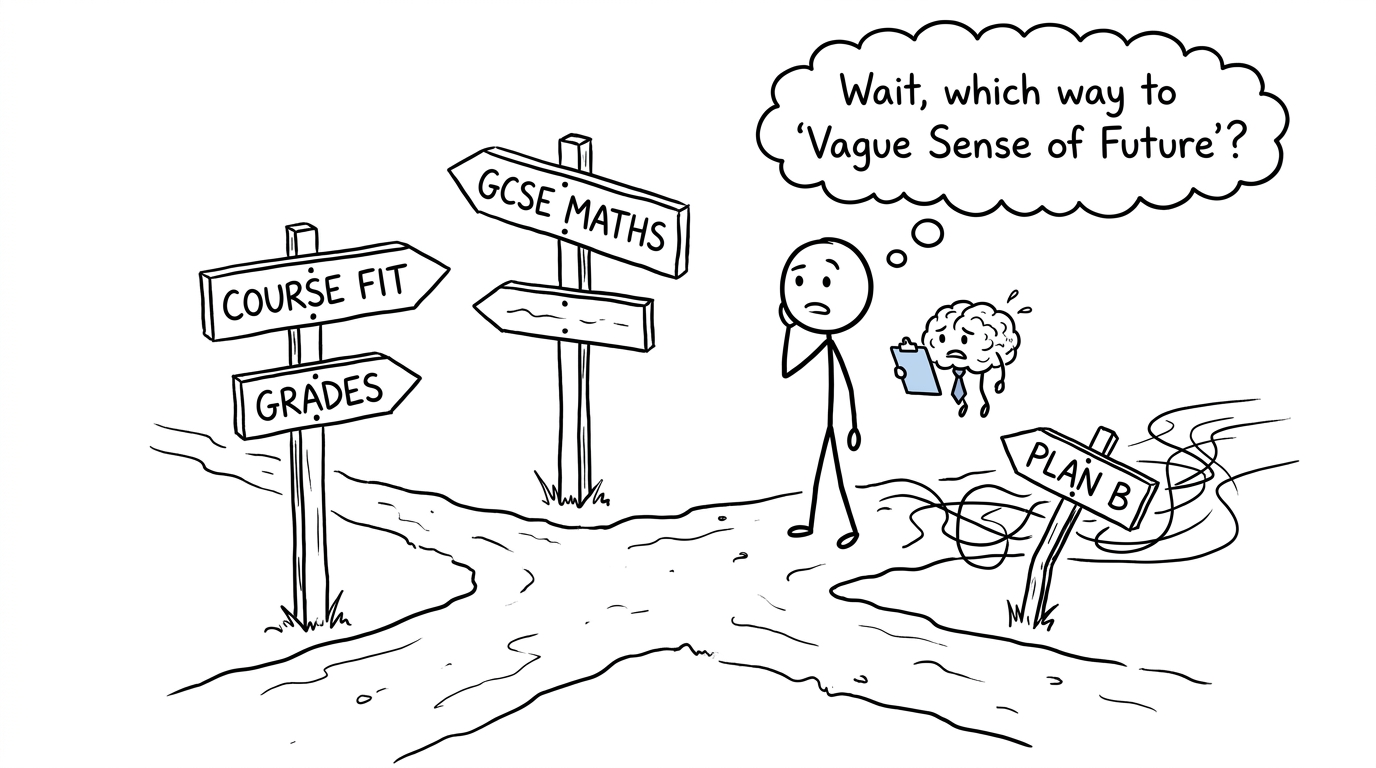 A student and a serious cartoon brain choosing between university admissions signposts
Grade-by-grade A-Level Psychology university guide
A single Psychology grade does not automatically qualify or disqualify you. Think of it as one part of a three-subject profile.
| Psychology grade | UCAS Tariff value | What it may mean for Psychology applications |
|---|---|---|
| A* | 565656 | Supports applications to highly selective courses, but other A Levels and subject conditions still matter. |
| A | 484848 | Meets the Psychology-specific component of many offers requiring an A in a relevant science. |
| B | 404040 | Fits many offers around AAB, ABB or BBB, depending on your other grades. |
| C | 323232 | Can support courses with CCC or tariff-based requirements, as well as some foundation years. |
| D | 242424 | May suit lower-tariff or foundation-year routes, but choices become more limited. |
| E | 161616 | Is a pass and earns tariff points, although direct entry options may be restricted. |
UCAS Tariff points describe the value of a qualification, but universities set their own rules. A provider can ask for named grades, particular subjects or a mixture of grades and tariff points.
An A* in Psychology
An A* demonstrates strong performance, but it does not replace the rest of an offer. For example, UCL published an A*AA offer for its 2026 Psychology BSc, including A*A from two accepted subjects such as Psychology, Biology, Chemistry, Mathematics or Physics.
Bristol published A*AA, including an A in a science-related subject, with Psychology included in its list. Your Psychology grade could therefore satisfy a subject condition while your complete profile determines whether you meet the offer.
An A in Psychology
An A opens a broad range of competitive possibilities. Manchester published AAA, including an accepted subject such as Psychology, Biology, Mathematics or Statistics. King’s College London published A*AA, including an A in an accepted science subject such as Psychology.
This reveals an important detail: an A may satisfy the subject requirement without satisfying the total offer. Read every part of the entry criteria.
A B in Psychology
A B can align well with many Psychology courses. Leicester published BBB for 2026 entry. Other universities use combinations such as AAB or ABB, sometimes with one specified science.
A B is not a judgement on whether you could become a psychologist. It is simply evidence used at one admissions stage. Contextual offers, foundation years and related courses can create additional routes.
A C in Psychology
A C earns 323232 UCAS Tariff points. Westminster listed CCC, equivalent to 969696 points across three A Levels, for a 2026 Psychology course.
Look carefully at course content and accreditation rather than choosing from the offer alone. A lower published requirement does not make a degree automatically suitable, just as a higher requirement does not guarantee the best personal fit.
A D or E in Psychology
Direct entry choices are likely to narrow, but the route does not end. Search for foundation years, tariff-based courses and related degrees, then ask admissions teams whether resits or alternative qualifications are accepted.
A thoughtful backup is not surrender. It is the university equivalent of showing another valid method in an exam.
Why your GCSE Maths grade still matters
Psychology is an evidence-based subject involving research design, data interpretation and statistics. Several universities specify GCSE Maths even when A Level Maths is not required. Recent examples include grade 555 at Exeter, grade 666 at Warwick and King’s, and grade 777 at Edinburgh under its stated alternatives.
Requirements differ, so do not assume that a GCSE pass meets every course condition. If you are still preparing for GCSEs, your present maths revision can preserve future choices.
Useful foundations include averages, percentages, graphs and correlation. Start with the GCSE Maths revision hub, then strengthen data interpretation through scatter graphs revision. Correlation does not establish causation, but learning to interpret it carefully is valuable preparation for psychological research.
What Psychology degrees expect beyond grades
Many universities do not require A Level Psychology. The British Psychological Society notes that applicants often need numeracy, literacy and an ability to handle scientific concepts. Psychology, Biology, Maths and essay-based subjects can all provide useful preparation.
If professional psychology may be your goal, check whether the course is BPS accredited for your intake. An accredited undergraduate degree can provide the academic basis needed for later BPS-accredited professional training, provided the relevant degree conditions are met.
To see what the subject actually demands, explore AQA A Level Psychology revision, AQA data handling and analysis and OCR research methods and techniques. The guide to choosing A Levels after GCSE Psychology also provides a useful starting point for connecting present subject choices with future degrees.
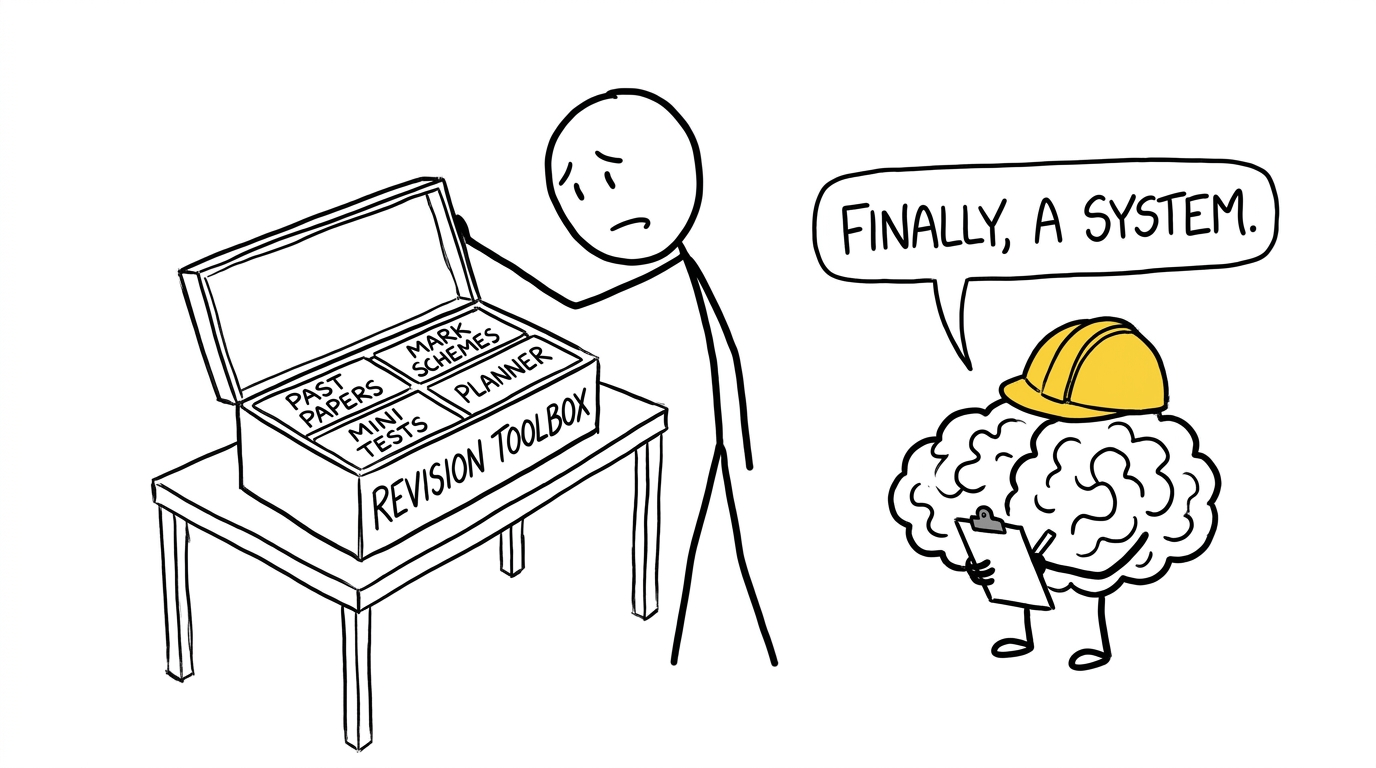 A student opening a revision toolbox while a cartoon brain wears a hard hat
Common mistakes when comparing Psychology offers
Reading one grade instead of the complete offer
An A in Psychology does not meet an A*AA offer by itself. Compare your full predicted profile with every condition.
Assuming Psychology is always required
Many degrees accept Psychology as a science-related subject, but some do not require it. Others request Biology, Chemistry, Physics, Maths or another accepted science.
Ignoring GCSE conditions
A Level predictions do not erase GCSE Maths, English or science requirements. Check these before building an application shortlist.
Treating typical requirements as guaranteed offers
Meeting published grades makes an application academically plausible; it does not guarantee admission. Universities consider applications under their own current policies.
Forgetting contextual and foundation routes
Eligible applicants may receive reduced contextual offers. Foundation years can offer another route when direct-entry requirements are out of reach.
Turn the grade into a plan
Your A-level Psychology grade university prospects are best understood as a range, not a verdict. Build a balanced shortlist, verify current requirements and protect the GCSE Maths skills that Psychology degrees repeatedly use.
MathsGenie can help you turn that plan into consistent revision. Use Edexcel GCSE Maths revision for lessons and practice questions, then test yourself with GCSE predicted papers, past papers, mini tests, mark schemes and video solutions. Later, the Psychology revision hubs can support your transition to research methods and data analysis.
Start with one weak topic today. University choices are often preserved quietly, one secure skill and one carefully marked paper at a time.











