A-Level After GCSE Psychology: What Should You Choose?
A-level after GCSE Psychology: compare grade thresholds, subject combinations and maths demands to choose the right sixth-form route confidently.
Results day can make one GCSE grade feel like a verdict on your future. It is not. If you are considering an A-level after GCSE Psychology, the direct answer is that A Level Psychology is the most natural progression, but it is not automatically the right choice. Your result matters, yet so do your enjoyment of research, confidence with extended writing, maths skills and plans beyond sixth form.
A Level Psychology combines scientific research, data analysis, theories of behaviour and evidence-based essays. GCSE Psychology is useful preparation, but it is not normally an official prerequisite. Exam-board specifications are designed so that students can begin without prior psychology knowledge, while individual schools and colleges set their own entry requirements.
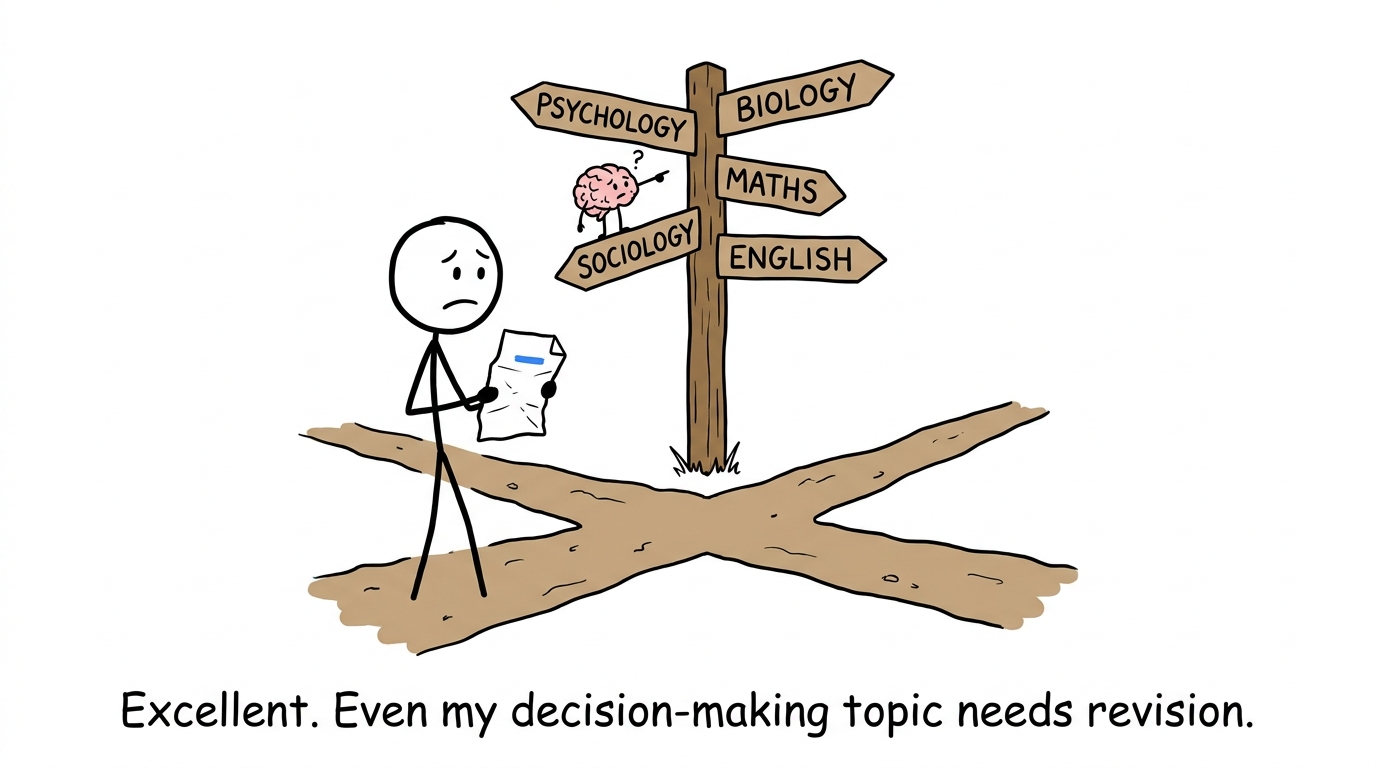 A student choosing between A-level subjects while a tiny brain offers conflicting advice
Your results-day decision checklist
Before confirming your options, ask:
- Did I enjoy explaining and evaluating psychological research?
- Am I comfortable writing structured, evidence-based answers?
- Can I interpret tables, graphs, averages and percentages?
- Do my grades meet my sixth form's published requirements?
- Does my subject combination support any university courses I may consider?
- Would I choose Psychology because I like the course, rather than simply because I took it at GCSE?
The final question is especially important. Familiarity can feel like certainty, but two years is a long time to spend with a subject chosen only because it seems safe.
What grades do you need for A Level Psychology?
There is no single national GCSE threshold for choosing A Level Psychology. Ofqual regulates the qualification, but sixth forms and colleges control admission to their courses. Published requirements vary: some providers ask for grade 444 or 555 in relevant subjects, while others require grade 666 in English, maths or science.
Use this as decision guidance, not as a universal admissions rule:
| GCSE profile | Sensible next step |
|---|---|
| Grade 666 or above in Psychology, English and maths | You are likely to have a strong starting profile, subject to your provider's rules. |
| Grade 555 in the core subjects | A Level Psychology may remain a realistic option at many colleges; check the exact criteria. |
| Grade 444 in maths, English or science | Some providers may accept this, while others will require a higher grade. Contact admissions before changing your plans. |
| Below the stated course threshold | Ask about reviews, resits or an alternative Level 333 route rather than assuming admission is impossible. |
A lower Psychology grade does not necessarily mean that you cannot succeed at A Level. Look carefully at why marks were lost. Weak recall can often be repaired. If extended evaluation and data questions remained difficult despite sustained practice, the A Level course may require a more substantial change in approach.
What changes from GCSE Psychology to A Level?
The move from GCSE Psychology to A Level is not merely a larger list of studies to remember. You will examine theories and research more critically, apply ideas to unfamiliar situations, analyse methodology and build longer arguments.
Research methods become central. Depending on the exam board, this may include experimental design, sampling, hypotheses, correlations, descriptive statistics and inferential testing. The national subject requirements state that at least 10%10\%10% of A Level Psychology assessment must involve mathematical skills at Level 222 or above. AQA describes these skills as being at least the standard of higher-tier GCSE mathematics.
That does not make Psychology an A Level Maths course. It does mean that avoiding numbers is not a workable strategy. You may need to calculate or interpret percentages, ratios, averages, range, standard deviation, graphs and research data.
MathsGenie's GCSE Maths revision hub can help you strengthen these foundations. Begin with averages revision and GCSE probability guidance, then use exam questions to check whether you can apply the ideas rather than merely recognise them.
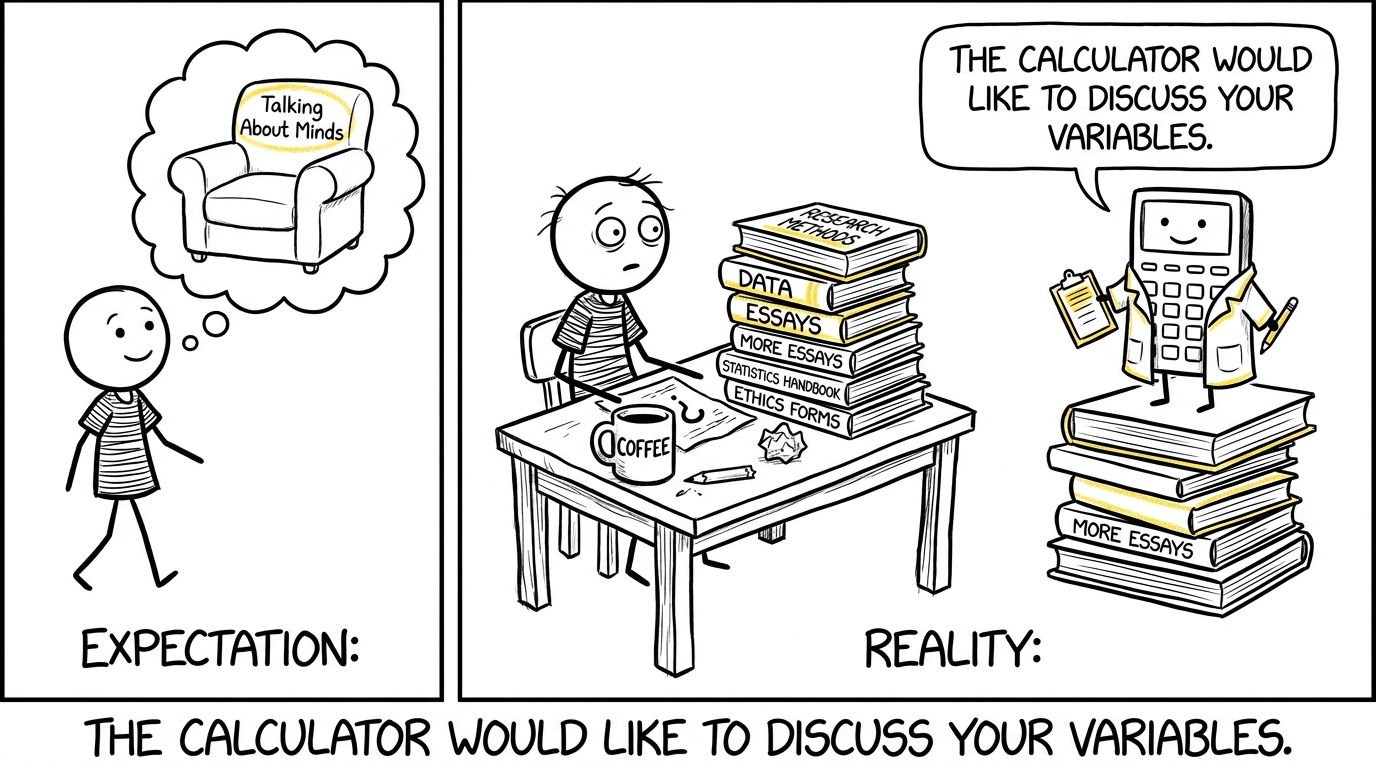 A calculator in a lab coat introduces research methods to a surprised psychology student
Which A Levels work well with Psychology?
Biology
Biology supports topics involving the brain, nervous system, hormones, genetics and biological explanations of behaviour. It is a logical choice if you enjoy scientific detail or may consider psychology, neuroscience or another life-science degree.
Maths or Statistics
Maths develops confidence with data, probability and logical reasoning. It can be valuable for research-intensive degrees, but you should choose it only if you meet the entry requirement and genuinely want the challenge. If full A Level Maths is not suitable, ask whether your provider offers Core Maths or A Level Statistics.
You can explore the expected level through Edexcel A Level Maths revision before committing. This is a better test than choosing it because someone said it “looks good”.
Sociology
Sociology complements Psychology by examining social structures, inequality, institutions and group behaviour. Both subjects require evaluation and extended writing, although their explanations and research traditions differ.
English, History or another essay subject
An essay-based subject can sharpen argument, evidence selection and written communication. This combination may suit students who enjoy Psychology's debates more than its biological content.
There is no universally perfect combination. University Psychology requirements vary, and some courses value or require a science or quantitative subject. If university is a possibility, inspect current course requirements individually rather than relying on a general subject list.
Is choosing A Level Psychology right for you?
A useful decision separates interest in people from interest in psychology as an academic discipline. The course is not mainly informal discussion or advice about mental health. It asks how claims about behaviour can be tested, whether evidence is reliable and how far a conclusion is justified.
Open the AQA A Level Psychology overview and examine the topics, assessment structure and question resources. Then sample the AQA Psychology revision guides. Even if your college uses Edexcel, OCR or Eduqas, this preview helps reveal the level of analysis expected. The Edexcel Psychology methods guide also shows how closely evidence, methodology and statistics are connected.
Common mistakes when choosing A Level Psychology
- Assuming GCSE Psychology is required. Prior study helps, but exam-board courses do not generally depend on it. Local entry rules still apply.
- Looking only at the Psychology grade. English, maths and science thresholds may also determine admission.
- Expecting an easy subject because it sounds familiar. A Level demands precise knowledge, application, evaluation and data handling.
- Ignoring the specification. AQA, Edexcel, OCR and Eduqas do not organise content and assessment identically.
- Choosing an entire combination for one possible career. Keep sensible options open unless a future course has specific subject requirements.
- Treating maths as a minor detail. Quantitative skills are formally assessed, so weak foundations should be addressed early.
Make the decision, then prepare for it
Choosing A Level Psychology is less about finding a perfect prediction of your future and more about making a well-evidenced next move. Check your sixth form's thresholds, read its exam-board specification and compare the actual course with what you enjoyed at GCSE.
If Psychology is your choice, start with the AQA A Level Psychology overview and use MathsGenie's lessons, practice questions, revision guides, past papers, predicted papers and mark schemes to understand what earns marks. Meanwhile, the MathsGenie revision planner can help you repair any GCSE maths gaps before research methods turns them into larger ones.
Your results provide information. They do not make the decision for you. Use them carefully, choose deliberately and let consistent practice carry you forward.