

A-Level Psychology Career Paths After Results Day
A-level psychology career paths explained: explore realistic university, apprenticeship and job routes, plus what to do after every results-day outcome.
Results day can make one grade feel like a verdict. It is not. A-level psychology career paths extend through university, apprenticeships, support roles, research and people-focused careers. Your result affects which door is easiest to open next, but it rarely decides your entire destination.
The immediate task is practical: compare your result with any offer you hold, check course requirements directly, and identify a first choice plus alternatives. Psychology A Level is valuable preparation, but it does not qualify someone to work as a psychologist on its own.
Your results-day checklist
- Check whether your university or apprenticeship place has been confirmed.
- Read any message from the provider before assuming you have missed the offer.
- Compare alternative courses by content, accreditation and entry requirements.
- Ask whether a foundation year, Clearing place, resit or different Level 3 route suits you.
- Keep your long-term career in view without treating it as a fixed promise.
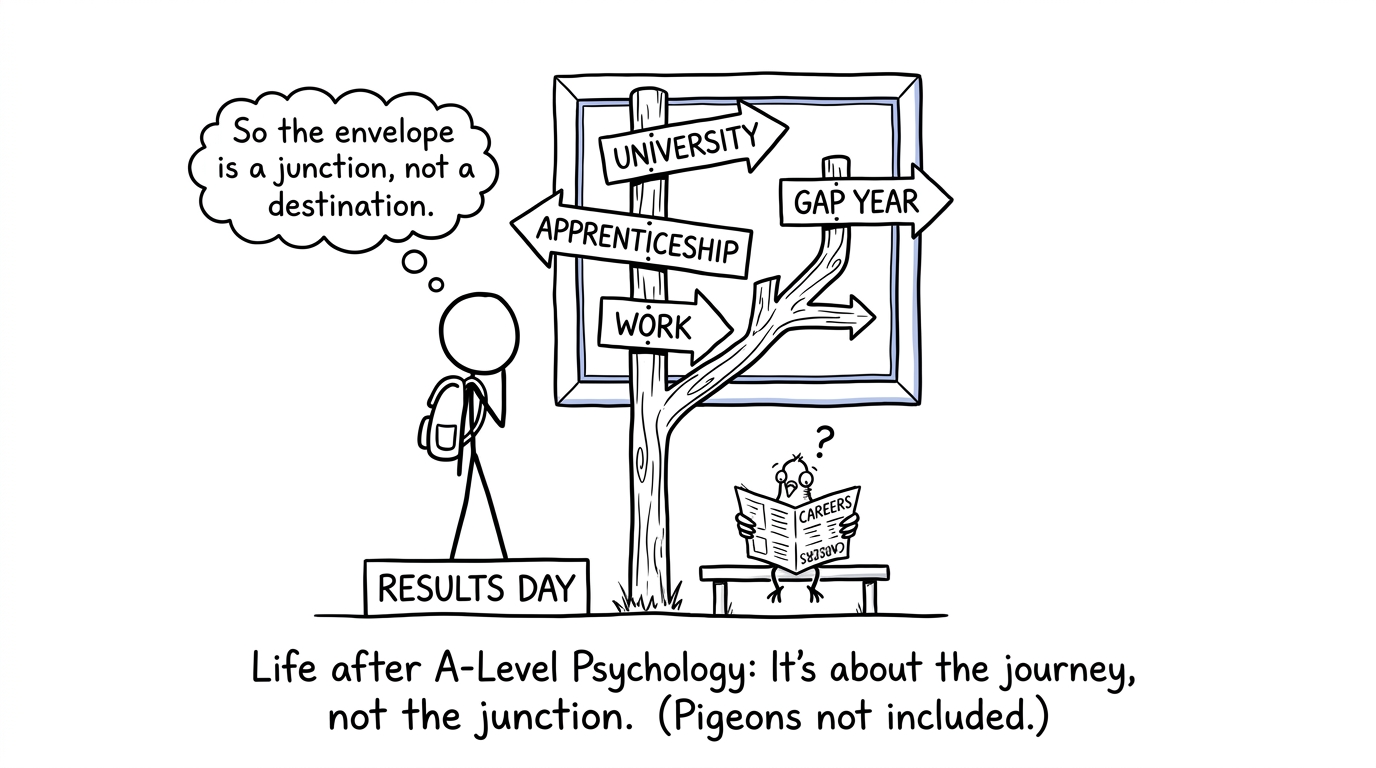 A student sees results day as a junction with several possible routes
What does an A Level in Psychology lead to?
Psychology develops three connected abilities: understanding behaviour, evaluating evidence and communicating a reasoned conclusion. Those skills appear in more careers than the subject's name suggests.
Possible destinations include:
- psychology and psychological professions;
- mental health and wellbeing services;
- education and youth work;
- criminal justice and rehabilitation;
- human resources and occupational development;
- market, social or user research;
- healthcare, public policy and charities;
- data-informed business roles.
Universities set their own requirements. Psychology A Level is not always essential for a psychology degree, while some courses prefer or require a science or maths subject. GCSE English and maths requirements also vary. Always check the current course page rather than relying on a previous year's offer.
Career and course pairings to consider
Clinical psychology and mental health
A typical professional route begins with a British Psychological Society-accredited psychology degree, or an accredited conversion course after another degree. Graduates then usually need relevant experience and approved postgraduate training. Clinical psychology training is highly competitive and normally includes a three-year doctorate.
A useful course pairing might be psychology with neuroscience, followed by experience in research or mental health support. Related careers include assistant psychologist, psychological wellbeing practitioner and research assistant, although each has separate entry and training requirements.
Start exploring the academic side through AQA A Level Psychology revision, where lessons, questions and exam resources show what degree-level foundations begin to look like.
Educational psychology and work with young people
If learning, development and additional needs interest you, psychology can support routes into educational psychology, teaching, youth work or school-based wellbeing.
Becoming an educational psychologist requires much more than A Level. The route generally involves an accredited degree or conversion course, relevant experience with children or young people, and approved postgraduate professional training. Requirements differ across the UK, so check the rules for the nation in which you plan to train.
A useful pairing could be psychology with education, leading towards learning support, research, teaching or further professional training.
Forensic psychology and criminal justice
Forensic psychologists apply psychological evidence within criminal justice and rehabilitation. A common route involves a BPS-accredited degree, specialist postgraduate study and supervised professional practice or an approved doctorate. Relevant experience is important and entry is competitive.
Related degrees include psychology with criminology and forensic psychology. However, a course title containing “forensic” does not automatically make it professionally accredited. Check accreditation before applying.
Occupational psychology, HR and business
Occupational psychology examines behaviour at work: selection, motivation, wellbeing, leadership and organisational change. Professional occupational psychologists complete accredited postgraduate training after gaining the appropriate graduate foundation in psychology.
Psychology also supports non-psychologist careers in recruitment, HR, consumer insight and workplace learning. A pairing such as psychology with business can connect behavioural understanding with commercial decision-making.
Research, marketing and data
Research methods are not merely an exam topic. They are the bridge between an interesting claim and trustworthy evidence. Psychology students learn about study design, sampling, ethics, descriptive statistics, correlations and significance.
That foundation can lead towards social research, market research, user research or policy analysis. Strengthen it with MathsGenie's guides to descriptive statistics, correlation analysis and research ethics.
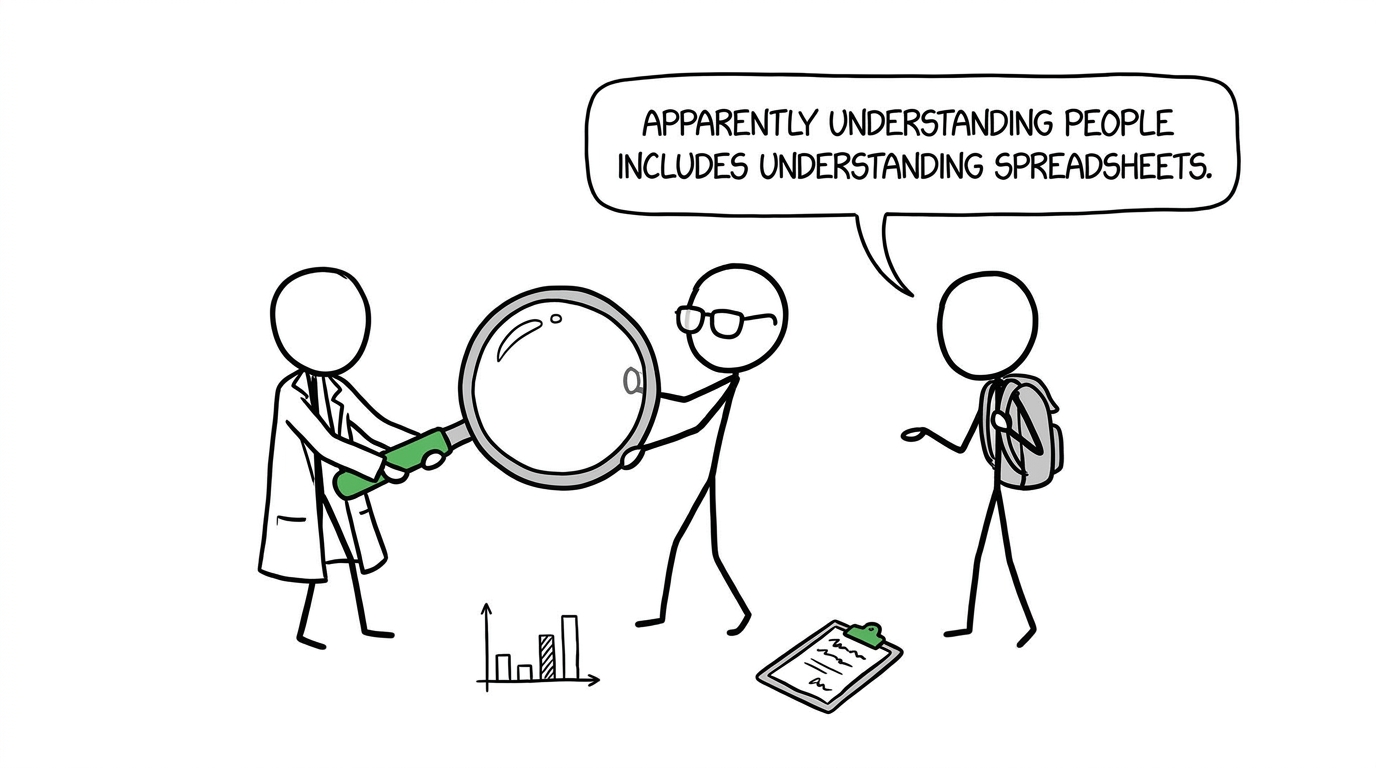 A psychologist and data analyst share an oversized magnifying glass
Why GCSE maths still matters for psychology
For a GCSE student considering Psychology A Level, numeracy is not an optional extra. Current UK A Level Psychology specifications require at least 10%10\%10% of assessment to involve mathematical skills at Level 2 or above, although where those marks appear differs by exam board.
You may need percentages, averages, ranges, standard deviation, graphs, probability and statistical interpretation. For example, percentage is represented by:
percentage=partwhole×100\text{percentage}=\frac{\text{part}}{\text{whole}}\times 100percentage=wholepart×100That is why improving GCSE maths can widen future choices. Use the GCSE maths revision guides, revisit averages practice, and build confidence with scatter graphs revision. These skills support both psychology exams and later research.
If your result is below the grade you hoped for
First, check your actual application status. A provider may still confirm your place. If it does not, realistic alternatives include Clearing, a foundation year, another institution, a related degree, an apprenticeship or a resit.
A different undergraduate subject does not necessarily close professional psychology forever. BPS-accredited conversion courses can provide a later route for graduates from other disciplines. That flexibility is useful, but it should not replace careful checking now: funding, entry requirements and professional accreditation all matter.
Common mistakes when choosing a psychology route
Assuming one A Level makes you a psychologist. Professional psychologist careers require degree-level and usually postgraduate training.
Choosing by course title alone. Compare modules, placements, assessment and BPS accreditation where professional psychology is the goal.
Ignoring maths and research methods. Psychology is a science of evidence as well as a study of people.
Treating one disappointing result as permanent. Alternative entry routes exist, but each has practical costs and requirements to investigate.
Planning only for the job title. Ask what the daily work involves, which settings employ the role and how much further training is required.
Turn the next grade into a useful next step
Results day is information, not identity. The strongest decision is the one based on verified requirements, honest interests and a route you are prepared to follow.
MathsGenie can help you build the evidence and numeracy behind that route. Use the AQA A Level Psychology question bank and revision tools, then practise under timed conditions with A Level Psychology past papers and mark schemes. Revision lessons, practice questions, mini tests, predicted papers and video solutions can turn a broad career hope into a clear next action.










