What you'll learn
- What ethics means in psychological research and why it matters.
- The role of the British Psychological Society’s code of ethics.
- The main ethical issues: consent, deception, withdrawal, harm, confidentiality and debriefing.
- How researchers can deal with ethical problems while still producing useful evidence.
The basic idea: why ethics matter
Psychology studies real people: their behaviour, thoughts, emotions, relationships and sometimes distressing experiences. This means researchers have a duty to protect participants, not just collect interesting data.
Ethics
Ethics are moral principles that guide researchers so that studies are carried out responsibly, respectfully and safely.
An ethical issue occurs when a study may conflict with participants’ rights or wellbeing. For example, a researcher might need to hide the true aim of a study to avoid changing participants’ behaviour, but that creates a problem with informed consent.
Ethical issue
An ethical issue is a potential conflict between the aims of research and the rights or welfare of participants or others affected by the research.
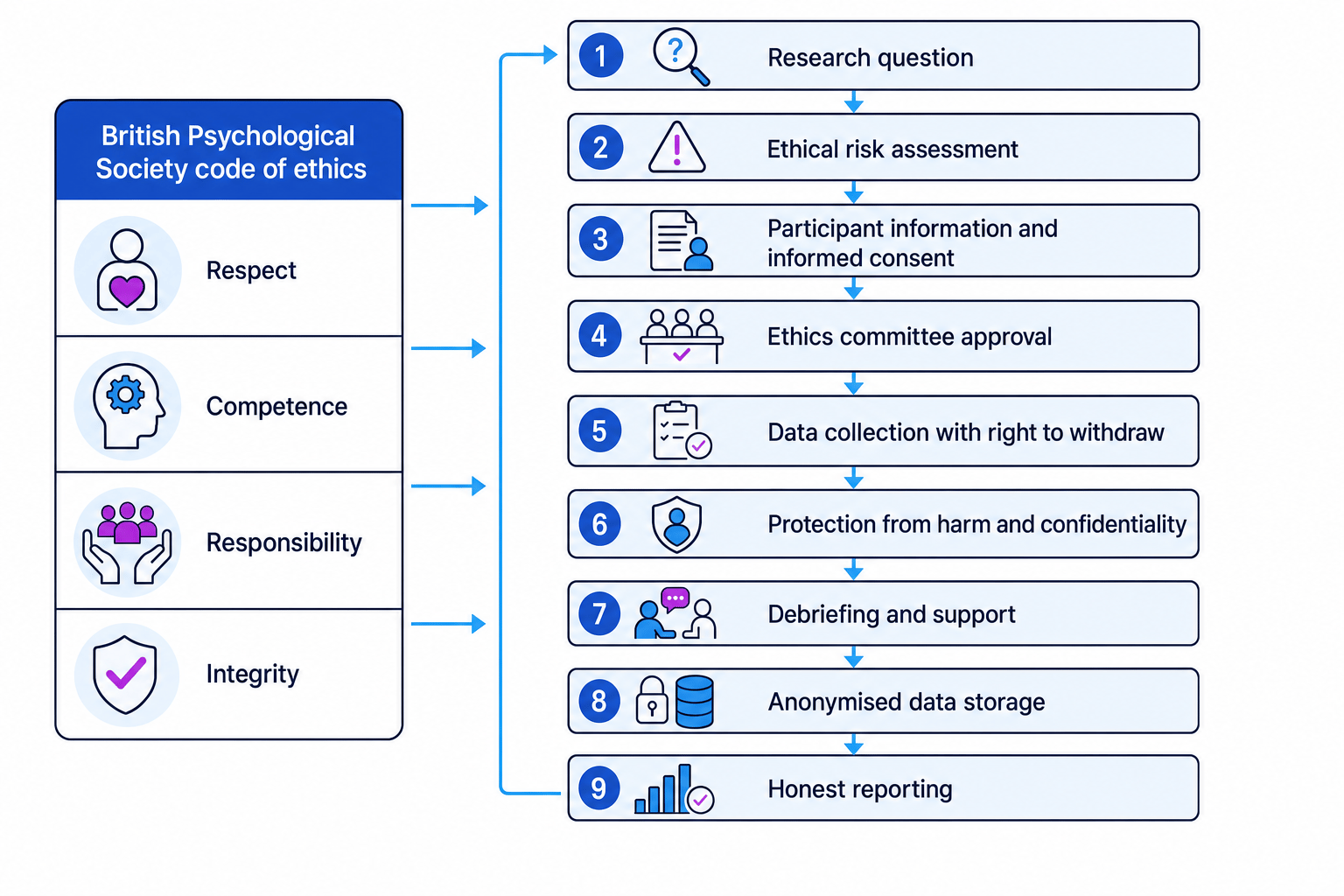
The flowchart below shows how ethical thinking should run through the whole research process, not just appear at the end.
The British Psychological Society code of ethics
The British Psychological Society, often shortened to BPS, is the main professional body for psychologists in the UK. It publishes ethical guidance for psychologists, including the Code of Ethics and Conduct and guidance on human research ethics.
At A-Level, you need to know that the BPS code helps researchers:
- plan studies responsibly
- decide whether a study should be approved by an ethics committee
- protect participants from unnecessary risk
- maintain public trust in psychology
- judge whether classic studies were ethically acceptable
The BPS code is built around four broad principles:
Respect
Researchers should respect people’s dignity, privacy, autonomy and rights. This links strongly to informed consent, confidentiality and the right to withdraw.
Competence
Researchers should have the skills, training and supervision needed to conduct the study safely and appropriately.
Responsibility
Researchers are responsible for managing risks, protecting participants from harm and acting if something goes wrong.
Integrity
Researchers should be honest and accurate. Deception must be justified, carefully managed and followed by a proper debrief.
The role of the BPS code
The BPS code does not just list “rules”. It gives psychologists a framework for weighing up the value of research against possible risks to participants.
Key ethical issues in psychological research
Informed consent
Informed consent
Informed consent means participants voluntarily agree to take part after being given enough information about the study’s aims, procedures, risks and how their data will be used.
In practice, researchers usually provide a participant information sheet and a consent form. For children or people who may not be able to give full consent, researchers may need consent from a parent, guardian or carer, as well as the participant’s own agreement where possible.
The difficulty is that fully explaining the aim can sometimes create demand characteristics — cues that make participants guess the purpose of the study and change their behaviour.
Demand characteristics
Demand characteristics are features of a study that may lead participants to work out the aim and behave differently from how they normally would.
For example, in Loftus and Palmer’s study of eyewitness testimony, participants watched car crash clips and answered questions using different verbs such as “hit” or “smashed”. If participants had been fully told the aim was to test whether wording affects memory, they might have tried to avoid being influenced.
Deception
Deception means deliberately misleading participants or withholding important information. It is not automatically banned, but it must be justified.
Milgram’s obedience study is a classic example. Participants believed they were giving real electric shocks to a learner, who was actually a confederate — someone working with the researcher while pretending to be a participant. This deception helped Milgram study obedience, but it also meant participants could not give fully informed consent.
Deception is not always automatically unethical
AQA answers are stronger when you explain whether deception was necessary, whether participants were likely to object, and whether they were properly debriefed afterwards.
Right to withdraw
The right to withdraw means participants should be able to leave a study at any point and, where possible, withdraw their data afterwards.
This must be made clear before the study begins. Researchers should avoid pressuring participants to continue. In Milgram’s study, the verbal prods such as “the experiment requires that you continue” made withdrawal difficult, so this is a major ethical criticism.
Protection from harm
Researchers should protect participants from physical and psychological harm. Psychological harm includes stress, embarrassment, anxiety, humiliation or lowered self-esteem.
Zimbardo’s prison study is often criticised here. Participants took on prisoner and guard roles, and some experienced distress as the study escalated. Although the study was stopped early, it raises serious concerns about whether participants were adequately protected from harm.
A quick way to judge harm
Ask: “Would the participant be likely to leave the study in a worse state than when they arrived?” If yes, protection from harm is a key issue.
Confidentiality and privacy
Privacy is a person’s right to control information about themselves. Confidentiality means researchers should not reveal participants’ identities or personal data.
Researchers can protect confidentiality by using ID numbers, pseudonyms, secure storage and reporting group results rather than naming individuals.
Confidentiality is not the same as anonymity
A study is only truly anonymous if the researcher cannot identify who gave which data. If the researcher knows participants’ identities but does not reveal them, that is confidentiality.
Rosenhan’s study of psychiatric hospitals raises ethical issues because hospital staff were deceived and observed without giving consent. However, the hospitals were not named, which helped protect confidentiality.
Debriefing
A debrief happens after the study. The researcher explains the true aims, reveals any deception, checks the participant’s wellbeing, reminds them of their right to withdraw data and provides support if needed.
Debriefing is especially important when deception has been used. However, a debrief does not automatically remove all ethical problems. If a participant has already experienced serious distress, explaining the study afterwards may not fully undo the harm.
Assessing ethical issues in Milgram 1963
-
Consent was only partly informed. Participants agreed to take part, but they were told the study was about memory and learning, not obedience to authority.
-
Deception was central to the procedure. The learner was a confederate, the shocks were fake, and the participant was misled about the true aim. This increased realism but reduced participants’ ability to make an informed choice.
-
The right to withdraw was weakened. The experimenter’s prods pressured participants to continue, so leaving the study may not have felt like a genuine option.
-
Protection from harm was a serious concern. Many participants showed signs of stress, such as sweating, trembling or nervous laughter, because they believed they might be harming another person.
-
Debriefing helped but did not erase the issue. Milgram did debrief participants and reassure them the learner was unharmed, but the distress during the procedure remains an important AO3 criticism.
Dealing with ethical issues in research
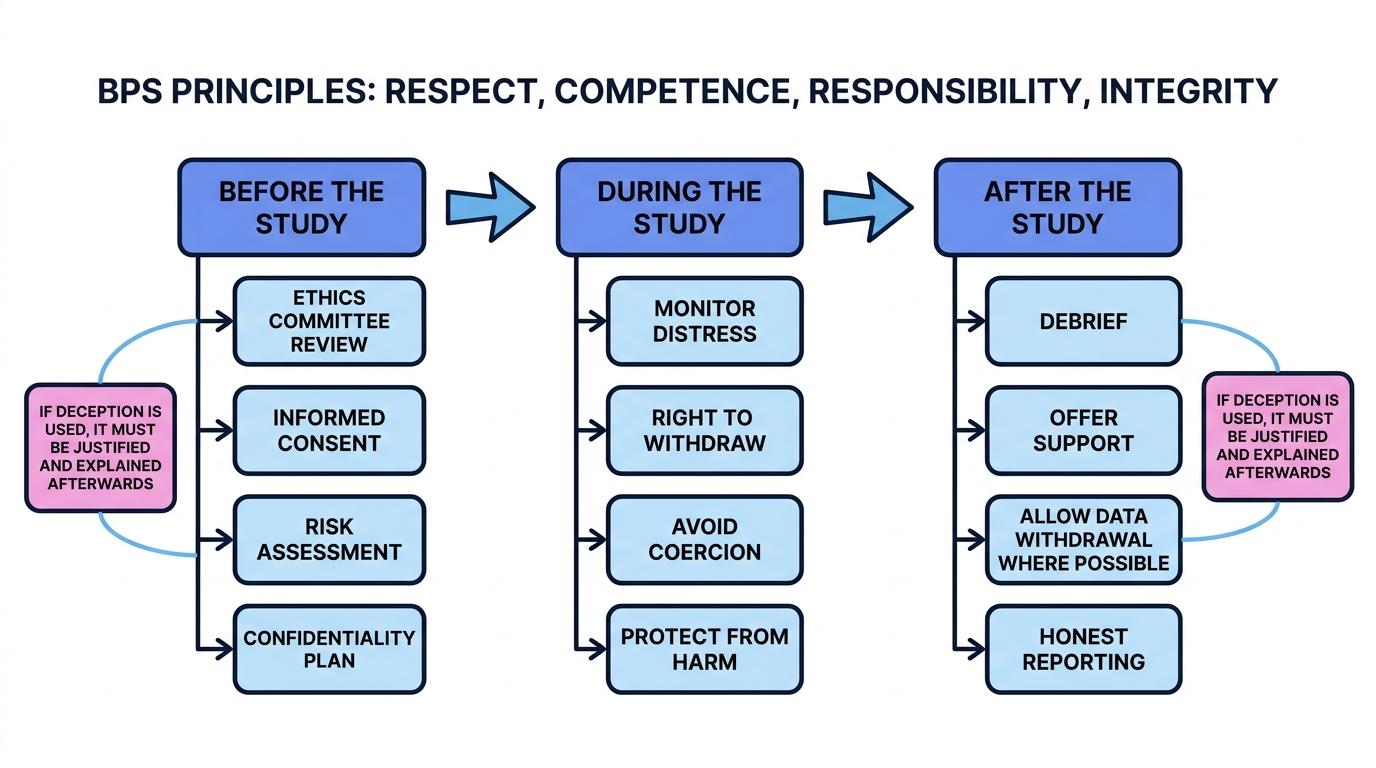
Ethical problems should be considered before, during and after the study.
Before the study
Researchers usually submit their proposal to an ethics committee. This committee reviews the aims, procedure, risks, consent materials, data handling and debrief plan.
Researchers may use:
- a risk assessment
- pilot testing to spot unexpected distress
- screening to exclude vulnerable participants where appropriate
- clear consent forms
- a planned withdrawal procedure
- secure data storage plans
During the study
Researchers should monitor participants for distress and stop the study if necessary. They should avoid coercion, which means pressuring someone to take part or continue.
Payments should not be so large that participants feel unable to refuse. Participants should also know who to contact if they are worried.
After the study
Researchers should debrief participants, offer support, allow data withdrawal where possible, and store data securely. They should also report findings honestly, including limitations and ethical concerns.
When deception is unavoidable
Sometimes deception is used because telling participants the full aim would ruin the study. In these cases, researchers may use:
- prior general consent, where participants agree to take part in a study where some details cannot be revealed until later
- presumptive consent, where a similar group is asked whether they would consider the procedure acceptable
- retrospective consent, where participants are fully informed afterwards and asked whether their data can still be used
Consent solutions have limits
Presumptive and retrospective consent can reduce ethical problems, but they are not as strong as fully informed consent because the participant did not know everything at the actual time of taking part.
Evaluating ethical guidelines
Ethical guidelines are a major strength of modern psychology because they protect participants and improve public confidence. They also make research more professional by giving researchers a clear process to follow.
However, ethics can create a tension with validity. If researchers reveal the full aim, participants may change their behaviour. If researchers avoid all stressful situations, they may be unable to study important topics such as obedience, prejudice, attachment disruption or mental health.
There is also subjectivity in deciding whether a study’s benefits outweigh its costs. Milgram’s findings helped us understand obedience and destructive authority, but many psychologists argue that the distress caused was too high. Zimbardo’s study generated discussion about prisons and social roles, but its ethical weaknesses make it difficult to justify by modern standards.
Ethics also includes ethical implications: the wider effects of research on society. For example, research on mental illness, aggression or group differences must be reported carefully to avoid stigma, discrimination or misuse.
Balanced evaluation
Strong AO3 does not simply say “this study was unethical”. It explains the specific issue, why it matters, how it affected participants, and whether the researcher dealt with it adequately.
In the exam
-
Name the exact ethical issue: consent, deception, withdrawal, harm, confidentiality, privacy or debriefing.
-
Apply it to the study or scenario: explain what happened and why it created a problem for participants.
-
Add balance: mention how the issue was dealt with, or how it could have been improved, then link to the value or validity of the research.
Check yourself
- Why does deception make informed consent difficult?
- How could a researcher protect confidentiality in a psychological study?
- In Milgram’s study, which ethical issue do you think was the most serious, and why?