

A-Level Politics Resit: Your Results Day Plan
A-level politics resit guide: review your result, secure an exam centre, diagnose weak papers and follow a practical revision timetable for exam success.

Results day can make two years of work feel as though it has been reduced to one letter. If that letter is lower than you expected, the useful question is not whether you are disappointed. It is what you do next.
An A-level politics resit normally means entering for the qualification again in the following summer exam series, arranging an approved centre and preparing for the required papers. Before committing, speak to your school or college about your marks, post-results options and retake arrangements. Then build your revision around evidence: your scripts, mark schemes and timed answers.
This plan takes you from results day to the next exam season without asking you to revise everything at once.
Your resit preparation checklist
- Check your component marks and grade boundaries.
- Ask whether accessing a script or requesting a review of marking is appropriate.
- Confirm your exam board, specification and required papers.
- Arrange your entry through a school, college or private-candidate centre.
- Diagnose weaknesses using one timed paper from each component.
- Build an error log covering knowledge, analysis, evaluation and timing.
- Complete targeted questions before moving to full papers.
- Keep examples current without replacing specification knowledge.
For students receiving results in summer 2026, A Level results are released on Thursday 13 August. Most A Level resits take place in the following May or June because these qualifications are normally examined in the summer series.
 A student turning the tangle of results day into a clear next step
Results day milestone: understand the result first
Do not begin by rewriting notes. Begin with diagnosis.
Ask your teacher or exams officer for the marks achieved on each paper. If available, discuss access to your scripts and compare your answers with the mark scheme. A review of marking is not a second attempt at the paper, and marks can move down as well as up, so it should be considered with your centre rather than requested automatically.
Separate lost marks into four categories:
- Knowledge: missing concepts, thinkers, institutions or examples.
- Analysis: points were asserted rather than explained.
- Evaluation: arguments lacked comparison or sustained judgement.
- Execution: timing, question choice or source use caused the loss.
This distinction matters. More reading will not repair a timing problem, while more timed essays will not repair weak knowledge of Parliament or liberalism.
First-month milestone: secure the correct retake
AQA and Pearson Edexcel A Level Politics are linear qualifications, so candidates sit the required papers at the end of the course. WJEC arrangements in Wales differ, so always follow your exact specification rather than assuming every board works in the same way.
Start with the A Level Politics revision hub, then choose the correct board. Maths Genie provides dedicated areas for Edexcel A Level Politics revision, AQA A Level Politics revision and WJEC A Level Politics revision.
Ask your former school or college whether it accepts resit entries. If not, you will need an approved centre that accepts private candidates. Confirm the specification code, entry deadline, fees, exam venue and identification requirements directly with the centre. Do this early: centre policies and charges vary.
Autumn milestone: rebuild knowledge selectively
Resitting A-level politics should not mean repeating the course exactly as before. The first attempt has already supplied something valuable: evidence about where the marks disappeared.
Create a specification tracker and label each area:
- secure enough to answer without notes;
- understood but short of precise evidence;
- weak or frequently avoided.
Spend most of your autumn sessions on the final two categories. A practical weekly rhythm is:
- one retrieval session for concepts, institutions and thinkers;
- one session building evidence for debates;
- one planned essay or source question;
- one short review of previous errors.
Keep an examples bank, but organise it by argument rather than headline. Record what an example demonstrates, which counterargument it supports and whether it remains current. Politics rewards relevant evidence, not a scrapbook of recent news.
The structure can be adapted from Maths Genie’s one-month revision planning method: diagnose, practise, mark, revisit and retest. The subject changes, but the feedback loop does not.
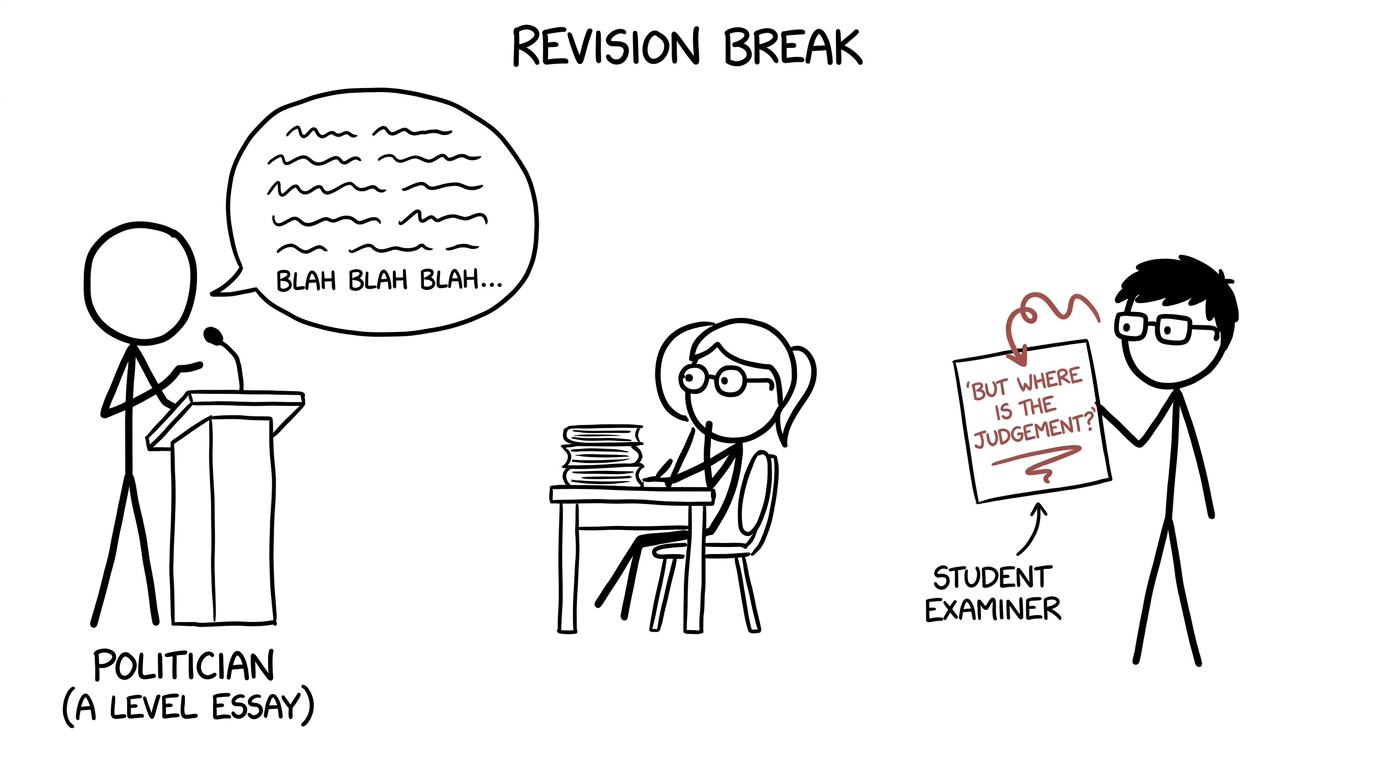 An examiner politely asking a politician where the judgement went
Winter milestone: turn knowledge into arguments
By winter, notes should become secondary. Your main materials should be questions, plans, completed answers and mark schemes.
For each essay, identify the precise debate, organise arguments into comparative themes and reach a judgement that answers the wording. Evaluation should run through the response rather than appearing suddenly in the conclusion.
Practise all required question types for your board. AQA and Edexcel use different paper structures and mark totals, so advice copied from another specification can quietly train the wrong technique. Use the Edexcel Politics past papers or AQA Politics past papers that match your entry.
After every answer, log one change under each heading:
- knowledge to add;
- reasoning to develop;
- judgement to sharpen;
- timing decision to improve.
Spring milestone: move into timed papers
In the final months, increase the proportion of revision completed under timed conditions. Begin with individual questions, progress to paper sections and then complete full papers without notes or pauses.
A past paper is most useful after it has been marked. Compare your response with the official mark scheme, identify why marks were lost and redo the weakest section several days later. Maths Genie’s guide to using past papers properly explains this paper, mark, fix and retest cycle.
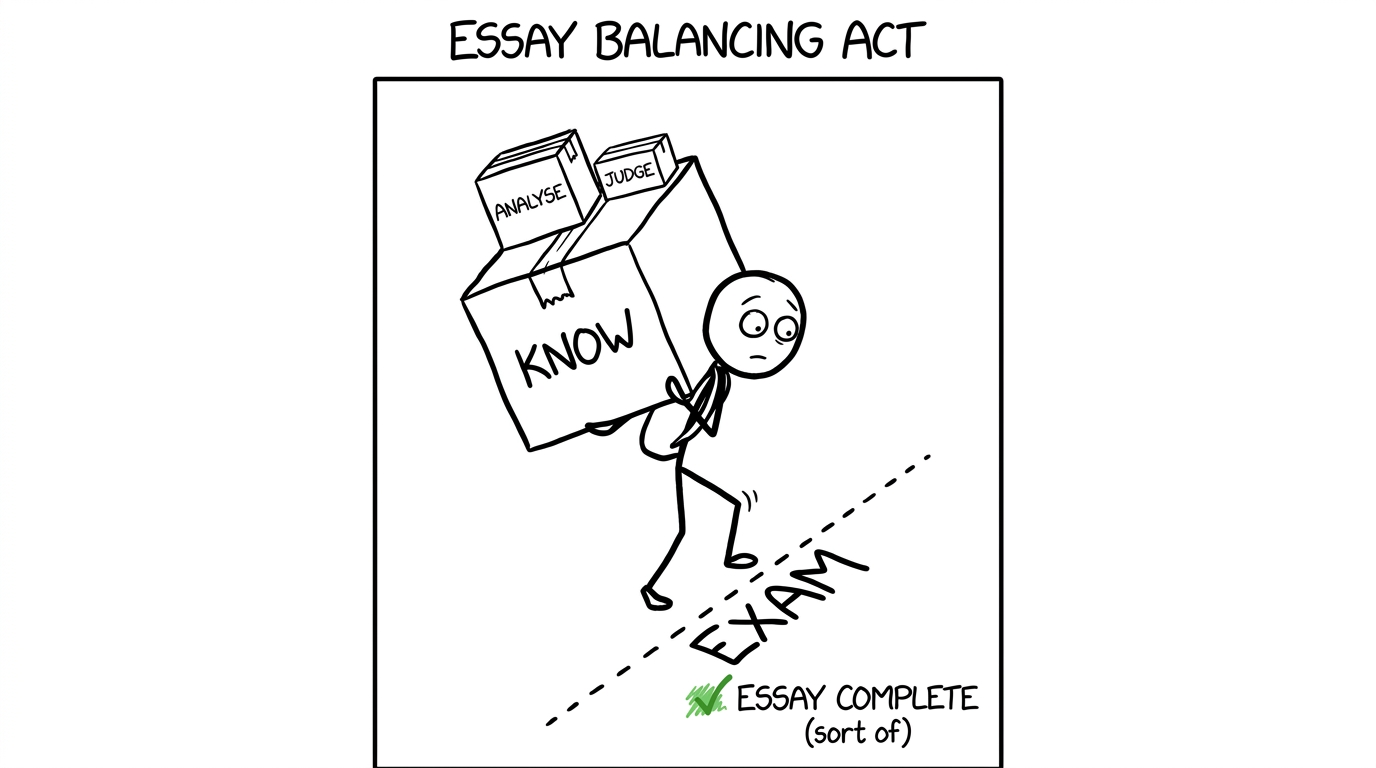 A student trying to carry knowledge, analysis and judgement equally
Common A-level politics retake revision mistakes
Revising every topic equally
Your result provides diagnostic evidence. Give more time to weak papers and recurring skill gaps while briefly retrieving stronger material.
Memorising essays
A memorised answer rarely fits the exact wording. Memorise flexible evidence, ideological tensions and lines of argument instead.
Following the wrong exam board technique
Question styles, timings and paper content differ. Keep the correct specification beside your plan and use board-specific papers.
Reading mark schemes without rewriting
Recognition feels like learning, but it is not proof. Correct the answer, close the mark scheme and attempt the question again later.
Using current examples without analysis
A recent event earns little by itself. Explain how it supports the argument, consider its limitations and connect it to the political principle being assessed.
Make the second attempt more deliberate
A resit is not a rewind. It is a second attempt with better information.
Start by confirming the entry. Diagnose the old result honestly. Build knowledge in autumn, arguments in winter and exam control in spring. Then let each marked answer decide what you revise next.
Open Maths Genie’s A Level Politics question bank and revision resources, choose your exam board and begin with one diagnostic paper. Use the revision lessons, practice questions, past papers, predicted papers, mini tests and mark schemes to turn a disappointing results day into a clear, measurable plan.











