

A-Level Physics Grade: University Entry Guide
A-level physics grade university choices explained: compare typical Physics BSc and MPhys offers, subject requirements, alternatives and next steps.
A university offer can look like three small letters. Yet behind AAB or BBB sits a much bigger question: what future does your result make possible?
The short answer to the A-level physics grade university question is that your Physics grade matters, but it rarely works alone. Physics degrees commonly consider your overall offer, your grades in Physics and Mathematics, and sometimes your GCSE English and Maths results. An A or A* can open highly selective courses; a B fits many strong degrees; and lower grades can still lead to foundation years or related subjects.
Your university entry checklist
Before judging any grade, check:
- the overall offer, such as AAB or BBB;
- the required grade in Physics;
- whether A-level Mathematics is compulsory;
- whether the course is a BSc, MPhys or foundation year;
- contextual offer eligibility;
- GCSE Maths and English requirements;
- the requirements published for your actual entry year.
Universities set their own conditions, and requirements can change. Treat the examples below as a map, not a guarantee.
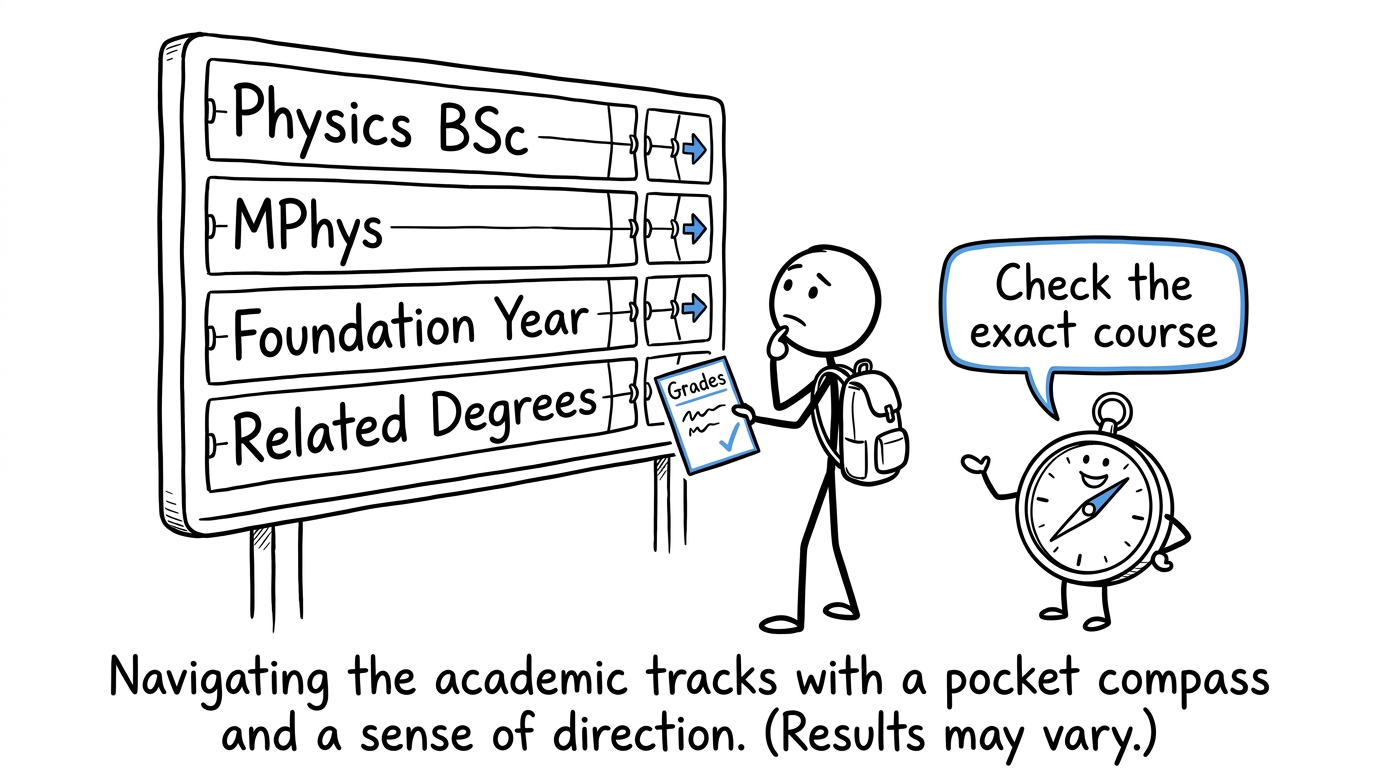 A student choosing between Physics degree routes at a university destination board
What does an A-Level Physics grade mean?
An A-level grade shows your overall attainment against that exam board's assessment standard. It does not represent a fixed mark across every year or board because grade boundaries vary between exam series. You can inspect recent AQA A-Level Physics grade boundaries, OCR A-Level Physics grade boundaries and Eduqas A-Level Physics grade boundaries to see this variation.
For university admission, a grade may also carry UCAS Tariff points:
| A-Level grade | UCAS Tariff points |
|---|---|
| A* | 565656 |
| A | 484848 |
| B | 404040 |
| C | 323232 |
| D | 242424 |
| E | 161616 |
However, a points total does not override a subject condition. If a course requires an A in Mathematics and an A in Physics, collecting the same number of points through other subjects may not satisfy it.
Grade-by-grade Physics degree entry requirements
A*: highly selective options become realistic
An A* in Physics is valuable for courses with demanding subject conditions, especially when paired with an A or A* in Mathematics.
For 2026 entry, Manchester's MPhys Physics listed AAA, including A* grades in Physics and Mathematics or Further Mathematics. UCL's Physics BSc listed AAA, requiring AA across Mathematics and Physics in either order.
These examples reveal the important detail: an A* in Physics is not automatically enough. Selective physics courses often place equal weight on Mathematics because degree-level mechanics, fields, waves and quantum physics rely heavily on mathematical modelling.
A: a strong position for many Physics degrees
An A indicates strong subject knowledge and can meet the Physics condition for a wide range of BSc and MPhys courses. Southampton's 2026 MPhys requirements, for example, listed offers from A*AA to AAA with minimum A grades in Physics and Mathematics or Further Mathematics.
An A also gives you more flexibility when comparing research-intensive courses, integrated master's degrees and joint degrees such as Mathematics and Physics. If this is your aim, build the mathematical side through Edexcel A-Level Maths revision, particularly mechanics, vectors and calculus.
B: many good routes remain open
A B in Physics is not a verdict against a physics career. It may meet the subject requirement for numerous courses, particularly when your Mathematics grade is also strong.
For 2026 entry, Exeter's Physics BSc listed a typical range of AAA to ABB, requiring either an A in Mathematics and B in Physics, or B in Mathematics and A in Physics. Heriot-Watt listed BBB for first-year entry to its MPhys, including B grades in both Physics and Mathematics.
This is where careful course selection matters. Look beyond league-table headlines and compare modules, laboratories, placements, accreditation, support and graduate destinations.
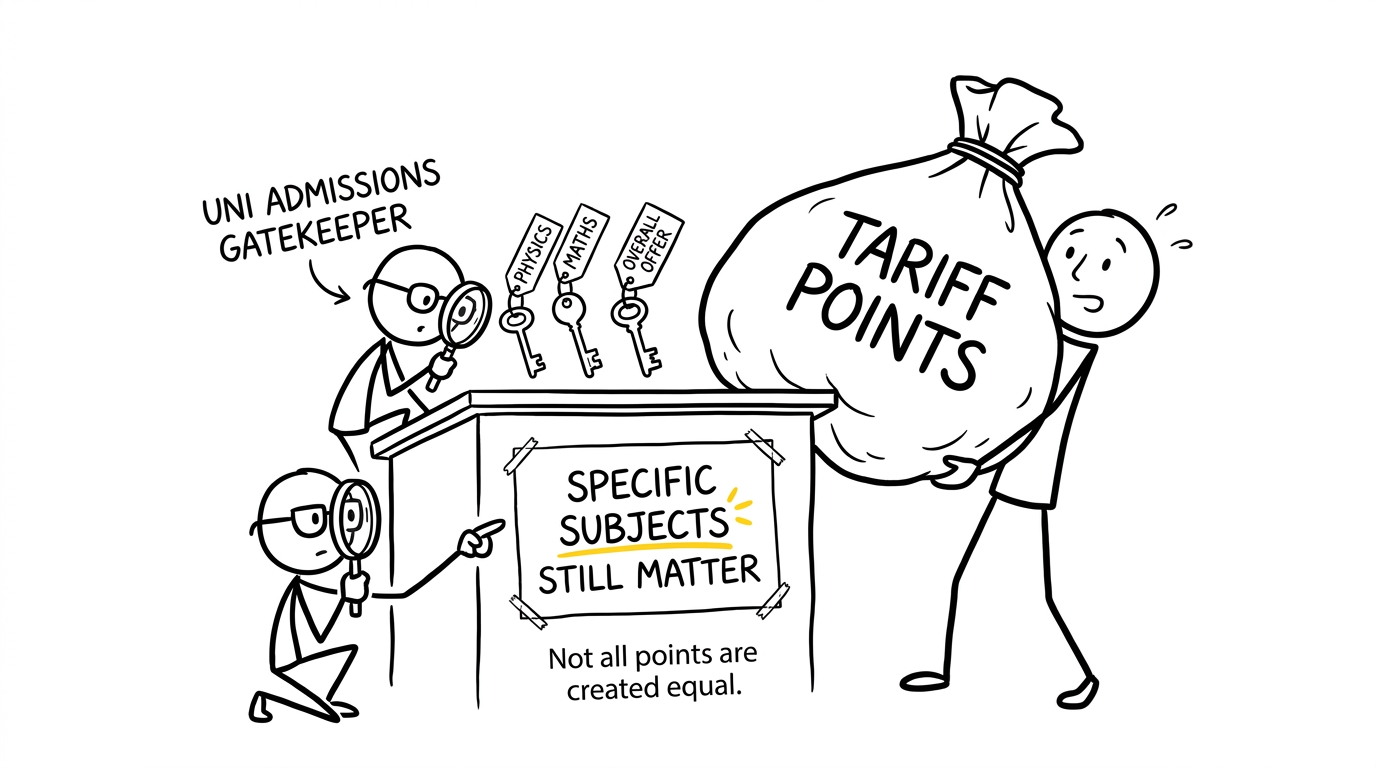 A university gatekeeper checking subject grades rather than only tariff points
C: consider broader searches and foundation years
A C may sit below the standard subject requirement for many direct-entry Physics degrees, but it does not end the journey. Your options may include:
- a Physics degree with a foundation year;
- a broader physical sciences course;
- an applied or related degree with different subject conditions;
- resitting where that is appropriate and permitted;
- beginning elsewhere and progressing after successful study.
Foundation years are designed to develop the knowledge needed before the main degree. They are not simply an easier first year, so compare progression conditions, fees and total course length.
D or E: build a different route rather than abandoning the goal
With a D or E, direct entry to a standard Physics BSc is less likely because many courses specify higher grades in both Physics and Mathematics. Alternatives can include an access course, further education, resits, an appropriate foundation route or a related qualification.
Speak to universities directly before assuming that a route qualifies you. Admissions decisions depend on your complete profile and the precise course conditions.
Why Mathematics can matter as much as Physics
Physics degree entry requirements frequently specify A-level Mathematics. This is not an administrative obstacle. It reflects what the degree becomes.
Calculus describes changing systems. Vectors represent quantities with magnitude and direction. Algebra rearranges models, while mechanics connects forces with motion. Students considering Physics can preview that relationship through the A-Level vectors revision guide and further kinematics revision guide.
For GCSE students, the preparation starts earlier: algebra, graphs, standard form, proportional reasoning and rearranging formulae. Strengthening these through GCSE Maths revision supports both future A-level subjects.
Standard offers, contextual offers and predicted grades
A published standard offer is not always the only offer available. Some applicants may qualify for contextual consideration based on factors defined by the university. Contextual offers can be lower, but required subject grades may still apply.
Predicted grades support your application; achieved grades decide whether you meet a conditional offer. Aspirational choices are sensible, but your list should also contain courses aligned with your predictions and a realistic lower-offer option.
Before choosing sixth-form subjects, read how to choose your three A Levels. Physics degrees frequently require both Physics and Mathematics, so discovering that condition after enrolment can narrow your options unnecessarily.
Common mistakes when interpreting entry requirements
- Looking only at the overall offer: AAA may still contain compulsory grades in Physics and Mathematics.
- Treating Tariff points as interchangeable: some courses accept points, while others insist on named subjects and grades.
- Assuming BSc and MPhys offers are identical: integrated master's courses can have different entry or progression requirements.
- Ignoring the entry year: always use the page for the year in which you intend to start.
- Forgetting contextual admissions: check eligibility rather than ruling yourself out.
- Applying from an old screenshot: verify conditions on the university's current course page before submitting your application.
 A student using topic practice, past papers and mark schemes in a revision gym
Turn the requirement into a revision plan
A target grade becomes useful only when it changes today's work. Use topic practice to repair gaps, mini tests to check recall, then past papers and mark schemes to develop timing and accuracy. As exams approach, A-Level predicted papers can add fresh practice, but they should supplement rather than replace genuine past papers.
If you are still at GCSE, begin with the skills beneath Physics: equations, units, graphs and algebra. If you are already taking A Levels, connect Physics revision with calculus, mechanics and vectors.
Your grade describes one result, not your entire potential. Start by checking current degree conditions, choose a realistic range of courses, and use MathsGenie's free revision lessons, practice questions, video solutions, mini tests, past papers, predicted papers and mark schemes to move from an entry requirement to a practical plan.











