

A-Level Maths Grade: University Entry Guide
A-level maths grade university guide: understand A* to E, typical maths degree entry requirements, contextual offers and practical revision next steps.
A university offer can make one letter feel enormous. An A might open a course; a B might appear to close it. Yet the real a-level maths grade university picture is more nuanced: universities consider your overall offer, required subjects, contextual information and sometimes Further Maths or an admissions test.
For many mathematics degrees, an A or A* in A Level Maths is a common subject requirement. A lower grade does not end the journey, but it may shift the route towards a different university, a related degree or a foundation year. Requirements change, so always check the official course page for your entry year before applying.
Your university entry checklist
Before comparing courses, check:
- the overall A Level offer, such as AAA or ABB;
- the specific grade required in Mathematics;
- whether Further Mathematics is required or preferred;
- GCSE English Language and Maths requirements;
- contextual or widening-participation offers;
- foundation-year options;
- whether an admissions test, EPQ or other qualification affects the offer.
A course asking for AAA including A in Mathematics is not simply asking for three good grades. The subject condition matters.
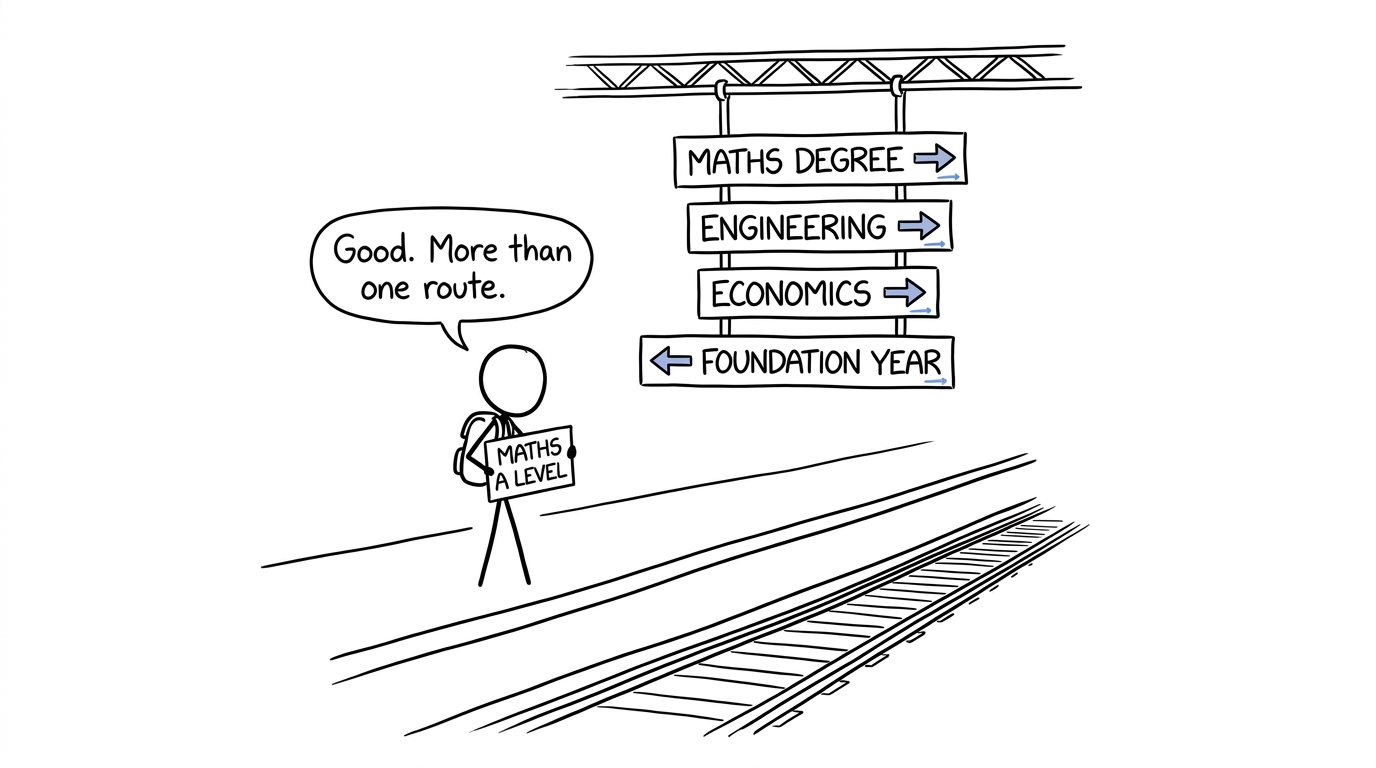 A student discovering several university routes from A Level Maths
A-Level maths grade meaning for university
A Level Mathematics is graded from A* to E, with U meaning unclassified. Your result is based on your combined marks across the qualification rather than a separately awarded grade for each paper. Grade boundaries can change between exam series, so a grade is not permanently tied to one percentage.
The table below is a practical guide, not a national admissions rule. The university examples reflect published requirements available for 2026 or 2027 entry when researched and may change.
| A Level Maths grade | UCAS Tariff value | What it can mean for university |
|---|---|---|
| A* | 565656 | Meets the Mathematics condition for many highly selective courses. Manchester, for example, publishes a typical Mathematics BSc offer of AAA including A in Mathematics or Further Mathematics. Some especially selective courses also require Further Maths. |
| A | 484848 | A common subject requirement for direct entry to Mathematics degrees. Published examples include Birmingham at AAA with A in Mathematics or Further Mathematics, and Sheffield at AAB including A in Maths. |
| B | 404040 | May suit some related courses, universities using broader Tariff offers, or foundation-year routes. Many direct Mathematics BSc courses still specify an A in Maths, so inspect the subject requirement rather than only the overall offer. |
| C | 323232 | Less likely to satisfy the subject condition for a standard Mathematics degree, but alternative institutions, related subjects and foundation years may remain available. |
| D | 242424 | Direct entry to a Mathematics degree becomes more limited. A foundation programme, resit or different course may provide a more realistic route. |
| E | 161616 | This is a pass, but it is unlikely to meet the Mathematics condition for a conventional maths degree. Seek individual admissions advice and investigate foundation or resit routes. |
UCAS Tariff values help some providers compare Level 3 qualifications, but universities set their own criteria and do not have to use the Tariff. A total of 120120120 points does not automatically satisfy an offer if the course also demands grade A in Mathematics.
What maths degree entry requirements really tell you
The headline offer describes the academic level expected at entry. It is not a judgement on your potential or a promise that every applicant with those grades will receive an offer.
Current published examples show how varied maths degree entry requirements can be. Manchester lists AAA with A in Mathematics or Further Mathematics. Birmingham lists AAA including A in Mathematics or Further Mathematics. Sheffield lists AAB including A in Maths, while York publishes routes including AAA with A in Mathematics or AAB with A grades in Mathematics and Further Mathematics.
The pattern is useful: the Maths grade may stay high even when the overall offer falls. This is because degree-level mathematics moves quickly into proof, abstraction, calculus, algebra, probability and modelling.
Further Mathematics also matters differently between courses. Some require it, some prefer it, and others offer an alternative condition when it is unavailable. Check this before selecting sixth-form subjects using MathsGenie's guide to choosing your three A Level subjects.
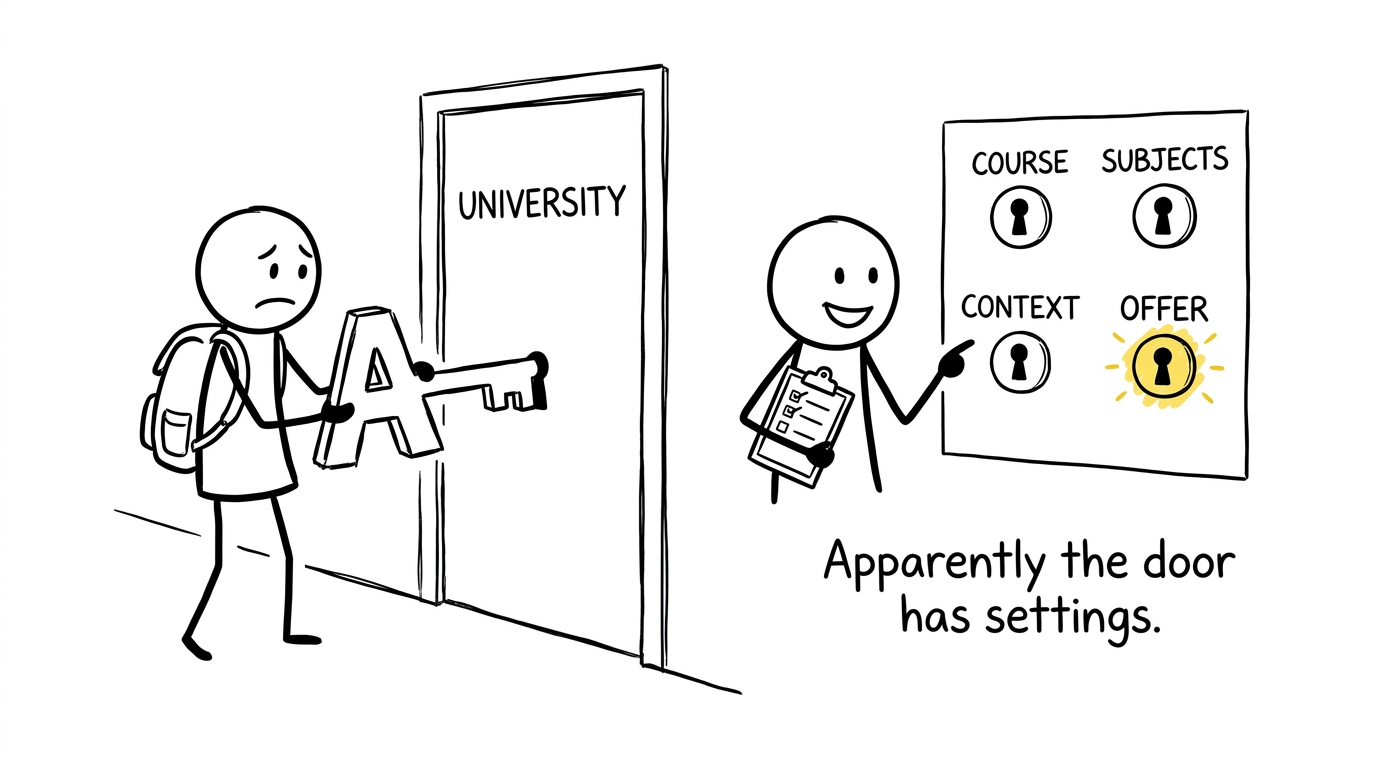 A university door with more than one admissions keyhole
Contextual offers and alternative routes
A contextual offer considers barriers or circumstances that may have affected an applicant's education. If eligible, you may receive a lower overall offer or additional consideration. The exact policy and evidence differ by university.
For example, published course information can show a typical offer alongside a reduced contextual offer. However, the required Mathematics grade may remain unchanged. Never assume that being eligible guarantees admission or removes a subject requirement.
Other possible routes include:
- an integrated foundation year;
- a Mathematics degree at a university with a different offer range;
- a related course such as statistics, data science or some computing programmes;
- resitting A Level Maths;
- transferring after successful university-level foundation study, where permitted.
Conditional offers are exact instructions. Read every subject condition rather than focusing on the three-letter headline.
Why this matters while you are still at GCSE
If you are preparing for GCSEs, your university application may feel distant. But the foundations are being built now. A Level Maths develops GCSE algebra, graphs, trigonometry, probability and problem-solving rather than replacing them.
Start from the GCSE Maths revision hub, then select resources matched to your board, such as Edexcel GCSE Maths revision or AQA GCSE Maths revision. Use GCSE mini tests to find weaknesses before they become A Level obstacles.
When you begin sixth form, move to the A Level Maths revision hub. Dedicated Edexcel A Level resources, AQA A Level resources and OCR A Level resources keep practice aligned with your specification.
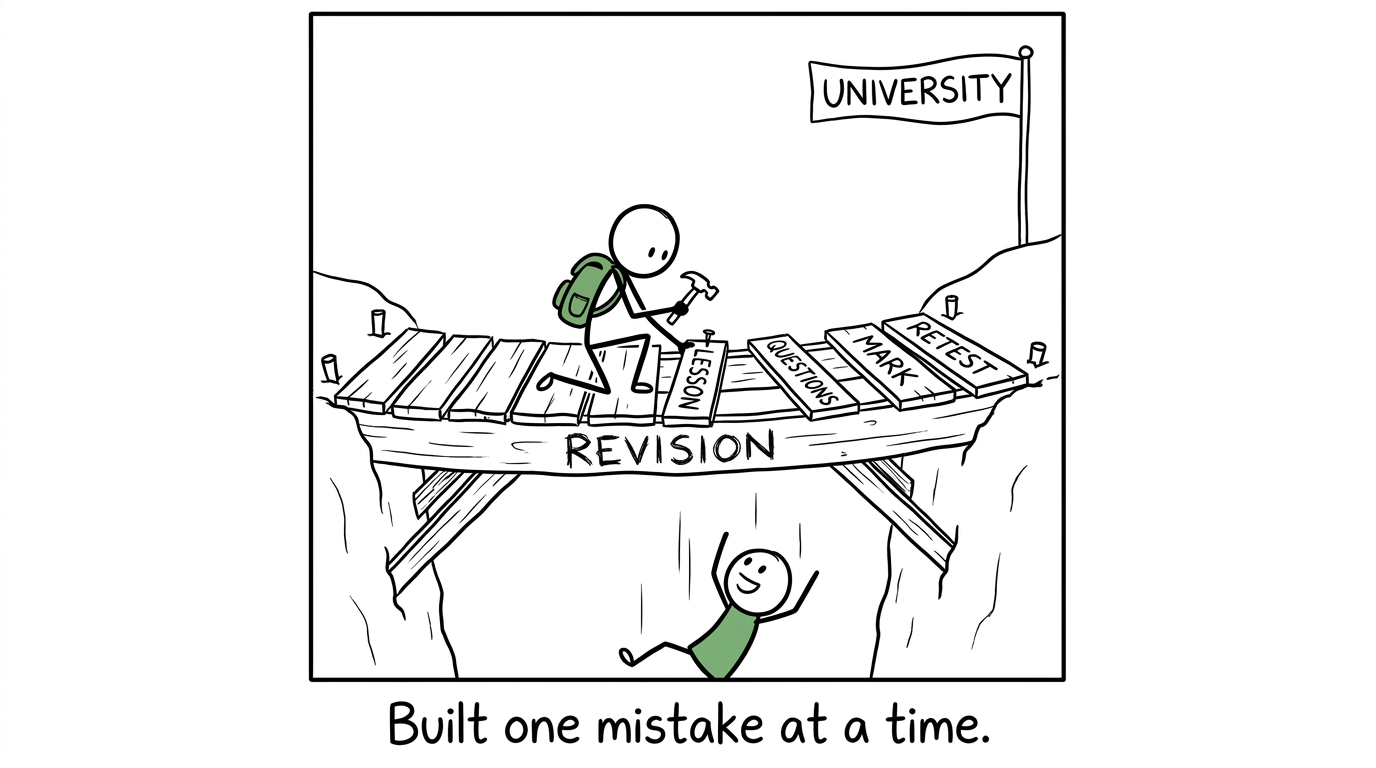 A student building a revision bridge one mistake at a time
Common mistakes when comparing university requirements
Treating a typical offer as a guarantee
Meeting the published grades may make you eligible, but admissions decisions can consider the full application and course capacity.
Looking only at the overall grades
ABB including A in Mathematics is different from any combination totalling ABB. The named subject condition is compulsory unless the university confirms otherwise.
Assuming UCAS points replace subject grades
Some courses use Tariff totals; others publish specific grades. Even a course using points may still require A Level Mathematics at a stated grade.
Ignoring the entry year
Requirements can change. Check the official page for the year you intend to start and revisit it before submitting your application.
Seeing one grade as a verdict
A grade describes performance in a particular qualification. It does not define every route available. Foundation years, contextual admissions and alternative courses exist because educational journeys are rarely identical.
Turn the requirement into a revision plan
A university target is useful only when it changes what you do next. Identify the required grade, diagnose weak topics, learn the method, complete practice questions, mark them carefully and retest.
MathsGenie brings that process together with free revision lessons, question banks, past papers, predicted papers, mini tests, mark schemes and video solutions. Start with the resource matched to your current exam board, then use the proper past-paper revision method to turn lost marks into specific next steps.
Your future course may publish its requirement as a single letter. Reaching it is usually the result of hundreds of smaller, calmer corrections. Begin the next one today.











