

A-Level History Resit: Your Results Day Plan
A-level history resit plan for after Results Day: review your scripts, confirm coursework rules and follow clear milestones towards your retake.

Results Day can make one grade feel larger than everything around it. Yet an A-level history resit is not a verdict on your ability. It is a second attempt with something valuable the first attempt never offered: evidence.
Your best preparation is to confirm the administrative details immediately, diagnose where marks were lost, then follow a revision cycle built around retrieval, essay planning, timed writing and precise feedback. For students receiving results on 13 August 2026, the next standard UK A-level examination opportunity will normally be the summer 2027 series. Confirm the arrangements with your school, college or examination centre before making plans.
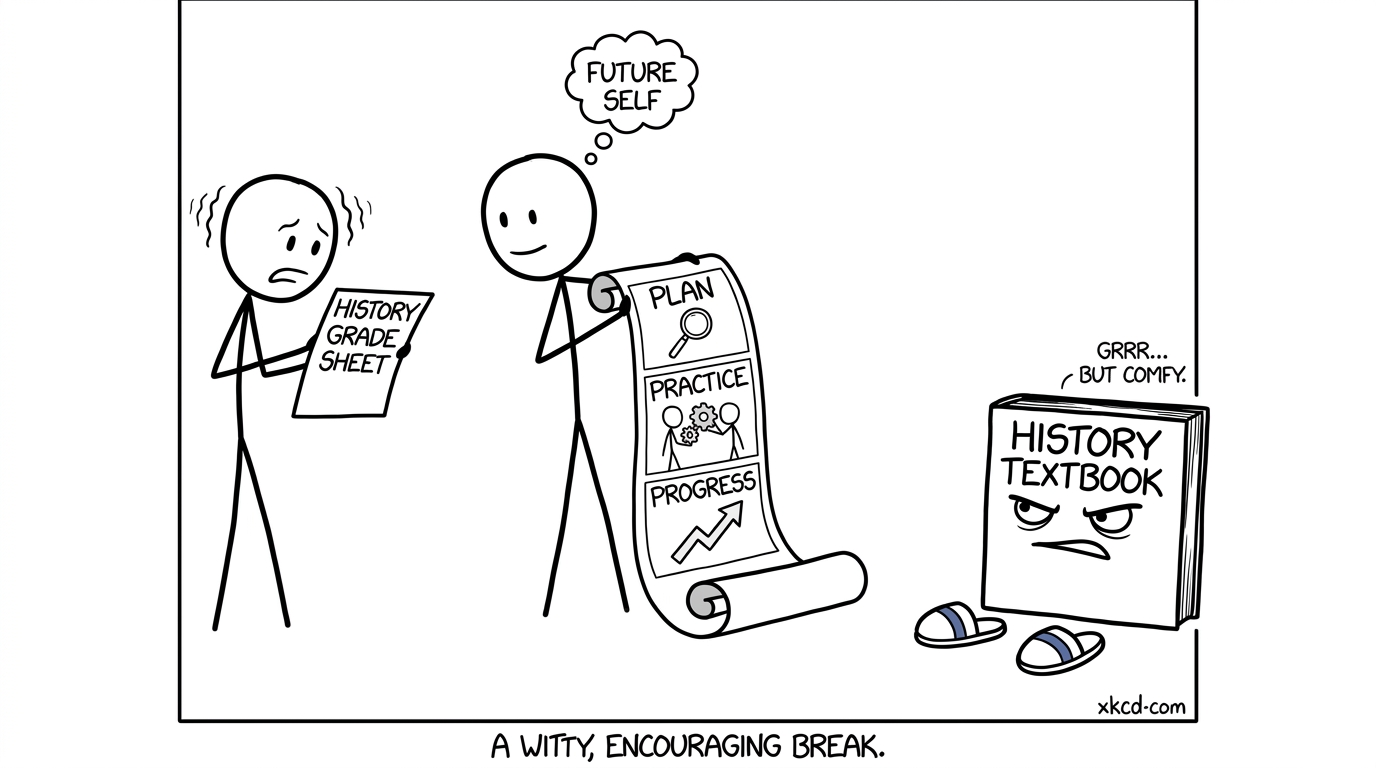 A student turns a disappointing History result into a calm road map
Your A-level History resit checklist
Before beginning months of revision, settle the decisions that determine what you are revising:
- Speak to your history teacher or examinations officer.
- Check whether a post-results service should be considered.
- Request access to your marked scripts where available.
- Confirm your exam board, specification and option codes.
- Ask whether your school or college will accept your resit entry.
- Decide whether to carry forward or retake your non-exam assessment.
- Record entry deadlines and the dates of every examined component.
- Download clean specifications, past papers and mark schemes.
- Complete a diagnostic paper before creating a timetable.
AQA, Edexcel, OCR and Eduqas are separate awarding bodies with different papers, options and administrative procedures. Do not revise from resources simply labelled “A-level History” until you know they match your exact specification.
Results Day milestone: pause before deciding
Start by separating disappointment from diagnosis. Your overall grade tells you what happened, but not why.
Ask your centre about your component marks and whether you can obtain copies of your scripts. If a mark appears unexpected, discuss the available post-results services and their deadlines promptly. A review of marking is not a free second attempt: marks can stay the same, rise or fall. Your centre can explain the risks and help you compare your script with the relevant mark scheme.
You should also contact a prospective university, employer or training provider if the result affects an offer. Do not assume that a resit is your only route until you understand your available options.
First two weeks: confirm the retake arrangements
Most current A levels in England are linear. Resitting A-level History therefore normally means taking all examined components again in the same summer series rather than repeating one weak paper in isolation.
History also includes non-exam assessment or coursework. Current rules generally allow eligible candidates to carry forward an existing NEA mark, but the process and consequences depend on the awarding body and specification. For example, AQA, Edexcel, OCR and Eduqas publish their own carry-forward instructions and entry codes. Using the original Unique Candidate Identifier may also be important.
Ask your examinations officer these questions:
- Can my existing NEA mark be carried forward?
- Which entry code must the centre use?
- If I retake the NEA, must I answer a new question?
- Which mark will count if the new attempt is lower?
- What supervision and authentication will be available?
Do not rewrite coursework independently before receiving official guidance. NEA must satisfy authentication, supervision and specification requirements.
Weeks three to six: diagnose the lost marks
A useful resit plan begins with the old scripts, not a new pack of highlighters. For each response, classify the main weakness:
- inaccurate or insufficient knowledge;
- weak focus on the wording of the question;
- narrative description instead of analysis;
- unsupported judgement;
- limited evaluation of sources or interpretations;
- poor paragraph organisation;
- unfinished answers or weak timing.
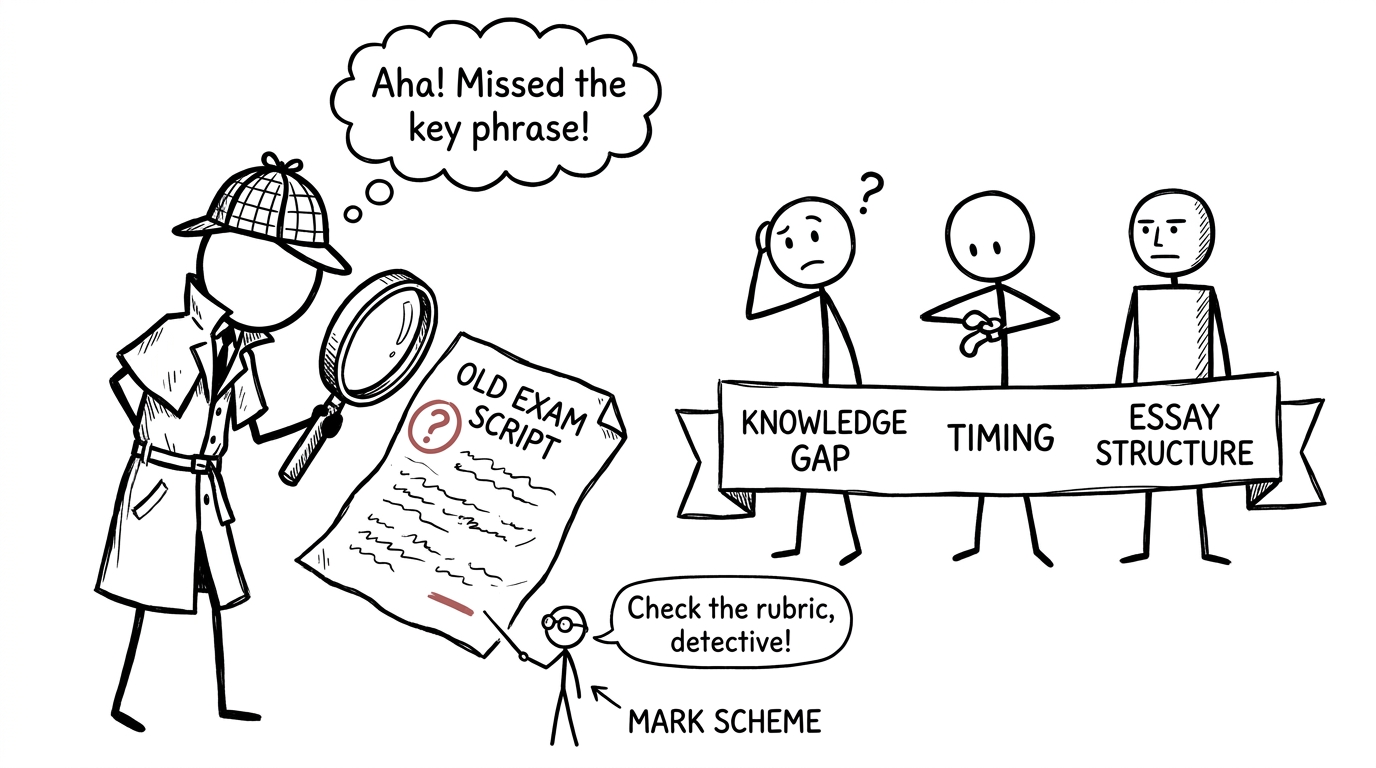 A student detective identifies the suspects behind lost marks
Create a marks-loss log with four headings: paper, question type, reason marks were lost and next action. This is similar to the diagnostic method in MathsGenie’s guide to finding your weakest topics. The subject is different, but the principle travels well: revision becomes effective when a weakness is specific enough to practise.
Then complete one paper from the Edexcel A Level History past-paper collection if that is your board. Work under realistic conditions and mark it using the official mark scheme. Treat the individual questions as your starting question bank rather than using every paper immediately.
Autumn milestone: rebuild knowledge and argument
During autumn, spend more time repairing knowledge than completing full papers. Divide each specification topic into manageable enquiries such as causes, consequences, change, continuity, significance and interpretations.
A productive weekly cycle includes:
- retrieving dates, events, individuals and evidence without notes;
- checking omissions against reliable course materials;
- planning two essay questions;
- writing one paragraph or source section under time pressure;
- reviewing the work against the level descriptors;
- returning to the same weakness later in the week.
Knowledge matters, but A-level History rewards its use in an argument. After recalling a fact, ask what it proves, how strongly it supports the judgement and what evidence might challenge it.
Build a timetable around actions rather than vague labels. “Plan two essays on political opposition” is more useful than “revise History”. MathsGenie’s revision timetable guide explains how short learn, practise, mark cycles can make a plan easier to sustain.
January to March: shift towards timed responses
By the new year, your preparation should increasingly resemble the assessment. Move from open-book plans to closed-book plans, then from individual paragraphs to complete timed answers.
Use the exact wording and mark allocation for your specification. Essay, source and interpretations questions assess different skills, so do not force one memorised structure onto every task. Compare your response with the mark scheme and examiner expectations, then write one precise correction such as: “My judgement must compare the relative importance of both factors.”
If you are balancing History with another qualification, keep resources organised. MathsGenie provides a central GCSE maths revision hub and A-level maths revision lessons and questions, allowing your maths practice to remain structured while History receives focused resit time.
Final eight weeks: practise complete papers
In the final phase, complete full papers under timed conditions. Rotate them so that every component receives attention, then use the mark schemes to identify patterns across several attempts.
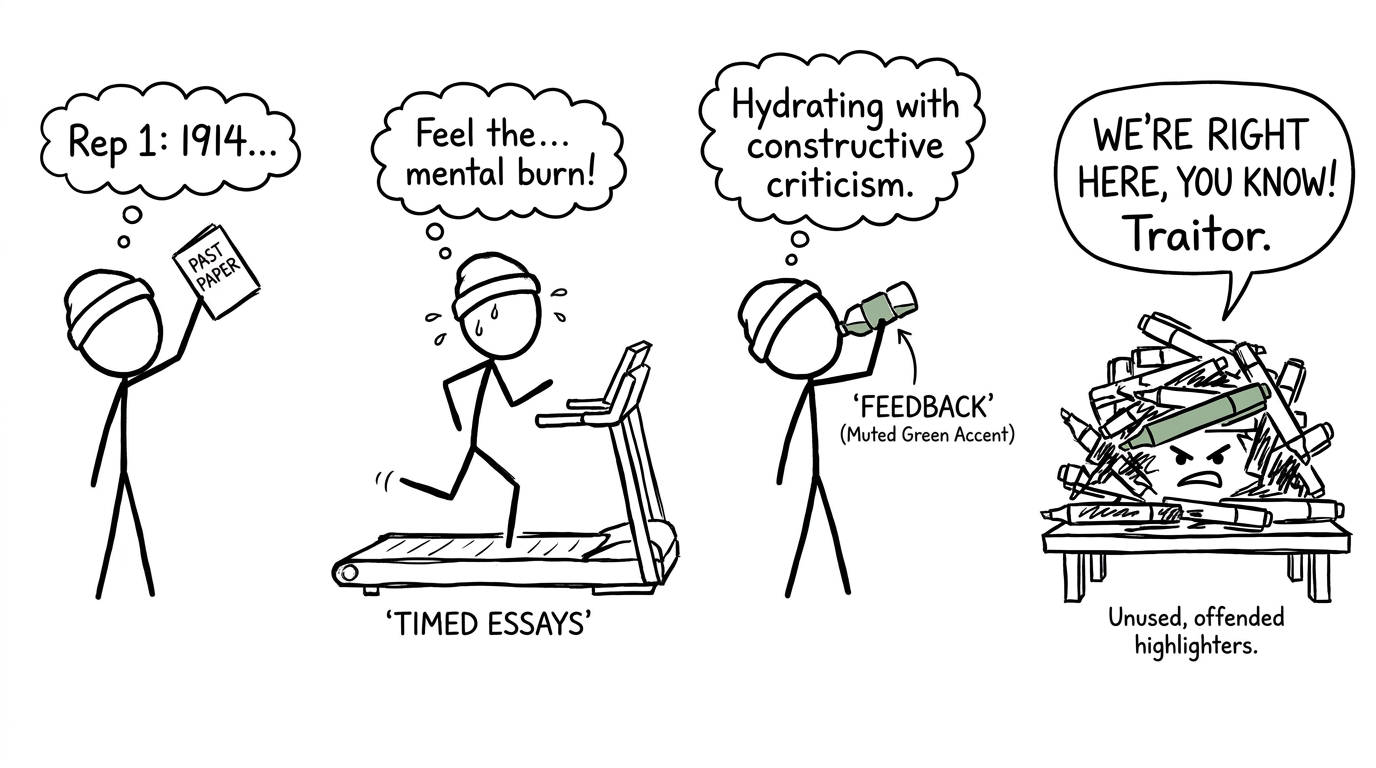 History revision becomes training while the unused highlighters watch
A strong weekly rhythm is:
- one complete timed paper;
- one careful marking and reflection session;
- two targeted sessions repairing recurring weaknesses;
- one shorter recall session;
- one timed answer using an unused question.
Past papers are finite, so use them deliberately. Keep at least a few unseen questions for the final weeks. Although predicted papers can help in subjects where suitable resources exist, they should never replace official papers, specifications and mark schemes. MathsGenie applies the same principle across its free GCSE predicted papers: practise, mark and repair rather than merely collecting scores.
Common mistakes when resitting A-level History
Repeating the original revision method
More hours will not correct a weak method. If passive rereading produced uncertain recall, replace it with closed-book retrieval and timed writing.
Ignoring the specification options
A paper from the correct board may still cover the wrong route or historical period. Check every code before using it.
Writing essays without feedback
Timed practice only helps when you analyse it. Use mark schemes, teacher feedback and your marks-loss log to choose the next task.
Delaying examination-centre arrangements
Private-candidate availability, fees and deadlines vary between centres. Confirm arrangements early rather than assuming your former school will enter you.
Treating every weak answer as a knowledge problem
Some marks disappear through timing, relevance or evaluation. Diagnose the skill before prescribing more notes.
Turn the first attempt into useful evidence
Resitting A-level History is less about starting again than starting with better information. Confirm the rules, study your scripts, repair one weakness at a time and gradually move towards complete timed papers.
Begin with the MathsGenie Edexcel A Level History past papers and mark schemes, using each unused question as focused retake practice. For students balancing other exams, MathsGenie also keeps free revision lessons, practice questions, past papers, predicted papers, mini tests, mark schemes and video solutions together. Build the plan now, then let each marked attempt tell you what to do next.











