

A-Level History Grade and University Entry
A-Level history grade university guide: compare A* to E with typical History degree entry requirements, contextual offers and sensible next steps.

A university offer can look like a verdict. Three letters sit on a course page, and it is easy to imagine that they divide your future into possible and impossible.
They do not. Your A-level History grade can shape university choices, but universities usually consider it as part of a complete offer containing three A Levels, required subjects, GCSE results and sometimes contextual information. History degree entry requirements also vary considerably between courses.
For 2026 entry, published examples range from AAA at Oxford, Manchester and York to BBB-BCC at Portsmouth. Some courses require a particular History grade; others recommend History or accept another relevant subject. Always check the live course page for your intended year before applying.
Your quick entry-requirements checklist
Before comparing your grade with a university course, check:
- the complete A-level offer, not just the History requirement;
- whether History is required, recommended or unnecessary;
- required GCSE English Language and maths grades;
- whether you qualify for a contextual offer;
- requirements for joint degrees such as History and Economics;
- written work, interviews or admissions assessments;
- whether the figures shown are current requirements or historical acceptance data.
If you are still choosing sixth-form subjects, read how to choose your three A Levels before narrowing your options.
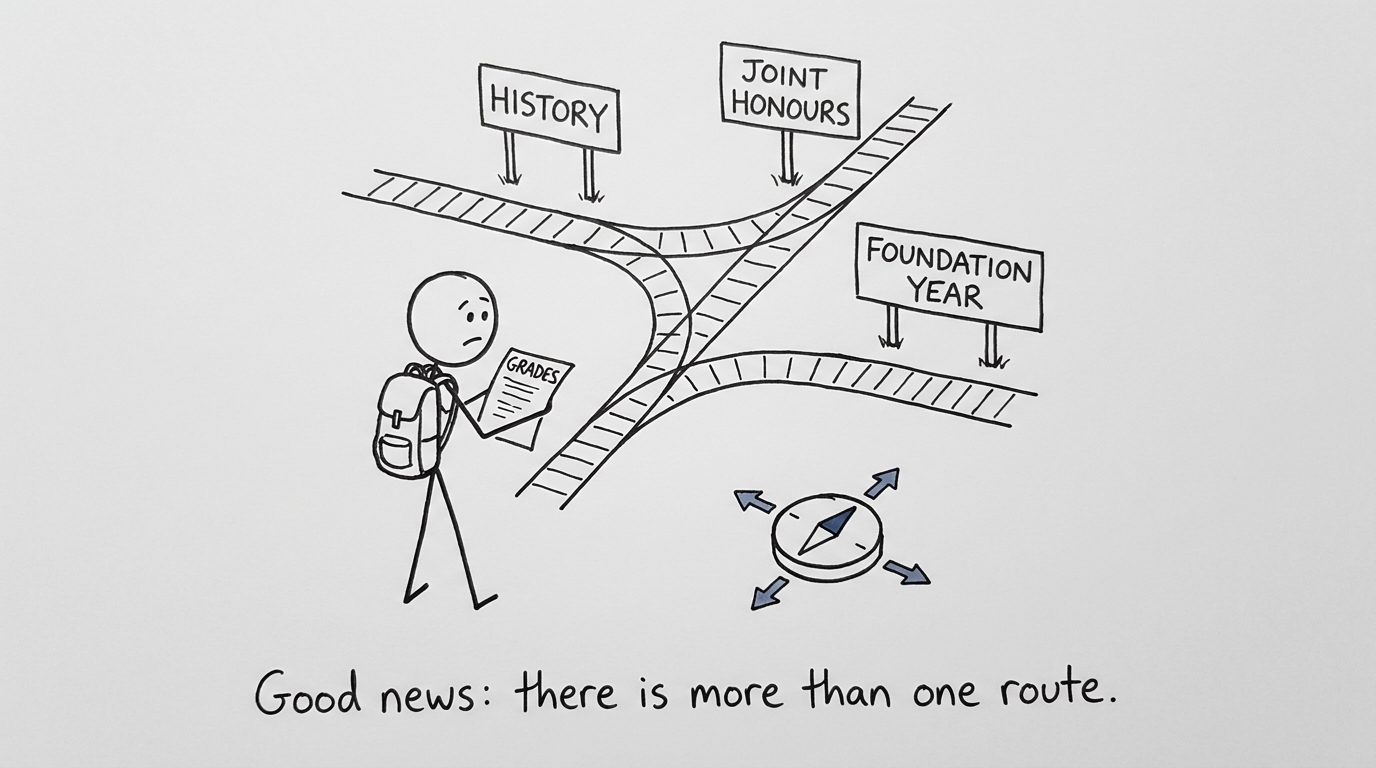 A student navigating several routes towards university History courses
A-level History grades and typical university options
A single History grade does not translate neatly into one type of university. The following breakdown is a planning guide, not a guarantee of admission.
| History grade | What it may mean for university applications |
|---|---|
| A* | Strong evidence of performance in History, including for courses asking for an A in the subject. You must still meet the complete offer. |
| A | Meets the subject grade currently specified by several selective History courses, provided your other grades satisfy the offer. |
| B | Fits many courses with offers around ABB, BBB or lower, although a course requiring an A in History would remain out of reach without an adjusted offer. |
| C | Can support applications to courses with requirements around BBC or BCC and to some foundation-year routes. |
| D | Direct-entry choices become narrower, but foundation years and courses using flexible Tariff requirements may remain available. |
| E | This is a pass at A Level, but most standard History degree offers require a stronger overall profile. Foundation routes and later progression may still be possible. |
A* in History
An A* is an excellent result, but it does not replace the other grades in an offer. If a course asks for AAA, an A* in History alongside lower grades does not automatically satisfy it.
Oxford's published requirement for History is AAA. History is highly recommended rather than formally essential, and applicants submit an argument-driven historical essay. Manchester's 2026 BA History offer is also AAA, but explicitly includes History.
The distinction matters: Oxford looks for substantial historical preparation, while Manchester states a subject-grade condition. Read every word after the headline grades.
A in History
An A can satisfy the subject component of several demanding offers. For 2026 entry, Manchester asks for AAA including History. York asks for AAA including an A in either History or Classical Civilisation.
Contextual offers can change the overall pattern. Manchester publishes ABB including an A in History for eligible contextual applicants, while York publishes ABB including an A in History or Classical Civilisation. Eligibility is determined by each university's policy; it is not something applicants can assume from grades alone.
B in History
A B leaves meaningful options open. It may suit History courses with overall requirements around ABB, BBB or BBB-BCC, provided no higher History grade is specified.
Portsmouth, for example, publishes a 2026 range of BBB-BCC for BA History and asks for a relevant subject. The important lesson is not that one university represents every course. It is that a B should lead to careful course research, not an assumption that History is closed.
C in History
A C will make highly selective courses unlikely, but it can align with the lower end of some published offer ranges. Courses with a foundation year can provide another route by adding an initial year that develops the academic skills needed for degree-level work.
Check the course content as carefully as its grades. A lower offer is useful only when the modules, teaching and route genuinely suit you.
D or E in History
With a D or E, standard direct-entry options are more limited. That is a change of route, not proof that university is permanently unavailable.
Possible next steps include foundation years, retaking an A Level, entering higher education later or considering related courses with different requirements. Speak to your school or college and individual admissions teams before making decisions, especially after results day.
Why your other qualifications still matter
Universities normally make offers across several qualifications. UCAS advises that providers set their own requirements, which may include grades, named subjects, GCSEs and other selection conditions.
Many courses expect evidence of literacy and numeracy. Manchester's 2026 History requirements, for example, include GCSE English Language at grade 6 and GCSE Mathematics at grade 4. Requirements elsewhere may differ.
For joint courses, maths can become more important. Oxford strongly advises applicants to History and Economics to study maths at A Level because of the economics component. History and Politics may also involve quantitative analysis.
That gives GCSE students a useful reason to protect their options now. Use the GCSE maths revision hub for board-specific resources, or work through AQA GCSE Maths revision and Edexcel GCSE Maths revision if either matches your course.
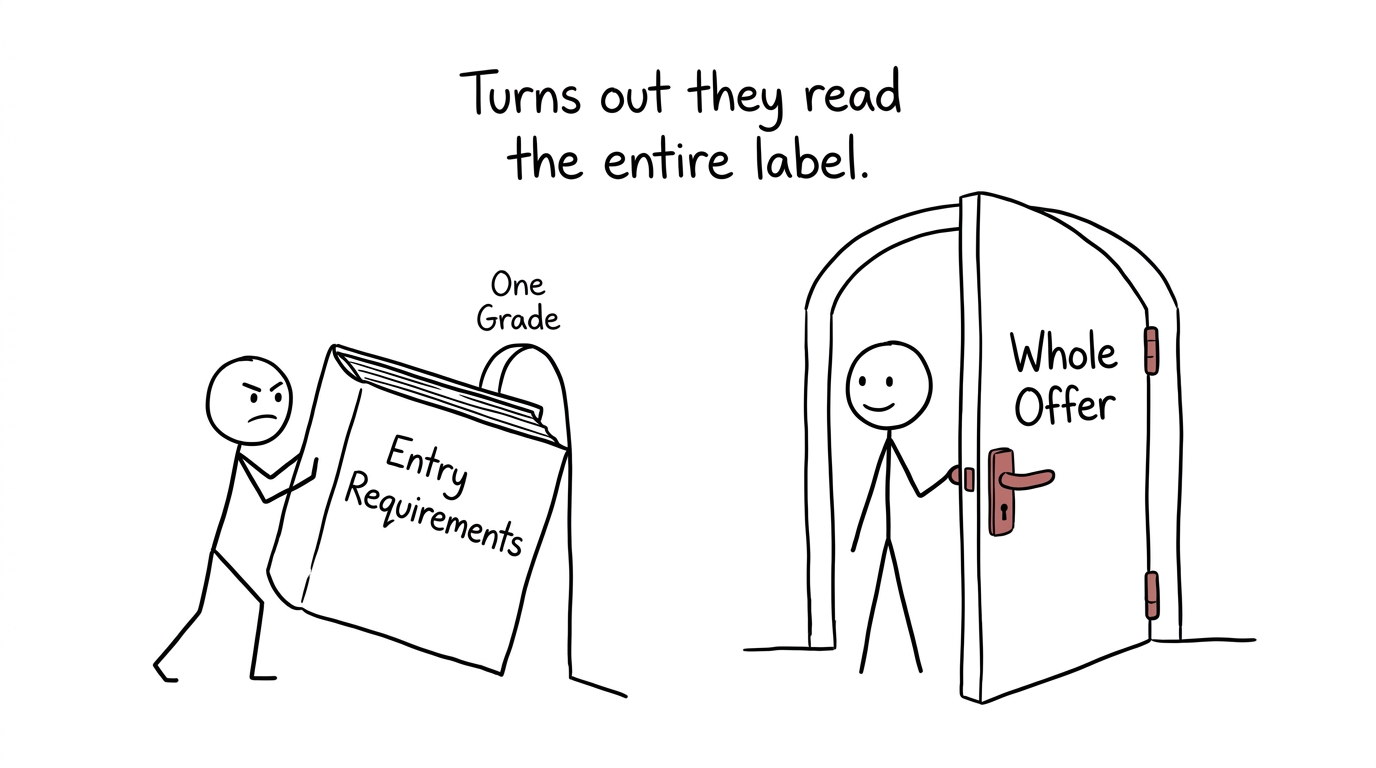 A student discovering that universities consider the whole offer
Predicted grades, achieved grades and offers
Predicted grades help universities assess applications made before final results. A conditional offer then states what you must achieve. Your place is normally confirmed when you meet those conditions.
Historical entry data can show the grades previously held by accepted students, including applicants admitted through Clearing. UCAS warns that this does not reveal what a university will accept in the current cycle. Current entry requirements should remain your starting point.
Grade boundaries are a different tool. They convert marks into awarded grades after assessment and can change between exam series. Use MathsGenie's A-level grade boundaries hub or the OCR A-level History grade calculator to interpret practice marks cautiously. A calculator estimate is not an official result or university decision.
Common mistakes when comparing History degree requirements
Reading one grade instead of the whole offer
An A in History does not satisfy an AAA offer by itself. Check every grade and subject condition.
Treating typical requirements as permanent
Courses can revise their offers, assessment processes and subject rules. Confirm the page for your entry year.
Ignoring contextual admissions
Eligible applicants may receive adjusted offers. Read the university's criteria rather than ruling yourself out prematurely.
Forgetting GCSE requirements
English Language and maths conditions can remain relevant even when your A-level profile is strong. Strengthen weak areas with GCSE maths mini tests and timed practice.
Choosing only ambitious or only cautious courses
A balanced application normally includes courses with different entry profiles, all of which you would genuinely be willing to attend.
Turn the grade into a plan
A grade is information. Its value lies in what you do next.
Build a shortlist, record each complete offer and mark any subject or GCSE conditions. Then revise towards the strongest realistic result rather than trying to predict the exact boundary. MathsGenie can help you keep the quantitative side of your application secure through free revision lessons, practice questions, mini tests, past papers, predicted papers, mark schemes and video solutions.
Start with the GCSE one-month maths revision plan, or move to A-level Maths revision if your intended joint degree needs stronger mathematics. Your History grade may influence the route, but careful research and consistent revision decide how many routes remain open.











