A scientific probe on a landing mission to a newly discovered dwarf planet releases a small spherical sensor capsule to measure the planetary environment. The capsule is released from rest from a certain height above the surface and falls vertically downwards.
The graph below shows how the downward velocity of the capsule changes with time from the moment it is released until it impacts the surface.
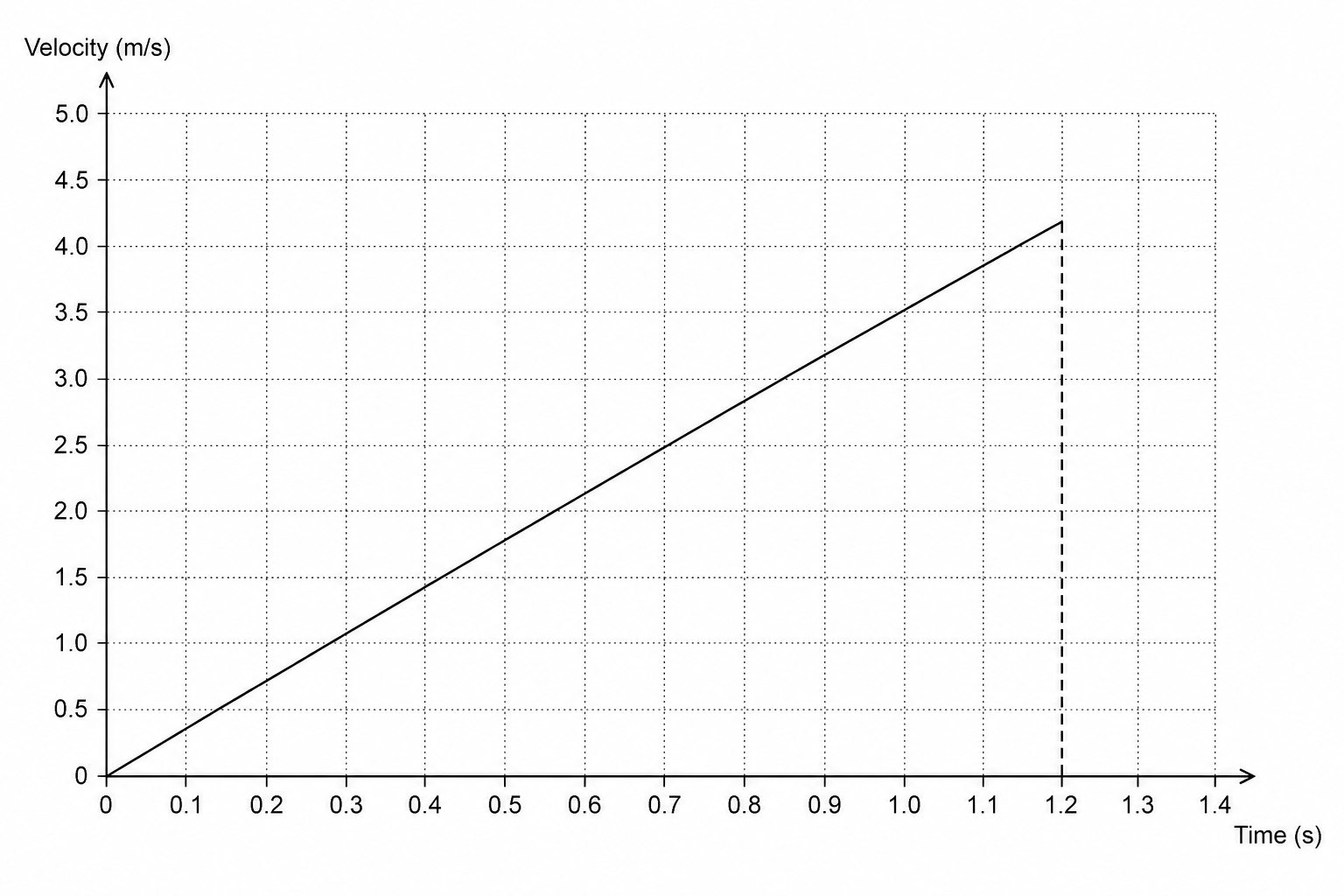
Use the graph to calculate the acceleration due to gravity on this dwarf planet. State the unit.
Use the graph to calculate the height from which the capsule was dropped.
The gravitational acceleration on this dwarf planet is significantly smaller than that on Earth. Suggest a physical reason why.
The experiment is repeated back on Earth, where air resistance is significant. A piece of crumpled paper and a solid lead sphere of the same radius are dropped simultaneously from the same height. The crumpled paper reaches the ground after the lead sphere, even though the maximum force of air resistance acting on the crumpled paper during its descent is much smaller than that acting on the lead sphere. Explain why the crumpled paper takes longer to reach the ground.

