A student investigates how the mass of a falling paper cup affects the time taken for it to fall to the floor from a fixed height of 1.5 m. To vary the mass while keeping the shape constant, the student stacks different numbers of identical paper cups inside each other.
This is the student's method:
The table lists some variables in this investigation.
Identify whether each variable is an independent variable, a dependent variable, or a control variable by selecting the correct category for each row.
| Variable | Independent variable | Dependent variable | Control variable |
|---|---|---|---|
| Type of paper cup | |||
| Number of paper cups | |||
| Time taken to fall | |||
| Distance fallen |
These are the student's raw results written in a notebook:
Draw a structured results table of the student’s results.
The graph shows the plotted results of the student's investigation:
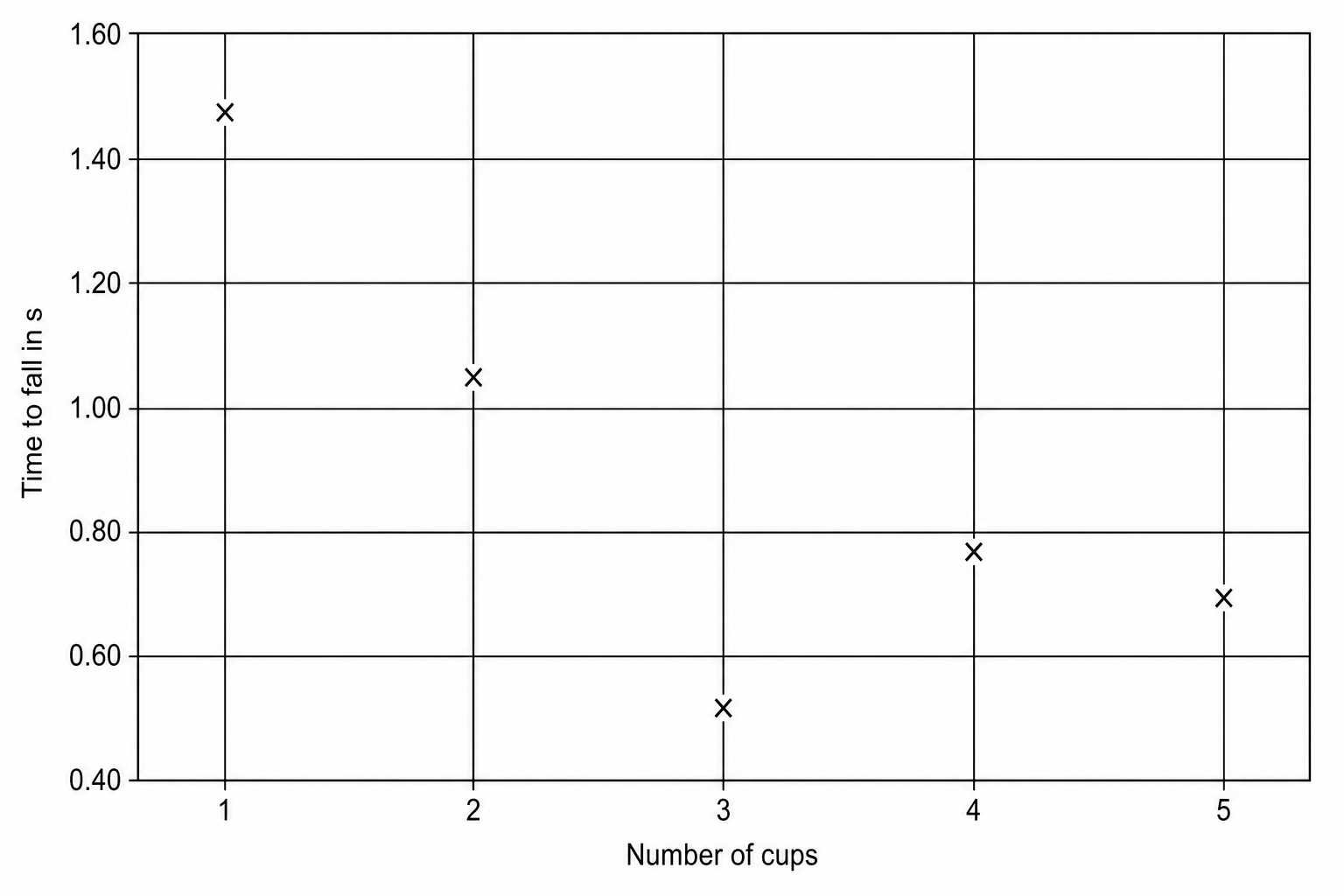
State the coordinates of the anomalous point on the graph.
Suggest how the student should deal with this anomalous result.
Suggest why the student did not start the vertical axis (time to fall) from zero.

