Question 6
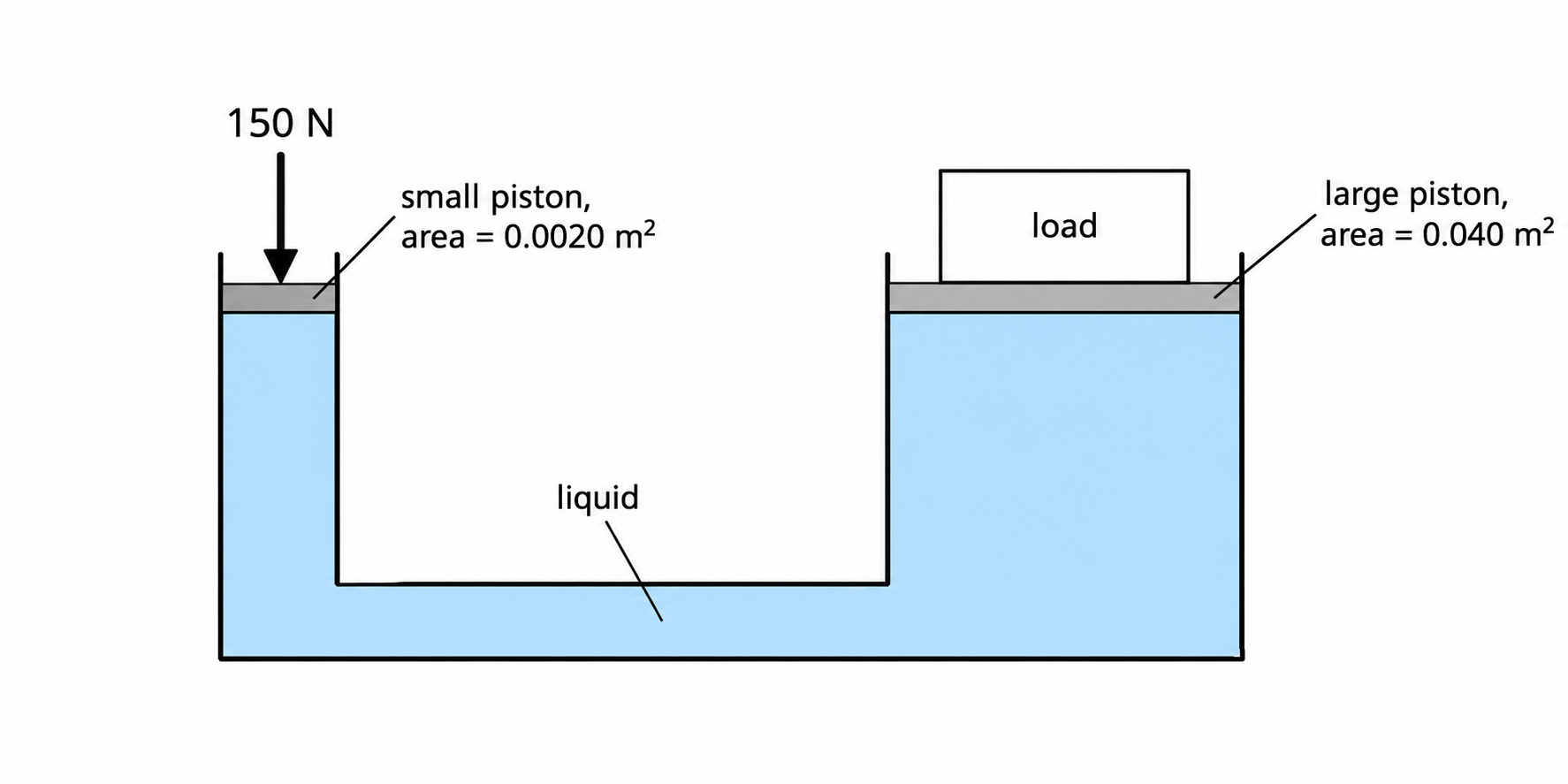
FThe Figure shows a simple hydraulic jack used to lift a heavy load.
Figure
Use the equation: pressure=force normal to a surfacearea of that surface\text{pressure} = \dfrac{\text{force normal to a surface}}{\text{area of that surface}}pressure=area of that surfaceforce normal to a surface
a.[2]
Calculate the pressure in the liquid caused by the force on the small piston.
b.[1]
State how the pressure in the liquid at the large piston compares with the pressure at the small piston.
c.[2]
Calculate the force exerted by the liquid on the large piston.
d.[1]
State the direction of the force that the liquid exerts on the bottom surface of the large piston.
e.[2]
Explain why the jack would not work if the liquid was replaced with air.
2.3 Forces in action Questions
46 exam-style questions on OCR GCSE Physics 2.3 Forces in action, covering 2.3.1 Stretching, bending and compressing, 2.3.2 Elastic and plastic deformation, 2.3.3 Force and extension of a spring, 2.3.4 Linear and non-linear force-extension behaviour, 2.3.5 The spring constant, 2.3.6 Work done in stretching, 2.3.7 Gravitational fields, 2.3.8 Weight and gravitational field strength, 2.3.9 Acceleration in free fall, 2.3.10 Relating force, mass and gravitational field strength, 2.3.11 Forces causing rotation, 2.3.12 The moment of a force, 2.3.13 Levers and gears, 2.3.14 Pressure in fluids, and 2.3.15 Pressure, force and contact area. Each one has a worked solution and a mark scheme showing where the marks go.