Question 3
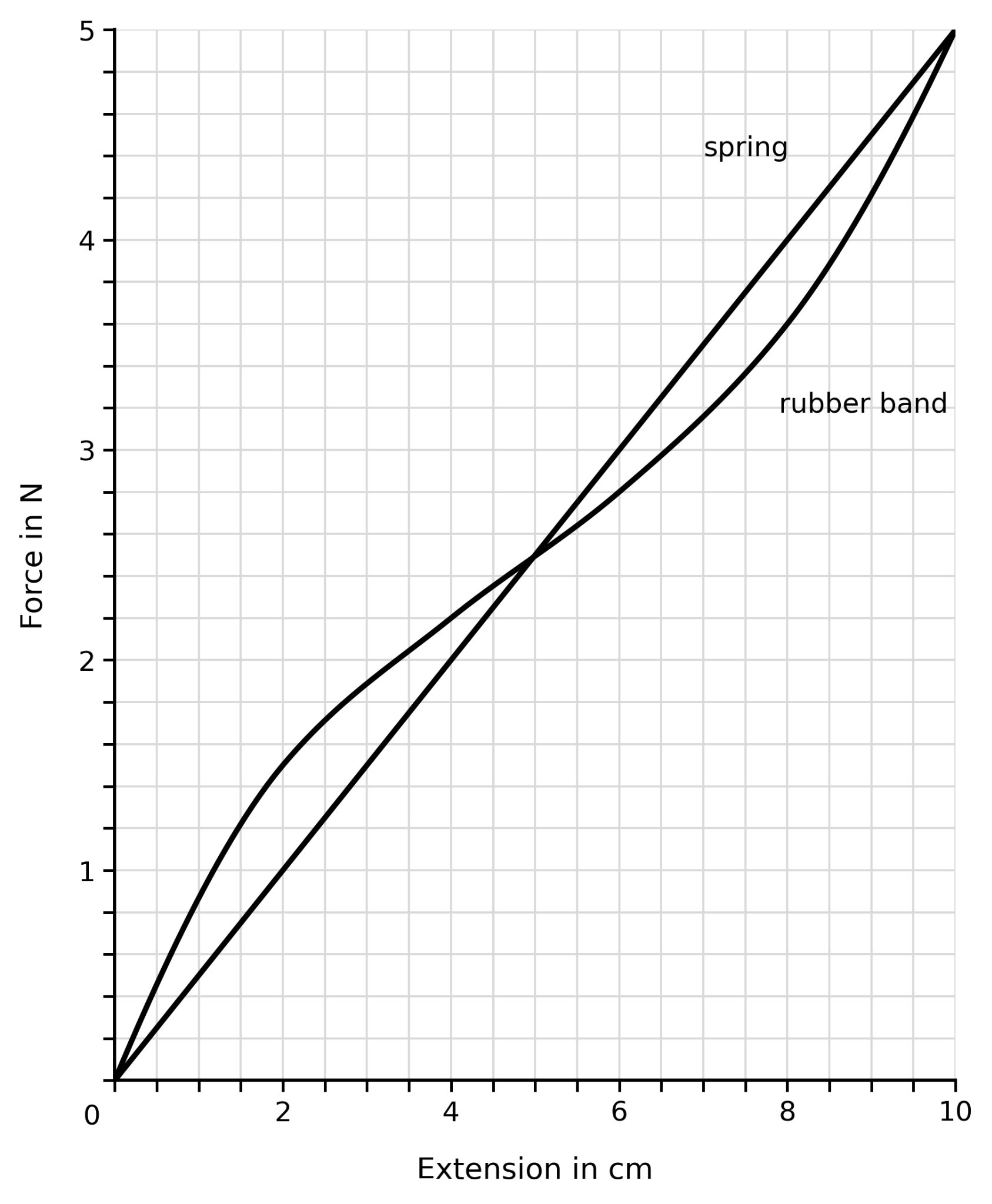
FA student stretches a spring and a rubber band.
The Figure shows the force-extension graph for each object.
Figure
a.[2]
Which object, the spring or the rubber band, shows a linear relationship between force and extension?
Give a reason for your answer.
b.[1]
Use the Figure to determine the force needed to stretch the spring by 6.0 cm.
c.[2]
Use values from the Figure to show that the extension of the spring is directly proportional to the force.
d.[2]
A student says:
'I can find the spring constant of the rubber band by dividing one value of force by its extension.'
Explain why the student is wrong.
2.3 Forces in action Questions
46 exam-style questions on OCR GCSE Physics 2.3 Forces in action, covering 2.3.1 Stretching, bending and compressing, 2.3.2 Elastic and plastic deformation, 2.3.3 Force and extension of a spring, 2.3.4 Linear and non-linear force-extension behaviour, 2.3.5 The spring constant, 2.3.6 Work done in stretching, 2.3.7 Gravitational fields, 2.3.8 Weight and gravitational field strength, 2.3.9 Acceleration in free fall, 2.3.10 Relating force, mass and gravitational field strength, 2.3.11 Forces causing rotation, 2.3.12 The moment of a force, 2.3.13 Levers and gears, 2.3.14 Pressure in fluids, and 2.3.15 Pressure, force and contact area. Each one has a worked solution and a mark scheme showing where the marks go.