Pressure in fluids and upthrust

EasyMediumHard
123456789101112131415161718192021222324252627282930313233343536373839404142434445464748495051525354555657585960616263646566676869707172737475767778798081
Question 52
Easy

Figure 1 shows a plastic syringe with a sealed tip containing trapped air.
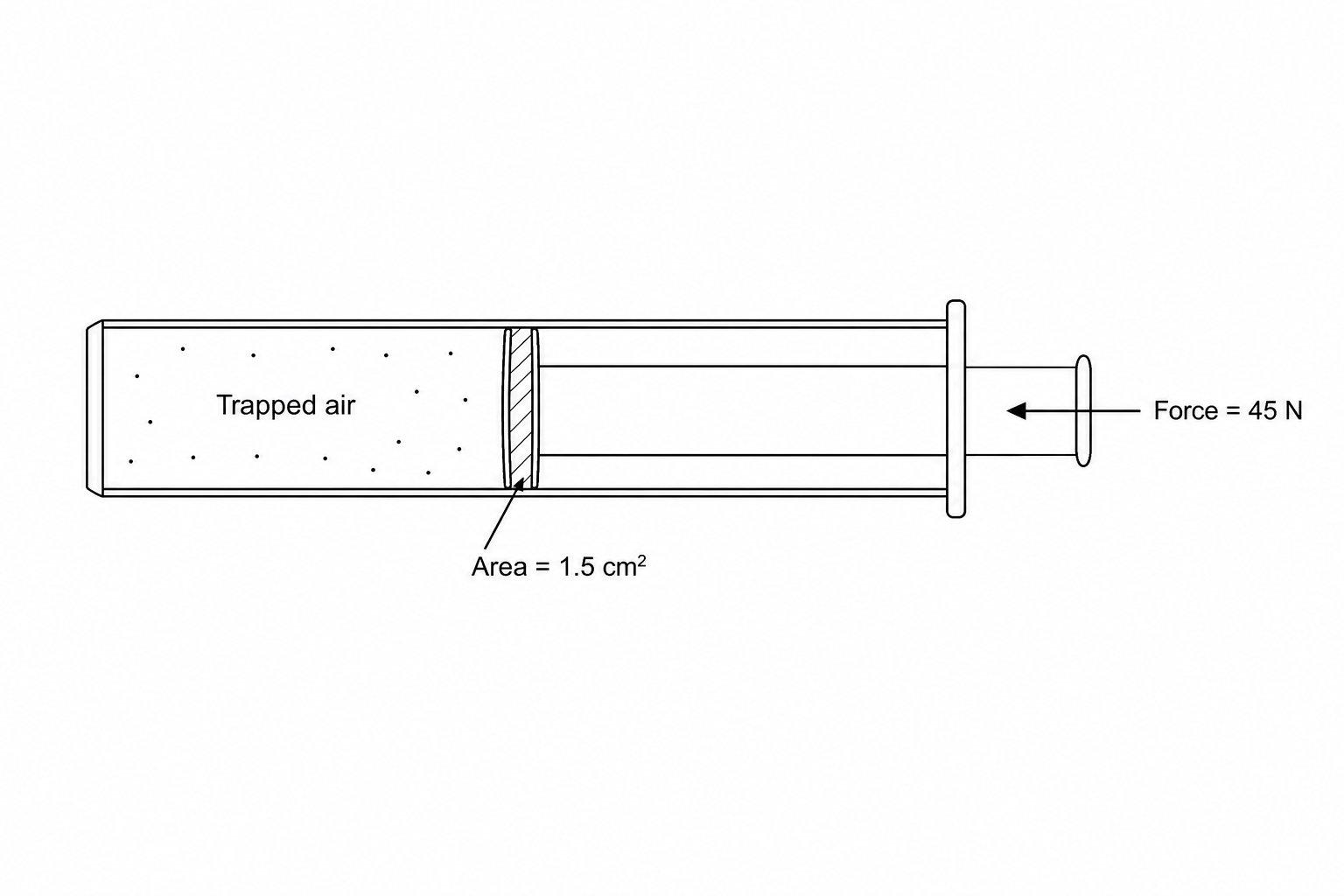
A diagram of a sealed syringe. A horizontal syringe cylinder is sealed at the left tip. A plunger is shown partially pushed in from the right. An arrow representing a horizontal force pointing to the left is applied to the end of the plunger, labeled 'Force = 45 N'. The cross-sectional area of the plunger piston inside the syringe is labeled 'Area = 1.5 cm²'.

The cross-sectional area of the plunger's piston is 1.5 cm2.

A force of 45 N is applied to the plunger.

Calculate the pressure, in N/cm2\text{N/cm}^2N/cm2, exerted by the piston on the trapped air.

[3]

Pressure in fluids and upthrust Questions

  1. GCSE
  2. /Physics
  3. /Pressure in fluids and upthrust