Question 4
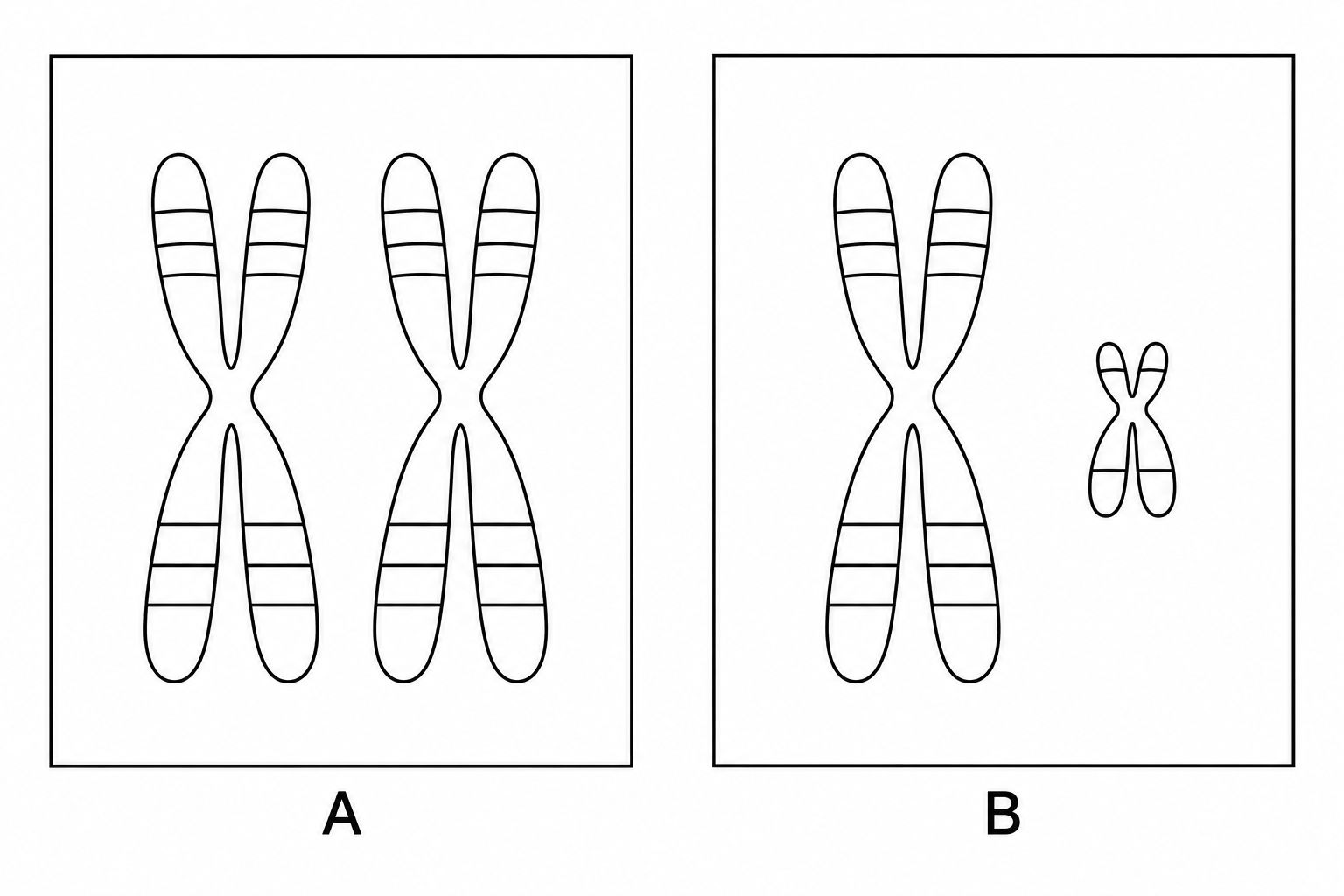
FThe Figure shows the sex chromosomes from a body cell of two people, A and B.
Figure
The Table shows an incomplete Punnett square for the inheritance of sex in humans.
Table
| Father's gamete: X | Father's gamete: | |
|---|---|---|
| Mother's gamete: X | ||
| Mother's gamete: | XY |
a.[2]
Identify which person, A or B, is female.
Give a reason for your answer.
b.[2]
Complete the Punnett square in the Table.
c.[1]
State the sex chromosome or chromosomes found in a human egg cell.
d.[2]
A couple have three daughters. The father says:
'Our next child is more likely to be a boy.'
Explain why the father is wrong.
5.1 Inheritance Questions
186 exam-style questions on OCR GCSE Biology 5.1 Inheritance, covering 5.1.1 The genome, 5.1.2 Environment and phenotype, 5.1.3 Variants and mutations, 5.1.4 How genetic variants influence phenotype, 5.1.5 Asexual and sexual reproduction, 5.1.6 Haploid and diploid, 5.1.7 Meiotic cell division, 5.1.8 Single gene inheritance, 5.1.9 Predicting single gene crosses, 5.1.10 Sex determination, 5.1.11 Multiple gene inheritance, and 5.1.12 Development of our understanding of genetics. Each one has a worked solution and a mark scheme showing where the marks go.