Question 16
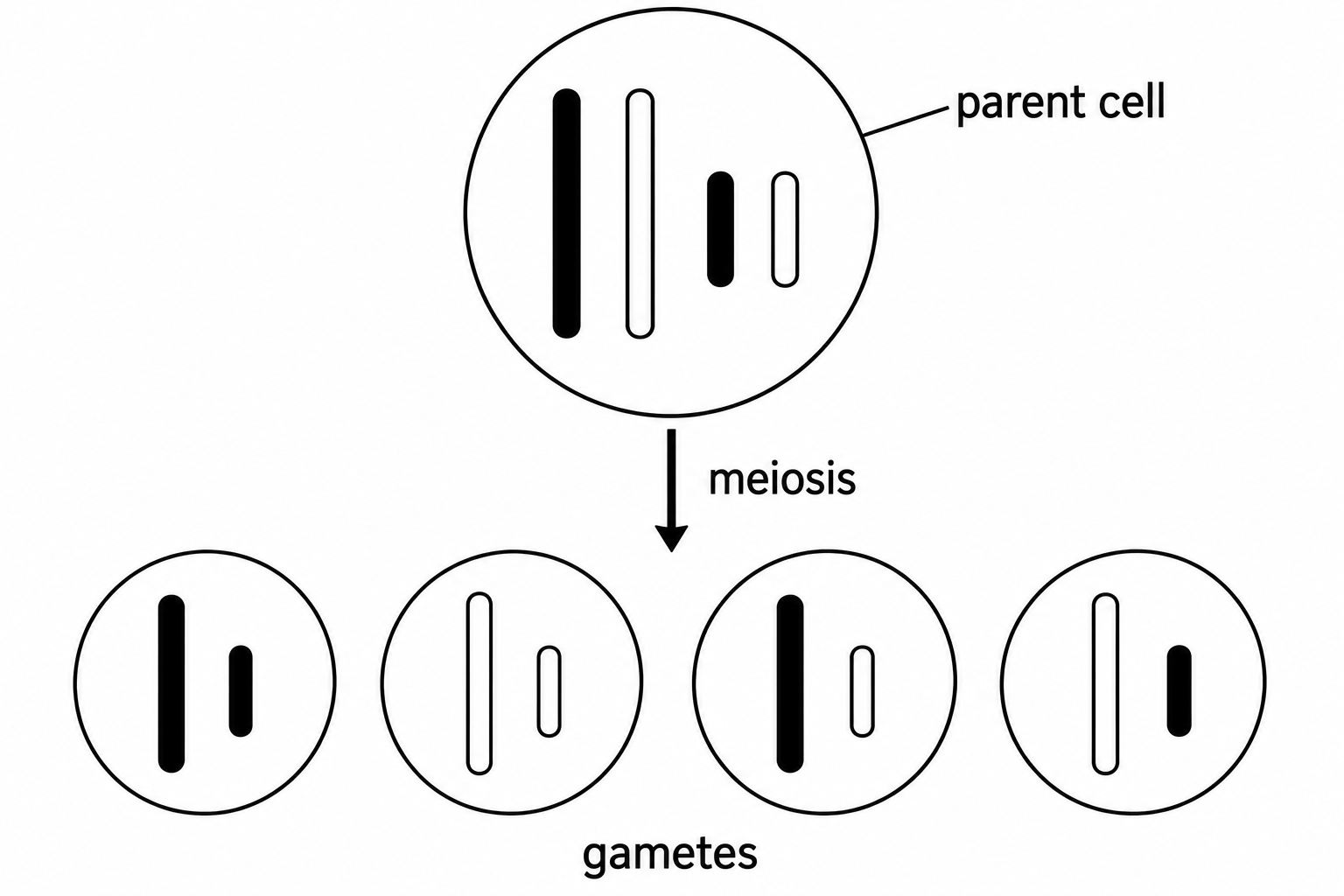
HThe Figure shows what happens to the chromosomes when one cell divides by meiosis.
Figure
a.[1]
State the diploid number of chromosomes in the parent cell.
b.[2]
Use the Figure to explain why the gametes are genetically different from each other.
c.[2]
Explain how meiosis keeps the number of chromosomes in body cells the same from one generation to the next.
d.[1]
A horse has 64 chromosomes in its body cells. A donkey has 62 chromosomes in its body cells.
A mule is the offspring of a horse and a donkey.
Calculate the number of chromosomes in a body cell of a mule.
e.[2]
Mules cannot usually produce gametes.
Suggest why meiosis cannot take place normally in the cells of a mule.
5.1 Inheritance Questions
186 exam-style questions on OCR GCSE Biology 5.1 Inheritance, covering 5.1.1 The genome, 5.1.2 Environment and phenotype, 5.1.3 Variants and mutations, 5.1.4 How genetic variants influence phenotype, 5.1.5 Asexual and sexual reproduction, 5.1.6 Haploid and diploid, 5.1.7 Meiotic cell division, 5.1.8 Single gene inheritance, 5.1.9 Predicting single gene crosses, 5.1.10 Sex determination, 5.1.11 Multiple gene inheritance, and 5.1.12 Development of our understanding of genetics. Each one has a worked solution and a mark scheme showing where the marks go.