Question 2
F41%Plants and animals are made of cells.
The figure shows an animal cell.
Figure: An animal cell
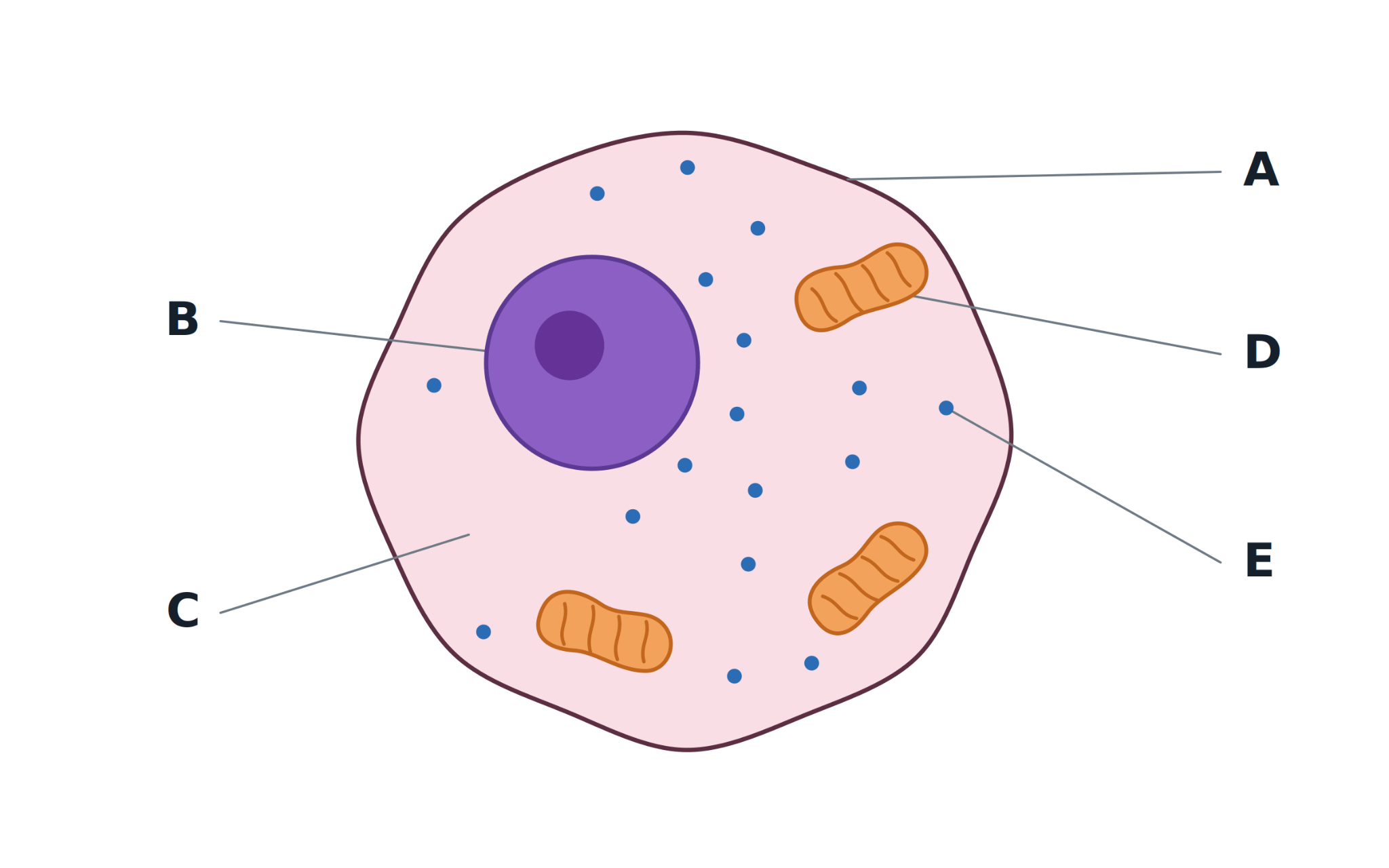
a.[2]
Name the structures labelled A and B in Figure.
b.[1]
Give the letter of the structure in Figure 1 where aerobic respiration takes place.
c.[2]
Muscle cells contain many more of structure D than skin cells do.
Explain why.
d.
[1]
Complete the sentence.
Choose the answer from the box.
| cytoplasm | mitochondria | ribosomes |
Proteins are made in the _____ .
1.1 Cell structure Questions
129 exam-style questions on AQA GCSE Biology 1.1 Cell structure, covering 1.1.1 Eukaryotes and prokaryotes, 1.1.2 Animal and plant cells, 1.1.3 Cell specialisation, 1.1.4 Cell differentiation, 1.1.5 Microscopy, and 1.1.6 Culturing microorganisms. Each one has a worked solution and a mark scheme showing where the marks go.