

Wrong Tier GCSE Modern Hebrew: What Happens?
Wrong tier GCSE Modern Hebrew entry? Learn what each tier allows, whether your school can change it before the exams, and who to contact for help.
An exam entry can look like a small administrative detail until one letter changes what grades are available. If you discover a wrong tier GCSE Modern Hebrew entry, the practical answer is simple: tell your Modern Hebrew teacher, exams officer or head of year immediately. Your school or exam centre may be able to amend the entry before the assessment, but you cannot change it yourself and waiting can make the situation harder to resolve.
The important facts are these: AQA GCSE Modern Hebrew has Foundation and Higher tiers, you must take all four papers at the same tier, and Foundation limits the grades available. A mistaken entry is serious, but discovering it before the exams gives your centre the best chance to put it right.
What to check first
Before assuming there has been an error, confirm:
- the subject is AQA GCSE Modern Hebrew, specification code 8678
- your entry says 8678/F for Foundation or 8678/H for Higher
- the tier agrees with what your teacher told you
- your speaking assessment has already happened or is still to come
- every document refers to Modern Hebrew, not Biblical Hebrew
Modern Hebrew and Biblical Hebrew are different qualifications. Current GCSE Modern Hebrew is offered by AQA, while Pearson Edexcel offers GCSE Biblical Hebrew. Similar names do not mean interchangeable courses, papers or entry codes.
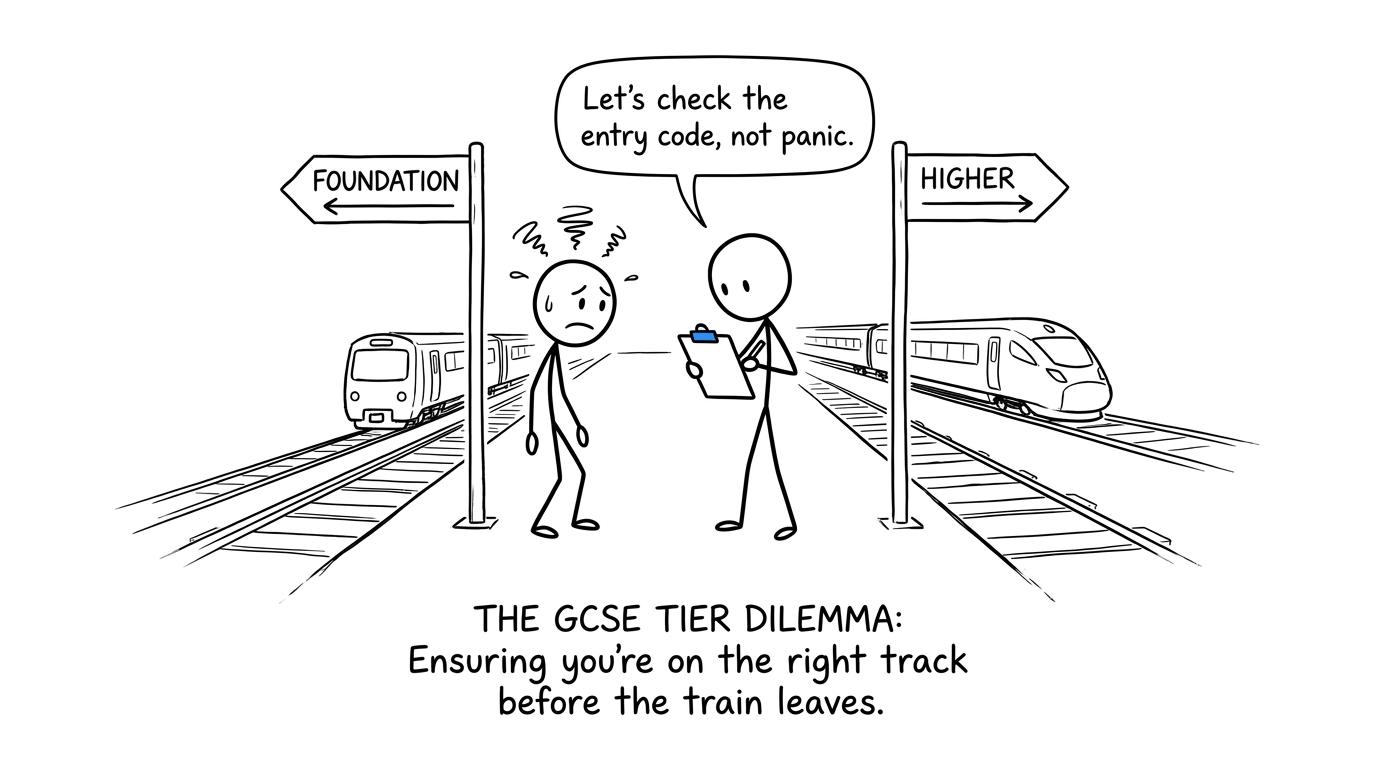 A student choosing between Foundation and Higher while an exams officer checks the entry code
What Foundation and Higher tier mean in Modern Hebrew
AQA GCSE Modern Hebrew assesses four language skills:
- listening
- speaking
- reading
- writing
Each component contributes 25%25\%25% of the qualification. Students must take all four assessments at the same tier and in the same exam series.
Foundation tier offers grades 111 to 555. Higher tier offers grades 444 to 999. The papers are not merely labelled differently: their demands, task lengths and, in some components, assessment times differ.
The same broad principle appears in tiered GCSE Maths. Foundation provides access to grades 111 to 555, while Higher is designed for grades 444 to 999. Maths students can explore the distinction in the GCSE Maths topics by exam board and tier guide or read the practical advice on moving from Foundation to Higher GCSE Maths.
The decision should not be reduced to “Higher is better”. The right tier is the one that gives a student a realistic opportunity to demonstrate what they know.
What happens if you are entered for the wrong tier in GCSE Modern Hebrew?
The consequence depends on which mistake has been made and when it is discovered.
You were entered for Foundation instead of Higher
If the entry remains unchanged, you will sit Foundation papers and the highest available grade will be a grade 555. Producing excellent answers does not allow a Foundation entry to be awarded a grade 666, 777, 888 or 999.
This matters if you have been preparing for Higher tasks or need a grade above 555. However, it does not mean your result is automatically invalid. You would still receive a valid Foundation-tier result based on your performance.
You were entered for Higher instead of Foundation
You will face the Higher versions of the listening, speaking, reading and writing assessments. These include more demanding language and longer or more open-ended tasks.
Being entered for Higher does not itself cause a fail. The concern is that a student whose evidence supports Foundation may find it harder to collect enough marks across the qualification. Because Higher is intended for grades 444 to 999, this can create more risk for someone working below that range.
Different components show different tiers
This needs urgent attention. AQA requires all four Modern Hebrew papers to be taken at the same tier. A student cannot intentionally combine Foundation listening with Higher reading and writing, for example.
If your speaking paperwork shows one tier but your statement of entry shows another, do not try to decide which document is correct. Give both to your exams officer and ask the centre to check the official entry and assessment records with AQA.
Can the tier be fixed before the exam?
Often, an exam centre can request an entry amendment before the assessment. Whether a particular change can still be processed depends on its timing, the examinations already completed and the awarding body's administrative rules.
Only the school or registered exam centre can make the change. A student or parent cannot contact the awarding body and personally replace an official entry.
Use this sequence:
- Tell your subject teacher and exams officer immediately.
- State clearly which tier you expected and which tier appears on your paperwork.
- Ask the centre to verify the official AQA entry rather than relying on a class list.
- Provide relevant evidence, such as emails, option forms or written confirmation from your teacher.
- Ask when you will receive confirmation that the issue has been checked.
Entry deadlines and possible amendment charges are matters for the centre. They should not be a reason to stay silent. The earlier the exams officer knows, the more options they are likely to have.
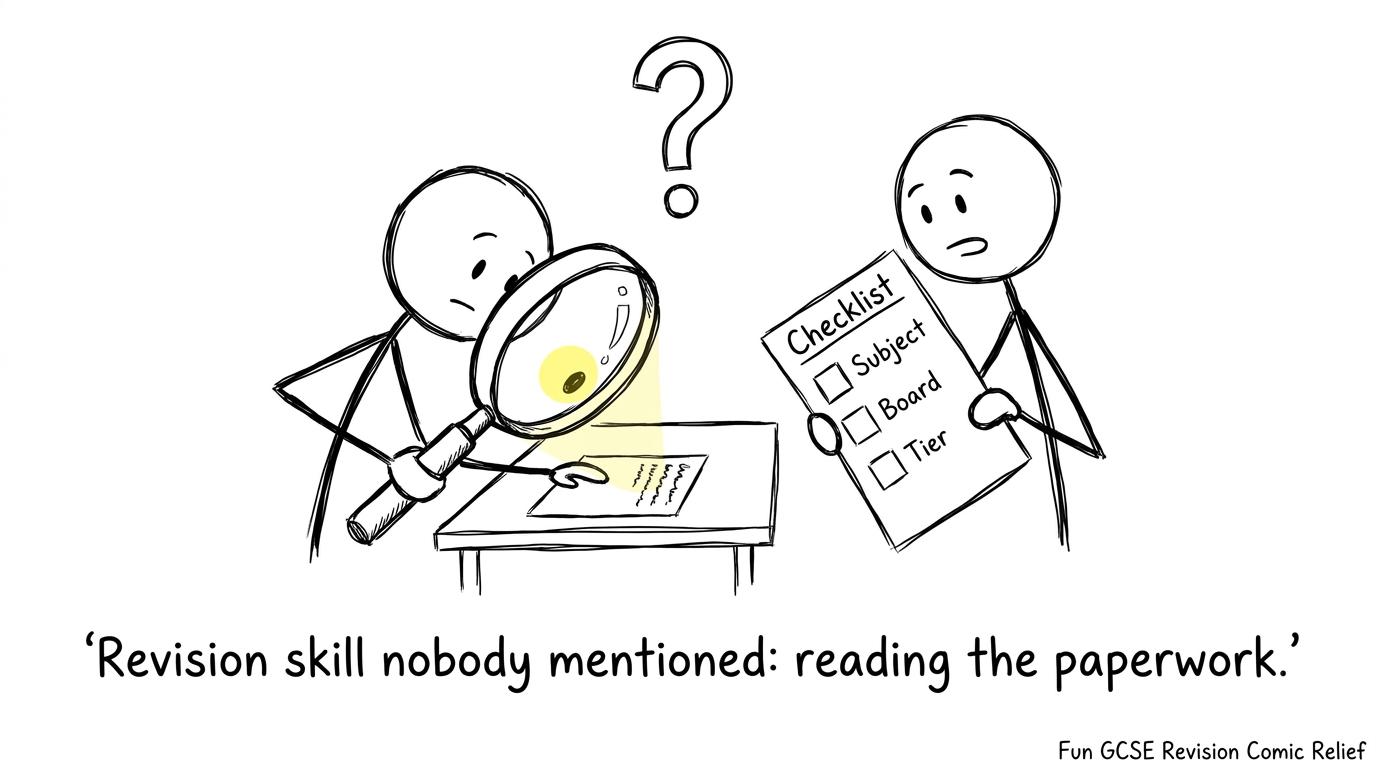 A student carefully checking the subject, board and tier on an exam timetable
Why the speaking assessment makes timing important
The speaking assessment is one of the four tiered components and is normally conducted before the main written examination period. Foundation and Higher speaking tests have different demands and timings.
If your speaking assessment has not taken place, raise the problem before you are given any confidential assessment material. That gives the centre the clearest opportunity to verify your entry first.
If you believe you have already completed the speaking assessment at the wrong tier, report it immediately. Do not assume the tier can simply be changed for the remaining papers, because all four components must match. The exams officer will need to establish exactly what happened and seek guidance from AQA where necessary.
Students should not attempt to repeat, photograph, discuss or obtain confidential speaking materials. Resolving the administrative issue is the centre's responsibility.
What to do on the day if the paper looks wrong
Sometimes the first visible warning is the paper placed on the desk. The front should identify the subject, component and tier.
If anything appears wrong:
- stop before beginning the paper
- keep the paper closed if instructed to do so
- raise your hand immediately
- quietly tell the invigilator which tier you expected
- allow the exams team to check the attendance register and entry information
Do not start the paper simply because everyone else has started. Equally, do not leave the room or argue with an invigilator. Exam staff need a few moments to confirm whether the paper or your expectation is wrong.
This habit transfers directly to maths exams. Before writing, check the exam board, subject, paper number and tier. The MathsGenie Edexcel GCSE Maths revision hub helps students become familiar with the appearance and demands of Foundation and Higher material before exam day.
How should the correct tier be decided?
A tier decision should rest on evidence rather than pride, fear or one unusually good lesson. Useful evidence includes:
- performance across several timed assessments
- listening and reading accuracy
- the range and control of language used in speaking and writing
- teacher assessment against the specification
- consistency under examination conditions
- the grade the student needs and the realistic route to it
The same disciplined approach works in GCSE Maths. A single high mock mark can be encouraging, but a pattern is more useful. Revision lessons identify missing knowledge; practice questions test a specific skill; past papers reveal whether that knowledge survives under time pressure.
Students who are also reviewing their maths tier can use MathsGenie's guide to whether GCSE Maths is hard for a realistic revision cycle. The MathsGenie homepage also brings together free GCSE and A Level revision lessons, questions and exam resources.
Common mistakes when checking a Modern Hebrew entry
Confusing Modern Hebrew with Biblical Hebrew
These are separate subjects with different specifications and assessments. Check both the qualification title and exam board, not just the word “Hebrew”.
Assuming a teacher's verbal plan changed the official entry
A conversation about moving tier is not proof that the examinations system was updated. Ask for the official statement of entry to be checked.
Waiting until the first written paper
Modern Hebrew includes a speaking assessment that may take place earlier. Reporting the issue after one component has been completed can make the situation more complicated.
Believing Foundation marks can produce a grade above 555
Foundation tier is capped at grade 555. A very strong Foundation performance does not convert into a Higher-tier grade.
Revising for both tiers indefinitely
While some content overlaps, preparing without knowing your actual entry creates avoidable uncertainty. Confirm the tier, then use the correct specification, task formats and timing.
Treating an administrative problem as a revision problem
You cannot revise your way out of an incorrect entry code. Keep preparing, but contact the exams officer as a separate and immediate action.
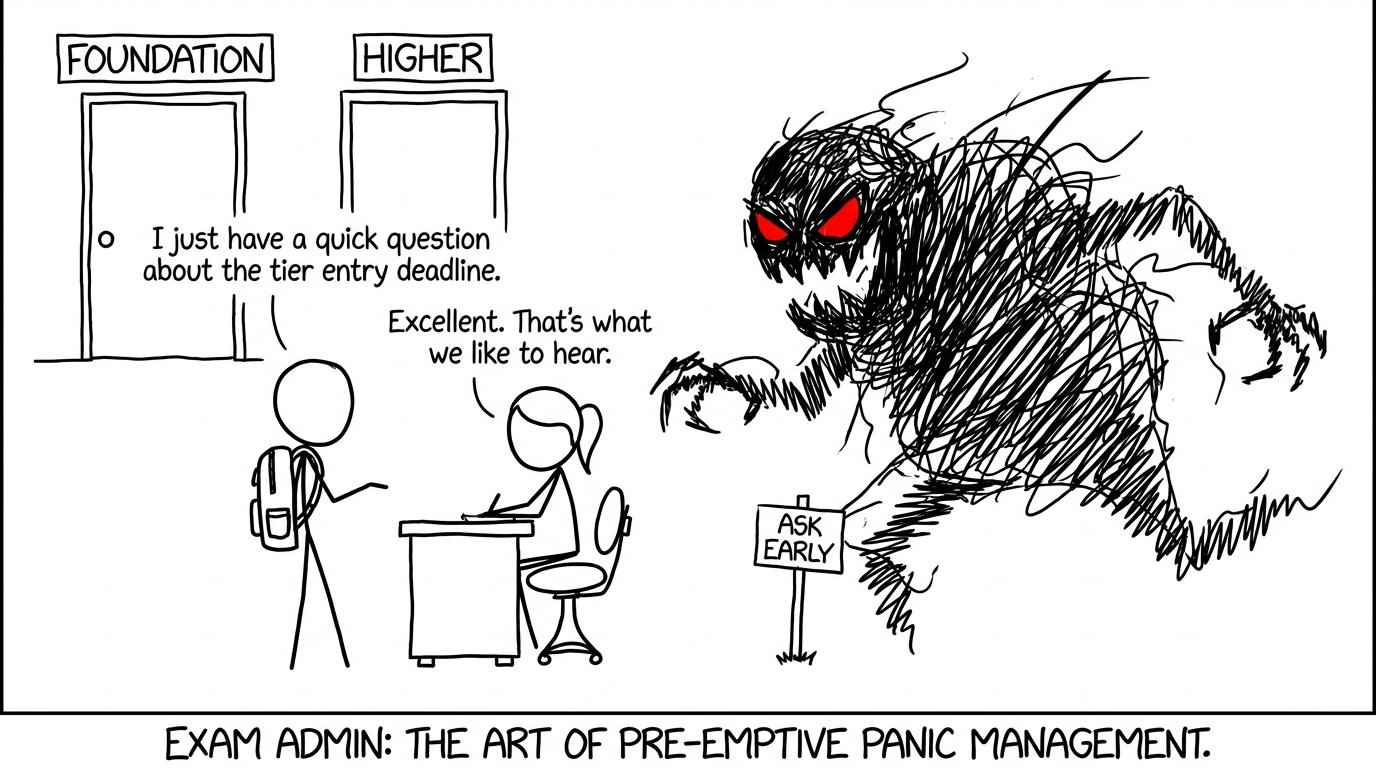 A calm early conversation keeps the panic monster outside the exam room
Turn the discovery into a useful exam habit
An incorrect entry feels alarming because it sits outside the usual revision routine. Yet the best response is wonderfully ordinary: check the evidence, speak to the right person and act early.
Once your Modern Hebrew tier has been confirmed, return your attention to preparation. Do the same for every tiered subject, including GCSE Maths. Check your exam board and tier, then make sure the resources you use match both.
MathsGenie is the free place to build that preparation: start with revision lessons, strengthen individual topics through practice questions and mini tests, then use past papers, predicted papers, mark schemes and video solutions to improve timing and accuracy. One checked entry prevents an administrative surprise. One well-planned revision session prevents the next avoidable lost mark.










