Wrong Tier in GCSE Arabic: What Happens Next?
Wrong tier GCSE Arabic entry? Learn how Foundation and Higher affect grades, when an entry may be changed, and who to contact before the exam.
Discovering that your exam entry may be wrong can make months of revision suddenly feel irrelevant. It is not. If you are worried about a wrong tier GCSE Arabic entry, the practical answer is to contact your school or exam centre immediately. A tier can often be corrected before the relevant assessment, although deadlines, fees and the stage of the speaking assessment may affect what is possible.
For Pearson Edexcel GCSE Arabic, students must take one tier across all four papers: listening, speaking, reading and writing. Foundation offers grades 111 to 555. Higher offers grades 444 to 999, with a narrow safety-net grade 333 for students who fall just below the grade 444 boundary. This makes the entry decision important, but discovering an error before the examination does not automatically mean it is too late.
Your immediate checklist
If your entry appears wrong:
- Tell your Arabic teacher and exams officer as soon as possible.
- Ask them to confirm your qualification, exam board, specification and entry option.
- Check whether you are entered for Foundation or Higher across all four papers.
- Explain why you believe the tier is incorrect.
- Ask whether your speaking assessment has been completed or scheduled.
- Request written confirmation once the entry has been checked or amended.
- Continue revising while the centre investigates.
Do not try to change the entry yourself. Exam entries are submitted and managed by the school, college or private examination centre.
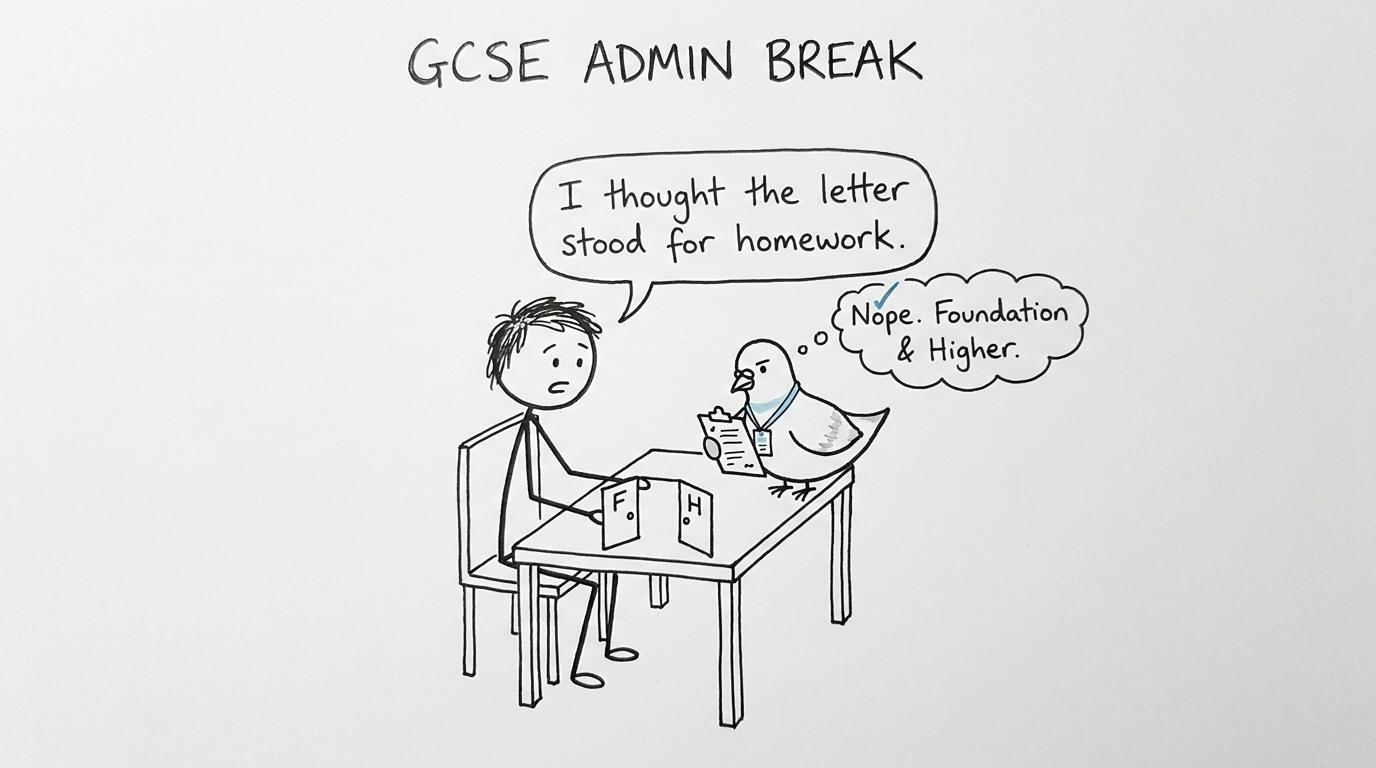 A student, two exam-tier doors and an unusually serious administrative pigeon
How tiering works in GCSE Arabic
This article refers to Pearson Edexcel GCSE Arabic, specification 1AA0. It has four equally important skill areas: listening, speaking, reading and writing. Each paper is available at Foundation and Higher tier, but mixed-tier entry is not permitted. A candidate cannot, for example, complete Foundation listening and Higher writing.
The centre must select one entry option for the complete qualification:
| Entry | Grades available | Main consequence |
|---|---|---|
| Foundation | 111 to 555 | Grade 555 is the highest possible result |
| Higher | 444 to 999, plus a narrow grade 333 safety net | A result below the safety-net threshold is unclassified |
The final grade is based on the total subject mark rather than a separate grade for each paper. A strong performance in one skill can therefore support the overall result, but every paper must still match the same tier.
A grade 444 or 555 has the same value whether it is achieved through Foundation or Higher. The certificate does not advertise which tier was taken. The difference lies in the available grade range and the demand of the questions, not in the status of the resulting grade.
Maths students will recognise the basic principle. The GCSE Foundation and Higher maths comparison explains the same central trade-off: Foundation protects access to the lower grade range but places a ceiling at grade 555, while Higher opens the route to the top grades and carries more risk near the lower boundary.
What happens if the Foundation entry is wrong?
If you are entered for Foundation when your teacher intended Higher, the immediate problem is the grade cap. Even an exceptional Foundation performance cannot produce a grade above 555.
That does not mean Foundation is automatically the wrong choice for a student working around grades 444 or 555. Foundation papers are designed to assess that grade range appropriately, and a grade 555 from Foundation is not worth less than a grade 555 from Higher. The entry is wrong only if it does not reflect the considered decision made by you, your teacher and your centre.
If the Foundation entry resulted from an administrative error and the speaking assessment has not taken place, the exams officer should investigate a change immediately. Pearson's published entry guidance classifies a tier or option change as an amendment. Depending on when it is submitted, the centre may face an amendment fee, but the existence of a fee does not by itself make the change impossible.
What happens if the Higher entry is wrong?
A Higher entry gives access to grades 444 to 999, but it also exposes the candidate to an unclassified result if the total mark falls below the narrow grade 333 safety net.
This is why Higher should not be treated as a free chance at a better grade. It is appropriate when the student's demonstrated performance supports it. Mock results, classwork, speaking performance and timed papers all provide better evidence than hope or fear alone.
If you believe Higher was selected accidentally, contact the exams officer rather than assuming you must sit it. The centre can check the original decision, current entry and assessment schedule. If the entry was deliberate, ask your teacher to explain the evidence behind it. A difficult mock does not necessarily prove the tier is wrong, just as one unusually strong paper does not settle the decision on its own.
Can the GCSE Arabic tier be fixed before the exam?
Usually, the earlier the problem is raised, the more straightforward it is to investigate. Pearson's GCSE Arabic instructions say that centres must decide the candidate's tier in advance of the speaking assessment. This matters because speaking is one of the four tiered papers, not an unrelated preliminary task.
Before the speaking assessment
This is the clearest opportunity for a correction. The exams officer can verify the entry and, where appropriate, submit a tier amendment. An entry deadline may already have passed, so fees or additional administration could apply. Deadlines vary by examination series and centre, which is why students should not rely on a date copied from an old letter or webpage.
After speaking but before the written papers
A late discovery is more complicated. Because all four papers must be taken at one tier, changing the remaining papers could create an invalid mixed-tier combination. The centre should contact Pearson for case-specific instructions rather than promising that a change can be made.
Do not assume that sitting different papers will somehow correct the record. The paper on your desk and the entry held by the awarding organisation must agree.
On the day of an examination
If the tier printed on your paper seems wrong, do not open the paper and carry on silently. Raise your hand and tell the invigilator immediately. The invigilator can pause the process and consult the exams officer.
Students should not leave their seats, swap papers or contact the exam board from the examination room. The centre has formal procedures for checking entries and distributing the correct materials.
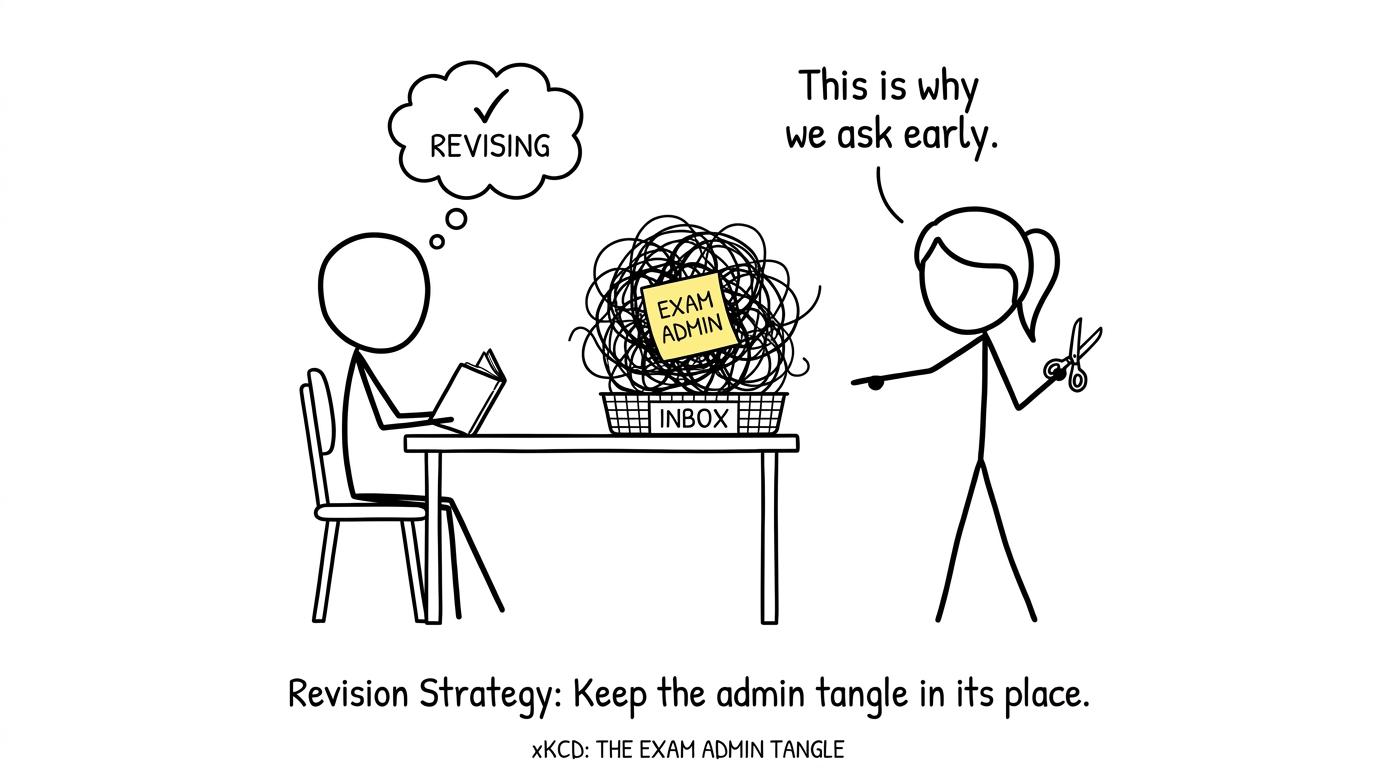 A teacher calmly untangling an exam administration problem
Who is responsible for fixing the entry?
Your first contact should normally be your Arabic teacher, but the exams officer manages the formal entry. If you are a private candidate, contact the examination centre through which you registered.
A useful message includes:
- your full name and candidate details;
- the qualification title and code, if known;
- the tier you believe is recorded;
- the tier you expected;
- whether your speaking assessment has happened;
- the date of your next Arabic assessment.
Keep the tone factual. The aim is not to prove who made a mistake before anyone has checked. It is to place the right information in front of the person who can act.
Parents or carers can help by following up with the centre, particularly when an assessment is close. However, repeated messages to several teachers may slow communication. One clear request to the exams officer, copied to the subject teacher where appropriate, is usually more useful.
How to make a sound tier decision
An administrative error is different from disagreement about academic judgement. If the recorded tier matches the school's decision but you want it changed, ask for a review based on evidence.
Useful evidence includes performance on tier-appropriate listening, speaking, reading and writing tasks. Consider consistency as well as the highest mark achieved. The central question is not simply, "Could I get a grade 666?" It is whether Higher gives you a realistic route to your target without creating disproportionate risk below grade 444.
This evidence-led approach also helps with maths. MathsGenie's GCSE maths topics by board and tier shows what changes between Foundation and Higher, while the main GCSE maths revision hub lets you select resources suited to your board and current level.
Keep maths revision moving while the issue is checked
An Arabic entry concern can consume an entire evening because uncertainty feels like a task. It is not. Once you have sent the necessary message, your next useful action is to return to preparation.
Use the same rule across subjects: revise for the confirmed paper, not a vague idea of the exam. For maths, check your board and tier before selecting questions. The Edexcel GCSE maths revision hub organises lessons, worksheets and exam-style practice, while Edexcel GCSE maths past papers provide tier-specific papers and mark schemes.
A calm revision loop is enough:
- learn or refresh one method;
- answer relevant practice questions;
- mark the work carefully;
- record the reason for each lost mark;
- revisit the weakness on another day;
- move into timed papers once the method is secure.
For a structured schedule, use the one-month GCSE maths revision plan. The guide to using GCSE past papers properly also explains how to turn mark schemes and video solutions into specific next steps rather than simply collecting scores.
 Arabic and maths revision folders comparing exam-season worries
Common mistakes to avoid
Waiting because the school probably knows
Schools handle many entries. If something looks wrong, ask. Early questions are easier to resolve than late surprises.
Treating Higher as automatically better
Higher offers grades above 555, but it is not the safest route for every student. A secure Foundation grade 444 or 555 has the same value as that grade from Higher.
Assuming all papers can have separate tiers
GCSE Arabic candidates must use one tier across listening, speaking, reading and writing. Mixed-tier entry is not permitted.
Relying on a mock-paper cover
A mock may not reflect the final awarding-body entry. Ask the exams officer to confirm what has actually been submitted.
Stopping revision until someone replies
Administrative uncertainty does not erase what you know. Send the enquiry, keep a record and continue practising the skills common to your preparation.
Act early, then return to the work
A wrong GCSE Arabic tier can affect the grades available, but it may be fixable when it is identified before the speaking assessment and raised promptly with the exams officer. After speaking, the position becomes more difficult because all four assessments must remain at the same tier. In every case, the centre should verify the entry and obtain guidance from Pearson where necessary.
Then let the administration return to the administrators. Your job is preparation. For maths, start with the MathsGenie GCSE revision hub, choose the correct board and tier, and build a repeatable routine from free revision lessons, practice questions, mini tests, past papers, predicted papers, mark schemes and video solutions. Correct information removes uncertainty. Consistent practice does the rest.