Why Study Religious Studies at A-Level?
Why study religious studies at A-Level? Explore the course content, transferable skills, careers and subject combinations before making your choice.
Choosing A-Levels can feel strangely permanent. A form asks for three subjects, but it seems to be asking what sort of person you will become. If you are wondering why study religious studies, the short answer is this: it teaches you to understand difficult ideas, test competing arguments and reach reasoned conclusions about questions that affect real lives.
A-Level Religious Studies is not simply about remembering religious beliefs. Depending on your exam board and your school's chosen course, you may explore philosophy of religion, ethics, theology and the detailed study of a religious tradition. It is an essay-based academic subject that rewards knowledge, analysis and carefully supported judgement.
Is A-Level Religious Studies right for you?
Use this quick checklist before choosing:
- You enjoy asking why people believe what they believe.
- You are interested in ethics, philosophy, culture or current affairs.
- You like discussing ideas but are willing to support your views with evidence.
- You want to improve your essay writing and critical thinking.
- You can consider a viewpoint seriously without having to agree with it.
- You are prepared to read, remember scholars' arguments and write under timed conditions.
You do not normally need to be religious. You also do not have to arrive with settled answers. The subject is built around investigation: what a claim means, why someone might accept it and whether the reasoning survives criticism. Your school or college may set its own GCSE entry requirements, so check those before applying.
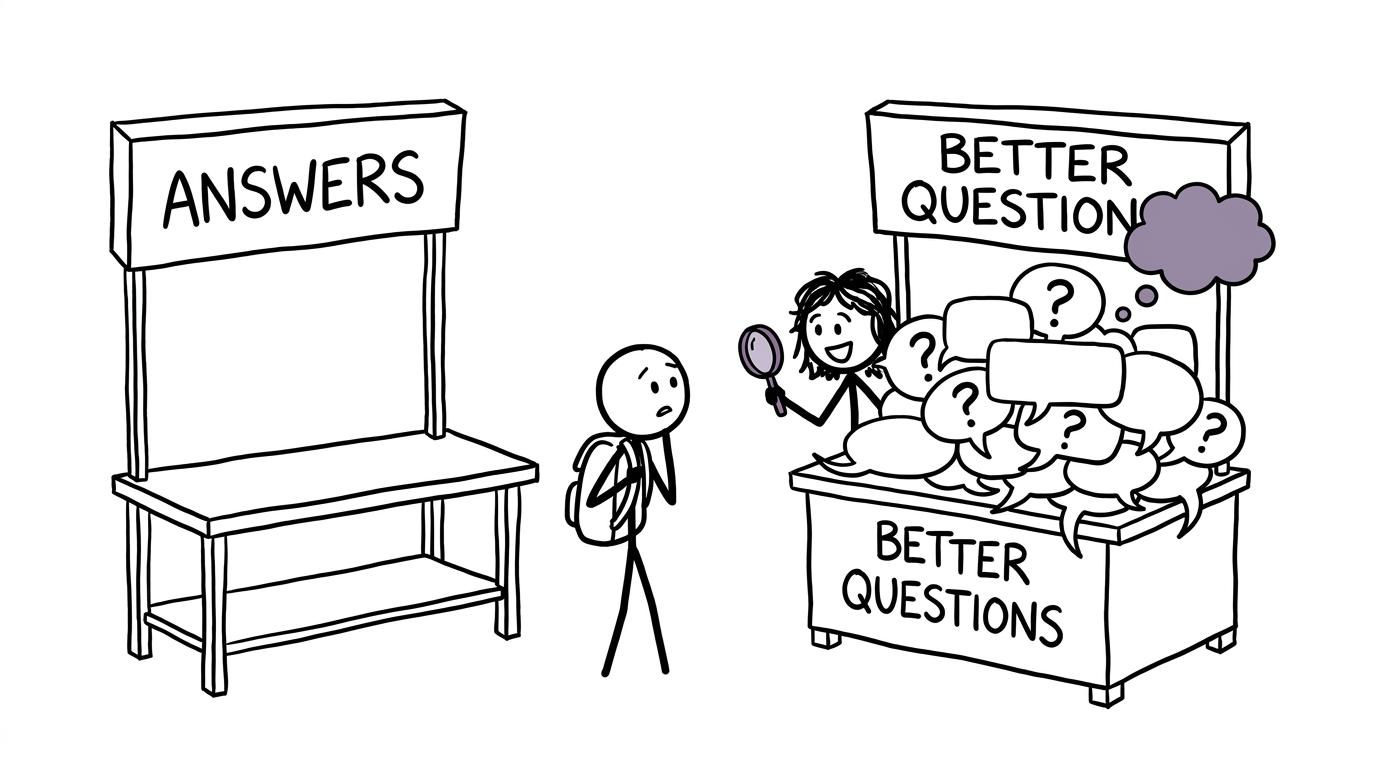 A student discovers that the best subject stall offers better questions rather than easy answers
What do you study in A-Level Religious Studies?
The exact content depends on the specification followed by your school. AQA, OCR, Pearson Edexcel and Eduqas do not arrange every topic in the same way, and schools may choose particular religious traditions or optional units.
Across common specifications, however, three broad areas frequently appear.
Philosophy of religion
Philosophy asks whether religious claims can be rationally defended. Topics may include arguments about the existence of God, evil and suffering, religious experience, miracles, the relationship between mind and body, and whether religious language has meaning.
You will not receive a list of approved conclusions. Instead, you learn how an argument is constructed, where its assumptions sit and how a critic might respond.
Religion and ethics
Ethics investigates how moral decisions should be made. You may study approaches such as natural law, utilitarianism, situation ethics or Kantian ethics, then examine how ethical reasoning applies to contemporary questions.
This gives the subject obvious real-world relevance. Medicine, law, technology, government and business all face decisions in which evidence matters but values cannot be avoided. Religious Studies helps you recognise the difference between asserting that something is wrong and building a defensible explanation of why.
Religious thought or the study of religion
This area explores beliefs, sources of authority and developments within a religious tradition. It may consider identity, gender, pluralism, secularisation, science or the effects of historical and social change.
Religions are not presented as single, unchanging sets of opinions. You examine debates within traditions as well as differences between religious and non-religious perspectives.
The skills you develop
The strongest case for A-Level Religious Studies is not that it hands you one particular career. It is that it develops abilities used across many courses and professions.
Analysis rather than unsupported opinion
For A-Levels regulated in England, Religious Studies assessment objectives give greater weight to analysis and evaluation than to knowledge and understanding: AO2 accounts for 60%60\%60%, while AO1 accounts for 40%40\%40%. That balance matters. Knowing a theory is only the beginning; you must compare interpretations, assess evidence and justify a conclusion.
This is close to mathematical reasoning in one important respect. A claim needs support. In maths, a conclusion follows from valid steps. In Religious Studies, the material is less tidy, but the discipline remains: define terms, identify assumptions, consider objections and avoid conclusions that your reasoning has not earned.
Clear writing and communication
Regular essays teach you to organise complex material, select relevant evidence and make a judgement that follows from the discussion. You also become more alert to vague language, false comparisons and arguments that sound confident without being convincing.
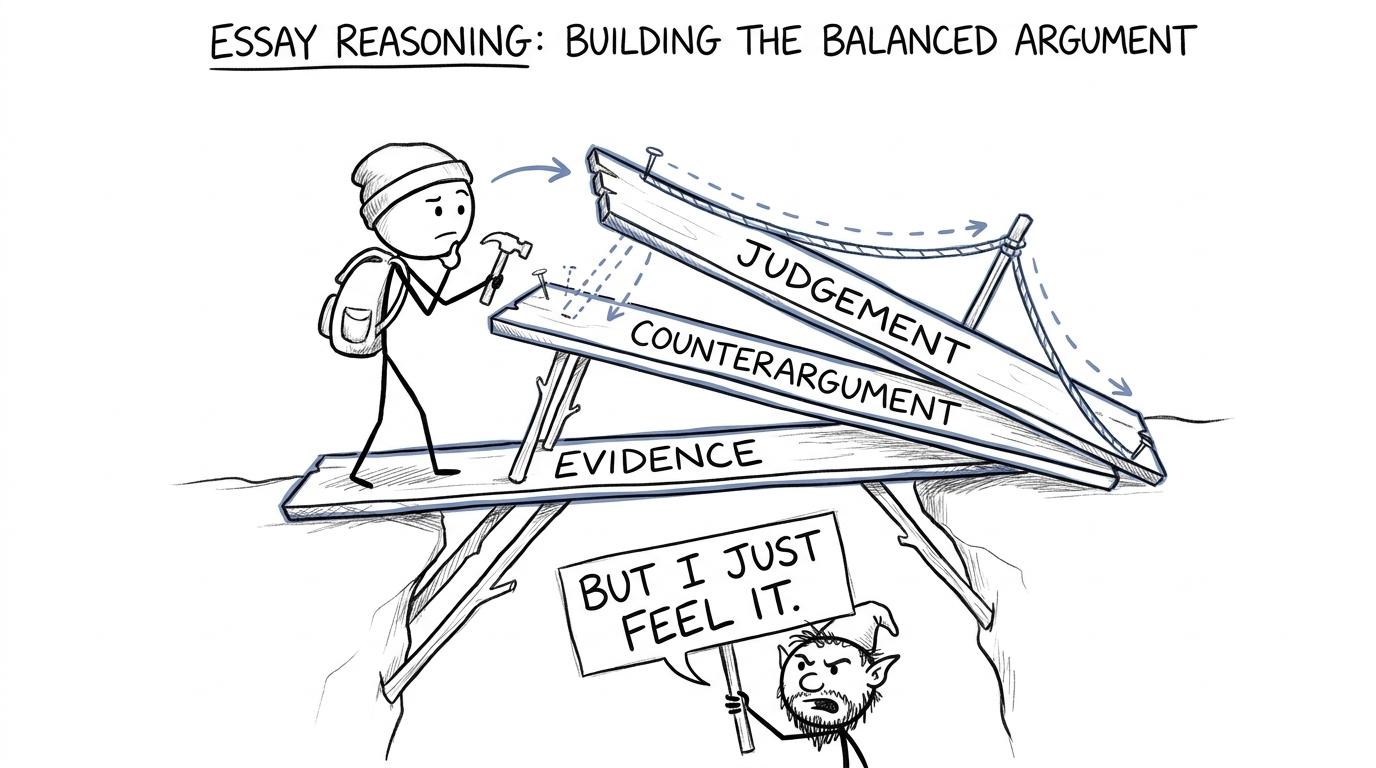 A student builds a bridge from evidence, counterargument and judgement while unsupported opinion waits underneath
Intellectual empathy
Understanding a position is not the same as agreeing with it. Religious Studies asks you to represent views accurately before evaluating them. That habit is valuable wherever people with different backgrounds, beliefs or priorities must work together.
How Religious Studies fits with other A-Levels
Religious Studies can complement English literature, history, politics, psychology and sociology because all involve reading, interpretation and extended writing. It can also provide breadth alongside biology, chemistry, physics, computer science or maths.
For a student taking numerical subjects, an essay-based A-Level can create a useful contrast. It strengthens written argument while philosophy develops precision about definitions, logic and assumptions. If you are considering A-Level Maths too, read MathsGenie's guide to the GCSE to A-Level curriculum transition.
There is no universally perfect subject combination. Begin with possible degree or apprenticeship routes and check their current entry requirements directly. Some university courses require particular A-Levels, while others focus mainly on grades. Choose a combination that keeps necessary routes open and contains subjects in which you can remain engaged for two years.
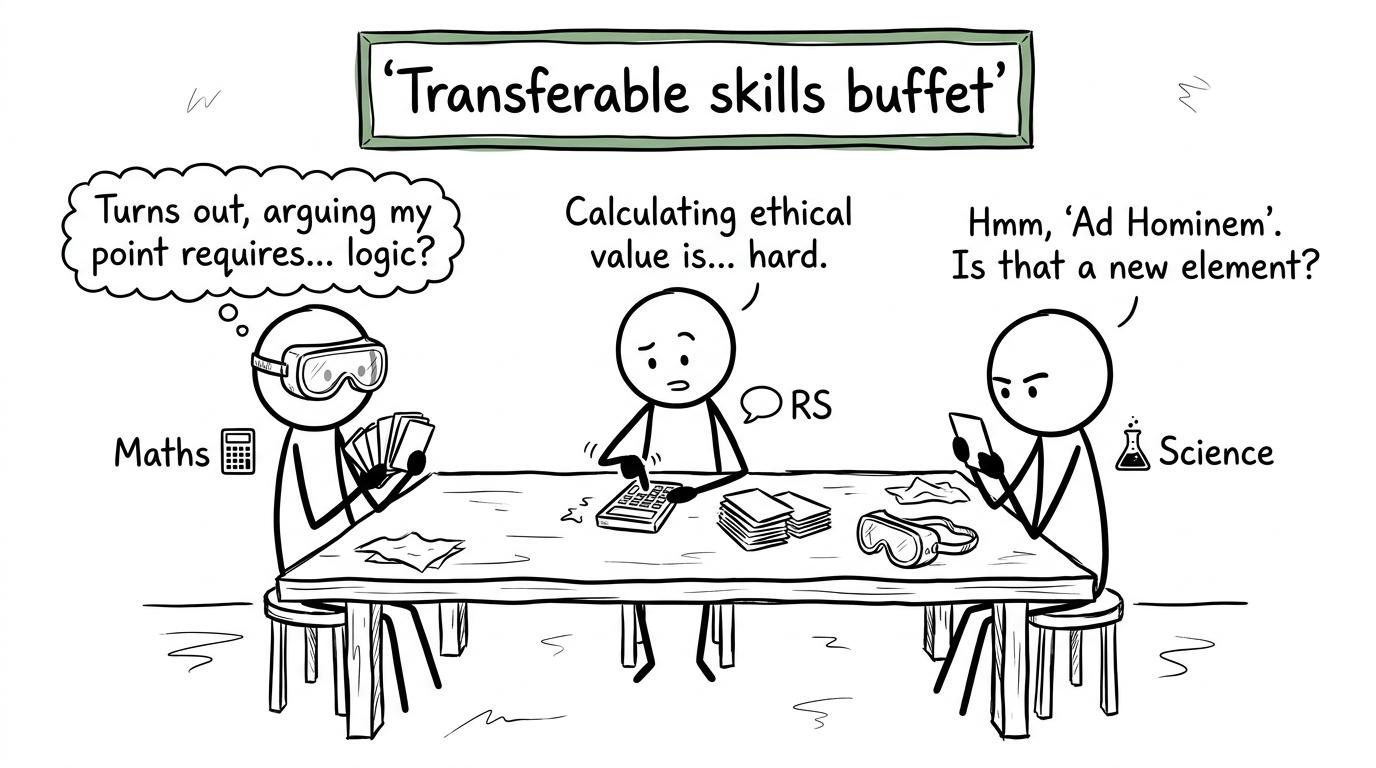 Maths, Religious Studies and Science exchange tools at the transferable skills buffet
Careers and real-world relevance
Religious Studies does not qualify you automatically for a particular job, but its transferable skills are relevant to fields including law, education, journalism, policy, the Civil Service, charities, communications and community work. Ethical and cultural understanding can also be useful in healthcare, business and public services.
At university, it can support progression towards religious studies, theology, philosophy, ethics and related humanities or social-science courses. Other routes may value the subject's evidence of analytical writing without requiring Religious Studies specifically.
The honest question is not, “Which job has Religious Studies in its title?” It is, “Where will I need to understand people, evaluate arguments and communicate a reasoned decision?” That is a much larger list.
What makes the subject challenging?
The volume of ideas can surprise students. You may need to remember technical vocabulary, scholars' arguments, criticisms and links between topics. Essays also demand more than listing both sides. Strong responses select material, sustain analysis and make a justified judgement.
Assessment is typically through written examinations, but paper structures and topic options vary. Check the current specification used by your school rather than assuming that one exam board's format applies to another.
Good preparation is methodical. Review content regularly, plan essays, write under time limits and study how mark schemes distinguish description from evaluation. The same habits improve maths revision. MathsGenie's GCSE revision timetable guide can help you organise both subjects without allowing one to consume the week.
Common mistakes when choosing Religious Studies
Assuming it is an easy essay subject
The questions may be open, but the marking is not arbitrary. Accurate knowledge, relevant analysis and supported judgement are required. A strongly expressed opinion cannot replace evidence.
Choosing it only because you enjoyed GCSE debates
Discussion is part of the appeal, but A-Level also involves substantial reading, note-making, recall and timed writing. Ask to see your school's specification and a sample paper before deciding.
Believing you must be religious
The course is academic rather than a test of personal faith. Students examine religious and non-religious arguments critically. What matters is your willingness to understand positions fairly.
Ignoring the rest of your workload
Three demanding subjects become manageable through routine, not last-minute rescue. While finishing GCSEs, use the GCSE Maths revision hub and the exam-board and tier topic guide to keep your maths preparation focused.
Do not treat papers as a score alone. Follow the MathsGenie past-paper method: complete, mark, diagnose, repair and retest. For Edexcel students, the GCSE Maths paper collection includes papers and mark schemes, while GCSE predicted papers provide further practice nearer the examinations.
Make the choice with evidence
Religious Studies is worth considering if you are curious about belief, morality and the reasoning behind human decisions. It offers intellectual breadth, demanding essay practice and a way to examine disagreements without reducing them to slogans.
Before choosing, speak to the teacher, confirm the exam board, inspect the specification and read a sample question. Then consider the whole combination rather than judging one subject in isolation.
Meanwhile, secure the GCSE results that will give you the widest choice. Use MathsGenie's free revision lessons, practice questions, mini tests, past papers, predicted papers, mark schemes and video solutions to turn weak areas into a clear revision plan. Subject choices shape the next two years; steady preparation gives you the freedom to make those choices confidently.