Why Choose GCSE ICT? Reasons Students Enjoy It
Why choose GCSE ICT? Explore the practical skills, maths connections and career value students appreciate, plus what to check before selecting it.
Choosing GCSE options can feel strangely permanent. A subject name sits in a small box on a form, yet the decision seems to carry the weight of an entire future. ICT can be especially confusing because schools do not always use the name in quite the same way.
So, why choose GCSE ICT? Students who enjoy an ICT-style course often value its practical problem-solving, useful digital skills, project-based tasks and links with data, business and everyday technology. It can suit someone who likes making things work, improving how information is presented and understanding how digital systems support real organisations.
There is one important detail to check first. The former GCSE Information and Communication Technology qualification was discontinued in England. A school using the label “GCSE ICT” may now mean GCSE Computer Science, a vocational digital or information technology qualification, or its own shorthand for a related course. Qualifications also differ across the UK. Always ask for the exact title, exam board and specification before choosing.
A quick ICT option checklist
ICT may be worth considering if you:
- enjoy working with data, documents, presentations or digital media;
- like practical tasks with a clear purpose and audience;
- are willing to explain decisions rather than simply use software;
- want digital skills that can support other GCSE subjects;
- can manage deadlines and check work carefully;
- understand the balance between examinations and assessed tasks on your course;
- have read the actual specification offered by your school.
The last point matters most. Do not choose a subject based on its nickname.
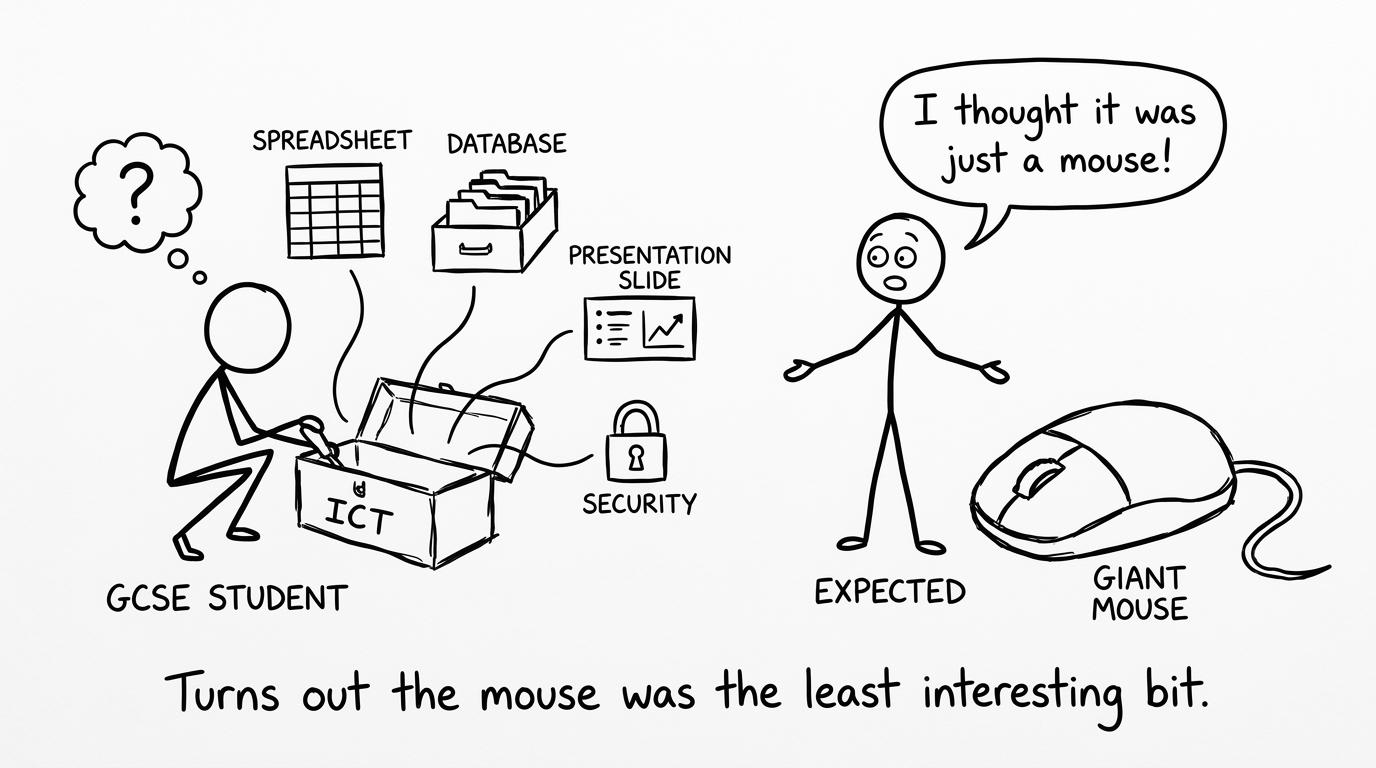 A student discovers that an ICT toolbox contains more than a computer mouse
What students value about an ICT-style course
There is no honest way to promise that every student will enjoy the same subject. However, the reasons students value ICT tend to be concrete rather than mysterious: the work feels useful, progress is visible and the skills travel beyond one classroom.
The work often has a practical purpose
In some subjects, it can take time to see where a piece of knowledge might be used. ICT often makes the purpose immediate. A database organises information. A spreadsheet tests possibilities. A presentation communicates an argument. A digital product is designed for a particular audience.
That sense of purpose can be satisfying. Instead of only remembering facts, students may need to choose a suitable tool, apply it and justify why it fits the task.
The strongest work is rarely the most decorative. It is the work that is accurate, readable and appropriate. A beautifully formatted chart with misleading data is still a poor chart. A complicated spreadsheet that produces unreliable results is still unreliable. ICT rewards judgement as well as technical confidence.
Digital confidence becomes less fragile
Many students use technology every day, but everyday use is not the same as deliberate digital competence. Knowing how to watch a video or send a message does not automatically mean knowing how to structure folders, validate data, protect personal information or select an effective chart.
An ICT-style course can replace guesswork with a process. You learn to name files sensibly, check sources, test outputs and recover when something fails. These habits are not dramatic, which is precisely why they are valuable. Useful systems often look boring from the outside.
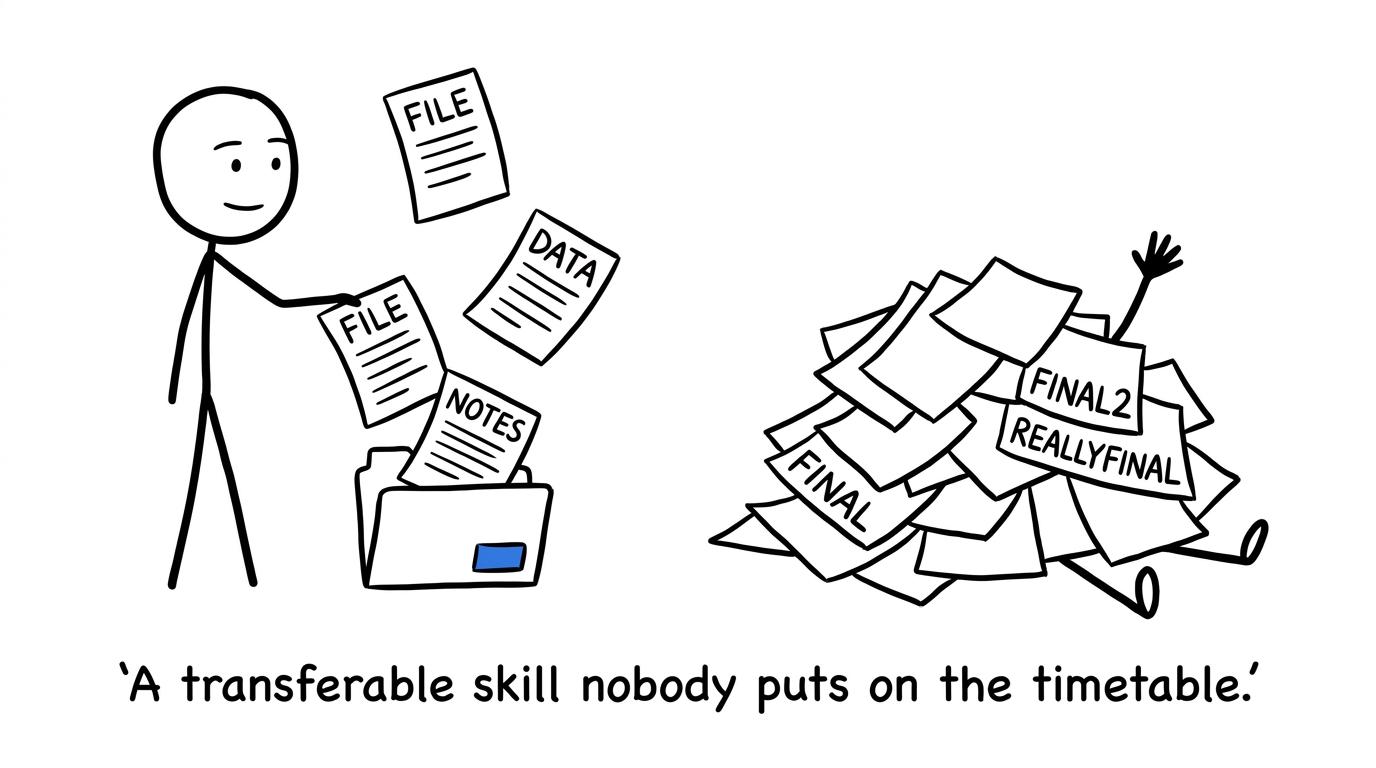 One student organises files while another is buried beneath versions called final
You create work rather than only consume information
Students who prefer active lessons may appreciate producing a spreadsheet model, database, report, interface or digital campaign. The exact products depend on the qualification, so check your specification rather than assuming every course contains the same tasks.
Creating something also makes feedback clearer. A formula either refers to the intended cells or it does not. A database search either returns the required records or it does not. A document either communicates clearly to its audience or needs revision.
This does not make ICT easy. Practical work can demand patience, accurate testing and repeated improvement. For some students, however, that challenge feels more tangible than revising a large body of disconnected notes.
Why choose GCSE ICT if you also care about maths?
ICT is not a substitute for GCSE maths, but there is useful overlap. Both subjects reward logic, accuracy and the ability to interpret information rather than merely collect it.
Spreadsheets make numerical thinking visible
Depending on the course, spreadsheet work may involve percentages, totals, averages, comparisons and formulas. The underlying ideas also appear in GCSE maths.
For instance, percentage change is based on:
Percentage change=new value−original valueoriginal value×100\text{Percentage change}=\frac{\text{new value}-\text{original value}}{\text{original value}}\times 100Percentage change=original valuenew value−original value×100The software can calculate quickly, but it cannot rescue a poorly designed model. You still need to decide which value is original, whether the units match and whether the result is reasonable.
That is the same checking habit needed in a maths exam. If percentage skills feel uncertain, the GCSE maths revision hub provides free lessons and practice organised around exam-board content.
Data handling connects the subjects
ICT can involve collecting, storing, presenting and interpreting data. GCSE maths and statistics ask related questions: Which average is appropriate? Is a graph misleading? Does a pattern support the conclusion? Are there missing or unusual values?
The mean, for example, is:
Mean=sum of the valuesnumber of values\text{Mean}=\frac{\text{sum of the values}}{\text{number of values}}Mean=number of valuessum of the valuesA computer may produce that value instantly. Your responsibility is to understand what it means. Students wanting more focused data practice can use MathsGenie's GCSE Statistics revision resources, while Edexcel students can explore the dedicated Edexcel GCSE Statistics course page.
Tables are another shared skill. Database outputs and spreadsheet summaries reward careful reading of rows, columns and totals, just as GCSE maths questions do. The AQA two-way tables revision guide is useful if this connection exposes a maths gap.
Logical testing supports algebraic discipline
Debugging a digital process and checking an algebraic method share a useful mindset: do not merely stare at the final answer. Trace what happened.
If an output is wrong, isolate the step responsible. Was the input incorrect? Was the formula unsuitable? Was a reference copied badly? In maths, the equivalent questions concern substitutions, signs, operations and rounding.
Students who build this habit become less dependent on luck. They learn that an error is information.
ICT and Computer Science are not interchangeable
This distinction should shape your decision.
An ICT or digital information technology course is commonly focused on selecting and using digital tools, managing information, creating digital products and considering their use in organisations. Computer Science is more likely to emphasise algorithms, programming, data representation, networks, computer systems and cyber security.
There can be overlap, but the centre of gravity differs. Enjoying presentations and spreadsheets does not guarantee that you will enjoy programming. Equally, someone fascinated by coding may find a digital applications course less technical than expected.
Before selecting the option, ask your teacher:
- What is the qualification's full name?
- Which exam board provides it?
- Is it a GCSE or a vocational qualification at the same level?
- What proportion is assessed by examination or supervised assignment?
- Does it include programming?
- Which software and project types will be used?
- When are major deadlines likely to fall?
Students preparing for exams in England should also be aware that qualification titles continue to evolve. Current GCSE Computer Science specifications remain relevant to particular cohorts, while future reforms may use different naming. Your school's specification and entry year are more reliable than an old options video or a relative's experience.
Skills that continue beyond the course
The best reason to choose a subject is not that it guarantees a particular career. No single GCSE can do that. A better question is whether it builds skills you are willing to practise.
ICT-style courses can develop:
- data literacy: interpreting information rather than accepting every figure;
- digital organisation: managing files, versions and deadlines;
- communication: adapting content for a purpose and audience;
- evaluation: recognising limitations and suggesting improvements;
- security awareness: treating personal and organisational data responsibly;
- testing: checking whether a digital product works as intended;
- independence: solving small technical problems methodically.
These habits can support sixth-form work, apprenticeships and employment, but their immediate value is simpler: they help you complete schoolwork more reliably.
When ICT might not be the right option
A useful choice is not automatically the right choice for everyone.
Think carefully if you dislike extended computer-based tasks, repeated testing or explaining design decisions. Do not assume the course will involve playing games, building computers or spending every lesson coding. Those expectations may not match the specification.
You should also consider the rest of your timetable. A qualification containing substantial assessed work can feel manageable when deadlines are spread out, but difficult when several subjects demand projects simultaneously. Ask how the department schedules assessment and what happens if work is incomplete.
Most importantly, do not pick ICT because somebody describes it as an easy GCSE. Familiar software can hide demanding assessment. High-quality responses may require precise terminology, justified choices and careful evaluation. Ease is usually a poor foundation for a two-year commitment.
Common mistakes when choosing or revising ICT
Choosing the label instead of the specification
“ICT”, “Computing”, “Computer Science” and “Digital Information Technology” can describe meaningfully different courses. Read the specification and sample assessment materials for the exact qualification.
Assuming confidence with devices guarantees high marks
Fast typing and regular phone use are not assessment objectives. Marks come from meeting task requirements, applying knowledge and explaining decisions accurately.
Spending too long making work look attractive
Presentation matters when it supports the intended audience. It should not replace accuracy, functionality or evaluation. Complete the requirements first, then improve the design.
Trusting software without checking the output
A spreadsheet will faithfully calculate the wrong formula. Check inputs, units, cell references and whether the result is sensible.
Revising by rereading alone
Recognition feels comfortable but does not prove recall. Close the notes, answer a question and then check the mark scheme. The same principle strengthens maths revision.
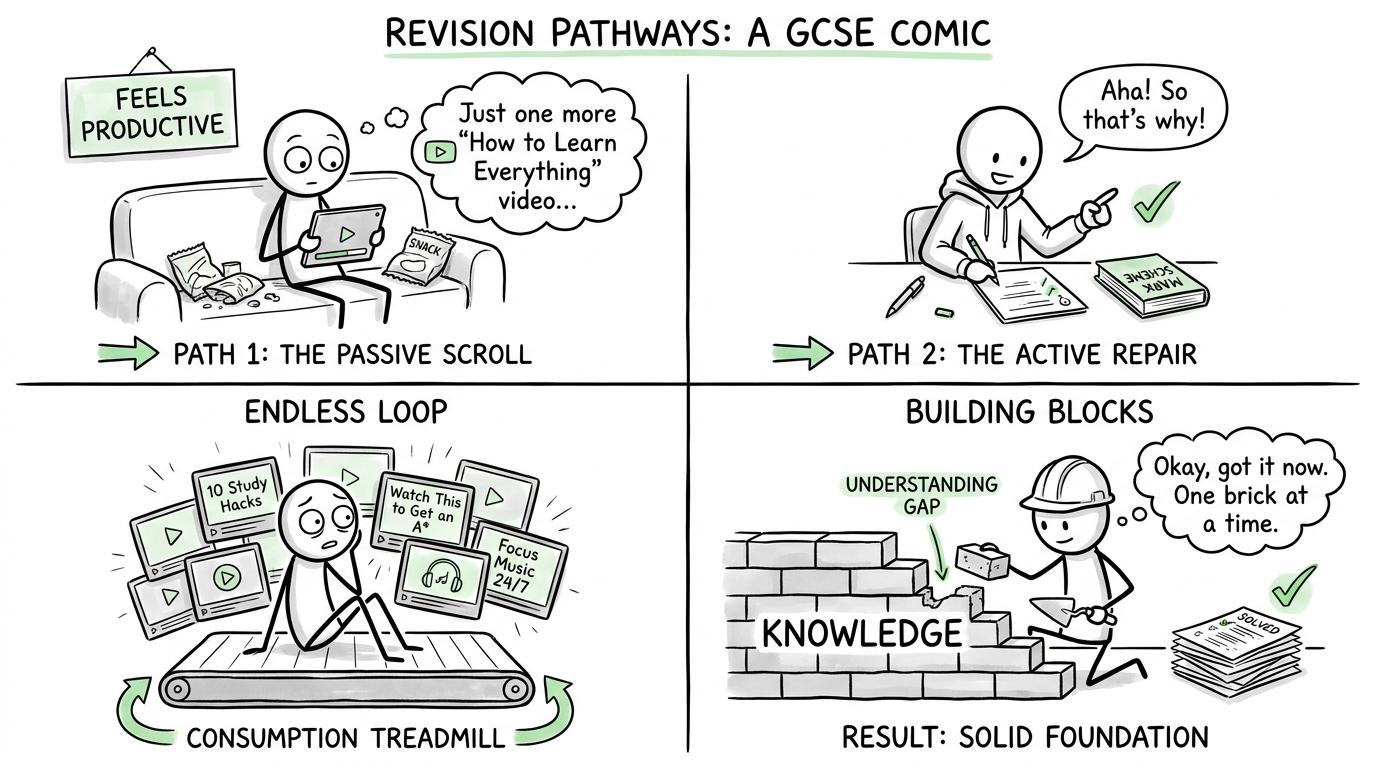 A student repairs a knowledge gap while another watches endless revision videos
How to balance ICT with GCSE maths revision
Practical subjects can expand to fill every available evening. Give each session a defined finish line: complete one section, test one feature or correct one set of feedback. Then stop.
For maths, use a similarly deliberate loop:
- identify one weak topic;
- use a short revision lesson;
- answer exam-style questions without support;
- mark the work immediately;
- record the precise cause of each lost mark;
- revisit the skill after a short gap.
Begin with GCSE maths past papers when you need an honest diagnosis. If you are unsure when to introduce full papers, read the guide to when to start GCSE past papers. Near the examination, predicted GCSE topics and revision guidance can help prioritise practice without pretending any prediction is certain.
That routine mirrors the best part of ICT: create, test, inspect and improve.
A useful subject begins with an accurate choice
Students who are glad they selected an ICT-style course often appreciate that its lessons lead to visible outcomes and practical habits. They become better at handling information, presenting ideas, checking digital work and solving problems systematically. Those benefits can reinforce maths too, especially in percentages, data handling, graphs and logical checking.
But the name alone is not enough. Confirm the qualification, exam board, assessment structure and actual content offered by your school. Choose it because the work fits how you like to think, not because someone promises an effortless grade.
Then protect your maths progress with a simple system. Use MathsGenie's free revision lessons and practice questions to repair individual topics, mini tests to check recall, and past papers or predicted papers to build exam confidence. Mark your work, watch the video solutions where available and fix the reason each mark disappeared. Digital tools are most powerful when they support good judgement, and so is revision.