

Why Choose GCSE Biblical Hebrew? Student Insights
Why choose GCSE Biblical Hebrew? Explore its language, literature, exam structure and why some students find this distinctive option deeply rewarding.
Choosing GCSE options can feel strangely permanent. A subject name sits in a box on a form, yet selecting it may shape hundreds of lessons, several examinations and a large part of your revision timetable.
So, why choose GCSE Biblical Hebrew? The clearest answer is that it offers something unusually focused: the chance to study an ancient language, read important literature closer to its original form and develop precise analytical skills. Students who find it rewarding tend to value the combination of language, story, history and close reading. It is distinctive, intellectually demanding and much more structured than its unfamiliar name might suggest.
It is not right for everyone. But if you enjoy patterns, grammar, interpretation and texts with historical significance, it may be an option worth investigating.
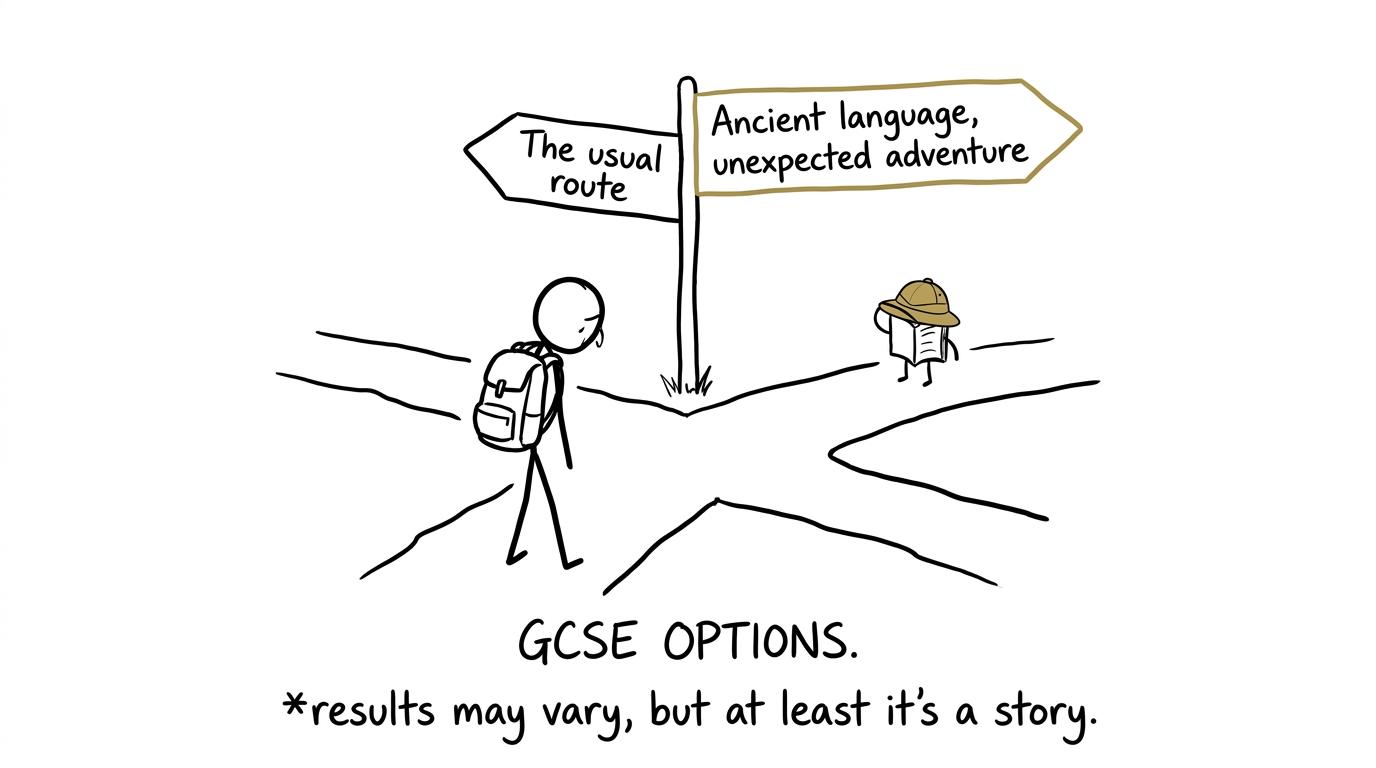 A student discovers the unexpected adventure hidden among familiar GCSE options
GCSE Biblical Hebrew at a glance
Before thinking about the reasons for choosing it, check what the course actually involves:
- The current GCSE is offered by Pearson Edexcel under specification code 1BH0.
- It is an ancient-language qualification, not a Modern Hebrew speaking course.
- Students develop vocabulary, grammar, translation and comprehension skills.
- They study prescribed literary texts in Biblical Hebrew.
- Assessment consists of two externally examined papers.
- Paper One covers language and contributes 50%50\%50% of the qualification.
- Paper Two covers literature and contributes the other 50%50\%50%.
- Each paper lasts two hours under the current specification.
- The qualification is graded 999-111 and does not have foundation and higher tiers.
- Availability depends on whether your school, college or another approved centre can teach and enter you for it.
The practical first step is therefore simple: ask your school whether the subject is available, which set texts your examination year uses and how many lessons you would receive.
What students can find rewarding about the subject
There is no single representative student verdict, and it would be misleading to promise that everyone enjoys the same things. However, the qualities emphasised in current school course information and the official specification help explain why some students finish the course feeling glad that they selected it.
Reading a text more closely than a translation allows
A translation is essential, but it also contains decisions. A translator must decide how a word, grammatical construction or turn of phrase should be represented in English.
Biblical Hebrew gives students the tools to examine some of those decisions for themselves. At GCSE, you are not expected to become a professional scholar. You are learning enough vocabulary, morphology and syntax to understand passages, translate carefully and notice how language creates meaning.
For students already interested in the Hebrew Bible or Tanach, that can make familiar material feel new. Instead of moving quickly through an English rendering, they must slow down and ask what each form is doing. That slower attention is often where the subject becomes compelling.
Discovering that language works like a system
At first, a new script, unfamiliar vocabulary and verb forms can look like a wall. Over time, the wall becomes a pattern.
Students learn to recognise roots, forms, prefixes, suffixes and recurring grammatical structures. A sentence that once seemed impenetrable begins to contain clues. This systematic quality can appeal particularly to students who enjoy solving problems rather than simply recalling isolated facts.
That does not make Biblical Hebrew the same as maths. It does, however, reward some familiar habits: identify what you know, apply a rule precisely, check the evidence and avoid jumping to a conclusion. If you enjoy the order found in algebra or logical reasoning, you may appreciate the architecture of the language too.
Combining stories with technical analysis
Some GCSE subjects lean heavily towards factual recall. Others emphasise technique. Biblical Hebrew combines both.
The language paper asks students to work with unseen material through comprehension, translation and grammatical understanding. The literature paper asks for close knowledge of prescribed texts, including translation, context, language and interpretation. Students must also analyse and compare rather than merely retell what happens.
For examinations from 202620262026 to 202820282028, the Edexcel specification identifies set material concerning Joseph's rise to power in Genesis, chapters 414141-434343, and the miracles of Elisha in Kings, chapters 444-777. Set texts change across examination cycles, so always use the list for your own year.
This mixture can be satisfying because grammar is not learned in isolation. It becomes a way to investigate character, power, choices, themes and narrative technique.
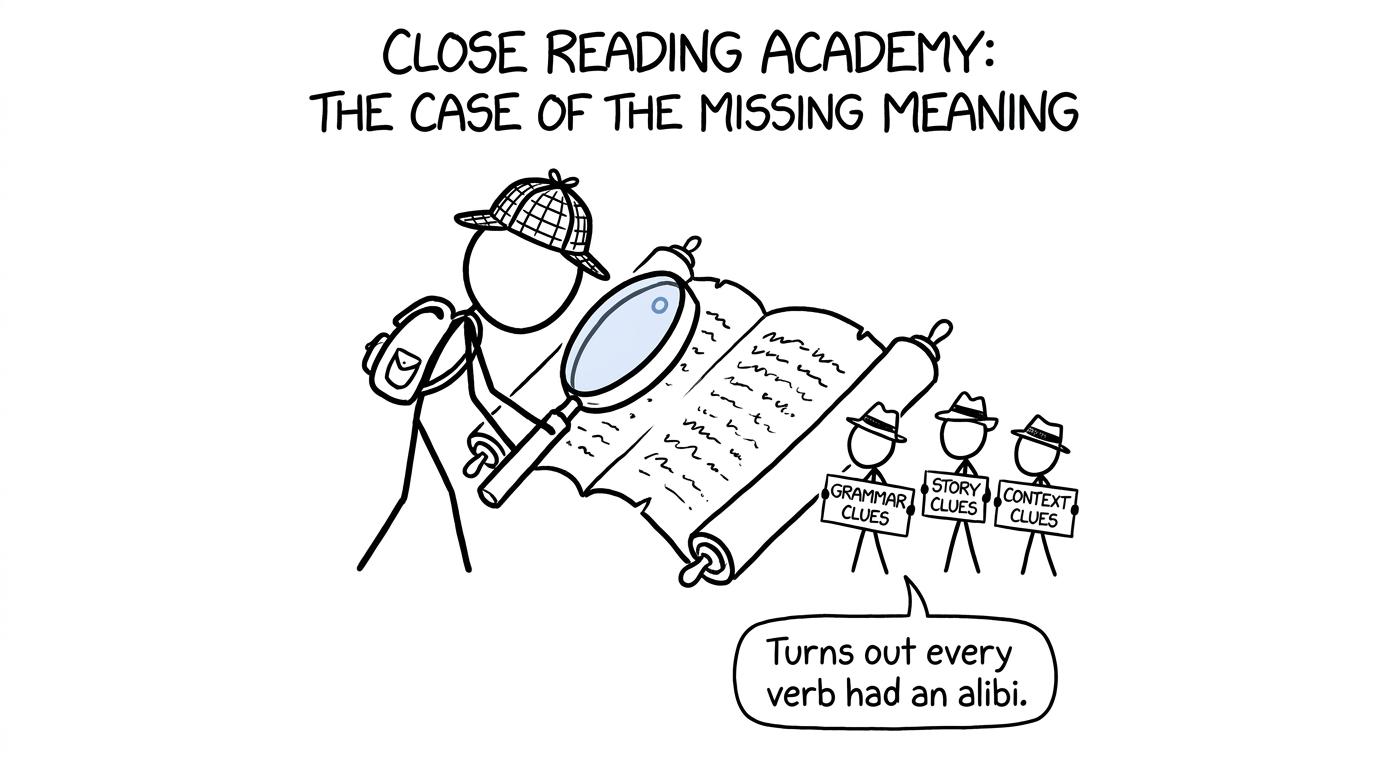 A student detective investigates grammar, story and context clues
Choosing a subject with a clear identity
A distinctive subject is not automatically a better subject. Yet some students value taking an option that feels genuinely different from the rest of their timetable.
Biblical Hebrew brings together ancient language, literature, history and interpretation. It may complement English, Religious Studies, Classical Civilisation or another language, but it does not simply repeat any of them.
Its value is not that it looks unusual on a list of qualifications. The real value comes from sustained engagement with demanding material. A subject only becomes a strong choice when you are prepared to do the vocabulary learning, grammar practice and textual revision behind it.
Developing precise reading and evidence-based writing
Translation teaches caution. A plausible answer is not always an accurate answer, and a familiar-looking word may not function as expected in a particular sentence.
Literature study demands similar discipline. An interpretation should be supported by the wording and context of the passage. Students must separate what the text establishes from what they assume it means.
These habits are useful beyond the course. They support careful reading, analytical writing and the ability to justify a conclusion. The official qualification is designed to develop independent enquiry and analytical skills relevant to further study in the humanities, languages and other disciplines.
That is a better reason to choose the course than trying to guess whether universities will be impressed by its title. Choose it for the work and skills it contains, not novelty alone.
How the examination structure affects your decision
Knowing the assessment format matters because enjoying classroom discussion is not the same as enjoying the work required in an examination.
Paper One assesses language. Students answer questions on unseen Biblical Hebrew, translate into English and complete a grammar or composition route specified by the paper. Success depends on secure vocabulary, accurate recognition of forms and repeated translation practice.
Paper Two assesses literature. It includes work on the prescribed texts, such as comprehension, grammar, translation and analysis. Students also need to compare themes and respond to the language of the passages.
The balanced 50%50\%50% and 50%50\%50% structure means you cannot rely entirely on memorising set passages or entirely on unseen translation. You need both linguistic control and literary understanding.
Ask yourself:
- Do I enjoy learning how a language is constructed?
- Am I willing to revisit vocabulary regularly?
- Do I like studying a story in detail rather than only reading its plot?
- Can I explain an interpretation using evidence?
- Will this option fit alongside my compulsory GCSE workload?
An honest answer is more useful than choosing because a friend has selected it.
Balancing Biblical Hebrew with GCSE maths revision
An option becomes stressful when every subject is treated as an emergency. The better approach is to give each one a repeatable place in the week.
Biblical Hebrew benefits from frequent vocabulary retrieval, short translation practice and regular contact with the set texts. GCSE maths improves through active question practice, marking and correcting errors. Both respond better to steady attention than occasional marathon sessions.
Use the GCSE maths revision hub to find resources for Edexcel, AQA, OCR and Eduqas, then build a realistic schedule with the GCSE maths revision timetable guide. On crowded school days, the twenty-minute GCSE maths routine can protect your maths progress without consuming the entire evening.
A balanced week might include short language-recall sessions, set-text revision and several focused maths blocks. The exact timings should reflect your weaknesses and school workload. The principle is simply to decide in advance, rather than allowing whichever deadline feels loudest to take every available hour.
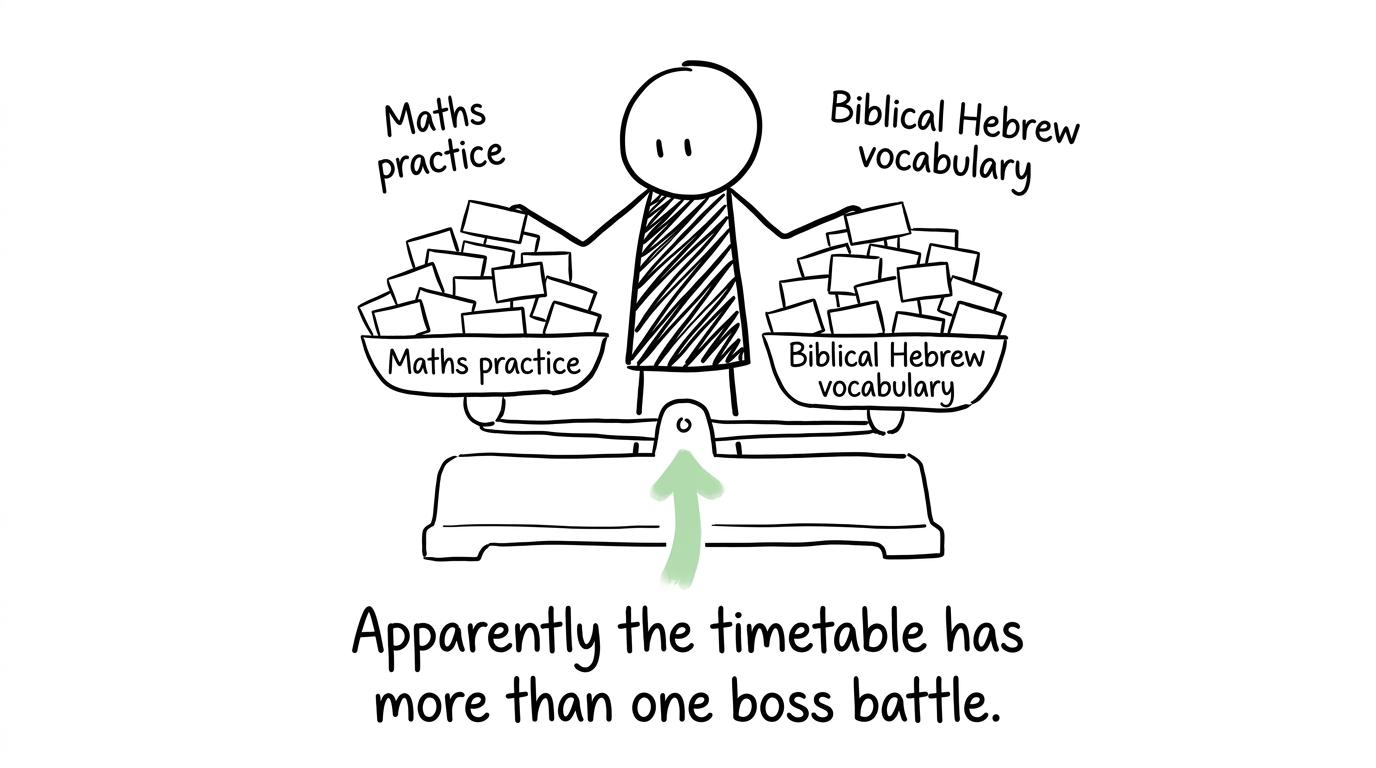 A student balances maths practice with Biblical Hebrew vocabulary
When GCSE Biblical Hebrew may not be the right option
A thoughtful choice includes the reasons to say no.
Biblical Hebrew may be unsuitable if you mainly want conversational Modern Hebrew. The GCSE focuses on an ancient language and its literature, so the aims and assessed skills are different.
It may also be a poor fit if you strongly dislike detailed grammar, regular vocabulary recall or close textual study. Interest in the stories helps, but interest alone does not remove the technical work.
Finally, check teaching arrangements. A subject can sound appealing in theory yet become difficult if timetable provision, specialist teaching or examination-centre access is uncertain. Ask your school for precise information before committing.
Common mistakes when making the choice
Confusing Biblical Hebrew with Modern Hebrew
They are related, but they are not interchangeable GCSE courses. Do not expect the course to centre on everyday conversation, travel situations or modern media.
Choosing it only because it seems unusual
Distinctiveness may attract your attention, but it will not complete vocabulary revision for you. Look at the specification content and assessment style before deciding.
Underestimating cumulative vocabulary and grammar
Languages build layer upon layer. Missing early foundations can make later passages much harder, so plan short and frequent review from the beginning.
Ignoring the literature half of the course
Language and literature each contribute 50%50\%50%. Accurate translation matters, but so do textual knowledge, comparison and analysis.
Letting one option crowd out maths
GCSE maths remains a core qualification. Use MathsGenie's guide to finding weak topics, then repair them with revision lessons and practice questions. As examinations approach, add GCSE past-paper practice and use Edexcel GCSE maths predicted papers as a supplement rather than a replacement for official past papers.
A distinctive choice, made for the right reasons
Students are most likely to value GCSE Biblical Hebrew when the daily work matches their genuine interests. The course offers access to an ancient language, close engagement with significant literature and the satisfaction of turning unfamiliar forms into meaningful text. It rewards patience, precision and evidence.
Before choosing, confirm availability, read the current Edexcel specification information supplied by your school and look carefully at the assessment tasks. Then consider the whole timetable. An interesting option should sit alongside a sustainable plan for compulsory subjects.
For maths, let MathsGenie remove the uncertainty. Start with free revision lessons and practice questions, use mini tests to identify gaps, and build towards past papers, mark schemes, video solutions and predicted papers. If exams are approaching, the one-month GCSE maths revision plan gives that work a clear structure. A distinctive GCSE choice can broaden your week, a dependable revision system keeps it under control.










